Key Stats for KO Stock
- Past week’s performance: Consolidating
- 52-week range: $65 to $92
- Valuation model target price: $92
- Implied upside: 3% over 2.3 years
Value Coca-Cola like a pro with 5 years of analyst forecasts using TIKR’s Valuation Model (It’s free) >>>
A Beverage Giant Doubles Down on America
Coca-Cola (KO) stock has been quiet lately, trading close to its 52-week high near $92. This week brought a headline that’s hard to ignore though. On Tuesday, Coca-Cola and its bottling partners announced plans to invest $10 billion in U.S. infrastructure from 2026 through 2030. The spending covers new and expanded production, distribution, and office facilities across states including California, Colorado, Alabama, and New York.
It helps to understand what this figure represents. Coca-Cola runs an asset-light model, so independent bottling partners fund the plants, trucks, and equipment. The $10 billion is a system-wide number, not Coca-Cola’s own capex alone. In fact, the company’s own 2026 capex guidance sits closer to $2.2 billion.
CFO John Murphy framed the announcement as a growth story rather than a tariff response. He said the Coca-Cola system “is deeply rooted in America and continues to deliver meaningful value” for its communities. The company also disclosed that its U.S. operations contributed $85 billion to GDP last year and supported nearly 1 million jobs.
Separately, India’s Supreme Court ordered the country’s food regulator to set a clear timeline for new warning labels, a rule that touches Coca-Cola and several rivals. If Coke’s U.S. investment pace holds through 2030, it should reinforce the durability of a business already trading close to fully valued.
Chart what’s driving Coca-Cola’s steady climb toward its 52-week high (It’s free) >>>
Priced for Stability, Not Surprise
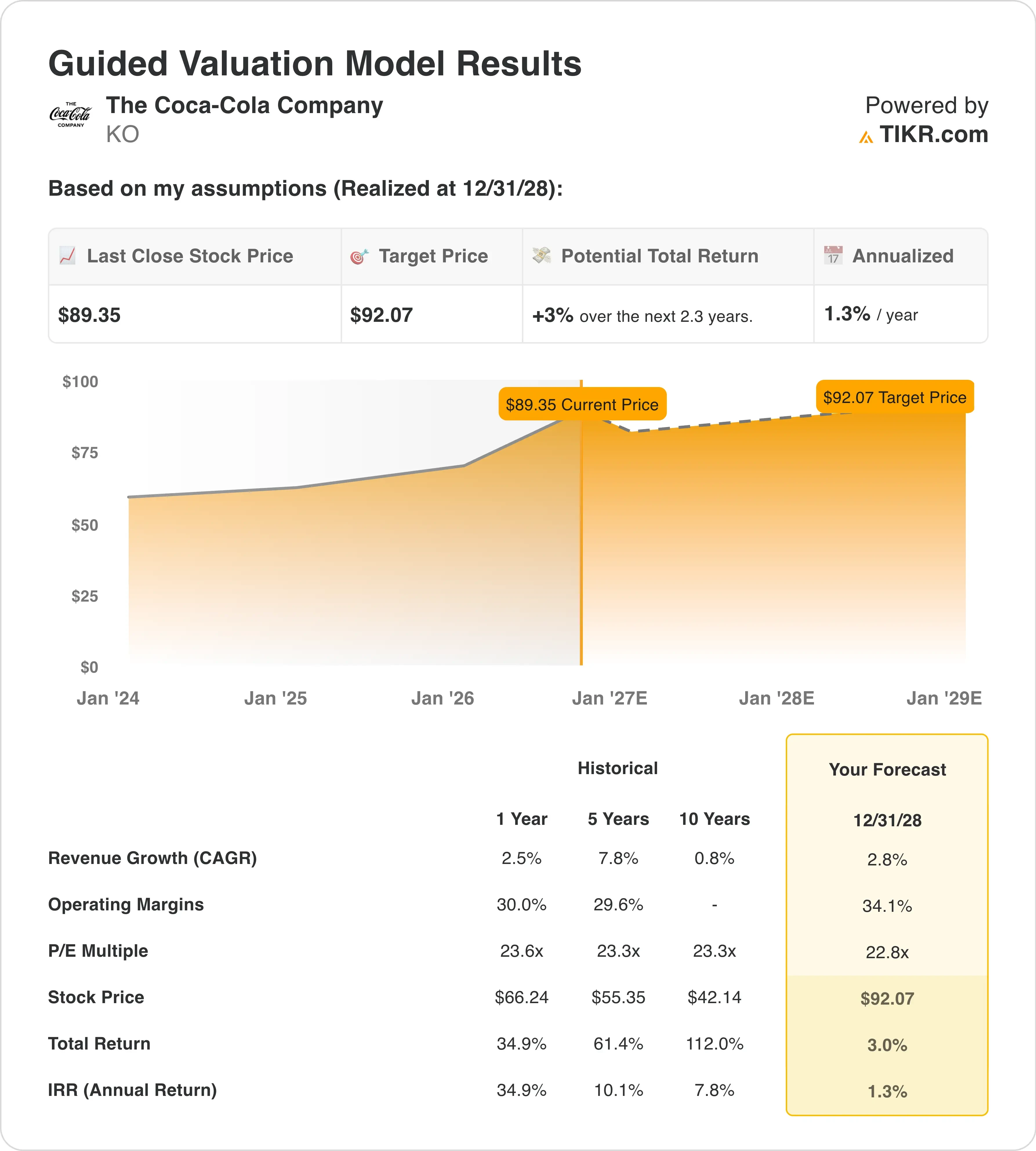
Under valuation model assumptions realized through 12/31/28, the stock is modeled using:
- Revenue Growth (CAGR): 2.8%
- Operating Margins: 34.1%
- Exit P/E Multiple: 22.8x
The model estimates a target price of $92, implying just 3% upside and a 1.3% annualized return over the next 2.3 years.
That’s about as low as return assumptions get in this format. It reflects a stock priced for stability rather than growth. Coca-Cola’s revenue is expected to grow under 3% annually, typical for a mature beverage giant, but that pace leaves little cushion if input costs or currency swings pressure results.
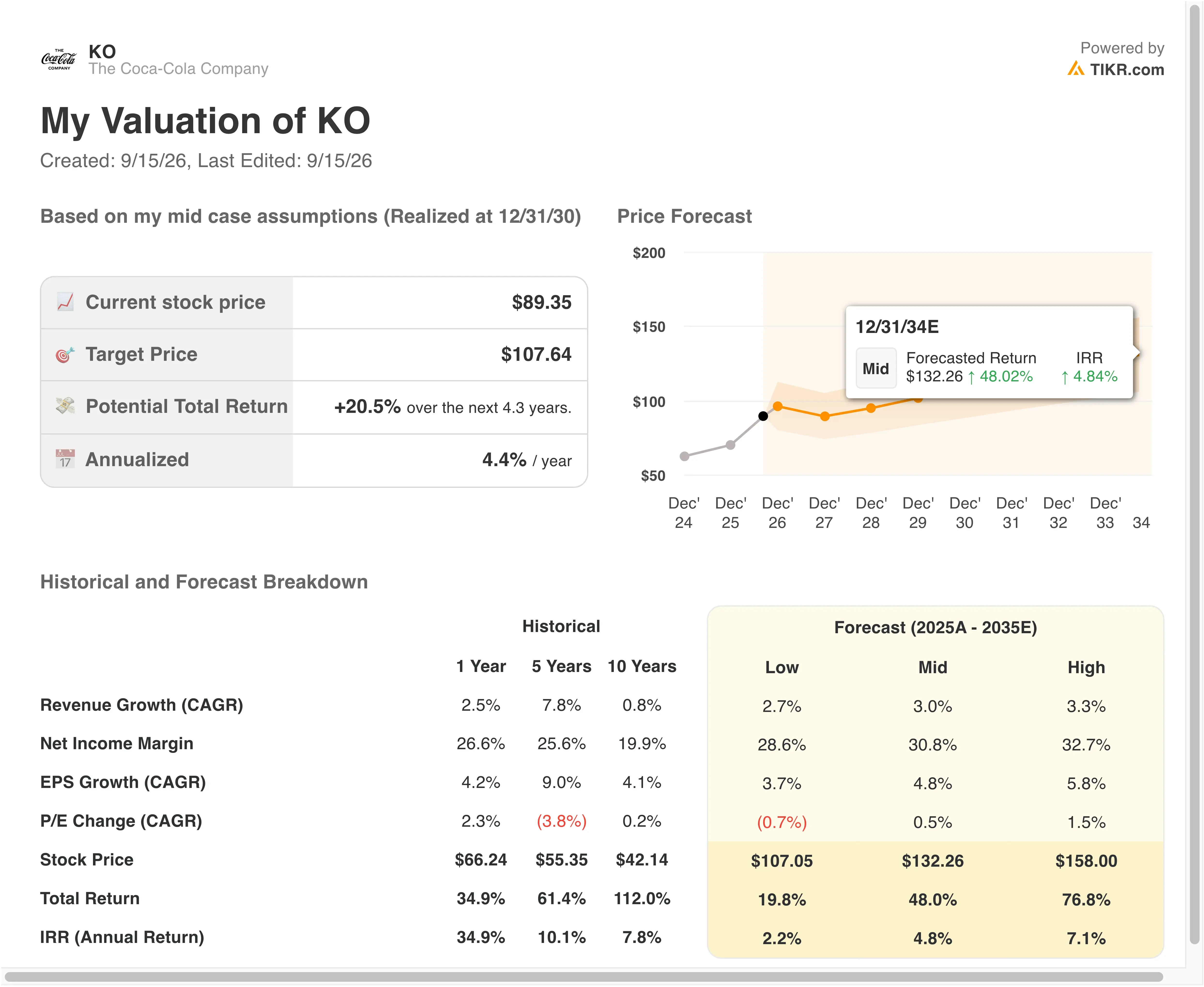
Margins remain the bright spot. A 34.1% operating margin shows Coca-Cola’s pricing power, built over more than a century of distribution scale. Yet at nearly 23x forward earnings, the stock trades roughly in line with its own five and ten-year averages, so there’s little discount on offer.
This looks like a capital-return story more than a growth story. Coca-Cola’s dividend yield sits above 2%, and its payout ratio remains high. That combination suits income focused investors even if total return potential looks thin from current levels.
Compare Coca-Cola’s current multiple with its own trading history (Free with TIKR) >>>
The Beverage Aisle Battle with PepsiCo
Coca-Cola’s closest rival, PepsiCo (PEP), faces similar pressure from the same India labeling rules, since both companies were named alongside Nestle in recent filings. PepsiCo trades at a lower forward P/E, generally in the high teens, because its snack and beverage mix carries lower margins overall.
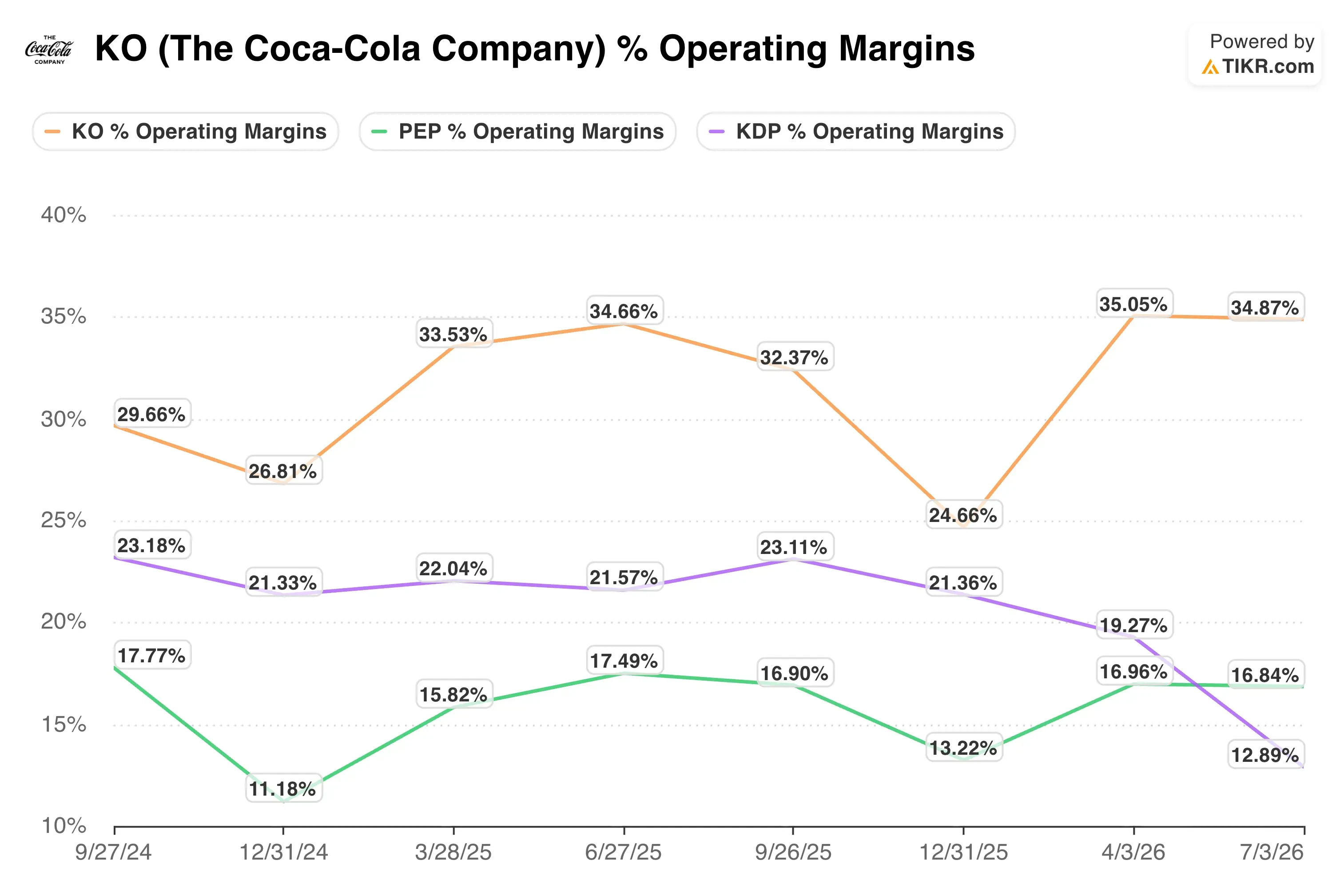
On margins, Coca-Cola’s beverage-only focus gives it an edge. Its 34.9% operating margin comfortably outpaces PepsiCo’s blended margin, which sits closer to the mid teens once Frito-Lay and Quaker Foods factor in. Keurig Dr Pepper (KDP) is a smaller but faster-growing rival, posting stronger revenue growth in recent years, though its profitability still lags Coca-Cola’s scale advantage.
None of the three has escaped India’s regulatory scrutiny. But Coca-Cola’s global bottling network and brand recognition give it more room to absorb local compliance costs than smaller regional players.
What’s Driving KO Stock Going Forward?
The $10 billion U.S. investment plan through 2030 is the clearest forward catalyst. It signals confidence in domestic demand even as growth stays modest. Investors will watch how quickly these facility upgrades translate into efficiency gains and margin support.
India’s warning-label rollout is the biggest near-term regulatory risk. If the Supreme Court forces a faster timeline than industry groups want, Coca-Cola could face packaging costs sooner than planned. Still, the company’s global scale should soften the impact.
Coca-Cola’s Q3 earnings, expected October 20, will show whether pricing actions keep offsetting soft volume growth. With a $0.53 quarterly dividend already declared, income investors have another data point to watch alongside the headline numbers.
Estimate Coca-Cola’s fair value in under 60 seconds (Free with TIKR) >>>
Should You Invest in Coca-Cola?
The only way to really know is to look at the numbers yourself. TIKR gives you free access to the same institutional-quality financial data that professional analysts use to answer exactly that question.
Pull up KO, and you’ll see years of historical financials, what Wall Street analysts expect for revenue and earnings in the quarters ahead, how valuation multiples have moved over time, and whether price targets are trending up or down.
You can build a free watchlist to track KO alongside every other stock on your radar. No credit card required. Just the data you need to decide for yourself.
Analyze KO stock on TIKR Free→
Disclaimer:
Please note that the articles on TIKR are not intended to serve as investment or financial advice from TIKR or our content team, nor are they recommendations to buy or sell any stocks. We create our content based on TIKR Terminal’s investment data and analysts’ estimates. Our analysis might not include recent company news or important updates. TIKR has no position in any stocks mentioned. Thank you for reading, and happy investing!