
Key Stats for The Trade Desk Stock
- Current Price: $14.97
- Target Price (Mid): ~$25
- Street Target: ~$14
- Potential Total Return: ~75%
- Annualized IRR: ~14% / year
Now Live: Discover how much upside your favorite stocks could have using TIKR’s new Valuation Model (It’s free) >>>
What Happened?
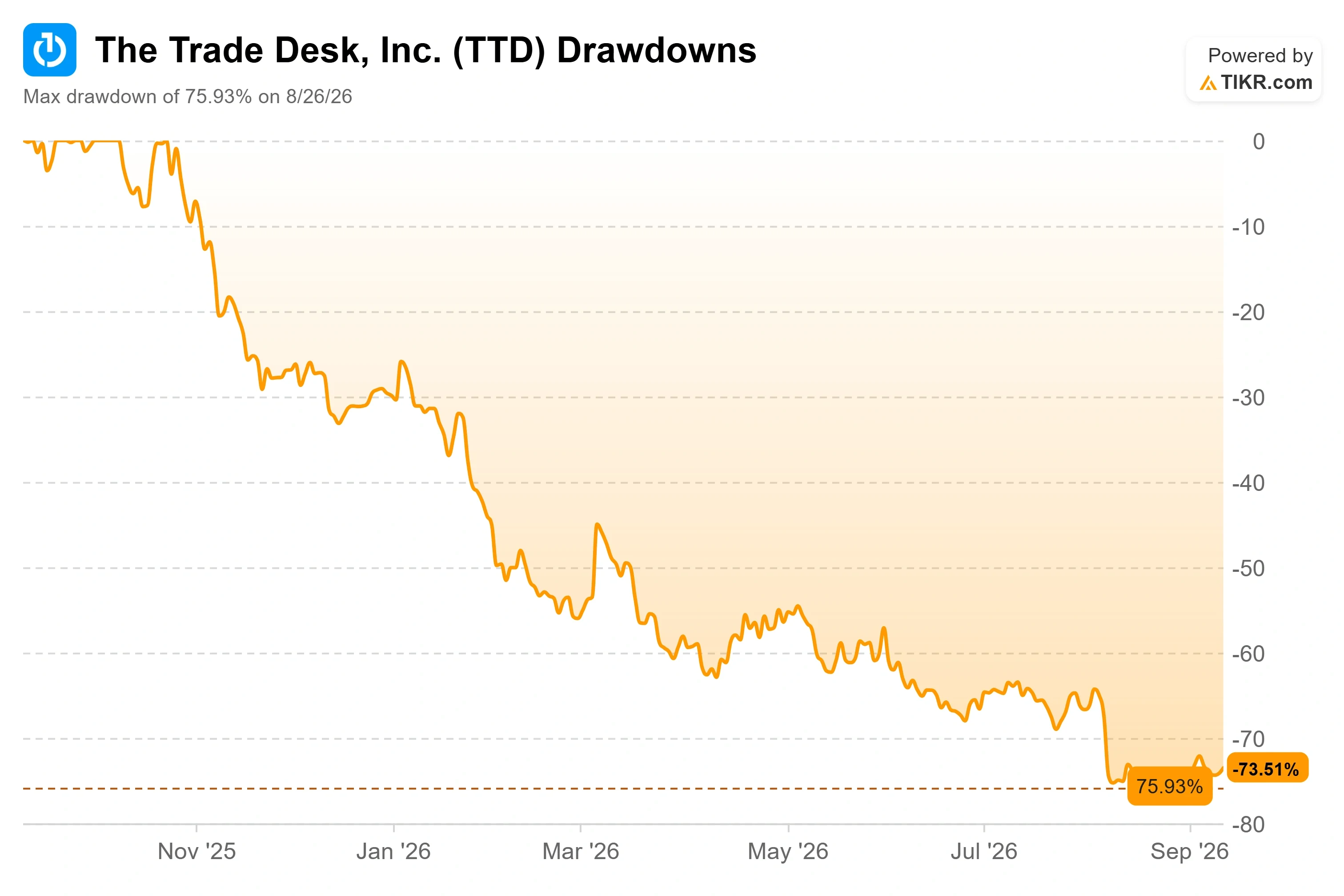
The Trade Desk (TTD) spent the first week of September doing two things no company wants to do at once. It told roughly 575 people they were losing their jobs, and it learned it was being removed from the S&P 500. Both landed on September 4. For a stock already down about 68% over the trailing year, the timing read like a verdict.
Even after the news, shares closed at $14.97 on September 14, up 4.4% on the day and well off their 52-week low of $12.83. A stock that had punished every buyer for a year steadied rather than breaking to new lows on the restructuring news. That reframes the debate from how bad things are to whether a company still generating cash is being priced as if its growth is gone for good.
A Layoff Jeff Green Told You Was Coming a Month Early
The restructuring cuts about 15% of a workforce that stood at 3,843 at the end of 2025, and it carries $39 million to $51 million in cash charges for severance, booked in the third quarter. Management framed it as a reallocation into what CEO Jeff Green described to staff as “smaller pods and smaller scrums,” not a response to distress.
The move is less of a shock than the headlines suggest, because Green effectively pre-announced it on the August 6 earnings call. “Over the rest of the year and into 2027, we’re going to be more disciplined than ever about where we invest,” he said, adding that “some teams will continue to grow while others will not.” A month later, that is what the layoffs did.
Operating expenses excluding stock-based compensation rose 12% year-over-year in Q2, driven by moving critical workloads off third-party cloud and onto owned data centers. New CFO Nate Olmstead, on the job barely a month, said the goal is building “the operational rigor needed to scale effectively.” Whether the cuts reaccelerate growth or merely defend margins is the debate that decides the stock.
See historical and forward estimates for The Trade Desk stock (It’s free!) >>>
The Index Exit Is a Symptom
The S&P 500 removal stung symbolically because TTD had joined only in July 2025. Fourteen months later, it was gone, skipping the S&P MidCap 400 entirely and dropping straight to the SmallCap 600, effective September 21. The company was not removed because it fell out of favor; it was removed because its market cap fell, from roughly $69 billion at the 2024 peak to about $6.7 billion today.
Passive S&P 500 funds must sell, and SmallCap 600 funds must buy around the September 21 effective date, which can add near-term volatility. But index membership changes no advertiser relationship or dollar of revenue.
The Business Underneath, and Why the Multiple Is the Real Question
Revenue of $715 million grew just 3% year-over-year and missed the roughly $751 million the Street wanted, and adjusted earnings of $0.34 fell short of the $0.40 estimate. Management then guided third-quarter revenue to “at least $650 million,” which implies a decline of around 12% from a year ago. That guide, more than the layoffs, is what has investors nervous, because it puts an actual revenue contraction on the table for the first time in the company’s public history.
Green is spending on measurement, the new Kokai Zuma platform release, and Audience Unlimited, a data product where an early campaign cut both cost per unique household and data CPM by more than 25%. His pricing philosophy underpins why he is not chasing cheap volume: “It is not our goal to be the cheapest platform. It is our goal to be the best,” Green said, defending a take rate that has barely moved in a decade. Connected TV and audio still grew double digits, audio was the fastest-growing channel for a fourth straight quarter, and the company generated $136 million of free cash flow while ending the quarter with about $1.5 billion in cash and short-term investments. This is a business slowing down, not one failing.
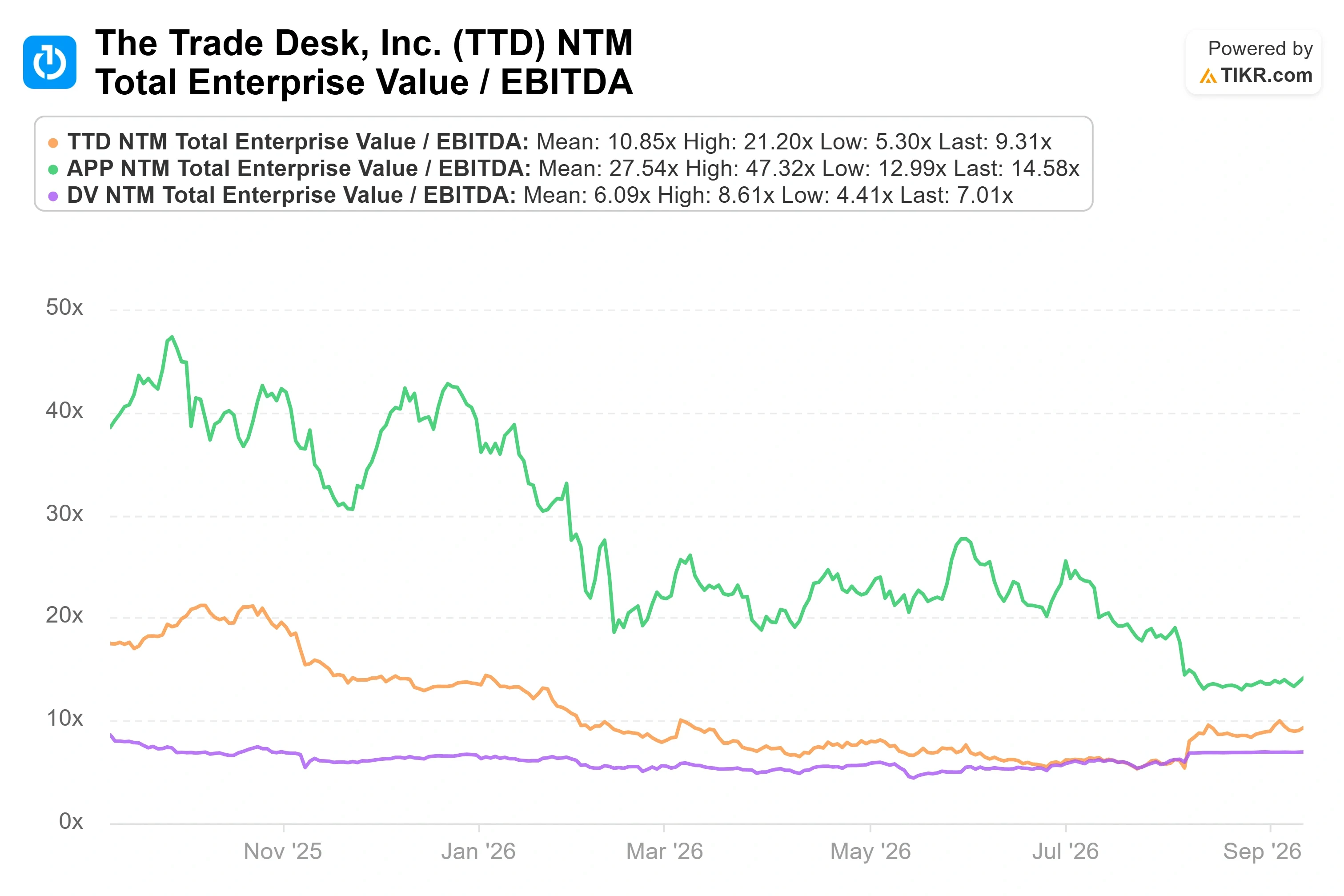
TTD trades at about 9.8x forward EV/EBITDA and 16.4x forward earnings, below most of its own history, cheaper than fast-growing AppLovin near 14.6x but pricier than DoubleVerify near 7.0x. The old growth premium is gone; a modest quality premium is not. The sharper tension is between the two targets in this article. The Street mean sits near $14, in line with a recent Evercore move to $14 and a fresh Sell from Citi, leaving consensus slightly below the $14.97 price, while TIKR’s mid-case model sees about $25. That split, the Street braced for flat-to-lower against a model implying roughly 75% upside, is the disagreement the stock now trades on, and it hinges on whether Q2’s 3% growth is a floor or a trajectory.
See how The Trade Desk performs against its peers in TIKR (It’s free!) >>>
TIKR Advanced Model Analysis
- Current Price: $14.97
- Target Price (Mid): ~$25
- Potential Total Return: ~75%
- Annualized IRR: ~14% / year
See analysts’ growth forecasts and price targets for The Trade Desk stock (It’s free!) >>>
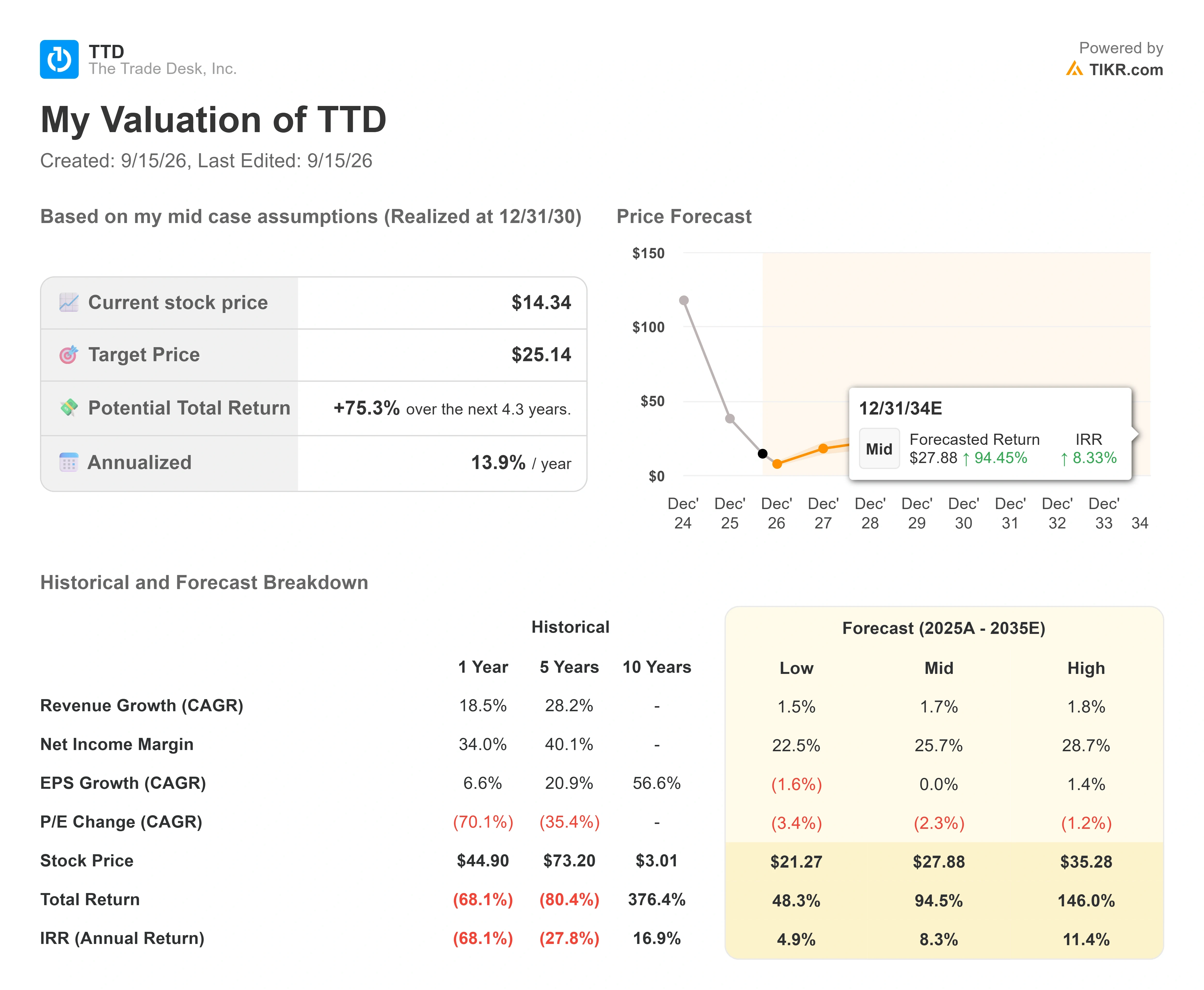
Using TIKR’s mid-case scenario, the model values TTD at around $25 by the end of 2030, implying roughly 75% total return and about a 14% annualized IRR from the model’s $14.34 entry price (shares trade near $14.97 today).
The two revenue drivers carrying that case are continued CTV and audio expansion, where international CTV is already growing over 50% year-over-year, and the Joint Business Plan flywheel, where partnership revenue compounds well above the overall rate.
The margin driver is the migration to owned data centers, a 2026 cost headwind management frames as later operating leverage, and the restructuring is the first step in converting that spending into a leaner base. The primary risk is that weakness in CPG and auto advertising, about a quarter of the business, proves structural rather than cyclical and drags the whole growth assumption lower.
The upside case is that the layoffs and the data-center transition reset the cost base just as measurement and Kokai Zuma reaccelerate spend, and the multiple re-rates off a trough. The downside case is that “at least $650 million” for Q3 marks the start of a genuine decline rather than a bottom, in which case even a cheap multiple has further to fall.
Conclusion
With the layoffs announced and the index change set for September 21, the next real test is the Q3 report in early November. Management set the bar at “at least $650 million,” so a print meaningfully above it suggests the guide was conservative and the business is stabilizing, while a result at or below it confirms the revenue decline is real and the cost cuts are defense, not offense. Watch the Q3 revenue line against that $650 million marker, and watch whether CTV, audio, and JBP growth held up while the company was cutting 15% of its people.
See what stocks billionaire investors are buying so you can follow the smart money with TIKR.
Should You Invest in The Trade Desk?
The only way to really know is to look at the numbers yourself. TIKR gives you free access to the same institutional-quality financial data that professional analysts use to answer exactly that question.
Pull up The Trade Desk, and you’ll see years of historical financials, what Wall Street analysts expect for revenue and earnings in the quarters ahead, how valuation multiples have moved over time, and whether price targets are trending up or down.
You can build a free watchlist to track The Trade Desk alongside every other stock on your radar. No credit card required. Just the data you need to decide for yourself.
Analyze The Trade Desk on TIKR Free →
Looking for New Opportunities?
- See what stocks billionaire investors are buying so you can follow the smart money.
- Analyze stocks in as little as 5 minutes with TIKR’s all-in-one, easy-to-use platform.
- The more rocks you overturn… the more opportunities you’ll uncover. Search 100K+ global stocks, global top investor holdings, and more with TIKR.
Disclaimer:
Please note that the articles on TIKR are not intended to serve as investment or financial advice from TIKR or our content team, nor are they recommendations to buy or sell any stocks. We create our content based on TIKR Terminal’s investment data and analysts’ estimates. Our analysis might not include recent company news or important updates. TIKR has no position in any stocks mentioned. Thank you for reading, and happy investing!