Key Takeaways
- Q2 gross margin rose 200 basis points to 60.5%, but underlying figures strip out a one-time $134.5 million tariff refund and show gross profit actually fell to $1.33 billion, with operating margin dropping to roughly 13.2%, from 20.7% in the same quarter a year ago.
- Only $134.5 million of the roughly $230 million in tariffs Lululemon has paid has been refunded so far. The remaining $105 million is uncertain and excluded from guidance, meaning the $0.86-per-share boost baked into FY26 EPS has no guaranteed sequel next year.
- Leggings sales fell about 20% in the quarter, and Lululemon’s share of the athleisure market dropped 10 points to 43.9% as Alo and Vuori gained ground, pointing to a brand and product problem that predates and outlasts any tariff story.
- LULU’s NTM P/E has fallen to about 11.9x, near its two-year low of 9.45x and well below its roughly 20x historical average, so a lot of bad news is already priced in, but against an earnings base still cushioned by a refund that’s rolling off.
Curious how much of Lululemon’s “margin recovery” is real versus refund-driven? See the full margin breakdown on TIKR for free →
A Refund Flattered Lululemon’s Headline Number
On the Q2 2027 earnings call, management walked through the gross margin bridge themselves: a 200 basis point year-over-year improvement to 60.5%, built almost entirely on a 560 basis point benefit from IEEPA tariff refunds. Strip that out and the underlying picture inverts. CFO Meghan Frank said product margin actually declined roughly 150 basis points on tariff costs and markdowns, while fixed-cost deleverage from an expanded store base cost another 230 basis points. The refund didn’t fix Lululemon’s margin problem. It temporarily covered it up.
This matters because the refund is not a recurring feature of the business. Lululemon has paid around $230 million in tariffs under IEEPA and gotten back $134.5 million. The remaining $105 million sits in limbo, and management explicitly said it isn’t reflected in guidance because “there remains some uncertainty in the process.” The $0.86 per share this refund added to FY26 EPS guidance of $9.48-$9.73 is, by the company’s own framing, a one-time item. FY27 starts without it.
What LULU Stock’s Underlying Numbers Actually Show
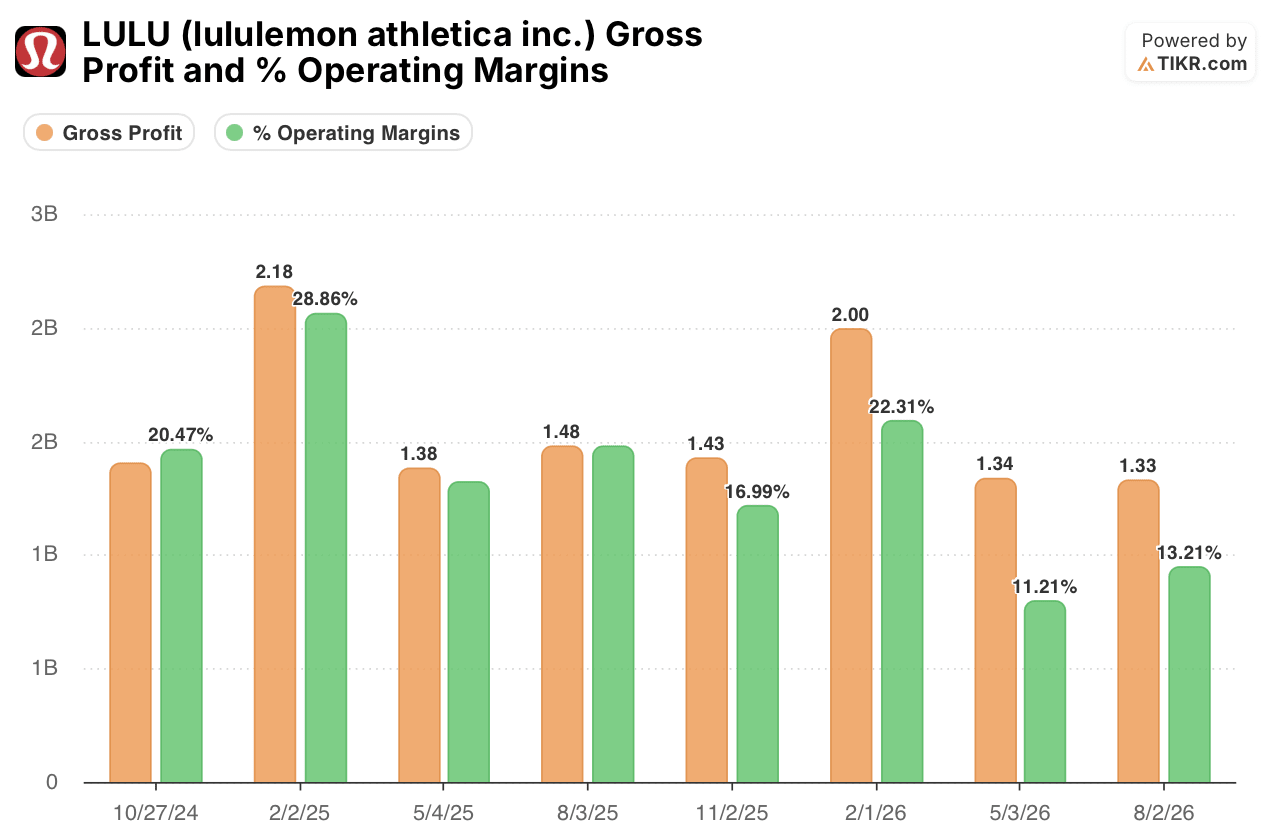
LULU’s own quarterly data backs out that refund, and the resulting trend is the real story. Ex-refund gross profit for the quarter just reported came in at $1.33 billion, versus $1.48 billion in the same quarter a year ago, a roughly 10% decline. Ex-refund operating margin fell to about 13.2%, down from the 20.7% operating margin the company itself reported for that same quarter last year, a compression of roughly 750 basis points in twelve months.
Zooming out across the last eight quarters makes clear this isn’t a one-off. Operating margin has been sliding on a comparable-quarter basis for over a year: 20.47% in the October 2024 quarter, 16.99% a year later in the equivalent November 2025 quarter.
Holiday quarters show the same pattern, 28.86% in the February 2025 quarter versus 22.31% in February 2026. And the two most recent quarters, ex-refund, sit at just 11.21% and 13.21%, the lowest readings in the entire series. Whatever growth-mode cost structure Lululemon built during its expansion years, revenue has stopped covering it, refund or no refund.
The Product Problem Behind the Numbers
The margin erosion isn’t just a cost-structure story, it’s a demand story. Leggings, still Lululemon’s signature category, declined about 20% in the quarter, and management acknowledged the shift toward away-from-body silhouettes came “a little more than we expected.” The company’s own market-share data shows why that matters: Lululemon’s share of the athleisure category fell 10 percentage points to 43.9% over the past year, while Alo grew 5.9 points and Vuori 2.2 points. North America, the largest market, posted a 12% comparable sales decline in the quarter.
Newer styles like the Groove Wide-Leg and Align Foldover Jogger are gaining traction, and management says it’s chasing about 20% more inventory into what’s working.
But by its own admission, that reordering hasn’t yet offset the legacy decline, and the SG&A line reflects the strain of trying to fix product and defend traffic simultaneously, with marketing spend rising even as revenue guidance for the year was cut to a 5%-7% decline.
Where This Leaves LULU Stock

The market has already absorbed a great deal of this. LULU’s NTM P/E sits around 11.9x, close to its two-year low of 9.45x and roughly half its historical average near 20x. That alone argues the easy bear case, that Lululemon is a broken growth story, is largely reflected in the price.
The harder question is what multiple applies once the tariff refund stops flattering earnings. If FY27 consensus estimates still assume something close to today’s reported margin rather than the roughly 13% underlying figure TIKR’s data implies, the stock isn’t as cheap as 11.9x suggests, it’s cheap against an earnings number that’s partly artificial. The next real test isn’t Q3, where management already guided to a further slowdown and 250 basis points of margin pressure. It’s whether the away-from-body product shift and O’Neill’s promised “next chapter” show up in North America traffic by the holiday season, and whether FY27 guidance in March shows margin stabilizing on its own, without a tariff check to lean on.
The multiple is already discounting trouble. What it hasn’t fully tested yet is whether the trouble is bottoming or still compounding.
Given the multiple already reflects a lot of pessimism, is the risk in this margin story mostly priced in, or is it about to get worse? Check LULU’s current valuation against its margin trend on TIKR for free →
Should You Invest in Lululemon athletica inc.?
The only way to really know is to look at the numbers yourself. TIKR gives you free access to the same institutional-quality financial data that professional analysts use to answer exactly that question.
Pull up LULU stock and you’ll see years of historical financials, what Wall Street analysts expect for revenue and earnings in the quarters ahead, how valuation multiples have moved over time, and whether price targets are trending up or down.
You can build a free watchlist to track LULU alongside every other stock on your radar. No credit card required. Just the data you need to decide for yourself.
Access Professional Tools to Analyze LULU stock on TIKR for Free →
Looking for New Opportunities?
- See what stocks billionaire investors are buying so you can follow the smart money.
- Analyze stocks in as little as 5 minutes with TIKR’s all-in-one, easy-to-use platform.
- The more rocks you overturn… the more opportunities you’ll uncover. Search 100K+ global stocks, global top investor holdings, and more with TIKR.
Disclaimer:
Please note that the articles on TIKR are not intended to serve as investment or financial advice from TIKR or our content team, nor are they recommendations to buy or sell any stocks. We create our content based on TIKR Terminal’s investment data and analysts’ estimates. Our analysis might not include recent company news or important updates. TIKR has no position in any stocks mentioned. Thank you for reading, and happy investing!