Key Stats for NextEra Energy Stock
- Current Price: $82.31
- Target Price (Mid): ~$135
- Street Target: ~$98
- Potential Total Return: ~65%
- Annualized IRR: ~12% / year
Now Live: Discover how much upside your favorite stocks could have using TIKR’s new Valuation Model (It’s free) >>>
What Happened?
NextEra Energy (NEE) just got the kind of news that used to send its stock higher. On September 8, the U.S. Department of Energy closed a loan of up to $1.9 billion to help restart the Duane Arnold nuclear plant in Iowa, and Google has agreed to buy the majority of that power for 25 years. The financing is closed, though the plant still needs Nuclear Regulatory Commission licensing before it runs. Shares closed the week at $82.31, roughly where they started and well off their 52-week high of $98.75.
NextEra missed second-quarter revenue by a wide margin, its merger with Dominion Energy still faces years of regulatory review, and a utility carrying more than $107 billion in net debt is exactly the kind of name investors sell when they get nervous about rates. The question is whether that caution has pushed a company rebuilding itself into an energy platform below a price its own numbers justify.
A Nuclear Restart the Federal Government Is Paying to De-Risk
Duane Arnold is a 615-megawatt plant that stopped running in 2020, when a derecho forced an already-planned retirement offline early. The restart plan itself dates to last October, so the new increment here is the funding: the DOE loan, made through its Office of Energy Dominance Financing, lowers the project’s cost of capital and shares its risk with the government. NextEra targets commercial operation no later than the first quarter of 2029, pending NRC approval.
What makes it pencil out is the buyer. Google holds a 25-year agreement for most of the plant’s output, taking the electricity as an around-the-clock carbon-free supply for its cloud and AI operations. That contract turns a speculative refurbishment into a funded one with a signed offtaker for decades.
On the July call, CEO John Ketchum tied the project to a bigger idea: “The recommissioning of our Duane Arnold nuclear plant is a perfect example of matching electric load with power generation.” That principle is the same one behind the FERC show cause orders issued in June, and Ketchum has spent 18 months positioning the company to sell it. A funded plant with a hyperscaler contract makes the positioning real.

See historical and forward estimates for NextEra Energy stock (It’s free!) >>>
The Upgrade the Market Hasn’t Priced
NextEra’s Q2 revenue came in at $7,534 million against a consensus near $8,168 million, a miss of almost 8%, even as adjusted EPS of $1.15 beat the $1.11 Street estimate and rose about 9.5% year-over-year. For a capital-heavy utility, that revenue gap reads more like build-cycle timing than lost demand, and the earnings engine that funds the dividend kept turning: Florida Power & Light grew regulatory capital employed by about 9.3%, management reaffirmed full-year adjusted EPS guidance of $3.92 to $4.02 at the high end, and the dividend rose to $0.62 with a payout ratio that leaves room.
In its recent S-4 filing, NextEra disclosed that Energy Resources’ 2032 adjusted EBITDA now runs roughly $4 billion higher than it guided at its December investor conference, driven by better-than-forecast returns on renewables and storage origination. That is a concrete lift to the forward earnings base, not a narrative. The demand feeding it is broad: NextEra now counts 30 potential data center hubs and expects 40 by year-end, while FPL raised its large-load target from 6 to 8 gigawatts by 2032, with roughly 21 gigawatts of interest and 12 in advanced talks. Every gigawatt served under FPL’s tariff means about $2 billion of capital expenditure earning a regulated return, and recontracting is landing at a premium of roughly $20 per megawatt hour on 15-year terms.
Net debt above $107 billion and deeply negative free cash flow mean the equity story leans on that spending converting into contracted assets on schedule, though a $46 billion interest-rate hedging program cushions the rate exposure. The Dominion merger adds a second variable: shareholders of both companies approved the $66.8 billion all-stock deal on September 3, but it needs state and federal regulators, is not expected to close until the second half of 2027, and Virginia’s governor has moved to intervene in the review. Against regulated peers, NEE’s EV/EBITDA near 14.5 times sits above where most trade, with Portland General around 8 times, OGE Energy near 10 times, and IDACORP close to 14 times, a premium defensible only if the demand converts.

See how NextEra Energy performs against its peers in TIKR (It’s free!) >>>
TIKR Advanced Model Analysis
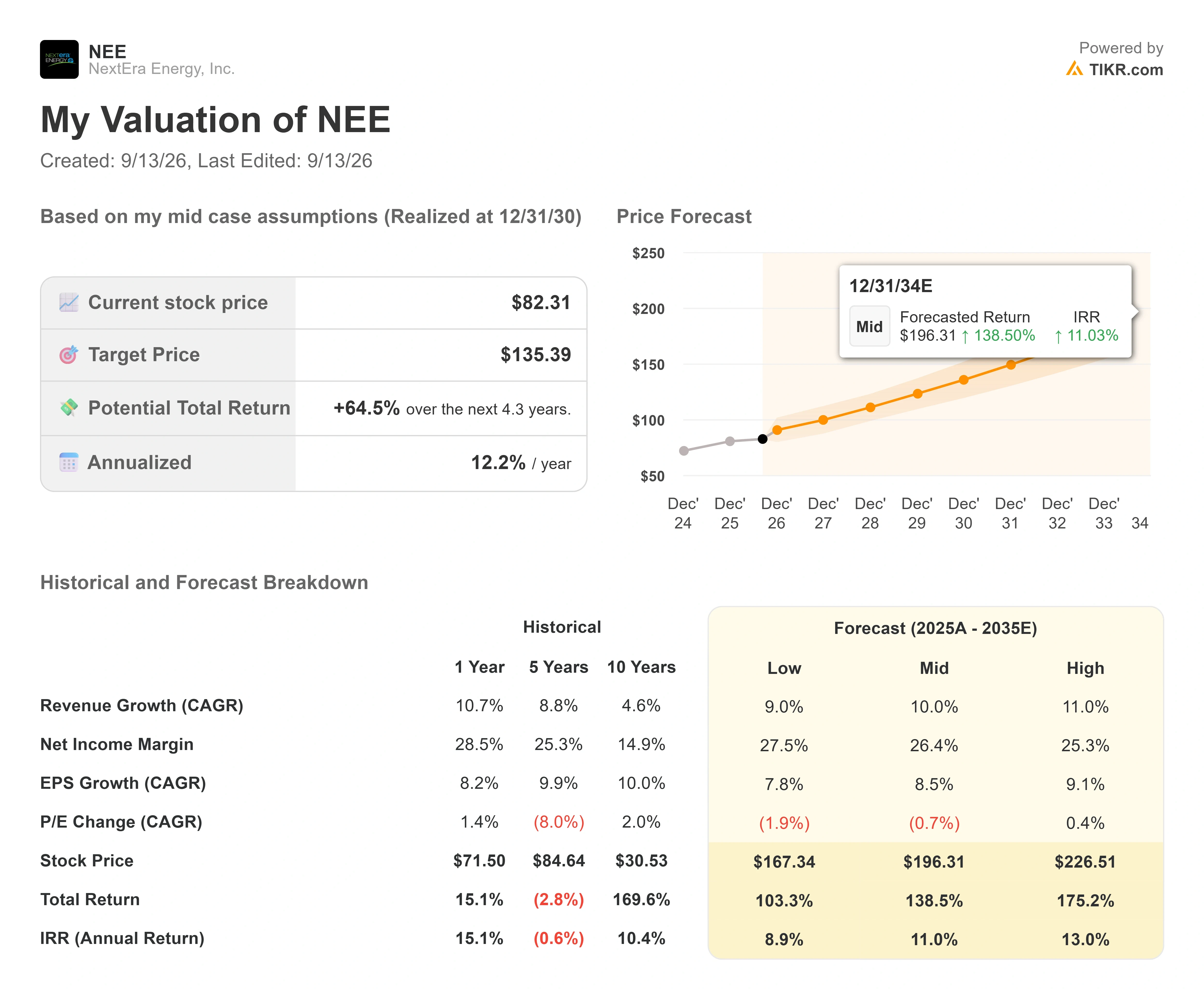
- Current Price: $82.31
- Target Price (Mid): ~$135
- Potential Total Return: ~65%
- Annualized IRR: ~12% / year
See analysts’ growth forecasts and price targets for NextEra Energy stock (It’s free!) >>>
TIKR’s mid-case model values NextEra near $135, implying roughly 65% total return and about a 12% annualized IRR from today’s $82.31. It uses the mid case because it tracks management’s own guidance: revenue growth around 10% a year and a net income margin near 26%.
Two drivers carry the top line. The first is FPL’s regulated build, anchored by large-load capital that earns a return on every gigawatt added. The second is Energy Resources’ contracted backlog, where recontracting premiums and the hub pipeline lift realized pricing. The margin driver is scale: FPL’s non-fuel operating costs run more than 70% below the industry average, protecting profitability as the company grows.
The primary risk is multiple compression. The model already assumes the earnings multiple drifts slightly lower, so the return depends on earnings growth, not a richer valuation; a debt-heavy utility re-rates down fast if rates stay high or demand slips. The upside: the hub pipeline converts faster than modeled and earnings compound at the high end of the 8%-plus target. The downside: regulatory friction on Dominion or a stall in large-load signings leaves the stock near where it trades, collecting its dividend while it waits.
Conclusion
The clearest test comes before year-end, when management expects to announce at least one large-load data center deal under FPL’s tariff. A signed agreement would confirm that the 21 gigawatts of interest is converting into regulated capital and hand the market the demand proof it has been waiting for. Silence into 2027 would suggest the pipeline is softer than the commentary implies, and the discount would look earned. For now, NextEra has a federally funded nuclear restart, a 25-year Google contract, and a stock that acted as if neither happened.
See what stocks billionaire investors are buying so you can follow the smart money with TIKR.
Should You Invest in NextEra Energy?
The only way to really know is to look at the numbers yourself. TIKR gives you free access to the same institutional-quality financial data that professional analysts use to answer exactly that question.
Pull up NextEra Energy, and you’ll see years of historical financials, what Wall Street analysts expect for revenue and earnings in the quarters ahead, how valuation multiples have moved over time, and whether price targets are trending up or down.
You can build a free watchlist to track NextEra Energy alongside every other stock on your radar. No credit card required. Just the data you need to decide for yourself.
Analyze NextEra Energy on TIKR Free →
Looking for New Opportunities?
- See what stocks billionaire investors are buying so you can follow the smart money.
- Analyze stocks in as little as 5 minutes with TIKR’s all-in-one, easy-to-use platform.
- The more rocks you overturn… the more opportunities you’ll uncover. Search 100K+ global stocks, global top investor holdings, and more with TIKR.
Disclaimer:
Please note that the articles on TIKR are not intended to serve as investment or financial advice from TIKR or our content team, nor are they recommendations to buy or sell any stocks. We create our content based on TIKR Terminal’s investment data and analysts’ estimates. Our analysis might not include recent company news or important updates. TIKR has no position in any stocks mentioned. Thank you for reading, and happy investing!