


Key Stats for CVS Health Stock
- Current Price: $94.66
- Target Price (Mid): ~$132
- Street Target: ~$116
- Potential Total Return: ~39%
- Annualized IRR: ~8% / year
Now Live: Discover how much upside your favorite stocks could have using TIKR’s new Valuation Model (It’s free) >>>
What Happened?
CVS Health (CVS) did something unusual on September 9. It talked down its own sector. Speaking at the Wells Fargo 21st Annual Healthcare Conference, management said medical costs are still running in a “high trend” environment, and the comment dragged managed care peers, including UnitedHealth, Humana, and Alignment Healthcare, lower alongside it. The stock closed at $94.66 on September 11, well off the $110.68 it reached earlier this year.
What drew less notice was the rest of the conversation: a management team detailing how far it has pushed operating efficiency, and how much room is left. The gap between a cautious cost message and a business quietly re-engineering its own cost base is the tension worth understanding here.
The Efficiency Push Nobody Wrote About
Aetna President Steve Nelson spent much of the session on numbers unrelated to medical trend and central to margins. Provider credentialing that once took 30 to 120 days now takes a single day. Preparing an Aetna advocate for a member call dropped from 90 minutes to two. Prior authorization approvals are now clear within 24 hours more than 90% of the time. These are agentic AI deployments already in production, and Nelson was clear it “is not all about cost.”
CFO Brian Newman framed the philosophy as “invest today to grow tomorrow,” describing over $1 billion in annual productivity that CVS has largely reinvested. For a business whose re-rating depends on operating leverage, a structurally lower cost base is the quiet engine underneath the loud cost warning.
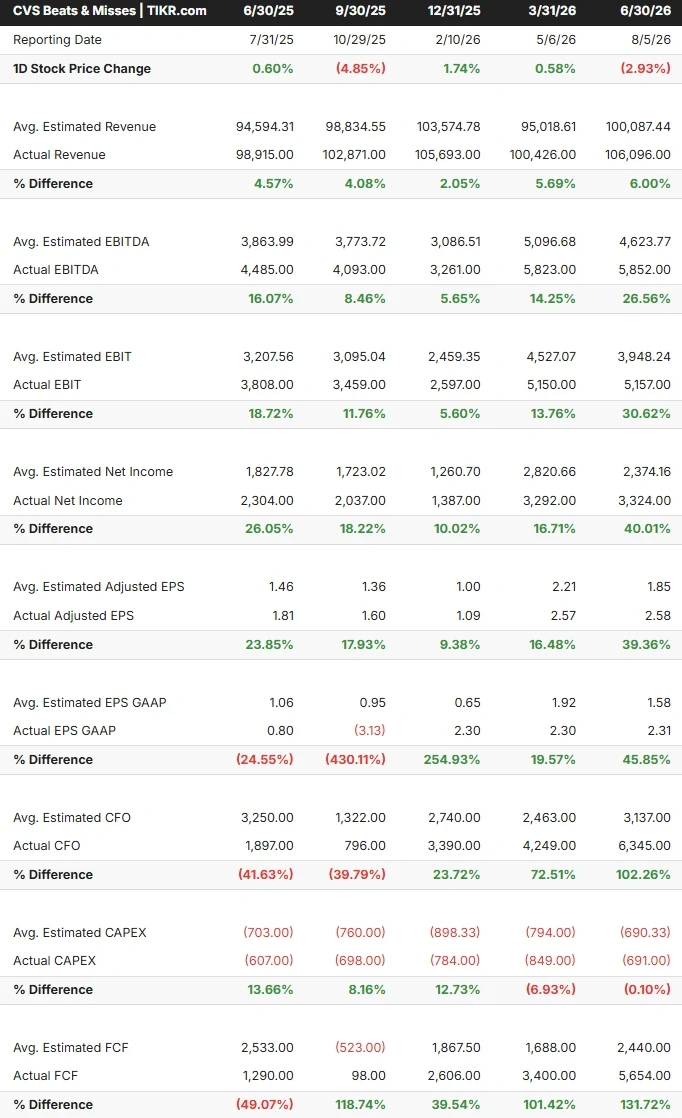
CVS reported Q2 2026 revenue of $106.1 billion, up 7.3% year over year, and adjusted EPS of $2.58, up more than 40% year over year and about 39% ahead of the $1.85 consensus. Management raised full-year adjusted EPS guidance to $7.90 through $8.10, its second increase this year, and lifted cash flow from operations guidance to at least $11.5 billion.
See historical and forward estimates for CVS Health stock (It’s free!) >>>
Why the Stock Still Trades Like Something Is Wrong
If the business is executing, why do shares sit near $94 rather than their July high? The answer is 2027, and management met it directly. Newman told investors he put out a floor of at least $8.44 in adjusted EPS for next year, framing it as “blessing consensus,” his way of endorsing the Street’s existing estimate as a minimum rather than promising upside beyond it. Chief Strategy Officer Larry McGrath stressed the floor is not a stretch, saying they “did not assume that we needed to do anything heroic or beyond our normal prudent guidance sort of philosophy to get there,” with no capital deployment beyond offsetting dilution.
Two headwinds pressure that year. The first is 340B, a federal drug discount program squeezing Caremark as manufacturers restrict participation; McGrath said it steps down again in 2027, which he called a reasonable proxy for where it stabilizes.
The second is a softer Caremark selling season: after $6 billion in new wins last year, retention slipped from above 99% to the mid-90s. Newman framed that as walking away from legacy contracts CVS did not want, discipline rather than share loss.
The real risk is narrower than the headlines suggest. Aetna’s recovery depends on medical costs behaving, and management was explicit that they are not fully cooperating. If utilization reaccelerates, the margin repair driving the whole thesis slows with it.
From Turnaround Story to Free Cash Flow
Newman has taken leverage from 5x debt to EBITDA in 2024 to the mid-3s, with roughly $4 billion in debt repaid this year. That progress is what lets CVS talk about restarting share repurchases and pursuing bolt-on acquisitions, capital returns that were off the table when the turnaround began. The dividend, held at $0.67 a quarter, yields around 2.8% at a payout near 70% of trailing earnings.
CVS also trades at a discount to insurer peers that its trajectory makes hard to fully justify. It carries more debt and a messier segment mix than a pure health plan, but grows adjusted EPS at 40% and guides to mid-teens growth through 2028. Whether that discount is deserved or an opportunity is the question the model answers.

See how CVS Health performs against its peers in TIKR (It’s free!) >>>
TIKR Advanced Model Analysis
- Current Price: $94.66
- Target Price (Mid): ~$132
- Potential Total Return: ~39%
- Annualized IRR: ~8% / year

See analysts’ growth forecasts and price targets for CVS Health stock (It’s free!) >>>
The mid-case rests on two revenue drivers: continued mid-single-digit growth in Pharmacy and Consumer Wellness, aided by the Rite Aid contribution and the CostVantage pricing model, plus steady Health Services expansion despite the 340B drag. It assumes revenue compounds at around 4% with a net income margin near 2.7%, a thin figure reflecting CVS’s high-revenue structure. The margin driver is Aetna’s benefit-ratio recovery, helped by the lower cost base. The primary risk is the one management named: a reacceleration in medical cost trend that stalls the recovery. Upside runs toward the high-case $219 if Aetna margins fully normalize; the downside leaves investors waiting through another year of repair while the discount persists.
Conclusion
The next test is the Q3 2026 print on November 4, and one line decides how the market reads it: Aetna’s medical benefit ratio. The ratio naturally rises through the year as deductibles reset, so the test is not a single number but whether Q3 lands in line with or below what management guided. Coming in on plan confirms cost trend is contained and the $8.44 floor is conservative. A meaningful miss above guidance says utilization is winning, and the thesis needs another quarter of patience. Management spent Wells Fargo telling investors to stay careful. On November 4, the number decides whether that was prudence or foresight.
See what stocks billionaire investors are buying so you can follow the smart money with TIKR.
Should You Invest in CVS Health?
The only way to really know is to look at the numbers yourself. TIKR gives you free access to the same institutional-quality financial data that professional analysts use to answer exactly that question.
Pull up CVS Health, and you’ll see years of historical financials, what Wall Street analysts expect for revenue and earnings in the quarters ahead, how valuation multiples have moved over time, and whether price targets are trending up or down.
You can build a free watchlist to track CVS Health alongside every other stock on your radar. No credit card required. Just the data you need to decide for yourself.
Analyze CVS Health on TIKR Free →
Looking for New Opportunities?
- See what stocks billionaire investors are buying so you can follow the smart money.
- Analyze stocks in as little as 5 minutes with TIKR’s all-in-one, easy-to-use platform.
- The more rocks you overturn… the more opportunities you’ll uncover. Search 100K+ global stocks, global top investor holdings, and more with TIKR.
Disclaimer:
Please note that the articles on TIKR are not intended to serve as investment or financial advice from TIKR or our content team, nor are they recommendations to buy or sell any stocks. We create our content based on TIKR Terminal’s investment data and analysts’ estimates. Our analysis might not include recent company news or important updates. TIKR has no position in any stocks mentioned. Thank you for reading, and happy investing!