


Key Takeaways
- Apple returned $33 billion to shareholders in the June quarter, split between $4 billion in dividends and equivalents and $25.8 billion in buybacks, backed by $34.4 billion in operating cash flow.
- The quarterly dividend has climbed from $0.25 to $0.27 across eight straight quarters.
- At 13.55%, Apple stock’s payout ratio sits far under the 25.81% level from two years back, even with the dividend yield compressed to just 0.33%.
- TIKR’s mid case model puts Apple stock’s target price at $457, projecting a 38% total return and an 8% annualized rate by 2030.
Apple’s Capital Return Machine Keeps Humming Even as Memory Costs Bite Margins
Apple Inc. (AAPL) closed its fiscal third quarter of 2026 with CFO Kevan Parekh confirming the company returned $33 billion to shareholders in the June quarter. That total split into $4 billion in dividends and equivalents and $25.8 billion in share repurchases, funded by $34.4 billion in operating cash flow, a June quarter record even after stripping out the tariff refund benefit management flagged elsewhere on the Q3 earnings call.
Parekh closed his prepared remarks by telling analysts that “today, our Board of Directors has declared a cash dividend of $0.27 per share of common stock payable on August 13, 2026, to shareholders of record as of August 10, 2026.”
That confirmation landed against a backdrop CEO Tim Cook did not soften. Cook described the current memory market as “a 100-year flood on the memory pricing, with exponential increases in memory prices,” the reasoning he gave for why Apple had “reluctantly raised prices” on iPad and Mac this year.
The cost pressure already shows up in the numbers: Parekh reported product gross margin of 40.1% for the quarter, up 140 basis points sequentially, a gain that existed only because a tariff refund benefit worth “over 2.5 percentage points” masked the underlying memory cost increase. Looking ahead, Parekh guided total company gross margin to a range of 47% to 48% for the September quarter, a sequential step down he tied to rising memory costs and to supply constraints hitting iPhone, Mac and iPad at once.
Cook was direct about the cause: the constraint traces to “the availability of the advanced nodes that our SoCs are produced on,” a limit he called a function of demand running ahead of even Apple’s own high expectations. None of that guidance mentioned the dividend by name. But the same operating cash flow funding $4 billion in quarterly dividends is the buffer management is counting on to absorb memory costs without pulling back on capital returns.
Apple Stock’s Payout Ratio Falls to a Multi-Year Low While the Dividend Keeps Climbing
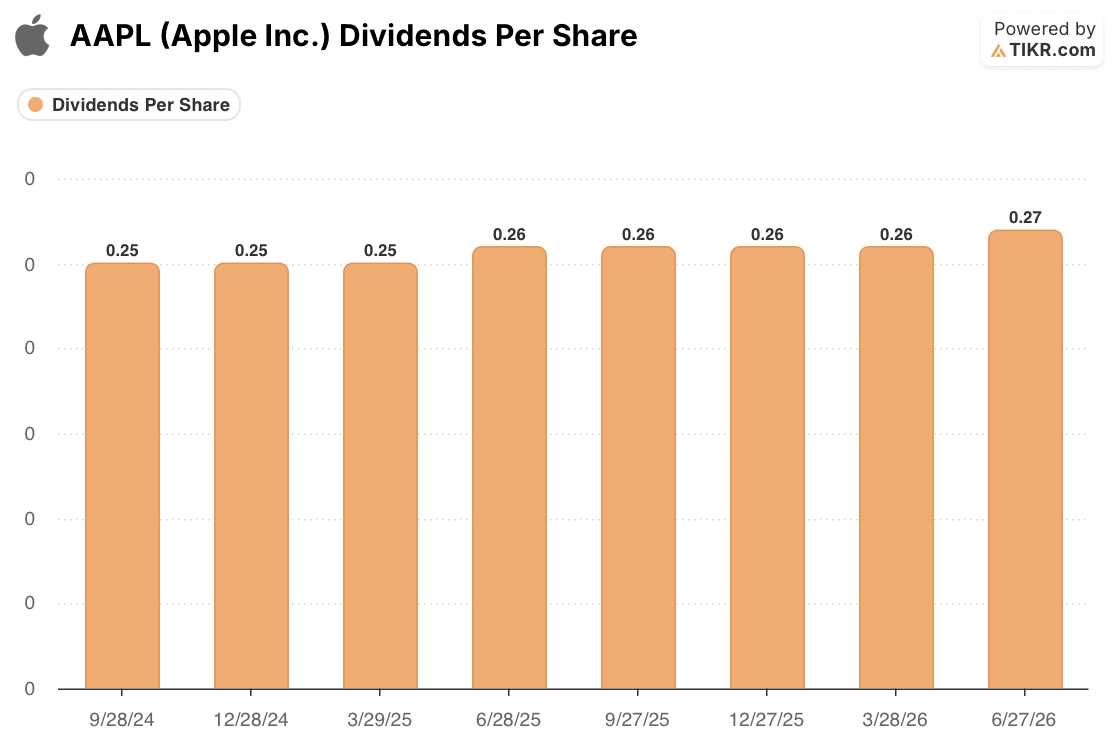
Apple’s quarterly dividend has moved from $0.25 to $0.27 across the eight quarters TIKR tracks, with the most recent step arriving alongside the board’s August 2026 declaration. The increases have come in small, infrequent steps rather than one sharp jump, and each has landed while the company’s payout coverage improved rather than tightened.

Apple stock’s payout ratio stood at 13.55% in the June 2026 quarter, down sharply from 25.81% in September 2024 and well under the 16.83% level recorded in mid-2025. That decline lines up with what Parekh’s cash flow disclosure suggested on the call: the dividend consumes a shrinking share of net income even as the per share payment keeps ticking higher.

Apple stock’s dividend yield has compressed to 0.33%, near the low end of a 0.32% to 0.61% range and beneath the 0.46% mean TIKR calculates over the period, a sign that price appreciation, not any change in dividend policy, is what has squeezed the yield.
The open question for income-focused holders is whether Apple lets the payout ratio drift back up toward its 25.81% high before the per share dividend takes a bigger step.
TIKR’s $457 Target Frames Apple Stock as a Steady Compounder, Not a Yield Play
TIKR’s mid case valuation model puts Apple stock’s target price at $457 against a $332 current price, a 38% total return and an 8% annualized rate over the next four years.

That return profile positions Apple stock as a steady compounder rather than an income vehicle, with price appreciation doing far more of the work toward that total return than the 0.33% dividend yield.
The case for reaching that target rests on the same drivers Cook and Parekh described on the call, including a 16% year over year revenue quarter, an installed base of over 2.5 billion active devices, and Services revenue that kept setting records even against foreign exchange headwinds. Reaching it does not hinge on how fast the dividend grows from here.
Should You Invest in Apple Inc.?
The only way to really know is to look at the numbers yourself. TIKR gives you free access to the same institutional-quality financial data that professional analysts use to answer exactly that question.
Pull up Apple Inc. stock and you’ll see years of historical financials, what Wall Street analysts expect for revenue and earnings in the quarters ahead, how valuation multiples have moved over time, and whether price targets are trending up or down.
You can build a free watchlist to track Apple Inc. alongside every other stock on your radar. No credit card required. Just the data you need to decide for yourself.
Access Professional Tools to Analyze AAPL stock on TIKR for Free →
Looking for New Opportunities?
- See what stocks billionaire investors are buying so you can follow the smart money.
- Analyze stocks in as little as 5 minutes with TIKR’s all-in-one, easy-to-use platform.
- The more rocks you overturn… the more opportunities you’ll uncover. Search 100K+ global stocks, global top investor holdings, and more with TIKR.
Disclaimer:
Please note that the articles on TIKR are not intended to serve as investment or financial advice from TIKR or our content team, nor are they recommendations to buy or sell any stocks. We create our content based on TIKR Terminal’s investment data and analysts’ estimates. Our analysis might not include recent company news or important updates. TIKR has no position in any stocks mentioned. Thank you for reading, and happy investing!


