Key Takeaways
- AMD’s gross margin recovered to 56% last quarter once a one-time export-control charge from mid-2025 is stripped out, and revenue growth hit 50% year over year, both verified in reported numbers rather than guidance.
- AMD’s stock rose from $202 to $522 in the quarter ended June 27, 2026, and touched an intraday high near $585 on June 30, before the Anthropic partnership, the $220 billion TAM reveal, or the August earnings guidance reset were public.
- Shares have not closed above that June 30 high since, even after all three of those catalysts arrived, and closed at $516 on September 11.
- The average Wall Street price target climbed from $500 in June to $615 in September even as the stock failed to make a new high, while several large funds trimmed or exited AMD positions as of the same June 30 reporting date.
AMD’s Margin Recovery Is Already Real, Not Just Promised
AMD’s own numbers back up more of its growth story than the forward guidance alone would suggest.
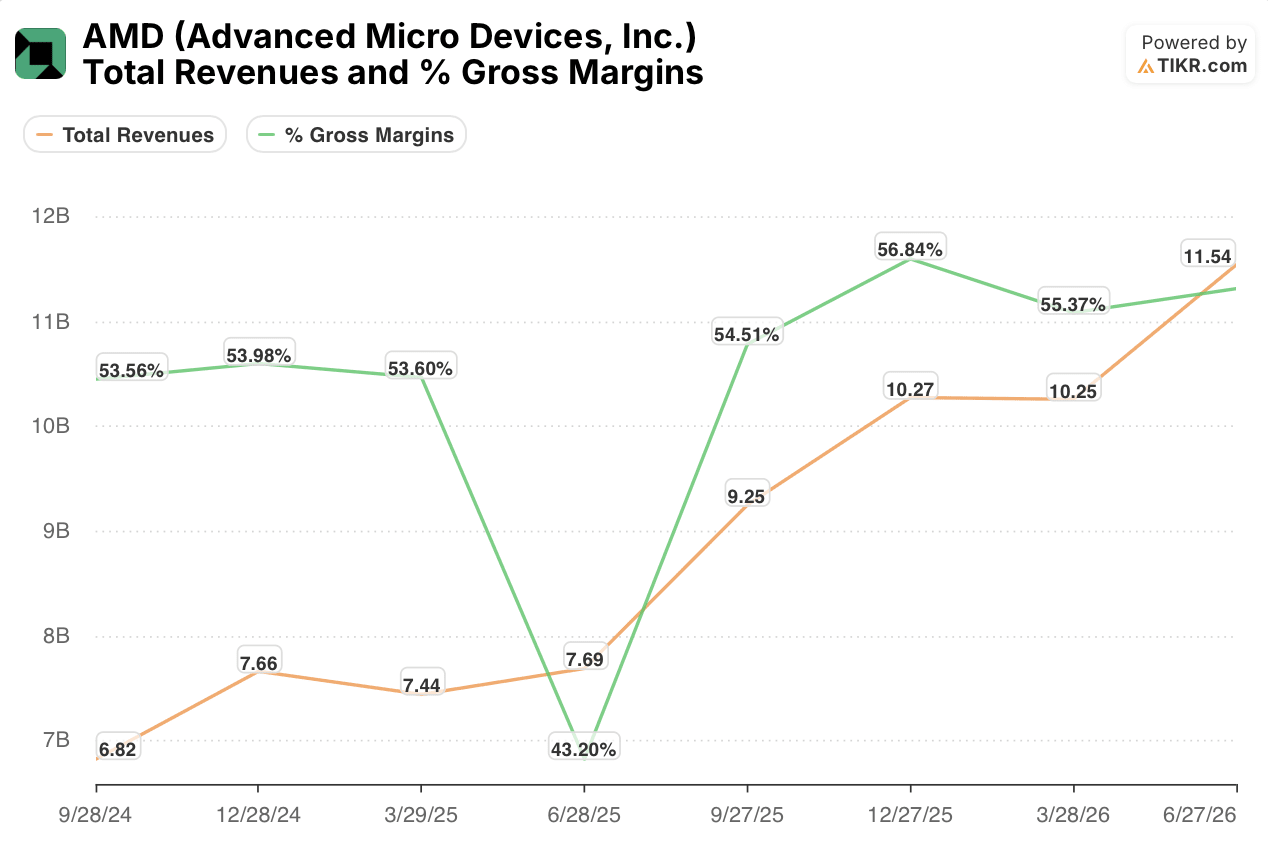
Revenue rose from $6.82 billion in the quarter ended September 28, 2024 to $11.54 billion in the quarter ended June 27, 2026, and year over year growth accelerated across most of that stretch, climbing from 18% to 50%.
Gross margin tells a similar story once one quarter gets adjusted for a known distortion.
The quarter ended June 28, 2025 shows gross margin collapsing to 43%, but that quarter absorbed roughly $800 million in inventory charges tied to U.S. export restrictions on MI308 shipments to China, a cost management flagged directly on its own call.
Strip that one-time hit out and the underlying trend is a steady climb from the 53% to 54% range in late 2024 to the 55% to 57% range through 2026, with the most recent quarter closing at 56%, matching what management described on its August earnings call.
That matters because management’s narrative rests on a specific claim: that server CPU and embedded margin gains are offsetting the dilution from ramping GPU racks. The trailing data is consistent with that offset already working, and it was working before Helios shipped in any real volume, since shipments of the rack-scale platform only began in September. The margin expansion showing up right now is coming almost entirely from the server CPU and embedded businesses, not from the GPU story drawing most of the investor attention.
AMD’s Biggest Re-Rating Happened Before Its Biggest News
AMD’s stock price and its news calendar do not line up the way a casual read of this year would suggest.
Shares closed at $202 on March 28, 2026, then $522 on June 27, 2026, a gain of roughly 158% in a single quarter, and touched an intraday high near $585 on June 30.
None of the developments now driving the bull case, the Anthropic partnership, the $220 billion server CPU forecast, or management’s “well over 100%” 2027 data center growth language, had been announced yet. Those specifics only became public at AMD’s Advancing AI event on July 22 and 23, and then again on the August 4 earnings call that followed roughly two weeks later.
A Q1 earnings beat on May 5, with revenue of $10.25 billion against a $9.89 billion estimate, likely explains some of the run into the June quarter, but a beat of that size does not obviously account for a move this large on its own, and the full mix of catalysts behind it is not established in the material available here.
What is established is what happened after the confirming news arrived. AMD has not closed above its June 30 high since, even with the Anthropic deal, the raised TAM, the guidance reset, and a broad chip-sector rally following Nvidia’s own blowout results in late August all landing in the following ten weeks.
Shares closed at $516 on September 11, roughly 12% below that June 30 peak. Positioning data adds a second wrinkle. Regulatory filings covering the quarter ended June 30, 2026, the same date as AMD’s high, showed Coatue Management and Situational Awareness LP fully exiting their AMD stakes and Viking Global cutting its position by 10%, even as Tiger Global reported a new stake.
That is not a uniform picture of conviction at the exact moment the stock peaked.
What the Street’s Numbers Now Assume
Wall Street’s own numbers have moved to match the story management has been telling.

The average price target rose from $500 in June to $615 by September 11, a 23% increase over a stretch in which the stock itself did not make a new high.
That is not unprecedented on its own; the average target sat 43% above the price back in March and only 96% of the price in June, so the relationship between price and target has swung in both directions this year, not just once.
What is different this time is the direction: targets are now rising into a stalled stock rather than a rising one. Consensus estimates for 2027 and beyond show how far that adjustment has gone.
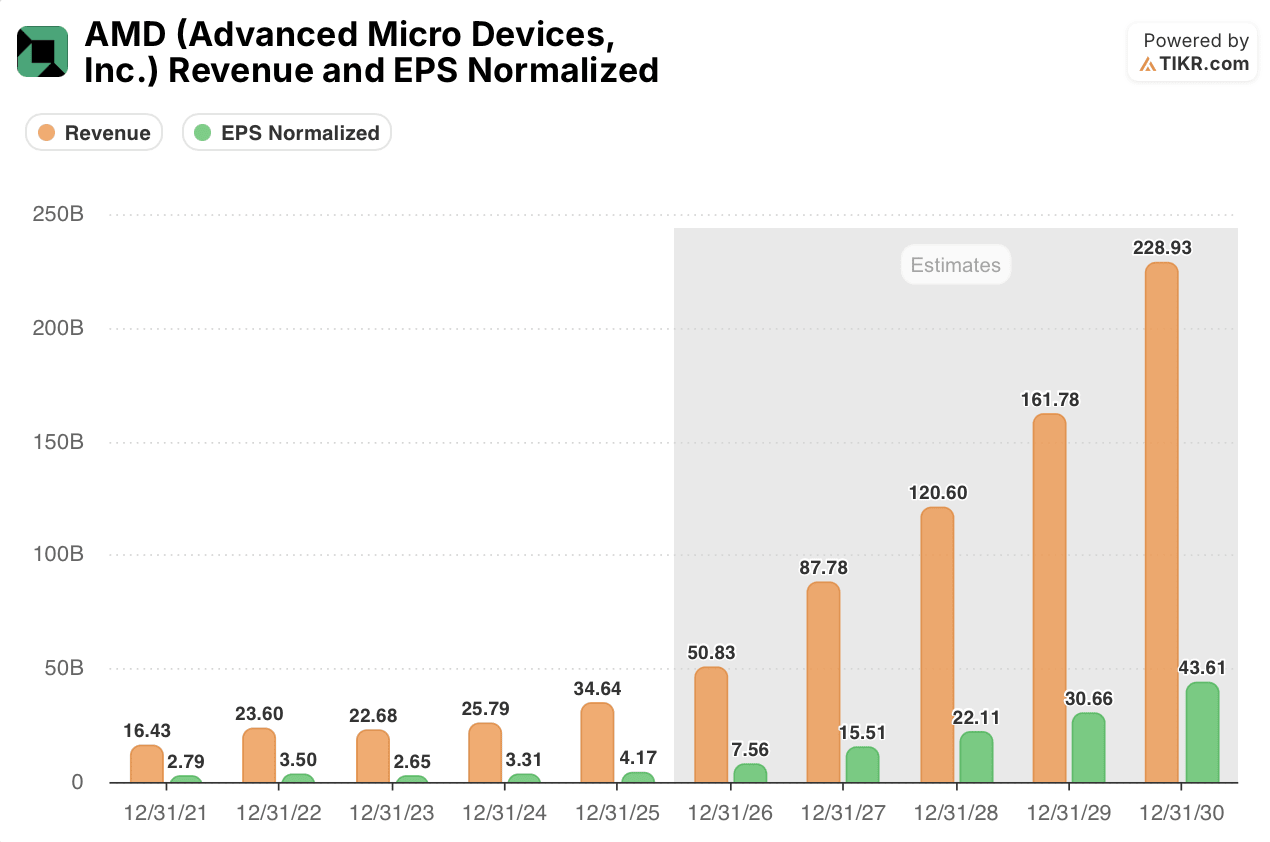
Analysts currently model 2027 revenue of $87.78 billion, up 73% from the 2026 estimate of $50.83 billion, a jump in the same broad range as the “well over 100%” data center growth figure Chief Executive Lisa Su cited on the August call, though that figure describes one segment and this one describes the whole company.
Meanwhile, consensus EPS is projected to rise from $7.56 in 2026 to $15.51 in 2027, then $22.11 in 2028, which is already past the $20 long-term target AMD set at its November 2025 Financial Analyst Day, a year ahead of the timeframe management described for reaching it.
None of this means the estimates are wrong.
It means the analyst community has largely finished building management’s escalating framework into its models, which leaves less room for those models to move further on narrative alone.
AMD’s Next Quarter Has to Confirm What the Stock Already Assumes
The case for AMD’s underlying business is not built on hope. Margin expansion and revenue acceleration both show up in reported numbers, not just guidance, and both were underway before Helios shipped anything at scale.
The open question is whether the market’s timing was right. AMD’s stock made its largest move of the year before its most important confirming news existed, then failed to extend that move once the news actually arrived, which is a pattern that can mean either of two things.
It can mean the spring rally was an accurate advance read of what management would go on to confirm, in which case the summer stall is just digestion before the next leg, supported by real dollars once Helios volume shows up in the numbers. Or it can mean the spring rally already captured more good news than the company has since been able to deliver, in which case three consecutive confirming catalysts landing without a new high is itself a signal worth taking seriously.
The company’s own repeated caveat, that server and GPU supply across wafers, HBM, packaging, and substrates remains tight heading into 2027, is the most direct risk to either outcome. AMD’s next reported quarter, expected in early November, will be the first to include a real quarter of Helios shipments rather than a ramp still described in future tense.
Whether Data Center AI revenue in that report shows the step-up management’s own framework requires, or whether the acknowledged supply constraints push that step-up out further, is the specific disclosure that will tell shareholders which of these two readings of 2026 was correct.
Should You Invest in Advanced Micro Devices, Inc.?
The only way to really know is to look at the numbers yourself. TIKR gives you free access to the same institutional-quality financial data that professional analysts use to answer exactly that question.
Pull up AMD stock and you’ll see years of historical financials, what Wall Street analysts expect for revenue and earnings in the quarters ahead, how valuation multiples have moved over time, and whether price targets are trending up or down.
You can build a free watchlist to track AMD alongside every other stock on your radar. No credit card required. Just the data you need to decide for yourself.
Access Professional Tools to Analyze AMD stock on TIKR for Free →
Looking for New Opportunities?
- See what stocks billionaire investors are buying so you can follow the smart money.
- Analyze stocks in as little as 5 minutes with TIKR’s all-in-one, easy-to-use platform.
- The more rocks you overturn… the more opportunities you’ll uncover. Search 100K+ global stocks, global top investor holdings, and more with TIKR.
Disclaimer:
Please note that the articles on TIKR are not intended to serve as investment or financial advice from TIKR or our content team, nor are they recommendations to buy or sell any stocks. We create our content based on TIKR Terminal’s investment data and analysts’ estimates. Our analysis might not include recent company news or important updates. TIKR has no position in any stocks mentioned. Thank you for reading, and happy investing!