

Key Takeaways
- PepsiCo told investors on its July call that first-half revenue rose 7% and reported EPS grew 6%, but full-year EPS guidance now leans toward the low end of the range.
- PepsiCo’s dividend has climbed from $1.36 to $1.48 per share.
- PepsiCo stock’s payout ratio has fallen to 65.35% from a 147.35% high last year, and its yield of 4.39% sits just below the two-year high of 4.44%.
- TIKR’s mid-case model puts PepsiCo stock’s target price at $189 by year-end 2030, a 38% potential total return and an 8% annualized rate.
PepsiCo Stock’s Payout Rests on Real Growth Management Is Guiding Down
PepsiCo (PEP) told investors on its July 9, 2026 second-quarter call that revenue grew almost 7% in the first half of the year.
CFO Stephen Schmitt said reported earnings per share grew 6% over the same stretch, while constant currency EPS grew 3%. That growth came with a catch. Schmitt said the company would likely land toward “the low end of the EPS range” for the year, even as he reaffirmed full-year guidance overall.
CEO Ramon Laguarta echoed the caution around organic growth, telling analysts PepsiCo has “a line of sight to the low end of our long-term 4% to 6% in the second half of the year,” and adding, “We were fighting for that.” Schmitt also said tariff refund claims from last year would add about a full point of EPS growth for the year, cash he said would help offset rising commodity costs while PepsiCo keeps investing in growth.
North America’s beverage business felt that pressure directly. PBNA’s operating margin fell about 90 basis points in the quarter, a decline Schmitt tied half to the commercial arrangement with Alani, with the rest coming from soft convenience and gas channel sales and product mix.
International kept expanding even as North America wobbled. Laguarta said the segment is on pace to cross $40 billion in revenue this year, and Schmitt noted its operating margin grew a full point in the quarter.
Schmitt was direct about the trade-off management is making. He said, “We’re not making decisions that hurt the top line,” pointing to planned increases in North America advertising and marketing spending in the second half versus a year earlier.
Schmitt added that productivity gains would keep building through the third and fourth quarters, the lever management is counting on to fund those growth investments without slowing earnings further.
PepsiCo Stock’s Payout Ratio Swings Hard but Lands Near Its Safest Level

PepsiCo’s per-share dividend held at $1.36 for three straight quarters before stepping up to $1.42, then rising again to $1.48 in the most recent quarter.
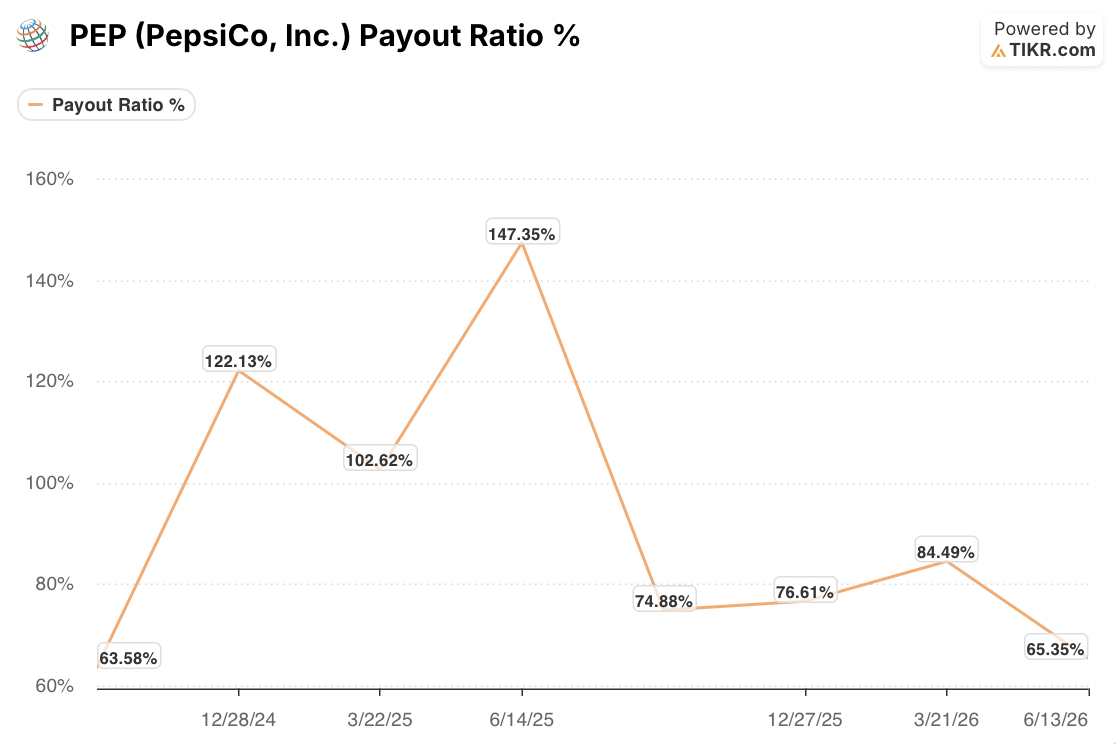
The payout ratio moved in a much rougher pattern than the dividend itself, starting at 63.58% before jumping to 122.13% and pulling back to 102.62%. It then spiked to a high of 147.35% in mid-2025, the point where the dividend outpaced earnings entirely.
From there it fell hard, dropping to 74.88%, then 76.61%, then 84.49%, before settling at 65.35% in the latest reading. That settling ratio lines up with what Schmitt described on the call: earnings growing again in the first half, even if guidance leans toward the low end of the range.
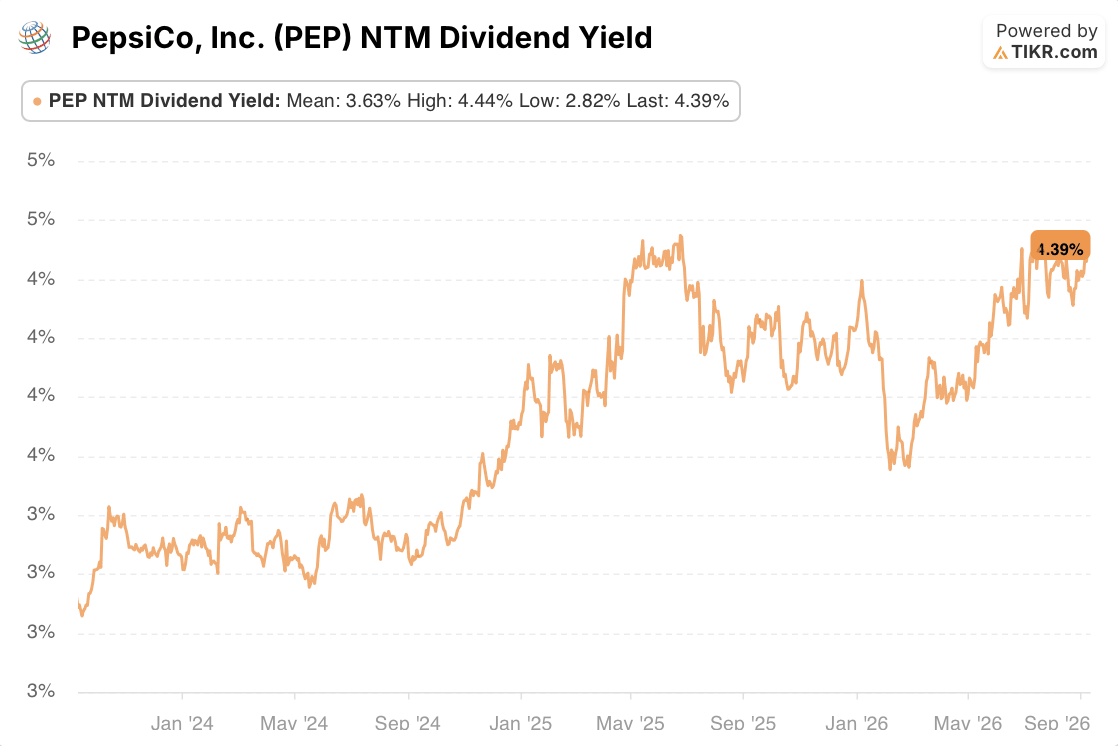
PepsiCo stock’s yield sits at 4.39%, just below its two-year high of 4.44% and well above its 3.63% average over that stretch. That gap between the current yield and the average suggests income investors are being paid more today than they typically have been across this two-year window, even as the payout ratio has cooled.
A payout ratio back above 100% would be the clearest signal the dividend has outrun earnings again. At 65.35% today, it isn’t close.
TIKR’s $189 Target Gives PepsiCo Stock an 8% Annualized Path to 2030
TIKR’s mid-case model puts a $189 target price on PepsiCo stock by year-end 2030, a 38% potential total return and an 8% annualized rate from today’s $136 share price.

That return puts PepsiCo stock in line with a steady compounder rather than a re-rating story, with the dividend as one piece of the total return rather than the reason for it.
The case for reaching that target rests on the same growth Schmitt and Laguarta described on the call: international revenue closing in on $40 billion, first-half revenue up 7%, and productivity gains funding continued investment even as North America margins recover more slowly.
Should You Invest in PepsiCo, Inc.?
The only way to really know is to look at the numbers yourself. TIKR gives you free access to the same institutional-quality financial data that professional analysts use to answer exactly that question.
Pull up PepsiCo, Inc. stock and you’ll see years of historical financials, what Wall Street analysts expect for revenue and earnings in the quarters ahead, how valuation multiples have moved over time, and whether price targets are trending up or down.
You can build a free watchlist to track PepsiCo, Inc. alongside every other stock on your radar. No credit card required. Just the data you need to decide for yourself.
Access Professional Tools to Analyze PEP stock on TIKR for Free →
Looking for New Opportunities?
- See what stocks billionaire investors are buying so you can follow the smart money.
- Analyze stocks in as little as 5 minutes with TIKR’s all-in-one, easy-to-use platform.
- The more rocks you overturn… the more opportunities you’ll uncover. Search 100K+ global stocks, global top investor holdings, and more with TIKR.
Disclaimer:
Please note that the articles on TIKR are not intended to serve as investment or financial advice from TIKR or our content team, nor are they recommendations to buy or sell any stocks. We create our content based on TIKR Terminal’s investment data and analysts’ estimates. Our analysis might not include recent company news or important updates. TIKR has no position in any stocks mentioned. Thank you for reading, and happy investing!


