Key Takeaways
- Verizon is building a new “AI Connect” fiber and data center business on top of its core turnaround, anchored by a Google dark fiber deal worth more than $1 billion and a fresh multibillion dollar supply agreement with Corning signed on September 8.
- Capital expenditures have fallen from a $23.09 billion peak in 2022 to $17.01 billion in 2025, and management says the 2026 AI infrastructure buildout fits inside a $16 billion to $16.5 billion budget rather than adding to it.
- Total debt still climbed to $193.65 billion at the end of the second quarter, up $18.91 billion year over year, driven largely by the January close of the Frontier acquisition.
- A plain total debt to trailing EBITDA cross check rose from roughly 3.50x to 3.77x over the same year, moving the wrong direction even as management highlights a narrower 2.5x net unsecured leverage ratio.
Verizon’s AI Fiber Pitch Rests On A Shrinking Capital Budget
Verizon Communications (VZ) spent three separate investor appearances in September repeating the same pitch. CEO Dan Schulman and CFO Tony Skiadas told the Goldman Sachs Communacopia conference, the Citi Global TMT conference, and the second quarter earnings call that Verizon’s decades old fiber network has become the right asset for a different era.
The company signed a deal with Google worth more than $1 billion to connect the search giant’s data centers over Verizon dark fiber routes. Management says several more billion dollar agreements are likely by year end. On September 8, Verizon signed a multibillion dollar supply agreement with Corning for more than 80 million miles of high density optical fiber, to be delivered between 2027 and 2032.
Schulman calls this initiative AI Connect. He splits it into three pieces. The first is leasing power, space, and cooling inside retired central offices. The second is building new dark fiber routes for hyperscalers. The third is selling lit or wave services to customers who want Verizon to run the electronics. He told the Goldman audience that a small trial of retrofitted central office capacity sold out in 24 hours.
The financial claim behind all of this is that it is additive, not incremental. Skiadas told Citi’s Michael Rollins that AI infrastructure capital for 2026 is already included inside Verizon’s $16 billion to $16.5 billion capex guide, not stacked on top of it. That claim is checkable, and the underlying capex trend supports it.
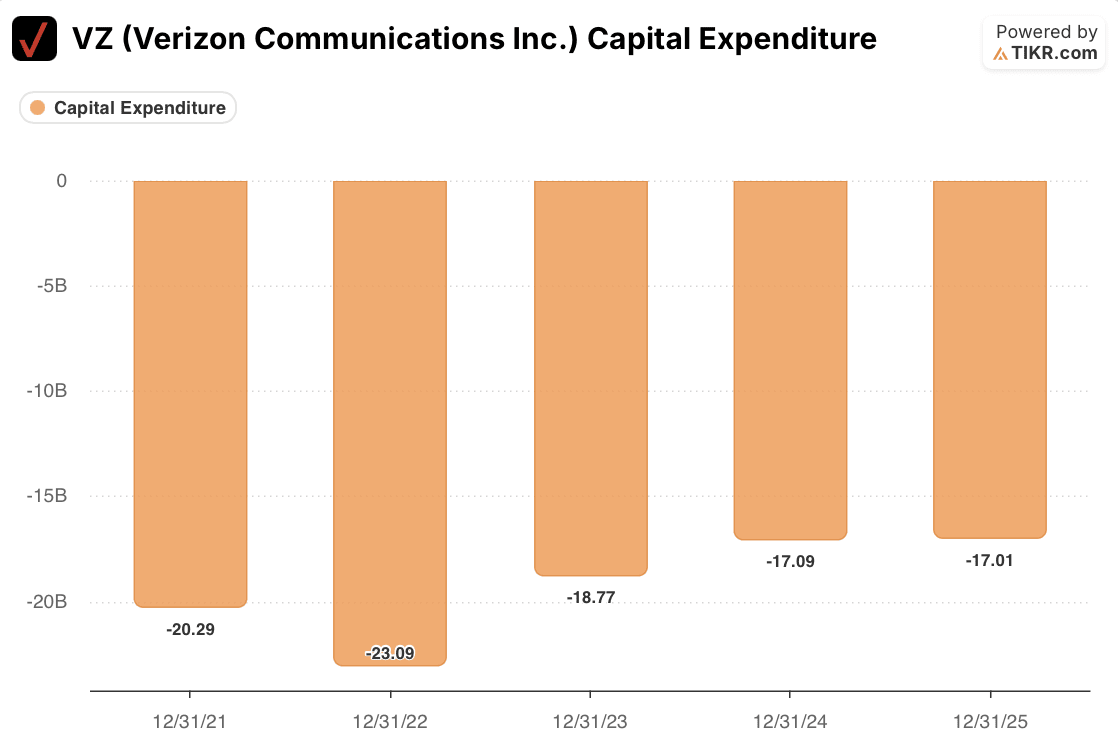
Verizon’s capital expenditures peaked at $23.09 billion in 2022 during its C-band spectrum buildout, then fell to $18.77 billion in 2023, $17.09 billion in 2024, and $17.01 billion in 2025. The 2026 guide of $16 billion to $16.5 billion continues that decline. Four years of capex discipline have freed up roughly $6 billion to $7 billion a year relative to the 2022 peak. That is real room to absorb a new business line without expanding the total budget.
Verizon’s Debt Numbers Tell A Different Story Than 2.5x
The leverage side of the pitch is less clean. On the Q2 earnings call, Skiadas said Verizon’s net unsecured debt to consolidated adjusted EBITDA ratio stood at 2.5x, an improvement of 0.1x from the prior quarter, with a return to the company’s target range expected sometime in 2027. That is a specific, credible sounding number. It is worth being precise about what it measures. It nets out cash, counts only unsecured debt, and divides by Verizon’s own non GAAP adjusted EBITDA definition, which the company reported at $13.7 billion for the second quarter alone, up 7% year over year.
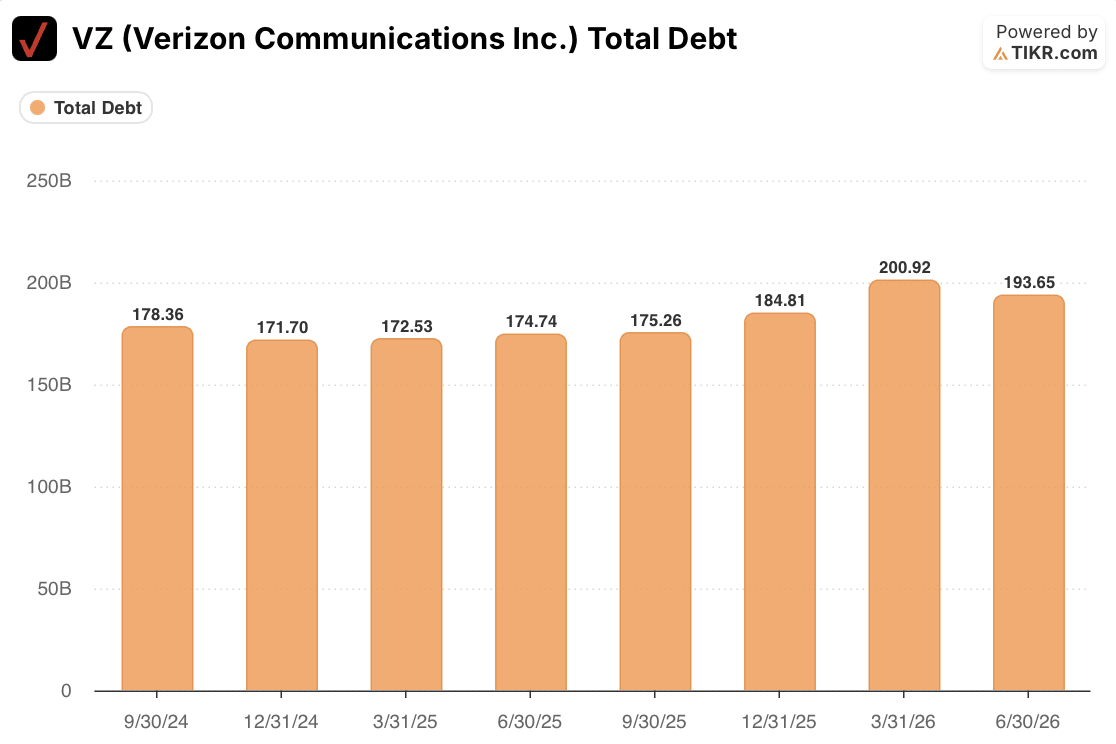
A simpler cross check tells a rougher story. Verizon’s total debt, all of it, secured and unsecured, rose to $193.65 billion at the end of the second quarter of 2026, from $174.74 billion a year earlier. That is an increase of $18.91 billion, or roughly 11%. Most of that jump happened in a single quarter.
Total debt went from $184.81 billion at year end 2025 to $200.92 billion at the end of the first quarter of 2026, the same quarter Verizon closed its acquisition of Frontier Communications. It has since come down to $193.65 billion, consistent with management’s statement that it paid off substantially all of Frontier’s assumed debt six months ahead of schedule.
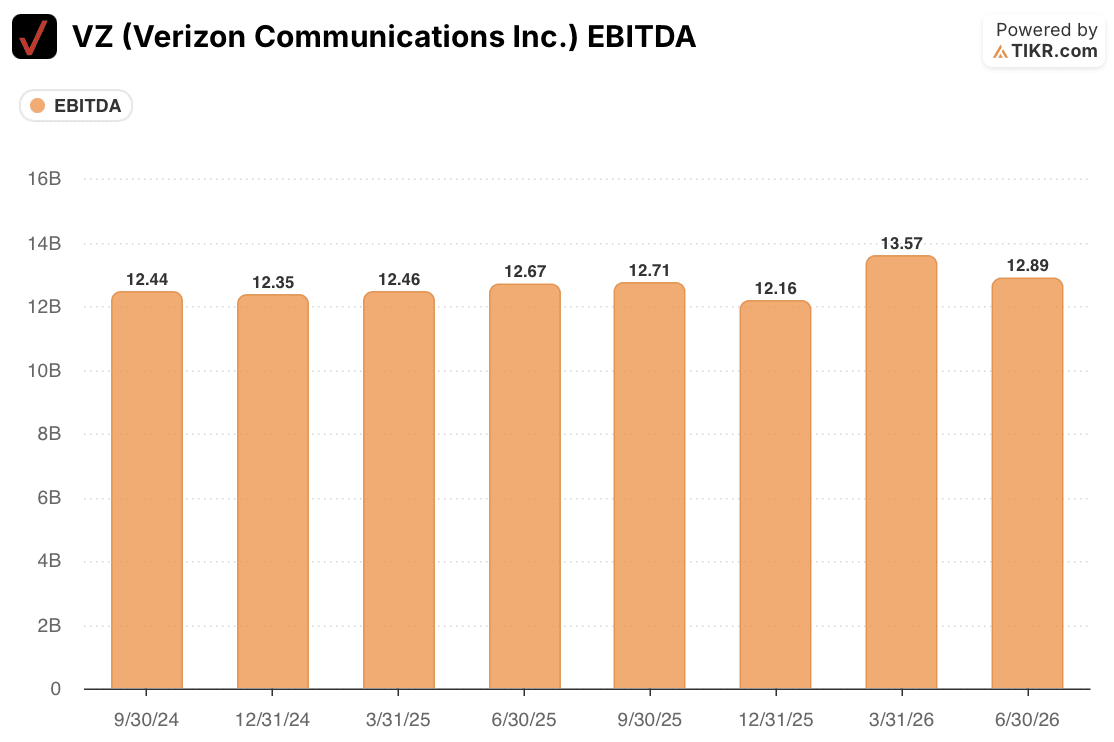
Dividing that same total debt figure by trailing twelve month EBITDA on a standardized basis, not management’s own adjusted figure, produces a leverage ratio of roughly 3.77x as of June 2026, up from about 3.50x a year earlier. That is not the same math as the 2.5x figure management cites, and the two should not be treated as interchangeable. It is, however, the plainest version of the leverage question a shareholder can ask. On that version, leverage got richer over the past year, not cheaper, largely because of one acquisition.
The pattern in Verizon’s financing activity this year is also consistent with a company managing how its debt is perceived, not simply reducing it. Verizon filed for junior subordinated notes twice in 2026, a $4 billion offering in May and a $3.75 billion offering in August, alongside a private exchange offer covering eleven series of existing notes. Junior subordinated notes typically receive partial equity credit from ratings agencies. That is a common way for a company to raise capital without it counting fully against the leverage ratios that ordinary debt affects.
Verizon’s Next Disclosure Will Reveal Which Story Is True
None of this means AI Connect is a fiction. The Google deal is real, disclosed, and dated. The Corning agreement is real, signed, and running through 2032. The capex trend behind the “it fits inside the existing budget” claim is also real, and it has declined for four straight years. That part of the pitch holds up against the data.
What does not yet hold up is the implicit suggestion that Verizon’s balance sheet is getting safer at the same time it takes on a new, capital intensive growth business. On a plain gross debt basis, leverage moved in the wrong direction over the past year, and the primary driver was Frontier, not AI Connect. Skiadas told Citi that Verizon has not yet guided 2027 capital expenditures and will address that in January. That is the specific gap in the record right now. AI Connect’s own capital commitments, described by management as success based, have not been sized publicly beyond the current year.
Two disclosures will settle which version of the story is closer to true. The first is Verizon’s third quarter total debt figure, which will show whether the $3.75 billion in junior subordinated notes filed in August pushed gross debt back up, or whether continued Frontier paydown offset it.
The second is the 2027 capital expenditure guide due in January, which will show whether AI Connect capital stays inside a shrinking envelope the way management has promised, or starts to resemble the 2021 to 2022 C-band cycle that once pushed capex to $23.09 billion. Until those two numbers land, the fairest reading of Verizon’s AI infrastructure story is that it is a legitimate new growth vector, being built by a company whose leverage picture is more mixed than the 2.5x headline suggests.
Should You Invest in Verizon Communications Inc.?
The only way to really know is to look at the numbers yourself. TIKR gives you free access to the same institutional-quality financial data that professional analysts use to answer exactly that question.
Pull up VZ stock and you’ll see years of historical financials, what Wall Street analysts expect for revenue and earnings in the quarters ahead, how valuation multiples have moved over time, and whether price targets are trending up or down.
You can build a free watchlist to track VZ alongside every other stock on your radar. No credit card required. Just the data you need to decide for yourself.
Access Professional Tools to Analyze VZ stock on TIKR for Free →
Looking for New Opportunities?
- See what stocks billionaire investors are buying so you can follow the smart money.
- Analyze stocks in as little as 5 minutes with TIKR’s all-in-one, easy-to-use platform.
- The more rocks you overturn… the more opportunities you’ll uncover. Search 100K+ global stocks, global top investor holdings, and more with TIKR.
Disclaimer:
Please note that the articles on TIKR are not intended to serve as investment or financial advice from TIKR or our content team, nor are they recommendations to buy or sell any stocks. We create our content based on TIKR Terminal’s investment data and analysts’ estimates. Our analysis might not include recent company news or important updates. TIKR has no position in any stocks mentioned. Thank you for reading, and happy investing!