
Key Takeaways
- Netflix’s record $4.7 billion share buyback in Q2 2026 ran about three times ahead of the $1.53 billion in free cash flow the business generated that quarter.
- The company’s cash and short-term investments jumped to $12.29 billion in Q1 2026, boosted by the after-tax proceeds of the $2.8 billion termination fee Paramount Skydance paid Netflix after winning the bidding war for Warner Bros Discovery.
- By Q2, that cash balance fell back to $9.13 billion, a drop that lines up closely with the shortfall between the buyback and organic free cash flow that quarter.
- Netflix’s forward earnings multiple has fallen from around 50 times in mid-2025 to 22 times now, below its own two-year average and close to its two-year low.
- Full-year guidance of $12.5 billion in free cash flow implies the second half needs to run at roughly double the Q2 pace for the current buyback rate to be self-funded going forward.
Netflix Got Paid $2.8 Billion to Walk Away From Warner Bros
Netflix (NFLX) spent most of early 2026 as the presumptive buyer of Warner Bros Discovery. Paramount Skydance kept raising its own competing offer instead, eventually reaching $32 a share and a $108 billion enterprise value.
In February, Netflix declined to match it. Co-CEO Ted Sarandos said the deal had become “no longer financially attractive,” and Netflix walked away with a $2.8 billion termination fee funded by Paramount.
That decision looks better in hindsight than it did at the time. The Paramount-Warner Bros deal is now stuck in an antitrust trial set for March 2027, brought by California and eleven other states.
On the Q2 2026 earnings call, Sarandos reaffirmed that Netflix is “primarily a builder, not a buyer,” and that the bar for large acquisitions remains high. That stance is central to how the company is now deploying capital.
See Netflix’s full free cash flow and balance sheet history on TIKR.
The Buyback Outgrew NFLX Stock’s Cash Flow
In Q2 2026, Netflix repurchased $4.7 billion of stock, its largest quarterly buyback ever. CFO Spence Neumann called it consistent with “no change” to the company’s capital allocation philosophy.
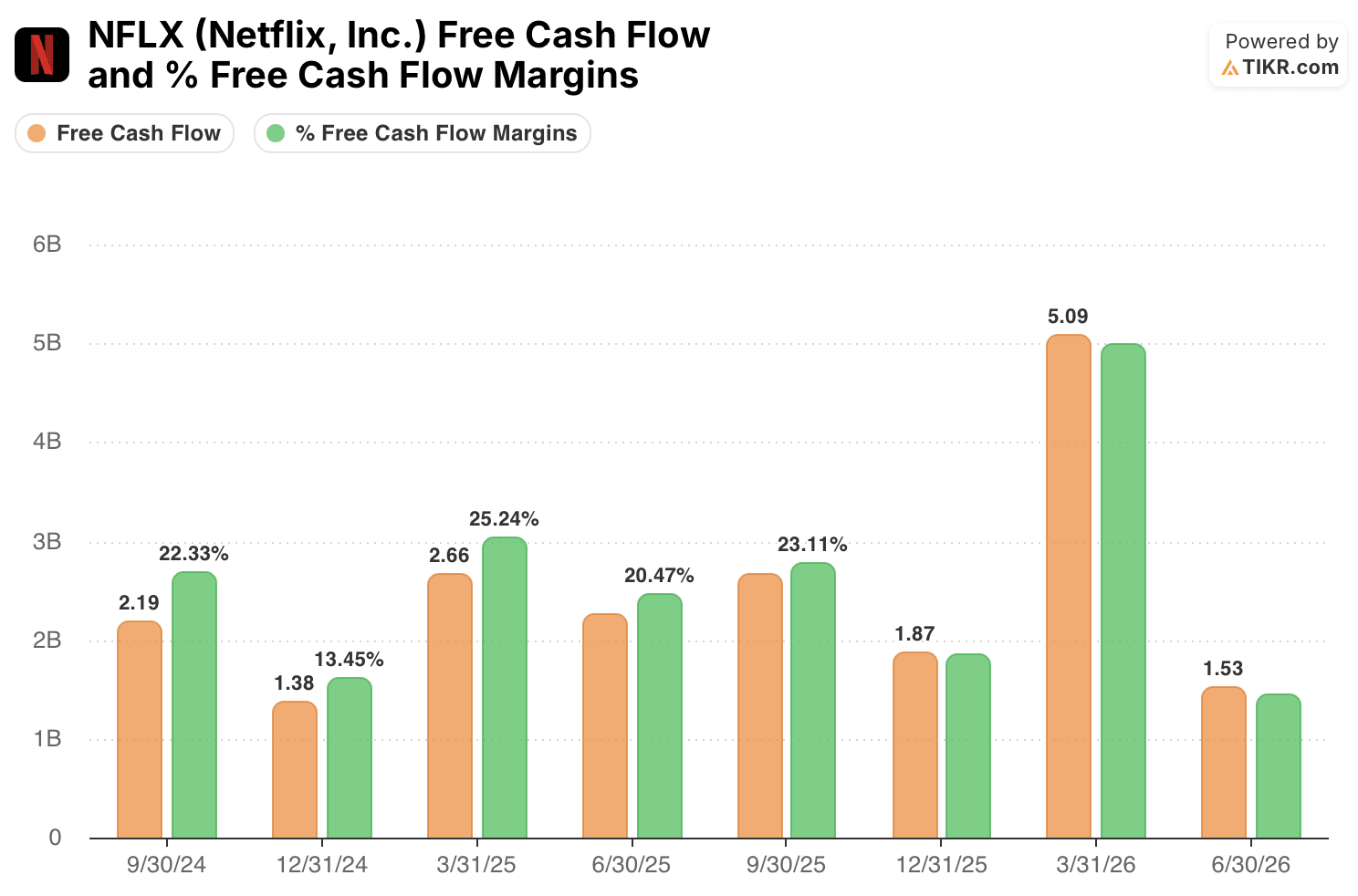
But Netflix generated only $1.53 billion in free cash flow that same quarter, a 12% margin and the weakest quarter in almost two years. The buyback ran roughly three times ahead of the cash the business actually produced in the period.
Diluted earnings per share still grew 11%, but net income grew only 9%, meaning much of the reported EPS gain came from a shrinking share count rather than stronger operating performance.
Where the Money Actually Came From
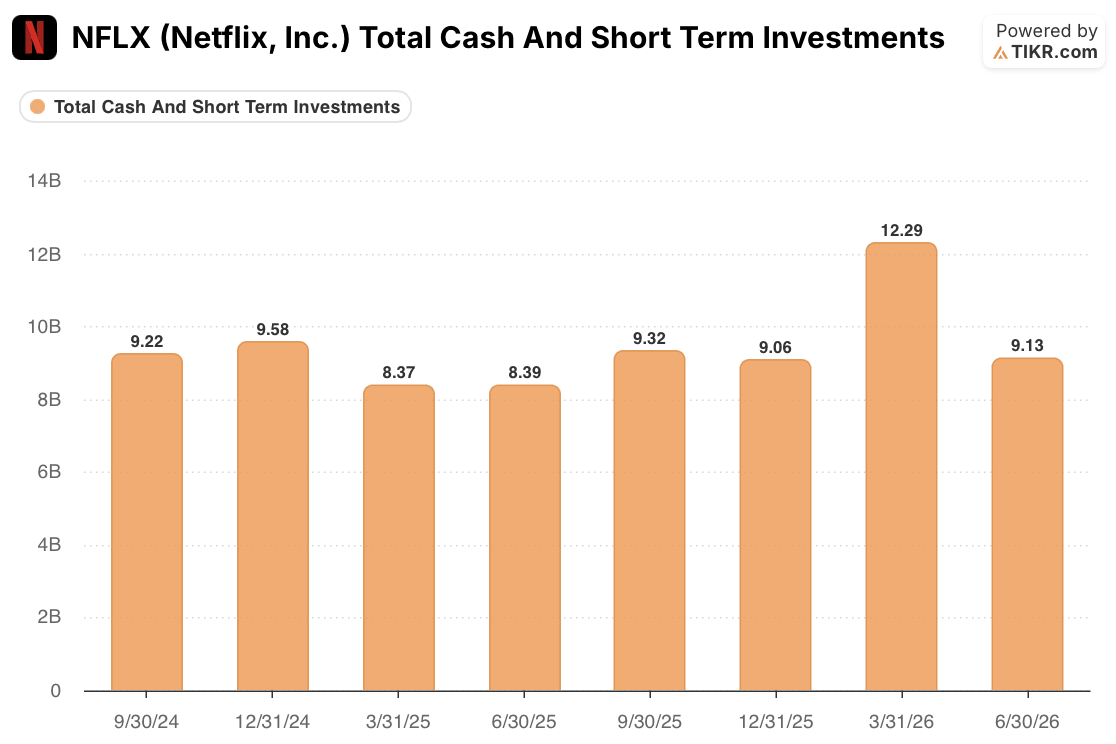
Netflix’s own numbers show where the funding gap was filled. Cash and short-term investments climbed from $9.06 billion at the end of 2025 to $12.29 billion by the end of Q1 2026. Management tied that quarter’s stronger free cash flow outlook directly to “the after-tax impact of the Warner Bros-related termination fee,” a one-time inflow from the failed WBD deal.
By the end of Q2, the cash balance had fallen back to $9.13 billion. That decline of roughly $3.2 billion is close to the exact gap between the $4.7 billion buyback and the $1.53 billion of free cash flow generated in the quarter.
That match is a calculation, not a disclosed figure, but it points the same direction as the disclosed numbers. Netflix appears to have funded a large share of its record buyback from the Warner Bros windfall rather than from the underlying business that quarter.
This analysis did not receive Netflix’s total debt figures, so it cannot rule out new borrowing also playing a role.
Track Netflix’s quarterly cash flow and buyback pace on TIKR as new results come in.
A Multiple That Has Already Come Down A Lot

None of this has gone unnoticed by the market. Netflix’s forward price to normalized earnings multiple peaked 50x in mid-2025. It now sits at 22 times, below its two-year average of 34x and close to its two-year low of about 20 x.
That is a sizable repricing for a stock long associated with premium multiples. It suggests investors have already absorbed the slower growth story, including the Q3 guide of 11% FX-neutral revenue growth, down from 12% in Q2.
Some large holders have also been trimming. Coatue Management cut its Netflix stake by 37% in the 13F covering the end of Q1 2026, then another 32% in the filing covering Q2. It added to Amazon and SpaceX over the same stretch.
A single manager’s 13F is not a verdict on the thesis, but it shows at least one prominent growth investor reducing exposure through the same stretch when Netflix’s cash flow story got more complicated.
A lower multiple on its own does not make the stock cheap or expensive. It only means less of the current story is priced in than a year ago.
The Real Test Is Whether NFLX Stock’s Free Cash Flow Catches Up
Netflix has not done anything improper by spending a one-time windfall on buybacks. The $2.8 billion fee was real cash, and returning an unplanned gain to shareholders instead of chasing another acquisition target is a defensible choice.
The open question is what happens once that windfall runs out. Full-year guidance calls for about $12.5 billion in free cash flow. Netflix generated $6.62 billion combined across the first two quarters, leaving roughly $5.9 billion needed in the second half, or close to $3 billion a quarter. That would be double the pace Netflix just posted in Q2.
If free cash flow reaccelerates as guided, the aggressive buyback will look like a smart use of a temporary windfall bridging into stronger organic cash generation. If it does not, Netflix will either need to slow the pace of repurchases or keep drawing down a cash balance that, while still healthy at $9.13 billion, is no longer flush with fee proceeds.
The $27.1 billion remaining buyback authorization is a ceiling, not a commitment. Investors watching Netflix’s capital discipline narrative should treat Q3 free cash flow, not the headline buyback number, as the actual test of it.
Should You Invest in Netflix, Inc.?
The only way to really know is to look at the numbers yourself. TIKR gives you free access to the same institutional-quality financial data that professional analysts use to answer exactly that question.
Pull up NFLX stock and you’ll see years of historical financials, what Wall Street analysts expect for revenue and earnings in the quarters ahead, how valuation multiples have moved over time, and whether price targets are trending up or down.
You can build a free watchlist to track NFLX alongside every other stock on your radar. No credit card required. Just the data you need to decide for yourself.
Access Professional Tools to Analyze NFLX stock on TIKR for Free →
Looking for New Opportunities?
- See what stocks billionaire investors are buying so you can follow the smart money.
- Analyze stocks in as little as 5 minutes with TIKR’s all-in-one, easy-to-use platform.
- The more rocks you overturn… the more opportunities you’ll uncover. Search 100K+ global stocks, global top investor holdings, and more with TIKR.
Disclaimer:
Please note that the articles on TIKR are not intended to serve as investment or financial advice from TIKR or our content team, nor are they recommendations to buy or sell any stocks. We create our content based on TIKR Terminal’s investment data and analysts’ estimates. Our analysis might not include recent company news or important updates. TIKR has no position in any stocks mentioned. Thank you for reading, and happy investing!