Key Takeaways
- Arm’s stock fell nearly 7% after hours on July 29 despite record fiscal first quarter revenue of $1.29 billion, up 22% year over year, after CFO Jason Child cut full year royalty growth guidance from roughly 20% to the high teens and guided second quarter royalty growth to just 13%.
- Shares have since rallied with the broader chip sector, closing at $264.79 on September 11, but that remains about 25% below the $354.57 level Arm hit on June 30, the day its reported quarter closed.
- Street price targets barely moved through the swing. The consensus mean target rose only from $286.41 to $289.21 between June 30 and September 11 even as the stock fell by a quarter, and buy rated coverage grew from 19 to 20 analysts.
- Nearly a third of Arm’s $574 million in Q1 license revenue, $193 million, came from a single technology licensing agreement with majority owner SoftBank, a related party deal management expects to keep contributing roughly $200 million a quarter.
- Arm’s forward EV to Revenue multiple has fallen from a record 78x to about 43x, still nearly double the roughly 20x multiple it carried a year earlier.
Arm’s AI Premium Outran Even Wall Street’s Own Targets
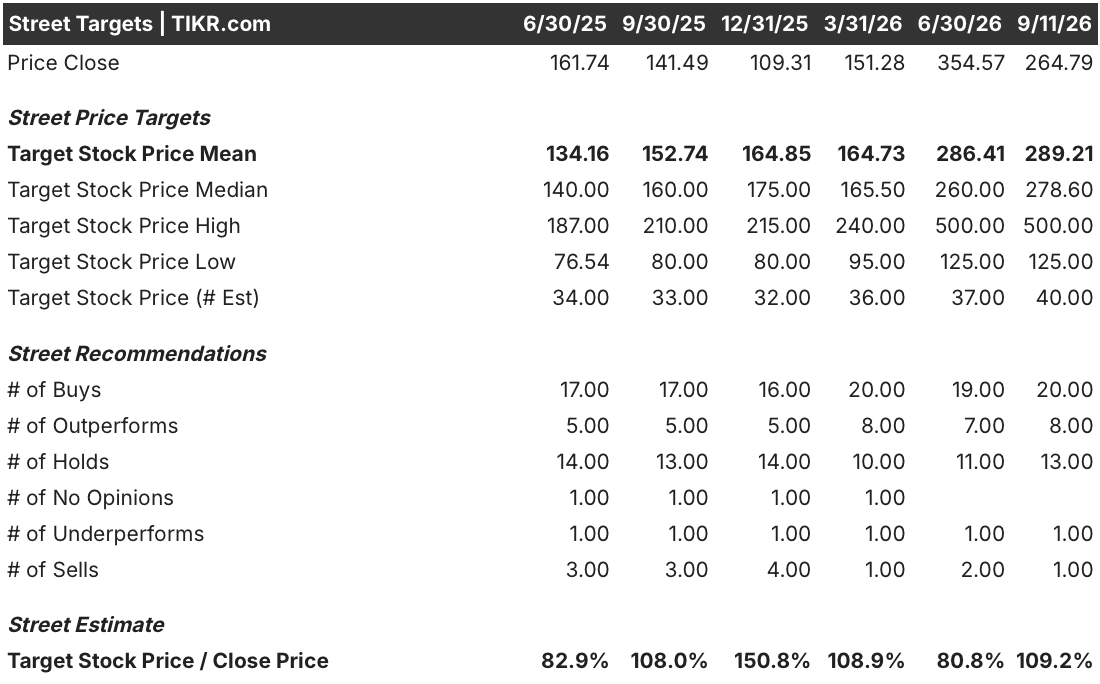
Arm’s stock closed at $354.57 on June 30, the last day of the fiscal quarter it would report on July 29. At that price, Arm was trading nearly a quarter above the Street’s own average price target of $286.41, a target to close ratio of just 80.8%.
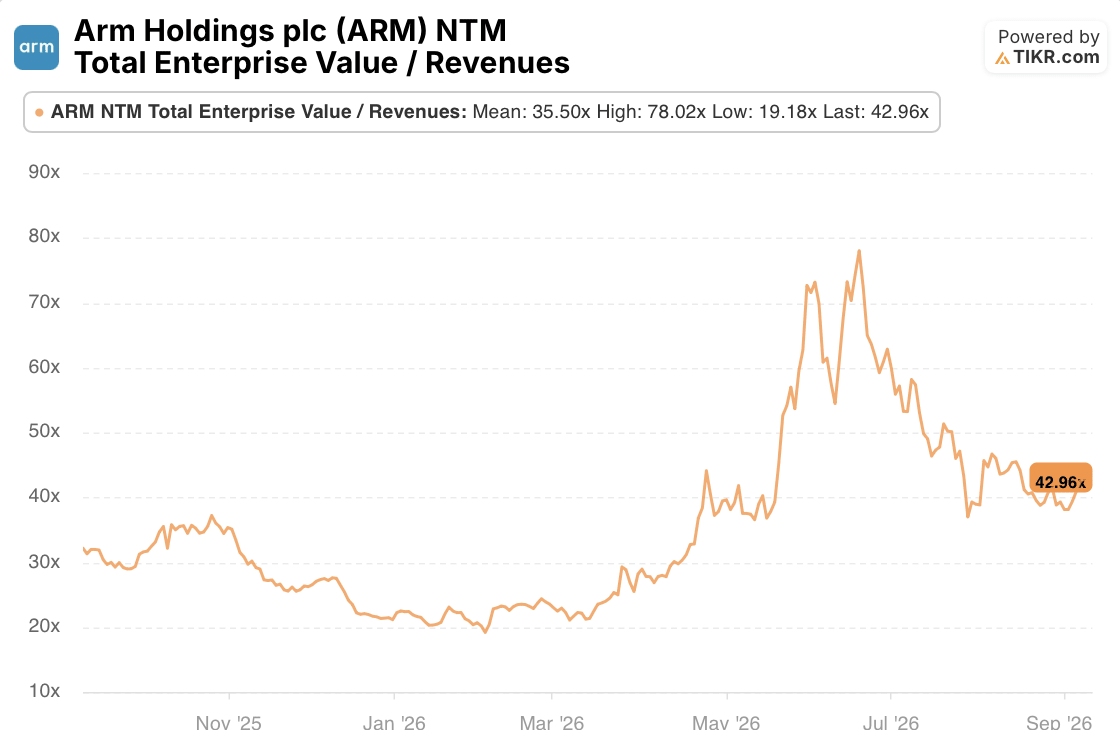
Its forward EV to Revenue multiple hit a record 78x around the same period, more than double the roughly 35x multiple it has averaged over the past year and close to four times the sub 20x level it traded at in January 2026. In other words, the market had already bid Arm well past what its own covering analysts thought it was worth before a single word of the June quarter results was public.
That gap matters because it sets up what happened next. A stock trading 24% above consensus targets has very little room for a mixed print, and Arm’s next earnings report gave it one.
Arm’s Smartphone Royalty Cut Triggered the Selloff
Arm’s fiscal first quarter of 2027, reported July 29, was by the numbers a record quarter. Revenue reached $1.29 billion, up 22% year over year. Royalty revenue grew 22% to $715 million and license revenue grew 23% to $574 million, both first quarter records, and non GAAP earnings per share of $0.45 beat the high end of guidance. Shares still fell nearly 7% in after hours trading.
The reason was guidance, not the quarter itself. CFO Jason Child told analysts that full year royalty growth, which Arm had expected to run around 20%, would now likely land closer to the high teens, and he guided second quarter royalty growth to just 13%.
The culprit was smartphones. Memory chip cost inflation pushed handset makers to raise prices, which pushed buyers toward cheaper and older phones, and Child noted the weakness had spread beyond the low end this cycle to affect some upper and mid tier devices as well, a wider drag than Arm had modeled entering the year.
Whether the “Cloud Offset” Is Real, or Just Accounting Optics
Management’s counterargument is that data center demand is more than making up the difference. Child said data center royalty revenue “more than doubled year on year again” in the quarter, and CEO Rene Haas pointed to Neoverse core shipments surpassing 1.5 billion, with 500 million of those shipped in just the last nine months versus six years for the first billion.
The trouble is that claim currently cannot be checked against Arm’s own disclosures. Arm does not break out royalty revenue by end market, and management said on the call it will not add a separate silicon revenue line until AGI CPU chip sales reach 10% of total revenue, a threshold it does not expect to hit before fiscal 2028. Until then, “data center royalties more than doubled” is a qualitative claim investors have to take on faith.
The license side of the ledger deserves similar scrutiny. Of the $574 million in Q1 license revenue, $193 million, roughly a third, came from a single technology licensing and design services agreement with SoftBank, Arm’s majority owner, and Child guided that relationship to keep contributing about $200 million a quarter for the rest of the year.
That is a related party arrangement propping up a meaningful share of headline license growth. The metric management itself flags as the cleaner underlying read, annualized contract value, grew a more modest 13% year over year, in line with Arm’s long stated licensing growth target rather than evidence of the acceleration the cloud narrative implies.
Arm’s Valuation Still Assumes the Offset Works
By September 11, Arm had fallen to $264.79, about 25% below its June 30 high, while the broader chip sector rallied on Nvidia’s results and a bullish CPU market forecast from Citi. Yet the Street barely blinked through the round trip. The consensus target actually rose slightly, from $286.41 to $289.21, and rated coverage grew more bullish, with buy ratings climbing from 19 to 20 and sell ratings falling from 2 to 1. The target to close ratio flipped from 80.8% at the June peak to 109.2% now, meaning the stock trades roughly 9% below where analysts, on average, think it belongs.
That pattern reads less like the market discovering a broken thesis and more like a valuation reset after an overshoot. Analysts never really bought the $354 print, and they have not meaningfully cut estimates on the smartphone news either. But the correction has not gone all the way back to earth.
Arm’s forward EV to Revenue multiple sits near 43x, still roughly double where it traded a year ago, which means the market continues to underwrite the doubling data center royalty story even though Arm provides no figures to verify it and even though its own preferred licensing metric is growing at less than half that pace. The next real test arrives with Arm’s fiscal second quarter report, expected around late October, when the 13% royalty growth guide and the promised update on AGI CPU supply will either confirm the offset is doing the work management says it is, or show the smartphone drag running deeper than the high teens revision assumed.
9Until that print lands, Arm’s stock is priced for the optimistic version of that answer, not for proof of it.
Should You Invest in Arm Holdings plc?
The only way to really know is to look at the numbers yourself. TIKR gives you free access to the same institutional-quality financial data that professional analysts use to answer exactly that question.
Pull up ARM stock and you’ll see years of historical financials, what Wall Street analysts expect for revenue and earnings in the quarters ahead, how valuation multiples have moved over time, and whether price targets are trending up or down.
You can build a free watchlist to track ARM alongside every other stock on your radar. No credit card required. Just the data you need to decide for yourself.
Access Professional Tools to Analyze ARM stock on TIKR for Free →
Looking for New Opportunities?
- See what stocks billionaire investors are buying so you can follow the smart money.
- Analyze stocks in as little as 5 minutes with TIKR’s all-in-one, easy-to-use platform.
- The more rocks you overturn… the more opportunities you’ll uncover. Search 100K+ global stocks, global top investor holdings, and more with TIKR.
Disclaimer:
Please note that the articles on TIKR are not intended to serve as investment or financial advice from TIKR or our content team, nor are they recommendations to buy or sell any stocks. We create our content based on TIKR Terminal’s investment data and analysts’ estimates. Our analysis might not include recent company news or important updates. TIKR has no position in any stocks mentioned. Thank you for reading, and happy investing!