Key Takeaways
- Deal Collapse Removes the Floor: Bloomberg reported in late August that the Advent-Stripe consortium had abandoned its $60.50-a-share, roughly $53 billion approach for PayPal, and the stock fell nearly 13% the next session as deal speculation evaporated.
- Turnaround Engines Are Diverging: Venmo grew TPV 14% and Braintree accelerated to 13% in Q2, but branded checkout, still PayPal’s core profit engine, just got guided down again for Q3 on a European tariff drag that management says is worse than it first modeled.
- Analyst Conviction Is Thinning Even as Dollar Targets Recover: Buy-equivalent ratings have fallen from roughly half of Street coverage in mid-2025 to just 7 of 45 ratings now, even as the mean price target climbed back to $57.07 from a June low of $51.57.
The $53 Billion Bid Is Gone, and PYPL Has to Prove Itself Alone
PayPal traded around $54 on September 11, a level that tells its own story about the last six weeks.
In late August, Bloomberg News reported that a consortium of buyout firm Advent International and payment processor Stripe had walked away from its pursuit of PayPal. The group had offered $60.50 a share, valuing the company at more than $53 billion, a price Reuters had reported in July citing people familiar with the matter.
PayPal’s board reportedly viewed that price as inadequate, and it was a fraction of the roughly $360 billion valuation PayPal carried at its pandemic-era peak in 2021.
Once the collapse was confirmed, shares fell close to 13% in a single session, closing around $54 after trading near $61 before the news broke. The stock has gone essentially nowhere since.
That reset matters because a takeover premium had been doing quiet work in the share price. With Advent and Stripe no longer in the picture, PayPal’s valuation has to stand on operating results instead of deal optionality.
Venmo and BNPL Are Accelerating While Branded Checkout Keeps Missing Its Own Bar
CEO Enrique Lores, roughly six months into the job as of PayPal’s September 9 appearance at the Goldman Sachs technology conference, is running his turnaround on five fronts: financial services, Venmo and Braintree acceleration, a shift toward high-value consumers over merchants, a simpler org chart, and modernized technology.
The evidence so far is genuinely split. Venmo delivered its seventh straight quarter of double-digit total payment volume growth in Q2, up 14% year over year, with Pay with Venmo up 44% and debit card adoption climbing off a small base. Braintree’s processing volume accelerated to 13% growth from 11% in Q1, its ninth consecutive quarter of profitable growth. Buy now, pay later volume jumped to 26% growth, aided by new merchant partnerships including an Amazon consumer-lending tie-up launching in Germany and Austria.
Branded checkout is a different story. That business, still the source of most of PayPal’s transaction margin, grew total payment volume just 2% on a currency-neutral basis in Q2, matching the prior quarter’s stabilization. On the September 9 call, Lores said Q3 branded checkout growth is now tracking to just 1% to 2%, because tariff and de minimis changes have cut deeper into European cross-border commerce tied to Chinese sellers than the 0.5 to 1 point hit management originally modeled.
That is the tension at the center of this stock. PayPal is funding the turnaround with a program targeting at least $1.5 billion in gross run-rate savings over two to three years, most of it earmarked for reinvestment in financial services, marketing and technology. That reinvestment only compounds returns if branded checkout stops surprising to the downside, and two quarters in, it still is.
Some of the cost-cutting is already visible. A source told Reuters that PayPal cut about 220 jobs in India on September 3, and checkout solutions president Frank Keller sold 4,612 shares that same day, trimming his stake to 41,567.
The Discount Is Real. So Is the Doubt Behind It
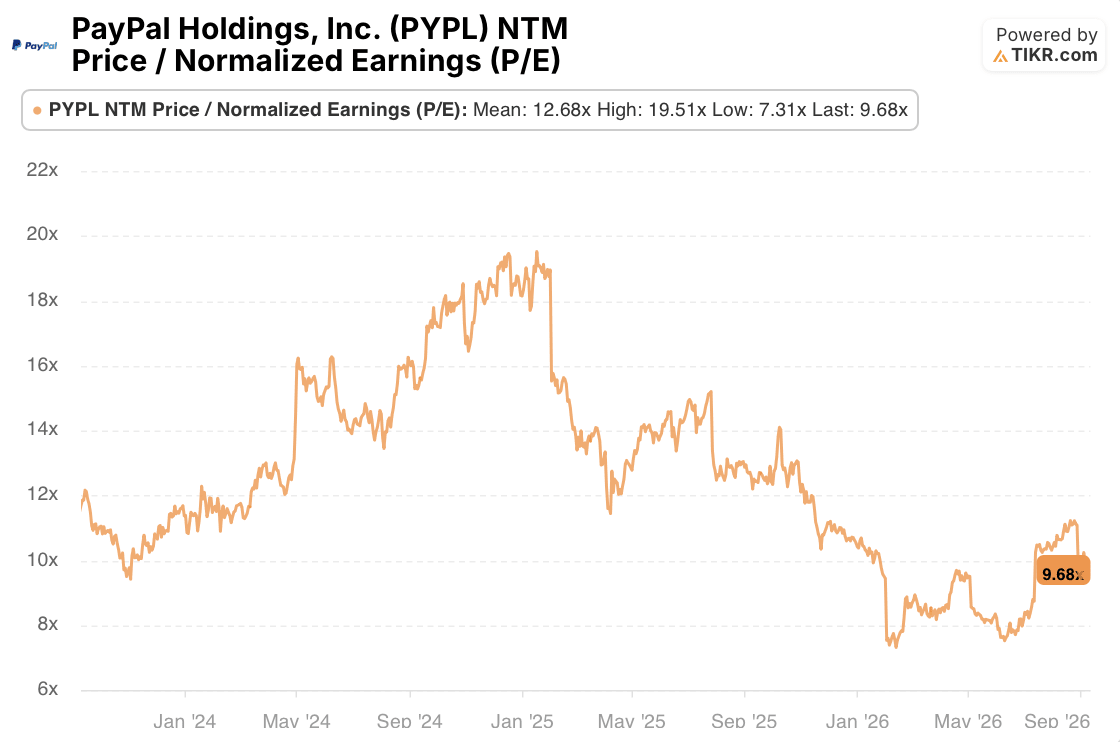
PayPal’s forward price-to-normalized-earnings multiple sits at 9.68 times, TIKR data show, below its own two-year mean of 12.68 times and well off the 19.51 times high the stock touched in early 2025. The compression predates both the CEO transition and the failed buyout, which means the discount is not simply a deal hangover.

The Street Analysts Target history adds detail. The mean target has recovered to $57.07 from a $51.57 trough in June, but still sits roughly 30% below the $81.74 mean analysts carried in mid-2025. Conviction has thinned faster than the dollar figure suggests, with buy and outperform ratings falling from close to half of Street coverage in mid-2025 to just 7 of 45 ratings now, and 33 holds.
The target-to-price ratio shows the net effect. At 106.2%, the gap between the mean target and PayPal’s price is the smallest of the six quarterly snapshots TIKR tracks, down from 133.5% in December 2025. Clear Street, Mizuho and Truist all cut targets within days of the Advent-Stripe collapse, and the aggregate has only partly recovered since. The median target of $57 implies about 6% upside from PayPal’s $53.72 close, the thinnest margin in that history.
The fair read is not that the turnaround has failed. Venmo, Braintree and BNPL are producing real, accelerating numbers, and management has raised full-year guidance twice this year. But the business that generates most of PayPal’s profit has missed its own growth bar for two straight quarters, and the latest miss is blamed on a factor, European tariffs, that management underestimated once already.
The next test is PayPal’s third-quarter report in October. Watch whether branded checkout lands in that 1% to 2% range or slips further, whether cost savings show up in fourth-quarter operating expenses as promised, and whether buy ratings keep shrinking even if the dollar target holds. Until checkout stops missing its own forecasts, a 9.68 times multiple looks less like a bargain and more like the market pricing in the uncertainty that remains.
Should You Invest in PayPal Holdings, Inc.?
The only way to really know is to look at the numbers yourself. TIKR gives you free access to the same institutional-quality financial data that professional analysts use to answer exactly that question.
Pull up PayPal Holdings, Inc. stock and you’ll see years of historical financials, what Wall Street analysts expect for revenue and earnings in the quarters ahead, how valuation multiples have moved over time, and whether price targets are trending up or down.
You can build a free watchlist to track PayPal Holdings, Inc. alongside every other stock on your radar. No credit card required. Just the data you need to decide for yourself.
Access Professional Tools to Analyze PYPL stock on TIKR for Free →
Looking for New Opportunities?
- See what stocks billionaire investors are buying so you can follow the smart money.
- Analyze stocks in as little as 5 minutes with TIKR’s all-in-one, easy-to-use platform.
- The more rocks you overturn… the more opportunities you’ll uncover. Search 100K+ global stocks, global top investor holdings, and more with TIKR.
Disclaimer:
Please note that the articles on TIKR are not intended to serve as investment or financial advice from TIKR or our content team, nor are they recommendations to buy or sell any stocks. We create our content based on TIKR Terminal’s investment data and analysts’ estimates. Our analysis might not include recent company news or important updates. TIKR has no position in any stocks mentioned. Thank you for reading, and happy investing!