Key Takeaways
- Snowflake’s Q2 FY27 print (reported Sept 2) beat estimates across the board and pushed full-year product revenue guidance to $6.07 billion, up from $5.84 billion, with growth guidance rising to 36% from 31%.
- GAAP operating margin has improved for six straight quarters, from -29.72% a year ago to -17.00% now, a pace roughly consistent with CFO Brian Robins’ target of GAAP profitability by the fourth quarter of fiscal 2028.
- Free cash flow margin for the same July quarter barely moved, 5.09% a year ago versus 5.42% now, even as GAAP operating margin jumped nearly 13 points over that stretch.
- Robins told the Citi TMT conference that Snowflake now defaults to one-year contracts instead of three-year commitments, a shift that could be slowing the upfront cash collection that typically lets SaaS free cash flow outrun revenue.
Snowflake’s Guidance Raise Isn’t the Real Story Behind the Rally
Snowflake’s fiscal second-quarter results, covering the period ended July 31, 2026 and reported Sept 2, beat estimates across the board.
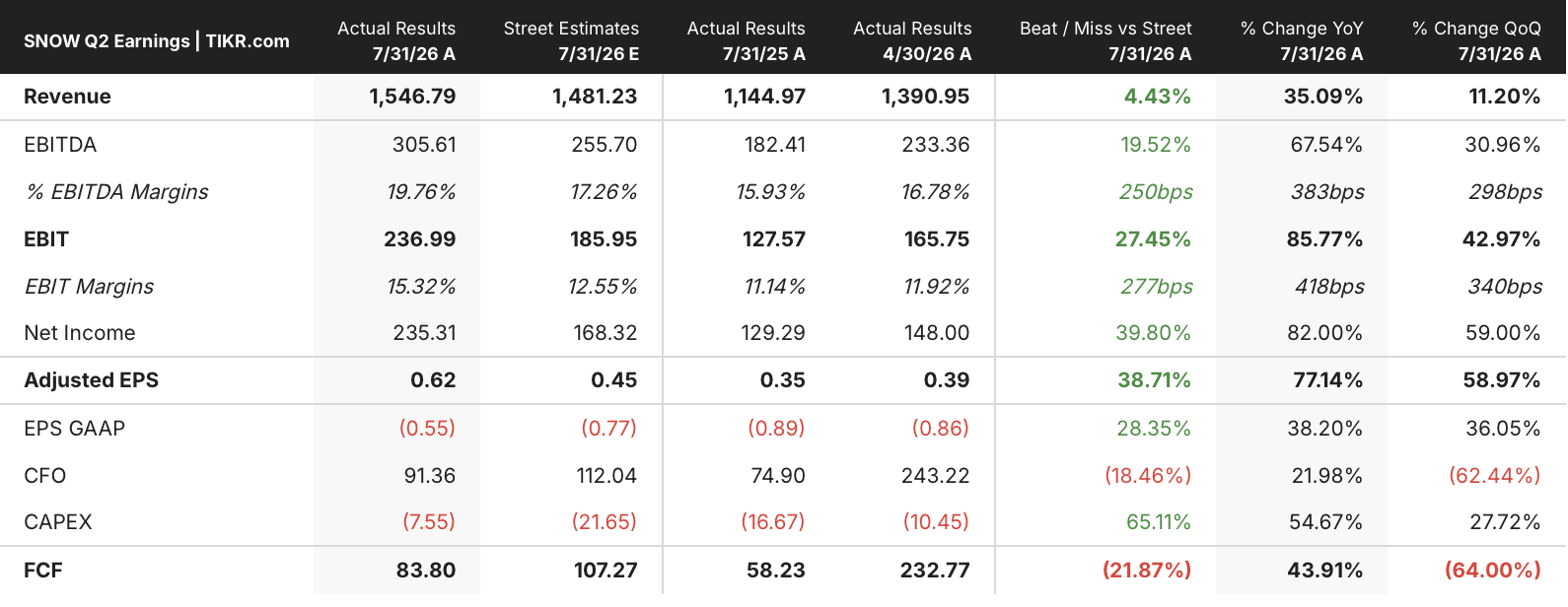
Revenue reached $1.5 billion, up 35% year over year, while product revenue climbed 37% to $1.49 billion. Adjusted earnings per share came in at $0.62 against a Street estimate of $0.45. Management raised full-year product revenue guidance to $6.07 billion from $5.84 billion, lifting the implied growth rate to 36% from 31%, the second straight quarterly guide-up. Shares jumped as much as 24% on the print and have since settled near $329, still comfortably above where they closed before earnings.
Most of the coverage framed this as an AI story. Coding assistant Cortex Code passed 9,100 accounts and enterprise tool CoWork reached 5,800, and CEO Sridhar Ramaswamy said AI products drove “approximately half” of the growth acceleration. But at the Citi Global TMT Conference on Sept 10, CFO Brian Robins pointed to a more measurable driver: headcount discipline. Snowflake added roughly 330 net employees in the first half of the fiscal year, versus about 950 a year earlier, with 180 of the 330 coming from the Observe acquisition rather than organic hiring. Robins tied that restraint to a specific commitment: GAAP profitability by the fourth quarter of fiscal 2028, which he called “just over a year out.”
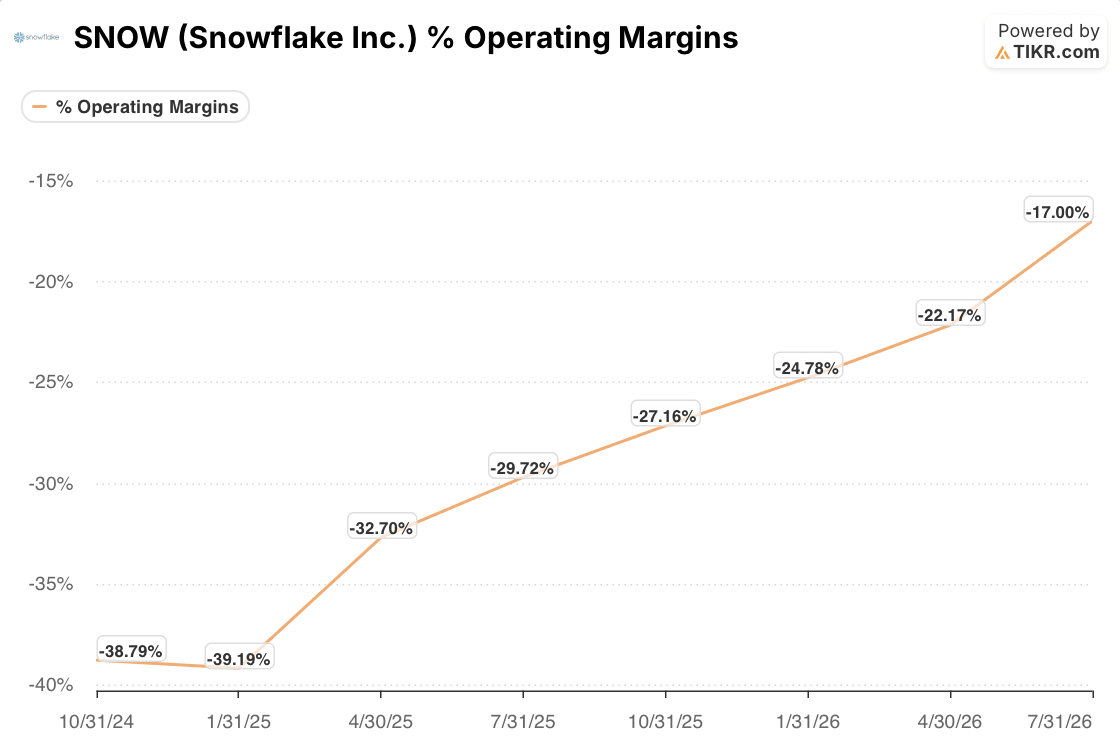
That claim holds up against Snowflake’s own trend line. GAAP operating margin has widened toward breakeven for six consecutive quarters, from -29.72% in the July 2025 quarter to -17.00% in the July 2026 quarter just reported, a nearly 13-point improvement in a single year. Closing the remaining 17-point gap to breakeven inside roughly five to six more quarters, which is close to the window Robins described, is not an aggressive extrapolation of the pace already on the board.
Where Snowflake’s Cash Flow Doesn’t Agree Yet With Its Margin Trend
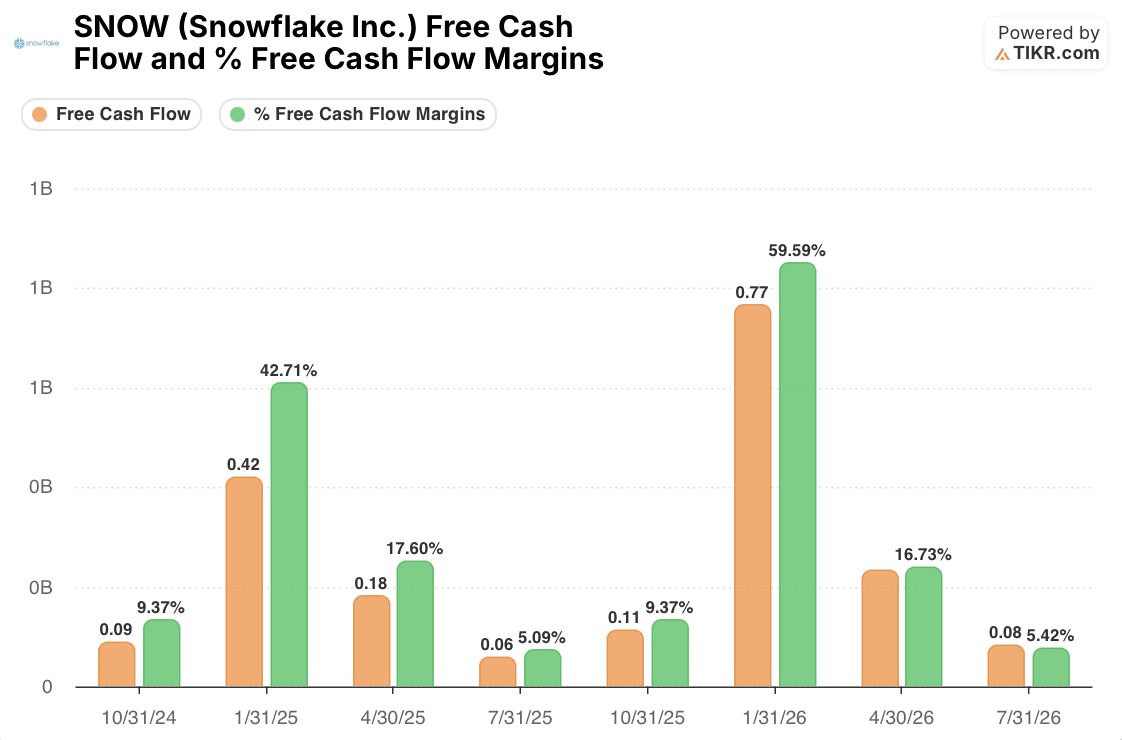
The margin trend doesn’t show up the same way in cash. Snowflake’s free cash flow margin is sharply seasonal, spiking in the fiscal fourth quarter, which ends in January and concentrates annual billings and renewals, then fading through the year: 59.59% in the January 2026 quarter, down to 16.73% in April, down to 5.42% in the July 2026 quarter just reported. Because of that seasonality, the fairer test is year over year within the same quarter, and there the picture is far less encouraging. FCF margin was 5.09% in July 2025 and 5.42% in July 2026, a gain of just 0.33 points, against the nearly 13-point jump in GAAP operating margin over the same stretch.
That gap is worth sitting with because GAAP operating margin already reflects stock-based compensation expense, so the divergence isn’t simply an accounting add-back effect. Something in how cash actually moves through the business isn’t keeping pace with what the income statement now shows.
Why Snowflake Stock Is Betting on Shorter Contracts
Robins offered a clue in the same appearance, while discussing procurement rather than product. He said Snowflake now defaults to one-year vendor contracts instead of three-year commitments, because “things are changing so rapidly” that locking in longer terms feels risky. He framed that as Snowflake’s own stance toward the software it buys, but the same logic plausibly shapes what Snowflake sells: in a market being reshaped quarter to quarter by new AI models, both Snowflake and its customers likely have less appetite for multi-year commitments than they did two years ago.
That distinction matters for cash, not just revenue. SaaS companies typically collect cash upfront on multi-year deals and recognize the associated revenue ratably over the contract’s life, which is why free cash flow can outrun revenue in strong years. A shift toward shorter, more frequently renewed contracts works the other way: less cash collected in advance, even when the underlying revenue eventually gets recognized just the same. Robins also noted that Snowflake keeps its platform deliberately open, using Iceberg tables that let customers move data in and out freely, which raises the stakes on product stickiness but does nothing to change how billing timing works.
The Number That Actually Tests Snowflake’s Profitability Case
None of this makes Snowflake’s growth less real. Net revenue retention of 126%, remaining performance obligations up 30% to $9 billion, and 828 customers now spending more than $1 million a year all point to genuine, broadening demand.
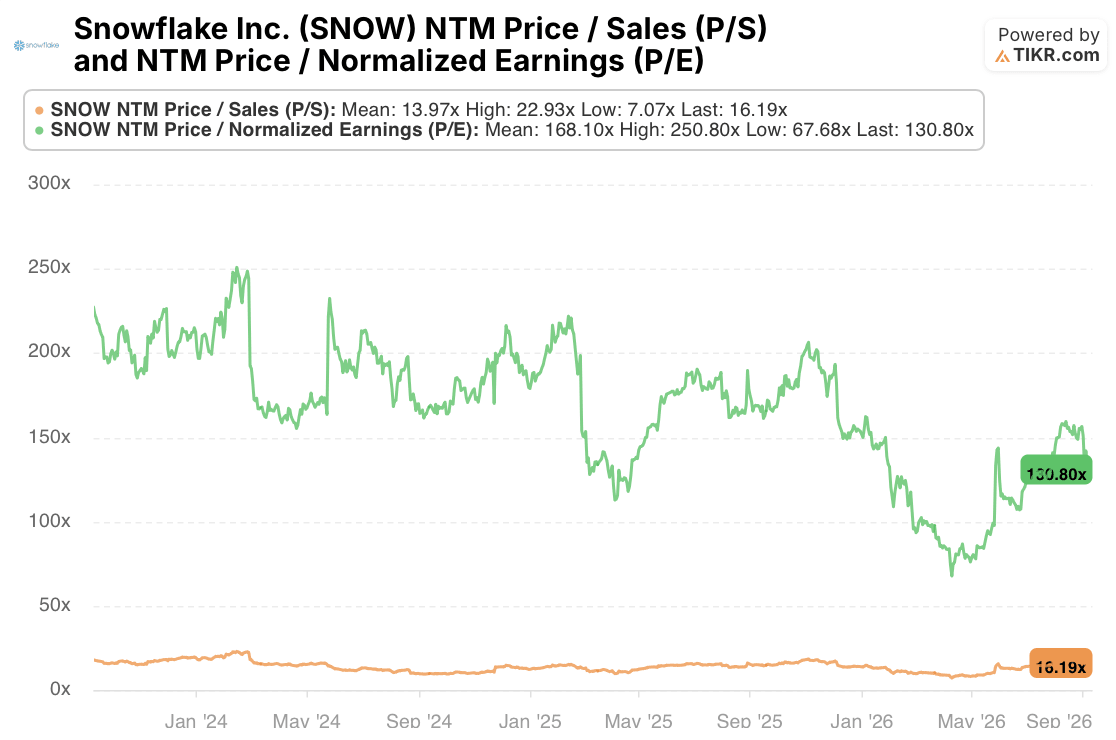
Nor is the stock priced as if the leverage case were already proven beyond doubt: at 130.8x forward earnings, SNOW trades below its own three-year average multiple of 168.1x, even after the post-earnings rally. Its forward price-to-sales multiple, 16.19x against a three-year mean of 13.97x, sits only modestly above its historical norm. This isn’t a stock priced for flawless execution. It’s priced somewhere in the middle of its own recent range.
A director and an EVP together sold roughly $27 million of stock in the days immediately around and after the print. That’s worth noting but proves little on its own; routine diversification after a rally of this size is common and doesn’t distinguish an insider who doubts the thesis from one who simply wanted liquidity.
The more useful thing for shareholders to watch is narrower: whether free cash flow margin reaccelerates toward the pace of GAAP operating margin over the next one to two quarters, or stays flat the way it did this July. Robins’ own framework, more AI-adopting personas, faster migrations, and now shorter contracts, gives a plausible reason cash could keep lagging paper profitability for a while yet. If FCF margin doesn’t start closing that gap soon, the fiscal 2028 GAAP profitability target will say less about Snowflake’s cash economics than the guidance implies.
Should You Invest in Snowflake Inc.?
The only way to really know is to look at the numbers yourself. TIKR gives you free access to the same institutional-quality financial data that professional analysts use to answer exactly that question.
Pull up Snowflake Inc. stock and you’ll see years of historical financials, what Wall Street analysts expect for revenue and earnings in the quarters ahead, how valuation multiples have moved over time, and whether price targets are trending up or down.
You can build a free watchlist to track Snowflake Inc. alongside every other stock on your radar. No credit card required. Just the data you need to decide for yourself.
Access Professional Tools to Analyze SNOW stock on TIKR for Free →
Looking for New Opportunities?
- See what stocks billionaire investors are buying so you can follow the smart money.
- Analyze stocks in as little as 5 minutes with TIKR’s all-in-one, easy-to-use platform.
- The more rocks you overturn… the more opportunities you’ll uncover. Search 100K+ global stocks, global top investor holdings, and more with TIKR.
Disclaimer:
Please note that the articles on TIKR are not intended to serve as investment or financial advice from TIKR or our content team, nor are they recommendations to buy or sell any stocks. We create our content based on TIKR Terminal’s investment data and analysts’ estimates. Our analysis might not include recent company news or important updates. TIKR has no position in any stocks mentioned. Thank you for reading, and happy investing!