
Key Stats for Snap Stock
- Current Price: $5.68
- Target Price (Mid): ~$8.90
- Street Target: ~$7.40
- Potential Total Return: ~56%
- Annualized IRR: ~11% / year
Now Live: Discover how much upside your favorite stocks could have using TIKR’s new Valuation Model (It’s free) >>>
What Happened?
Snap Inc. (SNAP) puts its $2,195 augmented reality glasses on stage in Los Angeles on September 16, the commercial launch of a product more than a decade in the making. The event, streaming at 4:00 p.m. Pacific, is what SNAP holders have been searching for all week. Yet the number that decides whether this bet works is not the price tag on the glasses. It is the $250 million of adjusted EBITDA the advertising core threw off last quarter.
Snap spent 2026 proving its cash engine finally runs, then chose the same year to fund its most expensive swing yet. The market has to decide whether one pays for the other, or whether Specs quietly drains a recovery that has only just taken hold.
A Core That Went From Burning Cash to Printing It
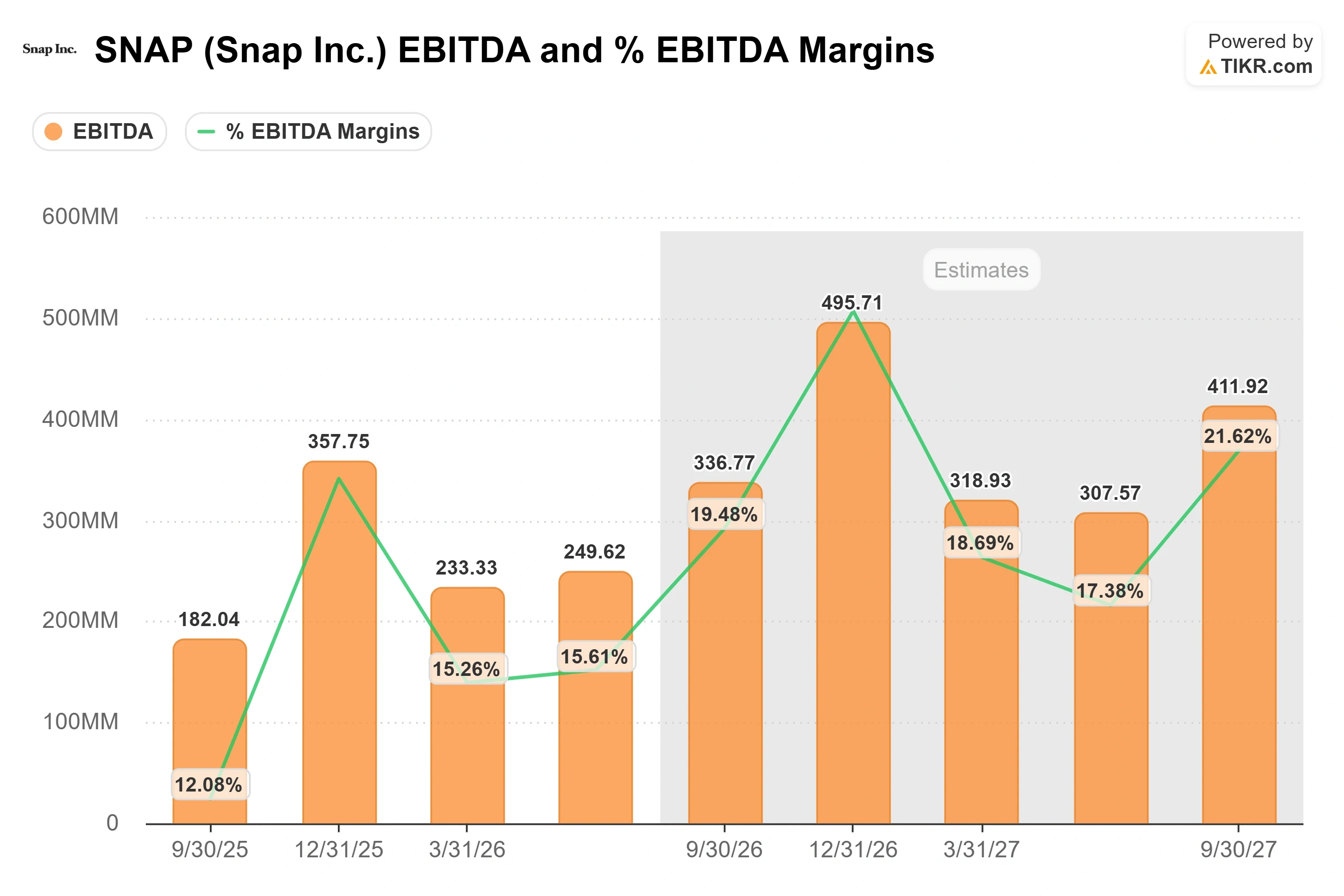
The turn showed up in the Q2 numbers Snap reported after the close on August 3. Revenue rose 19% year over year to $1.6 billion, beating the Street by 4.33%, while adjusted EBITDA jumped to $249.6 million from just $41.3 million a year earlier, per TIKR. Shares surged 14.88% the next session, and the proof ran deeper than the headline. Spiegel said conversions across the platform climbed 56% year over year, cost per install fell 8%, cost per purchase fell 18%, and app purchase volume rose 128%. The ad engine is not just cheaper to run. It works better for the advertisers paying into it.
Total adjusted costs grew only 4% year over year while revenue grew 19%, the flow-through from an April restructuring that cut roughly 1,000 roles. CFO Doug Hott put it plainly: “we grew revenue 19% year-over-year, and we only grew costs 4%.” He framed the savings as still building, with the full personnel benefit landing in Q3 and beyond.
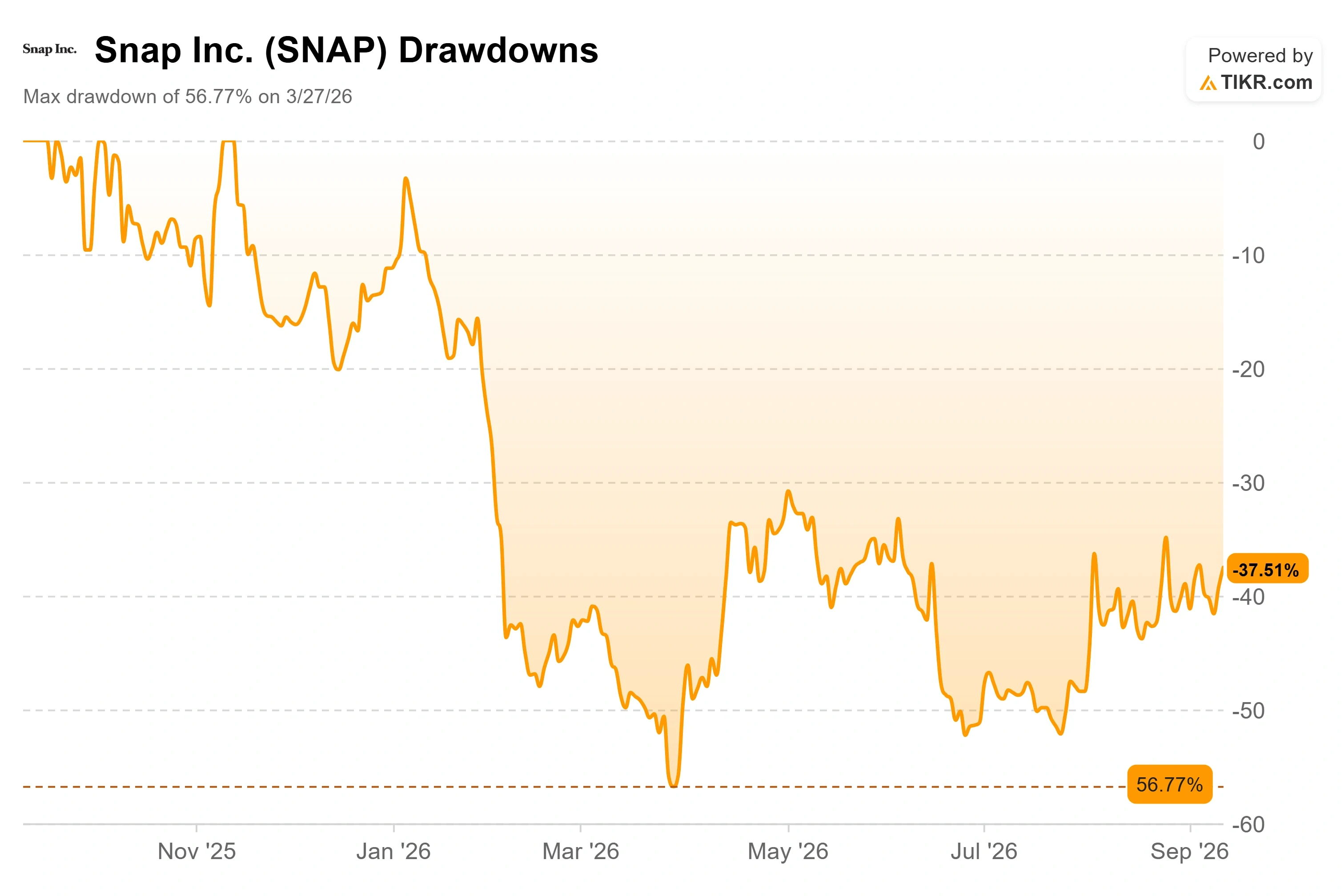
Snap generated $121 million of free cash flow in the quarter and $706 million over the trailing twelve months, its eighth straight positive quarter. With a market capitalization of nearly $9.6 billion, the core is a story about how the cash gets spent.
See historical and forward estimates for Snap stock (It’s free!) >>>
The $2,195 Question Management Keeps Deferring
The launch answers what the glasses can do. It does not answer whether anyone buys them. Specs run two Qualcomm processors in a standalone frame, weigh around 135 grams, and lean on AI assistance from Snap’s partners at OpenAI and Google. Shipping is still listed only as “this fall” in the US, UK, and France, and journalist Alex Heath has reported an initial run of roughly 100,000 units, a reported estimate rather than a Snap disclosure.
On the Q2 call, Spiegel sidestepped a direct question about preorder volume, saying only that people “want to try Specs” and that the $2,195 price makes it “a high consideration purchase.” He was blunter about the timeline than the launch hype suggests, saying mass adoption “will be towards the end of the decade” as weight and cost come down. That candor matters: it tells investors this is a multiyear cash commitment, not a 2026 revenue driver. Snap folds the Specs spend inside its existing operating expense outlook, which is why the core’s cash generation, not the glasses’ sell-through, is what protects the story.
On September 8, Snap named Ronan Harris, who ran its EMEA business through ten straight quarters of double-digit growth, as Chief Commercial Officer over global ad sales. The message: the ad engine that funds Specs stays the priority even as the hardware takes the stage.
Cheap Against Peers, and the Market Names Why
Snap trades at 1.60x next-twelve-month enterprise value to revenue and 7.84x NTM EV/EBITDA, per TIKR. Pinterest, the closest social comparison, sits higher at 2.13x revenue but a similar 7.21x EBITDA, while Reddit commands 7.35x revenue and 16.15x EBITDA. Snap is the cheapest of the group on sales, and the reason is not a mystery. Several youth-safety trials are scheduled in the United States later this year, with two teen addiction cases against Snap, Meta, and Alphabet still heading toward October trials after one New Jersey case was dropped. Hott flagged the risk directly, warning that outcomes “may result in significant changes to our products and business practices.” A discount to peers is how the market holds that risk. Whether it is too steep depends on the cash the core keeps producing.
See how Snap performs against its peers in TIKR (It’s free!) >>>
TIKR Advanced Model Analysis
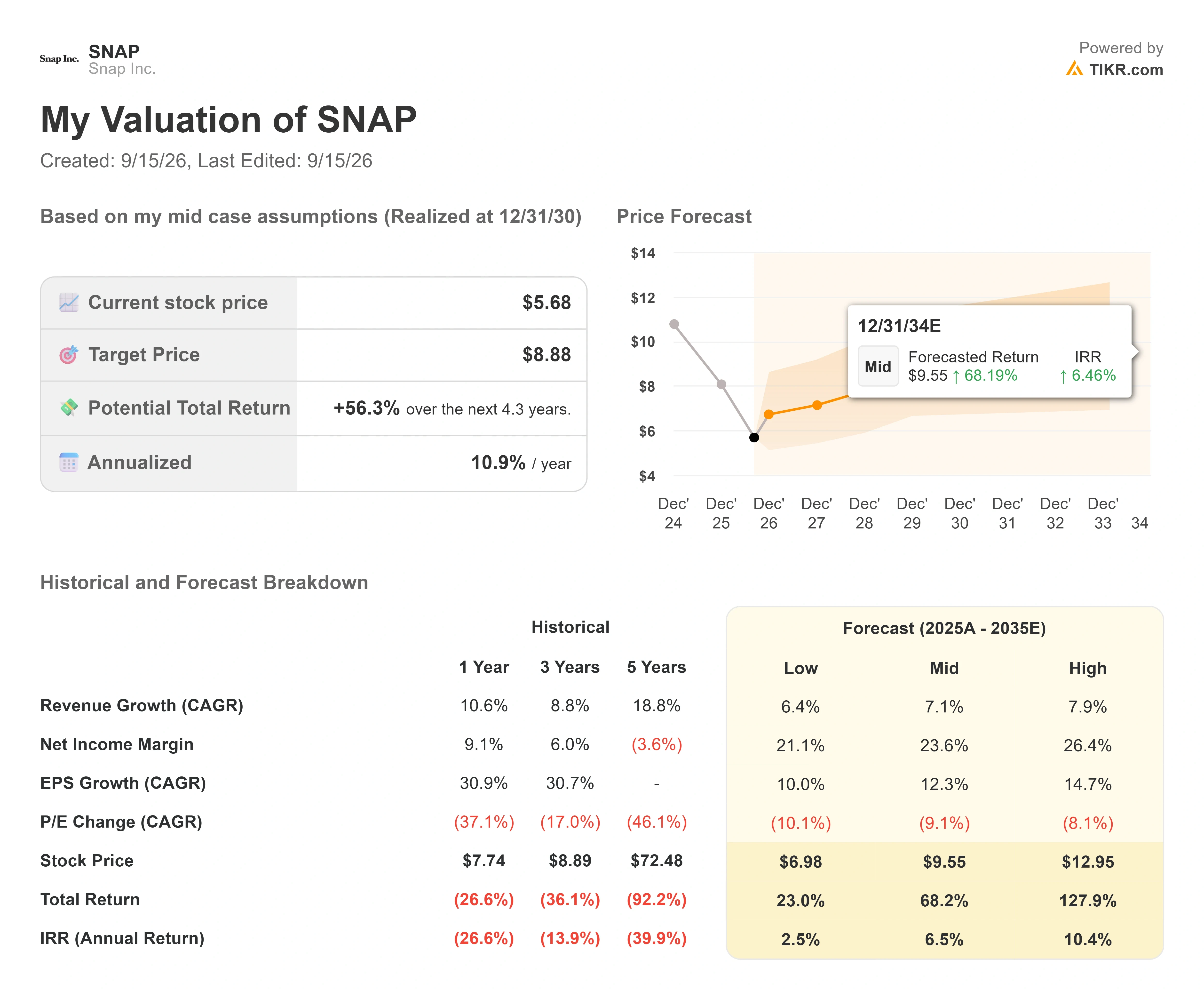
- Current Price: $5.68
- Target Price (Mid): ~$8.90
- Potential Total Return: ~56%
- Annualized IRR: ~11% / year
See analysts’ growth forecasts and price targets for Snap stock (It’s free!) >>>
Using the mid case, TIKR’s model targets around $8.90, implying roughly 56% total return and an 11% annualized IRR realized at the end of 2030. Two drivers carry the revenue line: continued advertising strength with large North American advertisers, and the 85% growth in other revenue from Snapchat+, Memory Storage, and Lens+, where fewer than 3% of monthly users pay today. Margin expansion carries the rest, with net income margin modeled near 24% as the restructured cost base holds.
The upside is a core that compounds free cash flow, while subscriptions and Specs add optionality the market has not paid for. The downside is a legal outcome that forces product changes, or a Specs spend that outruns the cash the ads generate. The Street sits cautious against that mid case: 8 Buys, 3 Outperforms, 29 Holds, 2 Underperforms, and 1 Sell, with a mean target near $7.40. That gap between the model and the Street is the disagreement worth watching.
Conclusion
The launch is theater. The verdict comes on October 15, when Snap reports Q3 against its own guidance of $1.70 billion to $1.74 billion in revenue and $300 million to $350 million in adjusted EBITDA. Hit the high end of that EBITDA range, and the cash thesis holds, giving management room to fund Specs without touching the recovery. Miss it, or signal Specs spend creeping outside the existing opex envelope, and the discount to peers stops looking like an opportunity.
See what stocks billionaire investors are buying so you can follow the smart money with TIKR.
Should You Invest in Snap?
The only way to really know is to look at the numbers yourself. TIKR gives you free access to the same institutional-quality financial data that professional analysts use to answer exactly that question.
Pull up Snap, and you’ll see years of historical financials, what Wall Street analysts expect for revenue and earnings in the quarters ahead, how valuation multiples have moved over time, and whether price targets are trending up or down.
You can build a free watchlist to track Snap alongside every other stock on your radar. No credit card required. Just the data you need to decide for yourself.
Looking for New Opportunities?
- See what stocks billionaire investors are buying so you can follow the smart money.
- Analyze stocks in as little as 5 minutes with TIKR’s all-in-one, easy-to-use platform.
- The more rocks you overturn… the more opportunities you’ll uncover. Search 100K+ global stocks, global top investor holdings, and more with TIKR.
Disclaimer:
Please note that the articles on TIKR are not intended to serve as investment or financial advice from TIKR or our content team, nor are they recommendations to buy or sell any stocks. We create our content based on TIKR Terminal’s investment data and analysts’ estimates. Our analysis might not include recent company news or important updates. TIKR has no position in any stocks mentioned. Thank you for reading, and happy investing!