
Key Stats for Carvana Stock
- Current Price: $70.87
- Target Price (Mid): ~$123
- Street Target: ~$83
- Potential Total Return: ~78%
- Annualized IRR: ~14% / year
Now Live: Discover how much upside your favorite stocks could have using TIKR’s new Valuation Model (It’s free) >>>
What Happened?
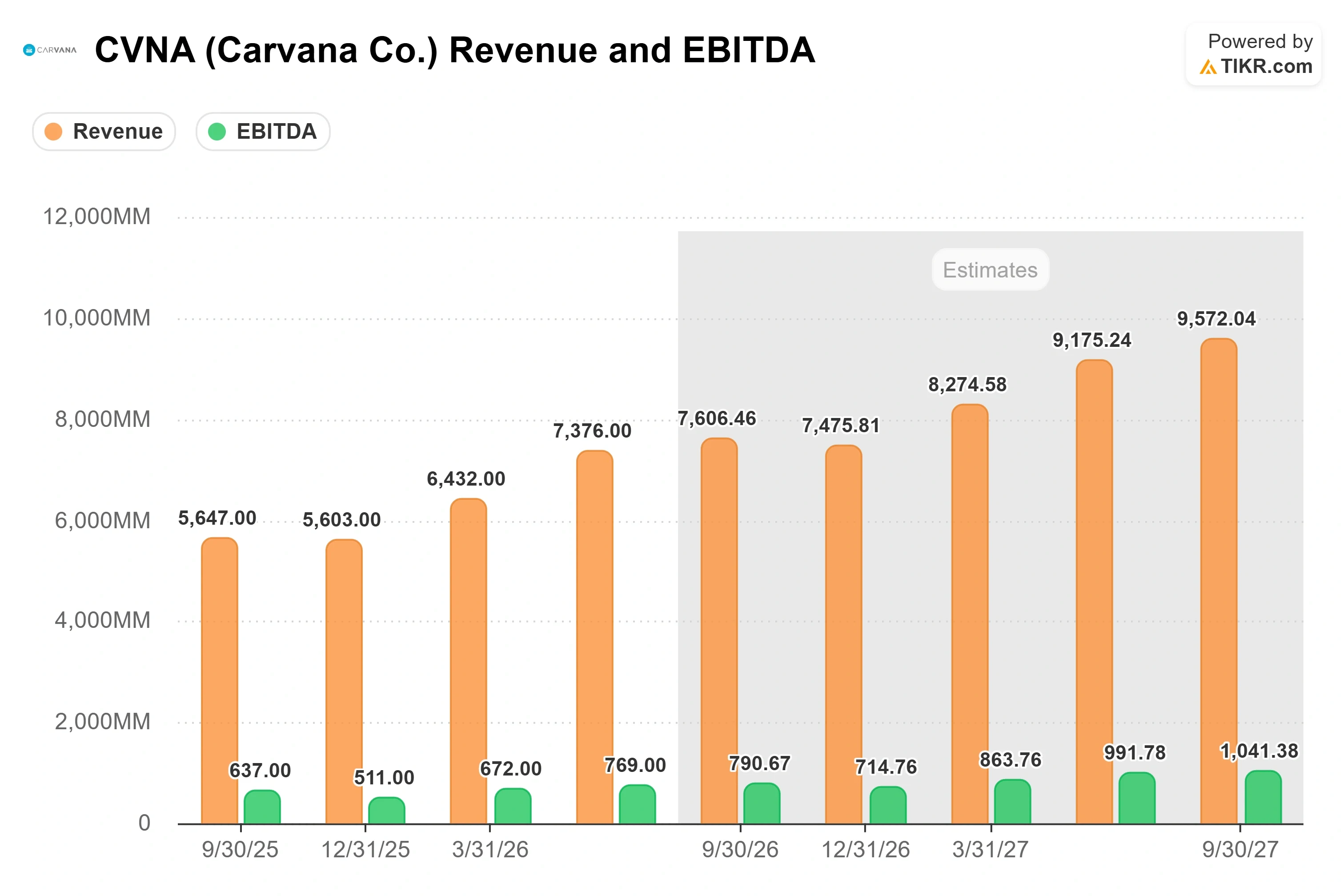
Carvana Co. (CVNA) posted record quarterly revenue and record adjusted EBITDA in the second quarter, and the stock still trades 27% below its 52-week high. Revenue hit $7.376 billion, adjusted EBITDA reached $769 million, and the online used-car retailer grew retail units 38% year over year while the broader used-vehicle industry contracted by low-to-mid single digits. Shares closed at $70.87 on September 14, well under their 52-week high of $97.38 and roughly 16% below where they started the year.
That gap between a business firing on every cylinder and a share price stuck in reverse is the whole reason to look here. The market is not disputing that Carvana is growing. It is asking whether full-year guidance implying softer second-half margins means the easy part of the turnaround is over, and whether a stock trading above the traditional dealer group still deserves that premium as growth decelerates from 40%-plus toward the mid-teens.
A Record Quarter the Market Treated Like a Warning
The Q2 print, reported July 29, was not a near-miss dressed up as a win. Revenue of $7.376 billion beat the Street’s $6.91 billion estimate by 6.8% and rose 52% year over year. Adjusted EBITDA of $769 million cleared consensus, and adjusted earnings reached $0.42 per share against a $0.37 estimate. GAAP net income was $310 million, and management pointed to net income above $500 million excluding one-time items, which it called record profitability. Free cash flow swung to a positive $187 million from a $2 million outflow a year earlier.
As TheStreet reported, management guided full-year adjusted EBITDA to a range whose midpoint lands at or below where the Street already sat, and Morgan Stanley, keeping its Overweight rating, trimmed its price target to $90 from $102 after the late-July print. The firm modeled roughly 35% top-line growth in the back half at an implied second-half EBITDA margin near 9.3%, about 110 basis points below the first half. Investors heard “record quarter” and “softer margins ahead” in the same breath, and they sold the second half.
CFO Mark Jenkins pushed back on that read at the J.P. Morgan Automotive Conference in August. His most telling point was regional: in the top two regions that make up roughly a third of the country, where Carvana grew reconditioning production the most, it also grew sales the most. “That growth rate was 55%, and that 55% was just really tightly correlated with how much were we able to increase production capacity year-over-year in the quarter,” Jenkins said.
See historical and forward estimates for Carvana stock (It’s free!) >>>
Why the Premium Holds If Execution Keeps Improving
The bear case that has dogged Carvana since late 2025 is specific: a reconditioning cost spike hit as the company absorbed 16 new facilities on a base of 18 in roughly 18 months, lifting costs and pushing throughput below target. Jenkins argued the worst is over. Labor hours per unit produced hit “some of our best ever levels in the second quarter,” he said, and year-over-year production growth has begun climbing off its early-2026 lows. If throughput keeps recovering, the guided second-half margin dip looks more like timing than a structural ceiling. The offsetting headwind is not operational: rising fuel prices cost roughly $75 per car in the quarter, and fast-rising benchmark rates pressured financing economics. Record Q2 EBITDA even with those drags argues they are cyclical rather than a new normal.
The balance sheet gave management a second-quarter win too. Carvana refinanced just under $1.7 billion of senior secured notes at nearly a three-point lower rate, cutting annual interest cost by about $45 million. “As we get bigger, we get better, and having a lower cost of capital is another example,” Jenkins said, and net income growth approaching 70% year over year showed leverage running well below the EBITDA line.
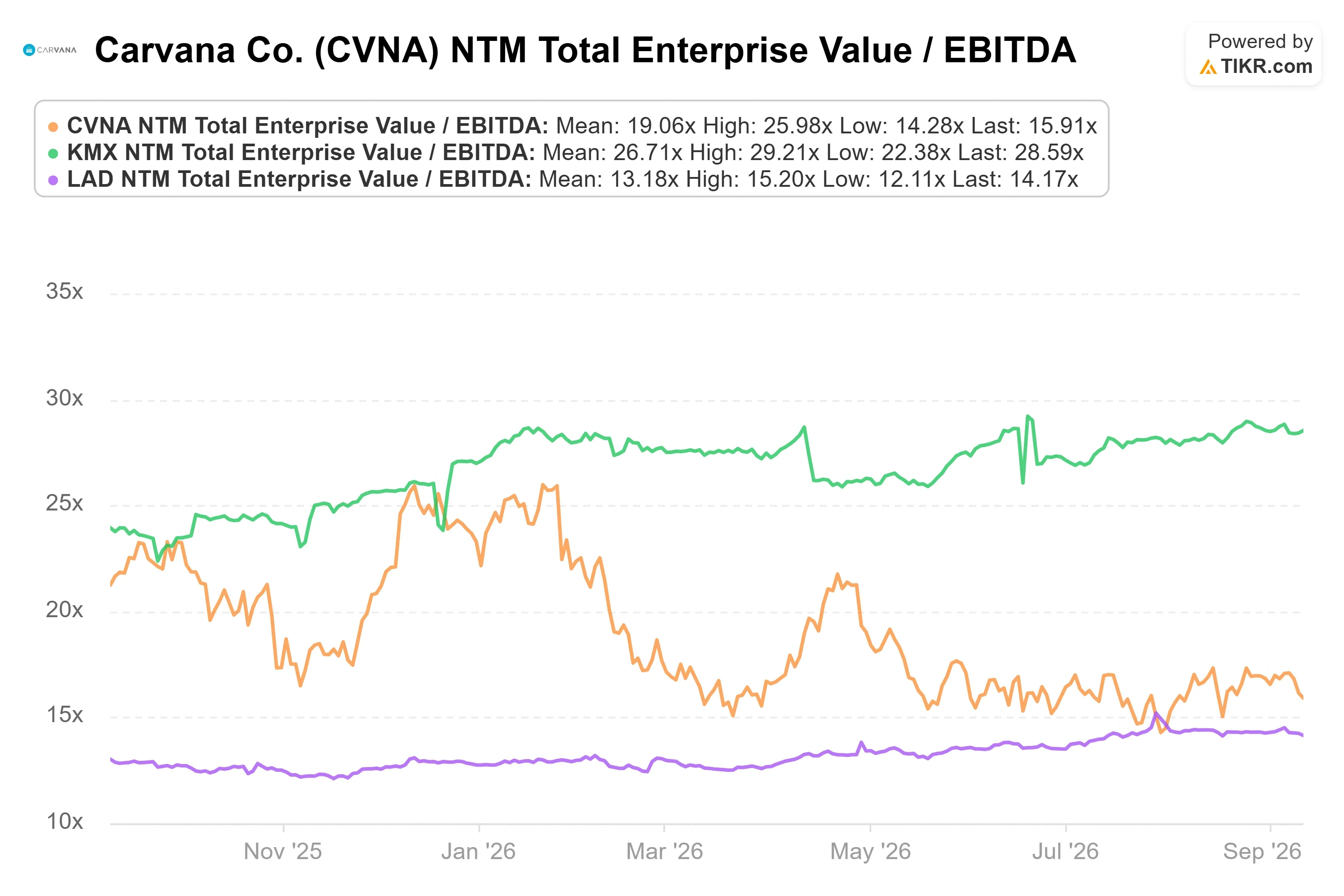
On next-twelve-months EV/EBITDA, Carvana trades near 16.3 times, above Lithia Motors near 14.2 times but below CarMax at roughly 28.6 times. The premium to the franchised dealers is real, and Carvana’s 38% unit growth into a shrinking industry, against dealers that grow in the low single digits when they grow at all, is the reason to test whether it is deserved rather than assume it is not. A grower compounding volume at that rate, on a fixed-cost base, management calls underutilized, is not obviously expensive at a mid-teens EBITDA multiple.
See how Carvana performs against its peers in TIKR (It’s free!) >>>
TIKR Advanced Model Analysis
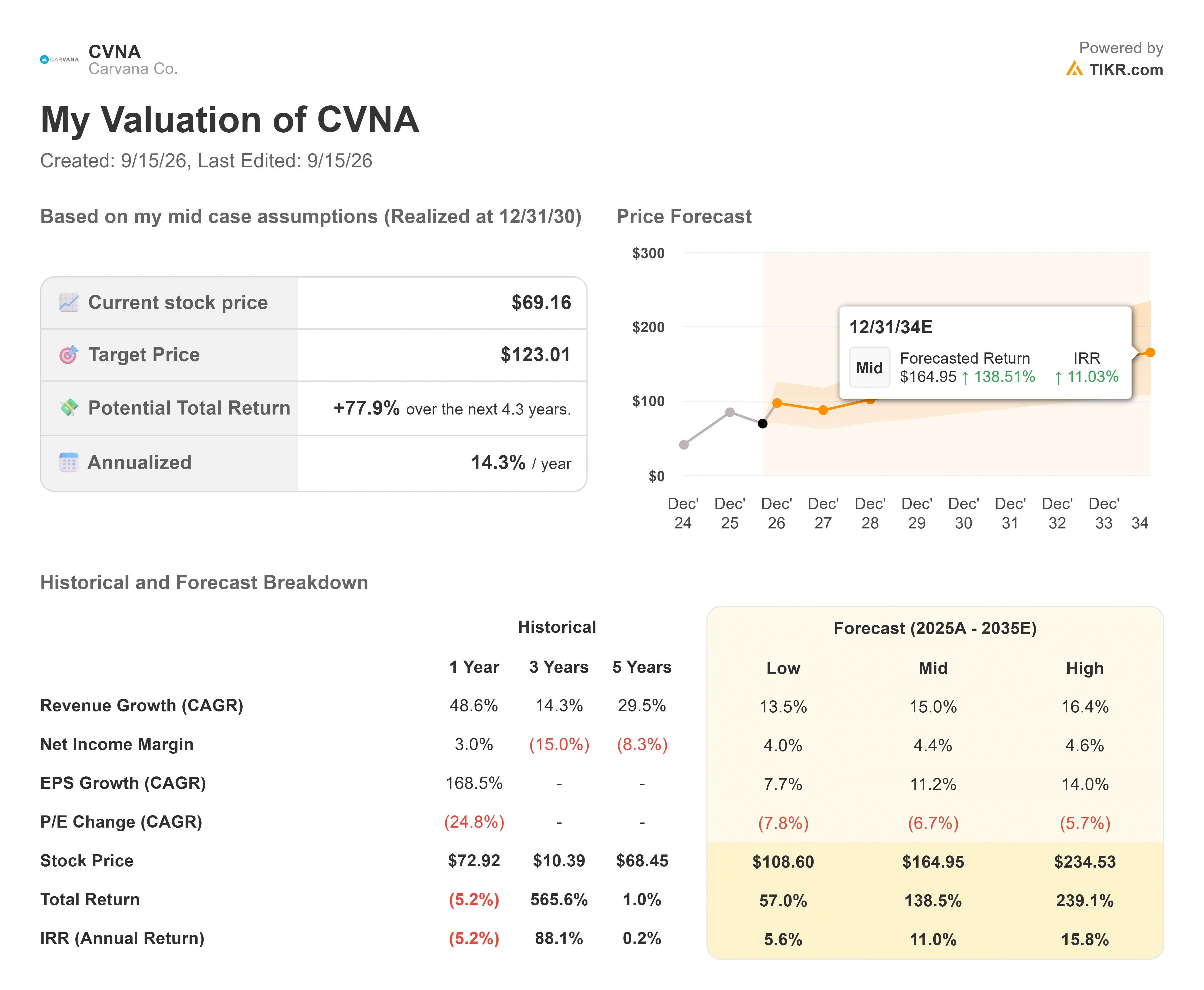
On mid-case assumptions, the TIKR Valuation Model produces the following, measured against a model entry price of $69.16:
- Target Price (Mid): ~$123
- Potential Total Return: ~78%
- Annualized IRR: ~14% / year
See analysts’ growth forecasts and price targets for Carvana stock (It’s free!) >>>
The model reaches that target while assuming the P/E compresses, so the return is carried by the business. Two revenue drivers do the work:
- Reconditioning capacity, the lever Jenkins tied to 55% regional growth, expanding through added production lines, integrated ADESA sites, and the first full ADESA build-out that broke ground in Q2.
- Online penetration, with total U.S. retail e-commerce near 17% of sales in Q2 2026, per the U.S. Census Bureau, while auto retail sits in the low single digits, leaving room to keep taking share.
On margins, the driver is operating leverage across an underutilized fixed-cost base in technology, corporate, and facilities. The primary risk is that the guided second-half margin dip proves structural, driven by financing-margin pressure and reconditioning mix rather than a passing fuel-and-rate squeeze.
- Upside: throughput keeps recovering and Carvana compounds units in the high teens to twenties while leveraging fixed costs, pushing past the mid-case target.
- Downside: macro rate pressure and slower unit growth cap the stock near the Street’s ~$83 mean, a level shares have struggled to hold in 2026.
Conclusion
The next real test is the Q3 2026 report in late October. Watch the adjusted EBITDA margin: management guided the second half toward roughly 9.3% at the midpoint, so a print holding near or above that with units still growing 30%-plus would confirm the fuel-and-rate drag is cyclical, and the reconditioning recovery is real. A margin that slips further while unit growth cools would tell you the softer guidance bears read the business correctly, and the premium multiple gets hard to defend. Two months from now, the number does the arguing.
See what stocks billionaire investors are buying so you can follow the smart money with TIKR.
Should You Invest in Carvana?
The only way to really know is to look at the numbers yourself. TIKR gives you free access to the same institutional-quality financial data that professional analysts use to answer exactly that question.
Pull up Carvana, and you’ll see years of historical financials, what Wall Street analysts expect for revenue and earnings in the quarters ahead, how valuation multiples have moved over time, and whether price targets are trending up or down.
You can build a free watchlist to track Carvana alongside every other stock on your radar. No credit card required. Just the data you need to decide for yourself.
Analyze Carvana on TIKR Free →
Looking for New Opportunities?
- See what stocks billionaire investors are buying so you can follow the smart money.
- Analyze stocks in as little as 5 minutes with TIKR’s all-in-one, easy-to-use platform.
- The more rocks you overturn… the more opportunities you’ll uncover. Search 100K+ global stocks, global top investor holdings, and more with TIKR.
Disclaimer:
Please note that the articles on TIKR are not intended to serve as investment or financial advice from TIKR or our content team, nor are they recommendations to buy or sell any stocks. We create our content based on TIKR Terminal’s investment data and analysts’ estimates. Our analysis might not include recent company news or important updates. TIKR has no position in any stocks mentioned. Thank you for reading, and happy investing!