Key Stats for RTX Stock
- Current Price: $195.50
- Target Price (Mid): ~$247
- Street Target: ~$235
- Potential Total Return: ~27%
- Annualized IRR: ~6% / year
Now Live: Discover how much upside your favorite stocks could have using TIKR’s new Valuation Model (It’s free) >>>
What Happened?
RTX Corporation (RTX) closed at $195.50 on September 15, 2026, and the number that matters most is not the price but how little the recent good news has done to move it. In early August, the aerospace and defense giant behind Pratt & Whitney engines, Collins Aerospace systems, and Raytheon missiles traded near $223, about a percent below its 52-week high, and the case against buying was that everything had already gone right. Since then, the case has only gotten stronger, and the stock is about $28 lower.
The backlog has climbed to a record $289 billion. A $22.9 billion Tomahawk award landed in August. On September 15, the F135 engine upgrade cleared a major design gate. None of it sparked a rally, and the market’s patience is what creates the question the numbers can now answer: with the fundamentals stronger than they were at $223, is a 12% cheaper stock the opportunity, or is the market pricing something the headlines are not?
The Backlog Grew While the Price Shrank
At Morgan Stanley’s Laguna Conference on September 15, CEO Chris Calio put the backlog at $289 billion, up 22% year-over-year, and stressed what it excludes. “Our $289 billion backlog that I cited a couple of times here this morning does not include the 5 framework agreements. It does not include the recently executed $23 billion [UCA] on Tomahawk,” he told the audience. The framework agreements, covering Tomahawk, AMRAAM, and the Standard Missile family, are set to lift volumes on those programs by two to four times as they convert into firm orders.
The August contract shows that conversion is happening in real time. The U.S. Navy awarded Raytheon a seven-year, $22.9 billion Tomahawk contract on August 17, supporting an annual production ramp above 1,000 missiles. RTX had already tripled Tomahawk deliveries in the first half of 2026 versus a year earlier, so the award funds a ramp already underway rather than a promise. Calio’s framing of the demand was blunt: “The story from our customers, whether it be commercial or defense, is we need more and we need it faster.”
See historical and forward estimates for RTX stock (It’s free!) >>>
Where the Growth Comes From Next
About 48% of Raytheon’s backlog is now international, up four points in a year, and Calio walked through an installed base that locks in follow-on orders: nine European countries fly Patriot, seven use NASAMS, and 20 use RTX effectors, with a comparable footprint across the Middle East. That base matters because sovereignty concerns have raised doubts about whether allies will keep buying U.S. systems. Calio’s answer was that co-production, not retreat, is the path, pointing to deals with Kongsberg and Polish suppliers that deepen the ties rather than loosen them.
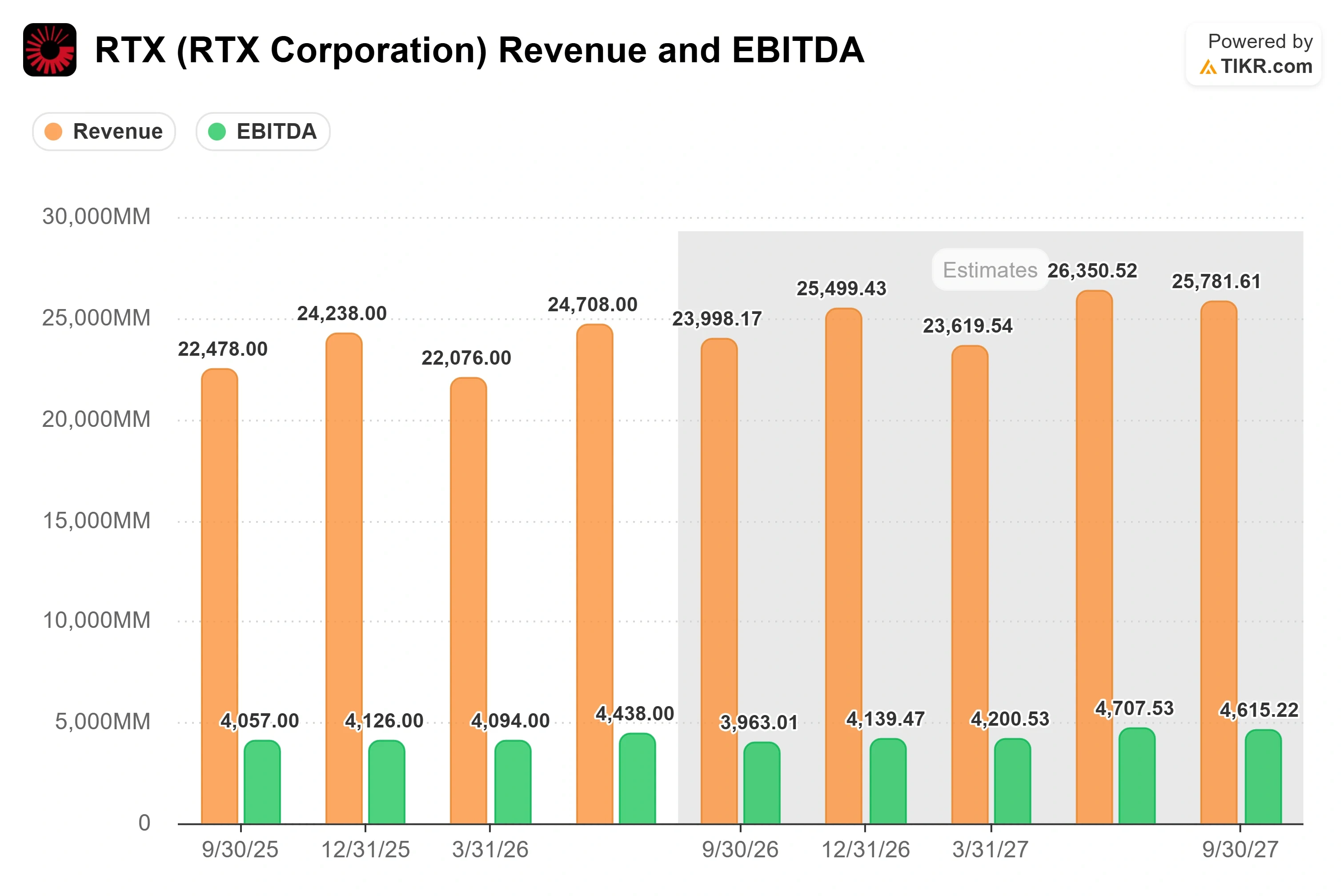
In Q2 2026, reported July 23, RTX posted revenue of $24,708 million, up 14.5% year-over-year, and adjusted EPS of $1.89, beating the Street’s $1.66 estimate by 13.7%. Free cash flow came in at $2,878 million against a $1,508 million estimate, and management guides full-year 2026 free cash flow to a range of $8.25 to $8.75 billion, up from roughly $7.9 billion in 2025 as the Pratt & Whitney powder-metal costs roll off. Collins, meanwhile, sees a path to 19% to 20% segment margins over the medium term, driven by aftermarket strength and structural cost cuts. The September 15 F135 Engine Core Upgrade milestone moved the stock 0.08%, and that non-reaction is the tell: the market has stopped paying up for individual wins on a name whose demand case is already understood.
What the Valuation Is Actually Asking
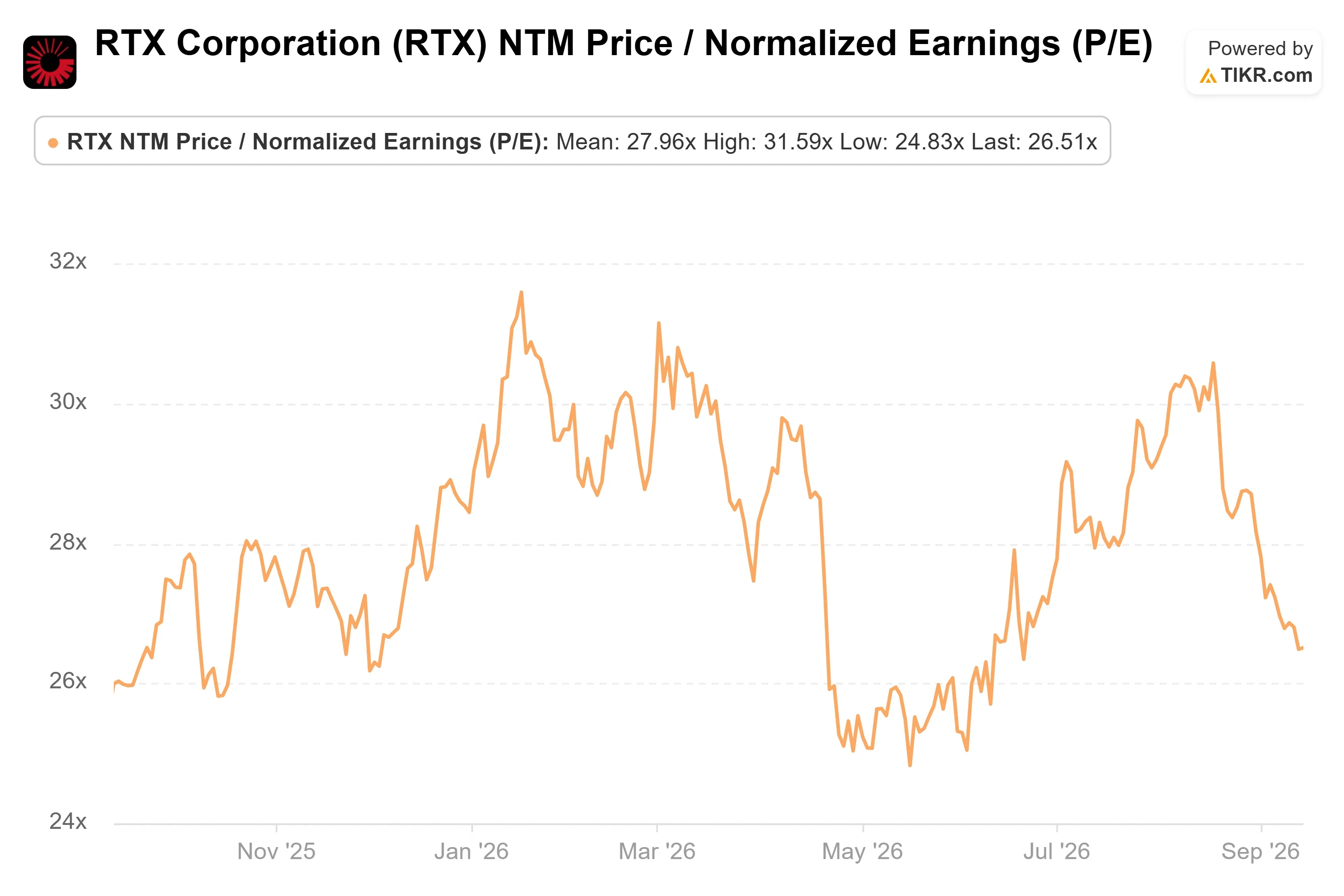
RTX trades at 26.5 times next-twelve-month earnings and 17.4 times NTM EV/EBITDA. Against European engine peer Safran, at 27.5 times forward earnings and 15.6 times EBITDA, RTX looks fairly matched. Against Airbus at 24.4 times and L3Harris at 19.7 times forward earnings, it looks full. The multiple is not cheap on any absolute reading, and it sits above where several defense peers change hands. The premium is the price of RTX’s diversification and its aftermarket tail; a buyer here is paying for quality.
RTX is a mature compounder, not a breakout, and at this multiple, the growth has to show up. The framework agreements still have to convert from signed intent into billed revenue on schedule, and management noted at Laguna that IEPA refunds are only starting to flow through in the third and fourth quarters, an outlook item still in motion rather than settled. The $22.9 billion Tomahawk award is a definitive contract, which is why it matters more than the frameworks that are not yet in backlog. Converting a $289 billion book into revenue at expanding margins is the entire job, and the industry’s constraint has been supply.
See how RTX performs against its peers in TIKR (It’s free!) >>>
TIKR Advanced Model Analysis
- Current Price: $195.50
- Target Price (Mid): ~$247
- Potential Total Return: ~27%
- Annualized IRR: ~6% / year

See analysts’ growth forecasts and price targets for RTX stock (It’s free!) >>>
The TIKR mid-case model values RTX at about $247, roughly 27% above the current price, realized over the next 4.3 years to the end of 2030, for an annualized return near 6%. This is the mid case, chosen because it maps closely to the Street mean target of about $235 rather than to an aggressive scenario.
- Revenue drivers: the defense ramp (munitions replenishment and international air-and-missile-defense demand) and the commercial aftermarket (GTF shop visits and Collins’s out-of-warranty content compounding as the fleet ages).
- Margin driver: the Collins path toward 19% to 20% segment margins plus the fading powder-metal drag, supporting a net income margin around 11%.
- Primary risk: the multiple itself. The model assumes P/E compression of about 2.5% a year, so a faster de-rating of defense names erodes the return quickly.
- Upside: the high case reaches roughly $382, about 95% higher over the period, or near 8% annualized, if margins and volumes both run ahead of plan.
- Downside: the low case assumes sharper P/E compression of about 3.7% a year, which cuts the annualized return to roughly 3% and leaves little margin for error if the ramp slips.
Conclusion
The next real test is the Q3 print in late October, with consensus near $1.77 in adjusted EPS. Watch two things above the headline number: whether full-year free cash flow guidance moves up within or past the $8.25 to $8.75 billion range, and whether any of the five framework agreements convert into backlog the way the Tomahawk award did. A cash-flow raise plus a second definitive munitions contract would tell you the ramp is real and on schedule. A quarter that beats on EPS but leaves cash-flow guidance flat would suggest the conversion is slower than the demand implies.
See what stocks billionaire investors are buying so you can follow the smart money with TIKR.
Should You Invest in RTX?
The only way to really know is to look at the numbers yourself. TIKR gives you free access to the same institutional-quality financial data that professional analysts use to answer exactly that question.
Pull up RTX, and you’ll see years of historical financials, what Wall Street analysts expect for revenue and earnings in the quarters ahead, how valuation multiples have moved over time, and whether price targets are trending up or down.
You can build a free watchlist to track RTX alongside every other stock on your radar. No credit card required. Just the data you need to decide for yourself.
Looking for New Opportunities?
- See what stocks billionaire investors are buying so you can follow the smart money.
- Analyze stocks in as little as 5 minutes with TIKR’s all-in-one, easy-to-use platform.
- The more rocks you overturn… the more opportunities you’ll uncover. Search 100K+ global stocks, global top investor holdings, and more with TIKR.
Disclaimer:
Please note that the articles on TIKR are not intended to serve as investment or financial advice from TIKR or our content team, nor are they recommendations to buy or sell any stocks. We create our content based on TIKR Terminal’s investment data and analysts’ estimates. Our analysis might not include recent company news or important updates. TIKR has no position in any stocks mentioned. Thank you for reading, and happy investing!