

Key Takeaways
- Rivian delivered a record 19,248 vehicles in the third quarter, up 46% and ahead of estimates.
- Automotive gross profit was still negative $36 million in the second quarter, while software and services carried margins.
- Rivian no longer expects positive adjusted EBITDA in 2027 as autonomy spending rises.
- The October 29 report will show whether automotive gross profit is moving toward positive.
Rivian Automotive (RIVN) finally has the volume story it promised. The stock has not followed.
Rivian delivered a record 19,248 vehicles in the third quarter, up 46% from a year earlier and ahead of the roughly 18,000 analysts expected. Shares still closed at $12 on October 27, down 28.3% over three months and just above the 52-week low of $11.
The market’s logic is simple. Volume only helps if each R2 eventually makes money, and Rivian has made 2027 profitability harder to see.
Thursday’s third-quarter report is where those two threads meet.
The R2 ramp shows up
The third quarter was the first full quarter of R2 deliveries, which began in June. The jump was immediate.
- Deliveries rose 58% from the second quarter’s 12,194.
- Production reached 19,751 at the Normal, Illinois plant.
- Full-year guidance of 65,000 to 70,000 deliveries held.
Hitting the low end requires at least 23,193 fourth-quarter deliveries, a 20.5% sequential increase. Rivian built about 500 more vehicles than it delivered, which gives it a small cushion.
Scale still looks tiny next to Tesla (TSLA), which delivered 486,532 vehicles in the same quarter.
Analysts model third-quarter revenue near $2 billion, up about 30%:

Software is carrying the margin
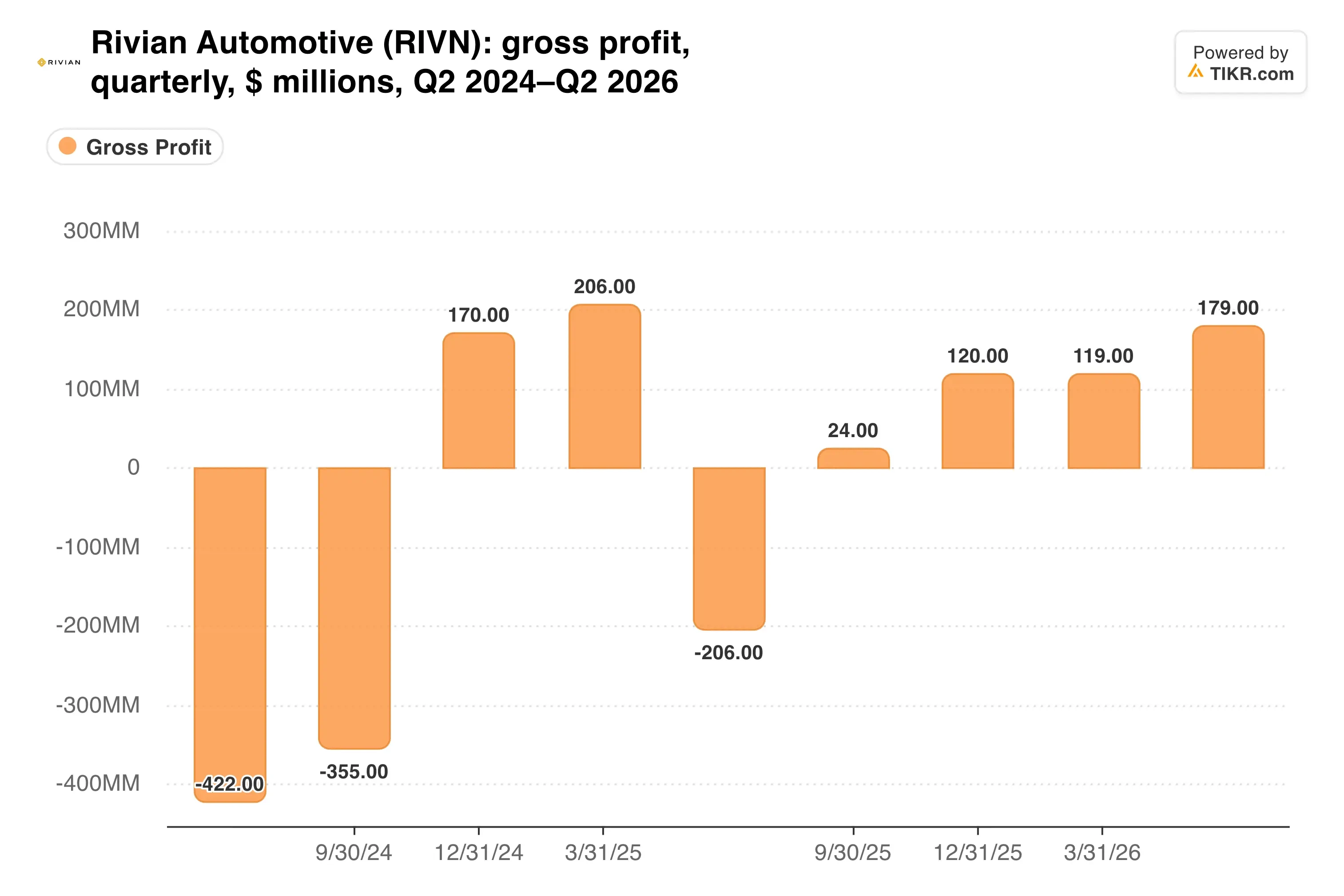
Second-quarter revenue rose 27% to $1.66 billion. Consolidated gross profit reached $179 million, a $385 million improvement from a year earlier.
Look closer, though. Automotive gross profit was still negative $36 million, while software and services revenue rose 37% to $515 million, largely through the Volkswagen Group (VOW3) joint venture.
Line up the quarters and the swing is hard to miss.
CFO Claire McDonough, who departs at the end of October, told Reuters in April that the R2 should cost less than half as much as the R1 to build once output reaches a higher run rate in 2027. She also expected Rivian to exit 2026 with positive automotive gross margins. That target matters more than any delivery number this year.
TIKR tracks 25 analysts on Rivian. How many say “Buy”?
See the full breakdown of Buy, Hold, and Sell ratings on Rivian, along with Wall Street’s revenue and earnings estimates, all in one place. More than 500,000 investors use TIKR to research stocks like this one. See Rivian’s Analyst Ratings
Cash burn sets the clock
Rivian has bought time. Volkswagen funded a $1 billion, 10-year loan at a 6.03% fixed rate, secured only by Rivian’s half of the joint venture, with no payments due until October 2028.
Volkswagen has now put about $5.3 billion of its $5.8 billion commitment into Rivian. Rivian also raised $1.2 billion by selling shares at roughly $16 in July, about 31% above where the stock trades now.
Where does all that money go?

Spending is heading higher. Rivian no longer expects positive adjusted EBITDA in 2027, citing heavier autonomy investment, and it bought Third Dimension AI on October 22 to speed up simulation work.
Add a recall of about 100,700 vehicles over a rearview camera issue and an interim CFO, Derek Mulvey, and the risk list is long. At 1.76x forward revenue, the stock already prices much of that in.
My take: the R2 is working as a product, and Volkswagen’s money removes any near-term funding panic. I’d stay patient until automotive gross profit turns positive, because volume without unit profit only speeds up the burn.
On October 29, the number that matters is automotive gross profit. A positive figure, or something close, would make the 2026 exit target credible.
So what is Rivian Automotive stock actually worth?
TIKR lets you forecast the future price of any stock in less than a minute. Just enter a few assumptions into TIKR’s valuation model and see what Rivian Automotive could be worth. Start from Wall Street consensus estimates, or adjust the inputs to reflect your own view of the business. It’s free to use.
Disclaimer:
Please note that the articles on TIKR are not intended to serve as investment or financial advice from TIKR or our content team, nor are they recommendations to buy or sell any stocks. We create our content based on TIKR Terminal’s investment data and analysts’ estimates. Our analysis might not include recent company news or important updates. TIKR has no position in any stocks mentioned. Thank you for reading, and happy investing!


