
Key Takeaways
- Cameco bounced 4.2% to $82 on October 27 but remains 39% below its 52-week high ahead of its October 30 report.
- Second-quarter adjusted EPS of $0.18 missed the $0.38 consensus as production fell and Westinghouse posted a loss.
- A realized price of $67.79 per pound trails the $96.50 long-term price because most output sells under older contracts.
- At 53.6x forward earnings, the stock needs a production recovery and higher-priced contracts to justify the premium.
Uranium has rarely looked better on paper. Long-term contract prices hit $96.50 per pound at the end of August and September, the highest month-end reading in data going back to 1996.
Cameco (CCJ) shareholders have barely felt it. The stock closed at $82 on October 27 after a 4.2% bounce, yet it is still down 33.1% over six months and sits 39% below its 52-week high of $135.
That disconnect is the whole story heading into Friday’s third-quarter report. The fuel cycle keeps tightening, while Cameco’s own results keep landing light.
A soft quarter with clear culprits
The second quarter was rough. All company figures here are in Canadian dollars.
- Revenue fell 7% to $814 million.
- Net earnings dropped 92% to $25 million.
- Adjusted EPS of $0.18 missed the $0.38 consensus.
Two things did most of the damage. Packaged production at McArthur River/Key Lake and Cigar Lake fell to 6.2 million pounds on a 100% basis from 7.7 million, as flooding disrupted northern Saskatchewan supply routes.
Then Westinghouse swung to a $10 million loss for Cameco’s share, from $126 million of earnings a year earlier.
CEO Tim Gitzel framed it calmly in the results release, describing the quarter as “normal quarterly variability.”
The quarterly earnings line shows how lumpy that variability gets:
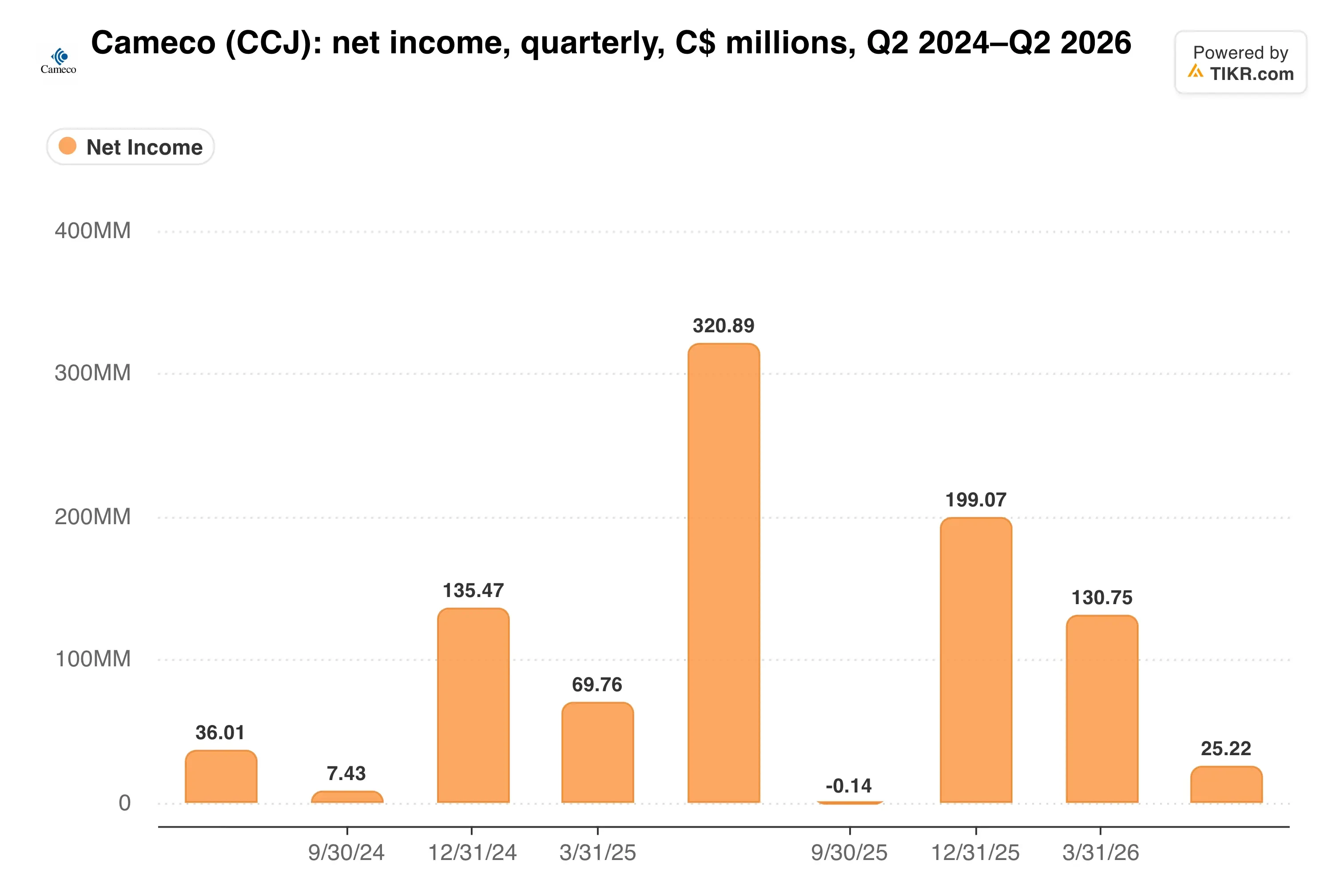
Investors can live with lumpiness. What they want is proof the dips are temporary, and an unchanged annual production outlook is management’s main answer.
Contracts lag the market
Cameco sold uranium at an average realized price of $67.79 per pound in the second quarter. That was up 18% year over year but well below the long-term price.
The gap is deliberate. Most output moves under long-term contracts, with average annual deliveries of more than 28 million pounds committed over the next five years, so higher prices reach the income statement slowly.
Meanwhile, Cameco keeps adding fuel-cycle exposure. In September it signed an exclusive deal to buy all future output from Global Laser Enrichment’s planned Kentucky plant, and Cameco owns 49% of GLE. Westinghouse also confidentially filed for a U.S. IPO in July.
Analysts expect the repricing to arrive gradually:

Consensus calls for about 7.7% annual revenue growth over the next two years, which looks modest given where contract prices sit.
TIKR tracks 21 analysts on Cameco. How many say “Buy”?
See the full breakdown of Buy, Hold, and Sell ratings on Cameco, along with Wall Street’s revenue and earnings estimates, all in one place. More than 500,000 investors use TIKR to research stocks like this one. See Cameco’s Analyst Ratings
Paying up for patience
Cameco trades at 53.6x forward earnings and 22.7x forward EBITDA. That is a growth multiple on a business expected to grow EBITDA about 2.4% a year over the next two years.
Rivals are still chasing capital. NexGen Energy (NXE) is seeking about $1 billion for its Canadian uranium project and has held talks with BHP (BHP). Cameco, by contrast, already produces at scale and carries just $77 million of net debt.
So where does today’s multiple sit against its own history?

My take: the valuation still asks a lot, especially with Westinghouse losing money and Cigar Lake operations temporarily suspended in July. I like Cameco’s position in the fuel cycle, but I would want to see production and contract pricing stabilize before paying 53.6x earnings.
On October 30, watch three things: production recovery at the Saskatchewan mines, Westinghouse’s contribution, and any new long-term contracts signed near today’s prices.
So what is Cameco stock actually worth?
TIKR lets you forecast the future price of any stock in less than a minute. Just enter a few assumptions into TIKR’s valuation model and see what Cameco could be worth. Start from Wall Street consensus estimates, or adjust the inputs to reflect your own view of the business. It’s free to use.
Disclaimer:
Please note that the articles on TIKR are not intended to serve as investment or financial advice from TIKR or our content team, nor are they recommendations to buy or sell any stocks. We create our content based on TIKR Terminal’s investment data and analysts’ estimates. Our analysis might not include recent company news or important updates. TIKR has no position in any stocks mentioned. Thank you for reading, and happy investing!