


Key Stats for ON Semiconductor Stock
- Current Price: $66.60
- Target Price (Mid): ~$145
- Street Target: ~$106
- Potential Total Return: ~118%
- Annualized IRR: ~20% / year
Now Live: Discover how much upside your favorite stocks could have using TIKR’s new Valuation Model (It’s free) >>>
What Happened?
ON Semiconductor (ON) spent September 16 telling investors it could nearly double its revenue to $11 billion by 2030, lift gross margins to 53%, and build a $2.5 billion AI-data-center business almost from scratch. The stock closed down 9.02% at $66.60. That is the odd shape of the day: management delivered the most detailed bull case it has ever laid out, and the market sold every share of it.
The Federal Reserve raised interest rates 25 basis points that same afternoon, its first hike since 2023, which is exactly the kind of move that punishes rate-sensitive growth names. But the deeper tension is about time. onsemi’s roadmap is real, and in places genuinely differentiated, yet almost all of the payoff lands in 2028 and beyond. Investors who had already bid the stock up roughly 50% off its April lows decided that a five-year promise was not worth today’s price.
A $213 Billion Roadmap That Pays Off on a Five-Year Delay
The centerpiece of the presentation was power density, the problem of fitting more power into less space without melting the hardware around it. President of the Power Solutions Group Achyut Shah framed the AI stakes in plain terms, borrowing a line from Goldman Sachs: the challenge is “how do you fit the power of 1,000 homes in 1 small cabinet?” His answer is a shift from today’s low-voltage racks to 800-volt high-voltage DC architecture, and he put a number on what that does for onsemi. Content per rack, he said, climbs from about $15,000 today to more than $115,000, roughly an 8x increase, as data centers rebuild their power trees around solid-state components.
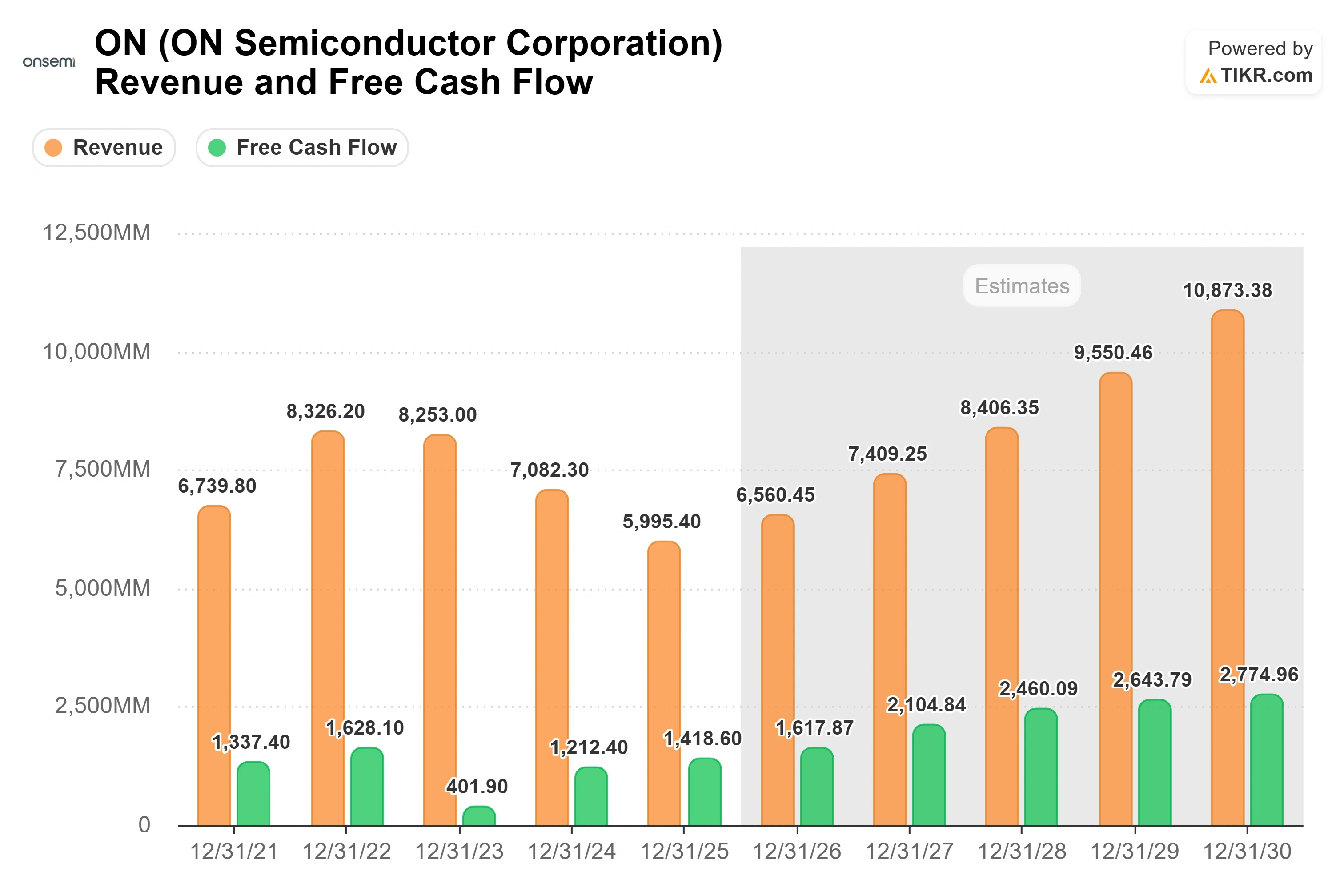
The timing is the sobering part. Shah said the first high-voltage sidecar racks begin ramping in the next 12 to 18 months, toward the end of 2027, and that solid-state transformers, the bigger structural change, likely start “in the end of ’28, early ’29.” So the architecture that justifies the $45 billion AI-data-center total addressable market is mostly a 2028-and-later event. In 2026, management expects AI-data-center revenue to exceed $500 million, more than double last year, then double again in 2027. Impressive growth, but off a small base against a company that will do about $6.6 billion in total revenue this year.
CEO Hassane El-Khoury leaned on the technology to justify the wait. The Embedded Power Platform, or EPP, is a wafer-level packaging approach that onsemi claims delivers a solid-state circuit breaker 50% smaller than the nearest competitor while running “20% cooler.” On vertical GaN, a power technology built at the company’s Syracuse fab, he was combative: “nobody has been able to figure it out yet,” he said, arguing the patent portfolio and manufacturing lead put onsemi “probably half a decade ahead” of the field. If those claims hold, they are a durable moat. The problem is that a moat around a market that scales in 2029 does little for a 2026 earnings estimate.
See historical and forward estimates for ON Semiconductor stock (It’s free!) >>>
The Recovery Is Real, but the Base Is Still Fragile
Underneath the AI story sits a core business that only recently stopped shrinking. In Q2 2026, reported August 3, revenue was $1.60 billion, up 9.18% year over year and ahead of the $1.59 billion consensus. Adjusted EPS of $0.74 beat by two cents, and free cash flow hit $425 million against a depressed $106 million a year earlier. Those are the first clean growth numbers after 2025, in which revenue fell 15.3%.
CFO Thad Trent’s margin bridge rests on factory utilization, which he said has climbed from 68% at the end of last year to about 83% exiting the second quarter. Each point of utilization is worth 25 to 30 basis points of gross margin, so most of the 650-basis-point recovery to the 53% target is already banked, with the rest coming from a richer mix of Treo and new products. The honest read is that the easy part of the margin story is behind the company, and the next leg depends on demand that has stabilized but not yet started replenishing. Automotive is the swing factor: Sudhir Gopalswamy, who runs automotive and industrial, reaffirmed a plan to grow that business about 9% a year through 2030, but the whole model assumes a flat vehicle market with the growth coming from content gains rather than a volume tailwind.
The 2030 targets are stand-alone onsemi and exclude the pending $6.7 billion all-stock acquisition of Synaptics, which management expects to close next year and which carries roughly 12% to 14% shareholder dilution. Investors were effectively asked to underwrite a five-year plan while a large, dilutive deal sits just outside the frame.
Where onsemi Sits Against Its Peers
On valuation, the sell-off has left onsemi looking reasonable rather than expensive within its group. The stock trades at 11.96x NTM EV/EBITDA, below NVIDIA at 14.52x and Texas Instruments at 18.49x, and far below AMD at 38.64x. For a power-focused analog franchise with a credible AI attachment and margins on the way up, a sub-12x multiple prices in a good deal of skepticism. Whether that discount is a gift or a warning comes down to a single judgment: do you believe the 2028-to-2030 ramp shows up on schedule, or do you think the cycle and the Synaptics dilution keep the story stuck in the low 40s on gross margin for longer than management admits?
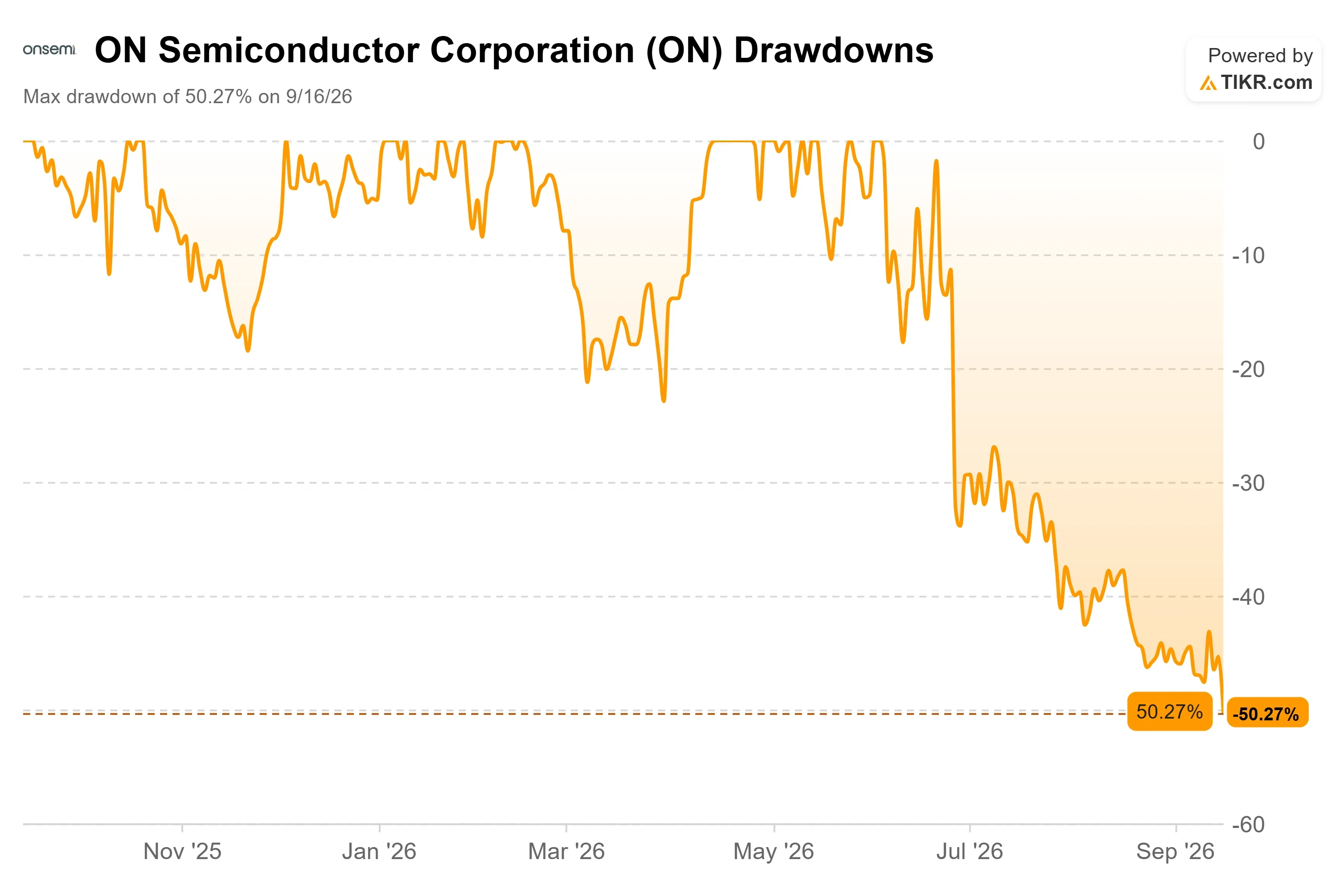
At $66.60, ON sits about 50% below its June 3 record high of $134.92, and analyst sentiment is split down the middle: 11 Buys and 2 Outperforms against 16 Holds and a lone Underperform. This is a market unwilling to pay in advance for growth it cannot yet see in the numbers.
See how ON Semiconductor performs against its peers in TIKR (It’s free!) >>>
TIKR Advanced Model Analysis
- Current Price: $66.60
- Target Price (Mid): ~$145
- Potential Total Return: ~118%
- Annualized IRR: ~20% / year

See analysts’ growth forecasts and price targets for ON Semiconductor stock (It’s free!) >>>
TIKR’s mid-case model values ON at around $145 over the next 4.3 years, an annualized return near 20%. This uses the mid-case scenario, which sits between a downside built on a stalled cycle and an upside tied to a firmer recovery, because it best captures a business that is clearly turning without assuming the AI ramp arrives flawlessly.
Two revenue drivers carry the number. The first is the AI-data-center ramp, which management expects to more than double in 2026 and double again in 2027 as high-voltage content scales. The second is automotive electrification, where onsemi targets roughly 9% annual content-driven growth against a flat vehicle market. The margin driver is factory utilization, worth 25 to 30 basis points of gross margin per point recovered, layered with a richer Treo mix. The primary risk is the cycle: if automotive replenishment stalls and the data-center ramp comes in too lumpy to fill the fabs, gross margin stays parked in the low 40s, and the whole re-rating slips to the right.
The upside case pushes utilization toward 92% and gross margin toward 50%, with the AI content step-up arriving on schedule. The downside is a delayed recovery compounded by Synaptics dilution, leaving the stock to tread water while the market waits for proof. At $66.60, closer to the downside than the base case is already priced in.
Conclusion
The number that settles this debate is not far off. onsemi reports third-quarter results in early November, and management has already guided to sequential revenue growth, with the Street looking for about $1.70 billion and adjusted EPS near $0.87. A clean beat that shows utilization pushing past 83% and AI-data-center revenue tracking toward the promised $500 million-plus for the year would tell you the recovery is compounding on schedule, and that the Analyst Day sell-off was the market flinching at a timeline rather than doubting the business. A soft print, or any wobble in the automotive order book, and the bears who sold the roadmap will look early rather than wrong.
See what stocks billionaire investors are buying so you can follow the smart money with TIKR.
Should You Invest in ON Semiconductor?
The only way to really know is to look at the numbers yourself. TIKR gives you free access to the same institutional-quality financial data that professional analysts use to answer exactly that question.
Pull up ON Semiconductor, and you’ll see years of historical financials, what Wall Street analysts expect for revenue and earnings in the quarters ahead, how valuation multiples have moved over time, and whether price targets are trending up or down.
You can build a free watchlist to track ON Semiconductor alongside every other stock on your radar. No credit card required. Just the data you need to decide for yourself.
Analyze ON Semiconductor on TIKR Free →
Looking for New Opportunities?
- See what stocks billionaire investors are buying so you can follow the smart money.
- Analyze stocks in as little as 5 minutes with TIKR’s all-in-one, easy-to-use platform.
- The more rocks you overturn… the more opportunities you’ll uncover. Search 100K+ global stocks, global top investor holdings, and more with TIKR.
Disclaimer:
Please note that the articles on TIKR are not intended to serve as investment or financial advice from TIKR or our content team, nor are they recommendations to buy or sell any stocks. We create our content based on TIKR Terminal’s investment data and analysts’ estimates. Our analysis might not include recent company news or important updates. TIKR has no position in any stocks mentioned. Thank you for reading, and happy investing!


