
Key Stats for Marriott Stock
- Current Price: $337.24
- Target Price (Mid): ~$440
- Street Target: ~$381
- Potential Total Return: ~31%
- Annualized IRR: ~6.5% / year
Now Live: Discover how much upside your favorite stocks could have using TIKR’s new Valuation Model (It’s free) >>>
What Happened?
Marriott International (MAR) just gave investors a number that should have moved the stock, and it didn’t. Speaking at the Bank of America Gaming and Lodging Conference on September 9, CEO Anthony Capuano said global RevPAR grew 7% in July, with the U.S. and Canada up 8%. Strip out the one-off boost from the FIFA World Cup, and U.S. and Canada growth was still 5%, a clear step up from the 3.4% pace reported for the second quarter. Yet shares closed at $337.24 on September 15, roughly 18% below the 52-week high of $410.98 they touched in June.
Demand is not the worry, and management spent most of the session explaining why. The tension sits elsewhere: a fee-driven business firing on improving demand, trading against a Street that keeps trimming its targets and a multiple the market is no longer willing to expand.
Demand Is Broadening
For most of the past year, the running narrative was a K-shaped travel economy, with luxury travelers spending while everything below them softened. July broke that pattern: luxury RevPAR rose 5% globally, premium and select brands rose 4%, and midscale rose 5%, with strength across chain scales, demand segments, and geographies at once. Capuano called the current backdrop one of the strongest demand environments in nearly a decade.
“This notion that the RevPAR trends are almost singularly led by luxury is just inaccurate,” he said, framing the breadth as the reason for his confidence into the back half of the year. That breadth is what separates a durable demand cycle from a temporary one, and a recovery running across luxury, select service, business transient, group, and government demand at the same time is much harder to knock over than one carried by high-end travelers alone.
Even the Middle East, the portfolio’s worst-performing region, improved sharply. Second-quarter RevPAR there fell 43% amid regional conflict. In July, the decline narrowed to just 12%, ahead of the company’s own expectations. The recovery is early, and the conflict is ongoing, so the region stays a swing factor, but it is only about 3% of global fees, and the improvement removes an overhang that dragged on international results all year.
See historical and forward estimates for Marriott stock (It’s free!) >>>
The Growth Engine Owners Keep Funding
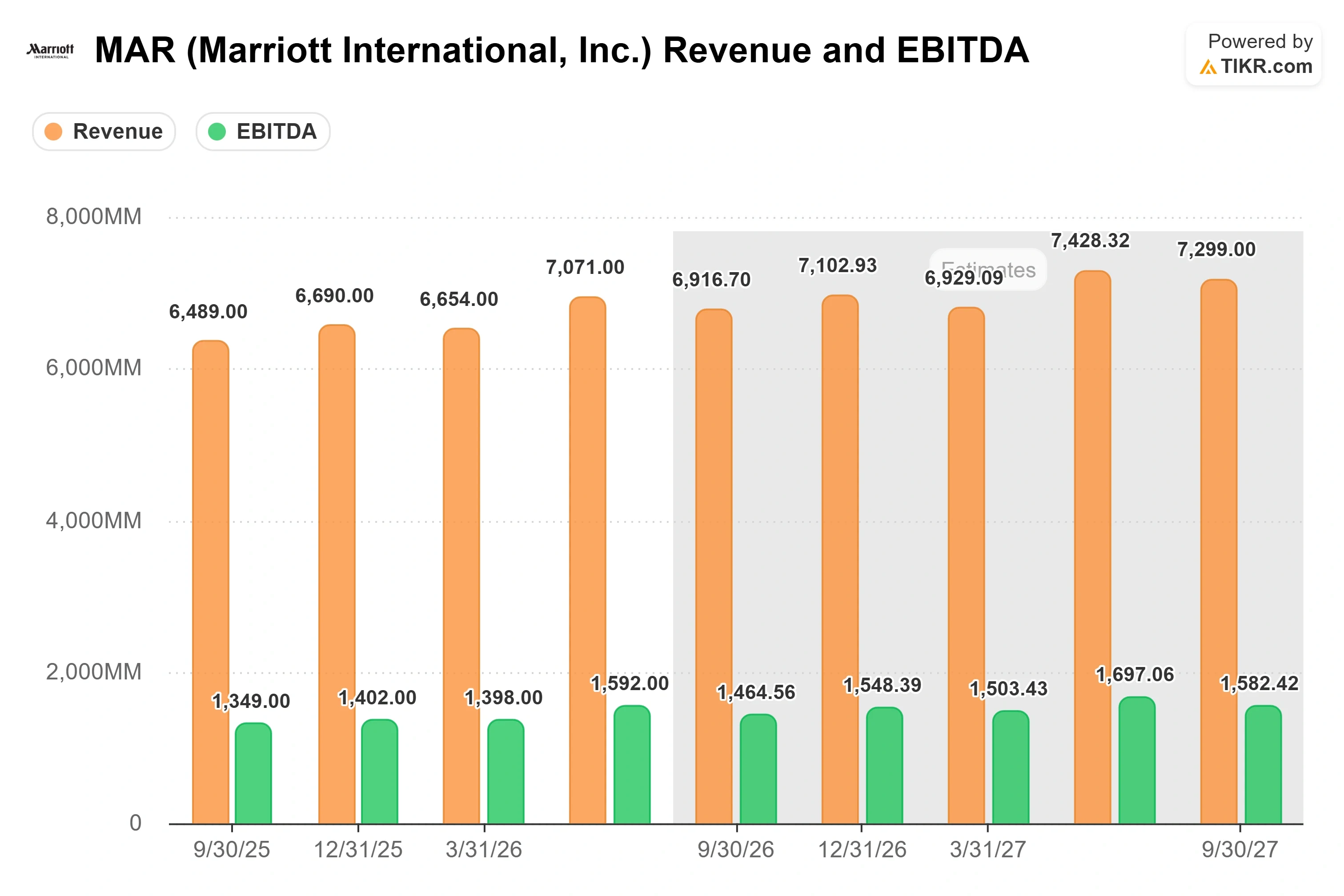
Marriott manages and franchises the hotels flying its flags rather than owning them, so demand strength converts efficiently into fee income while owners carry the capital risk. That leverage showed in the second quarter: gross fee revenue rose 13% to $1.58 billion, and adjusted EBITDA grew 12.5% to $1,592 million on revenue that rose a more modest 4.9%. The business carries an LTM gross margin above 79% and a return on invested capital near 32%.
Marriott signed more management and franchise agreements in the first half of 2026 than in the first half of any of its prior 68 years in the lodging business, pushing the pipeline to a record near 629,000 rooms. Conversions are a growing share of that growth, and Capuano pointed to a large untapped pool: outside the U.S., 50% to 60% of hotel inventory is unbranded. Marriott is also using white-label deals to bring assets in before they reflag, converting the Pelican Hill resort in Newport Beach to a St. Regis estate while it books on marriott.com during a $100-plus million renovation.
Management is spending real energy protecting owner returns, because unit growth sits on those owners’ balance sheets. After years of thin RevPAR growth followed by cost inflation, franchisees pushed back on their total fee load, and Capuano’s answer was a stack of small cuts rather than one dramatic move. “We’ve got to find lots of nickels and dimes,” he said, “but if you find enough of them and stack them up, we ought to be able to drive pretty significant improved performance.” Marriott cut its Bonvoy loyalty charge-out rate by 5% last year and announced an incentive worth roughly a 50 basis point reduction in affiliation costs. A newer technology push fits the same thesis: on September 1, Marriott and LG Electronics announced a co-developed, cloud-based guest-room platform now piloting in 40 U.S. and Canada hotels, which management frames as a revenue opportunity as much as a cost one, opening the door to selling food and beverage, spa, and room upgrades in the booking path.
See how Marriott performs against its peers in TIKR (It’s free!) >>>
Where the Disagreement Lives
So why is the stock down 18% from its high? Part of it traces to the August 3 second-quarter report, where a 1.7% revenue miss overshadowed beats on EBITDA and adjusted EPS, and shares slipped on the day. The larger factor is the multiple. Marriott trades near 27 times next-twelve-month earnings and 16.9 times NTM EV/EBITDA, a premium to the travel group, though not to its closest peer: Hilton sits higher on both, near 32 times earnings and 19.4 times EV/EBITDA, while Booking Holdings trades near 11.6 times EV/EBITDA. That premium leaves little room for a miss, and the Street has been walking targets down even as demand improved: UBS cut to $395 from $412, BMO to $395 from $410, Barclays to $348 from $379, and Deutsche Bank to $372 from $379. The mean target near $381 implies only modest upside from $337, and of 28 analysts, 13 rate Marriott a Buy or Outperform, 13 a Hold, and 2 bearish. That is a coverage list that respects the business and questions the entry point.
TIKR Advanced Model Analysis
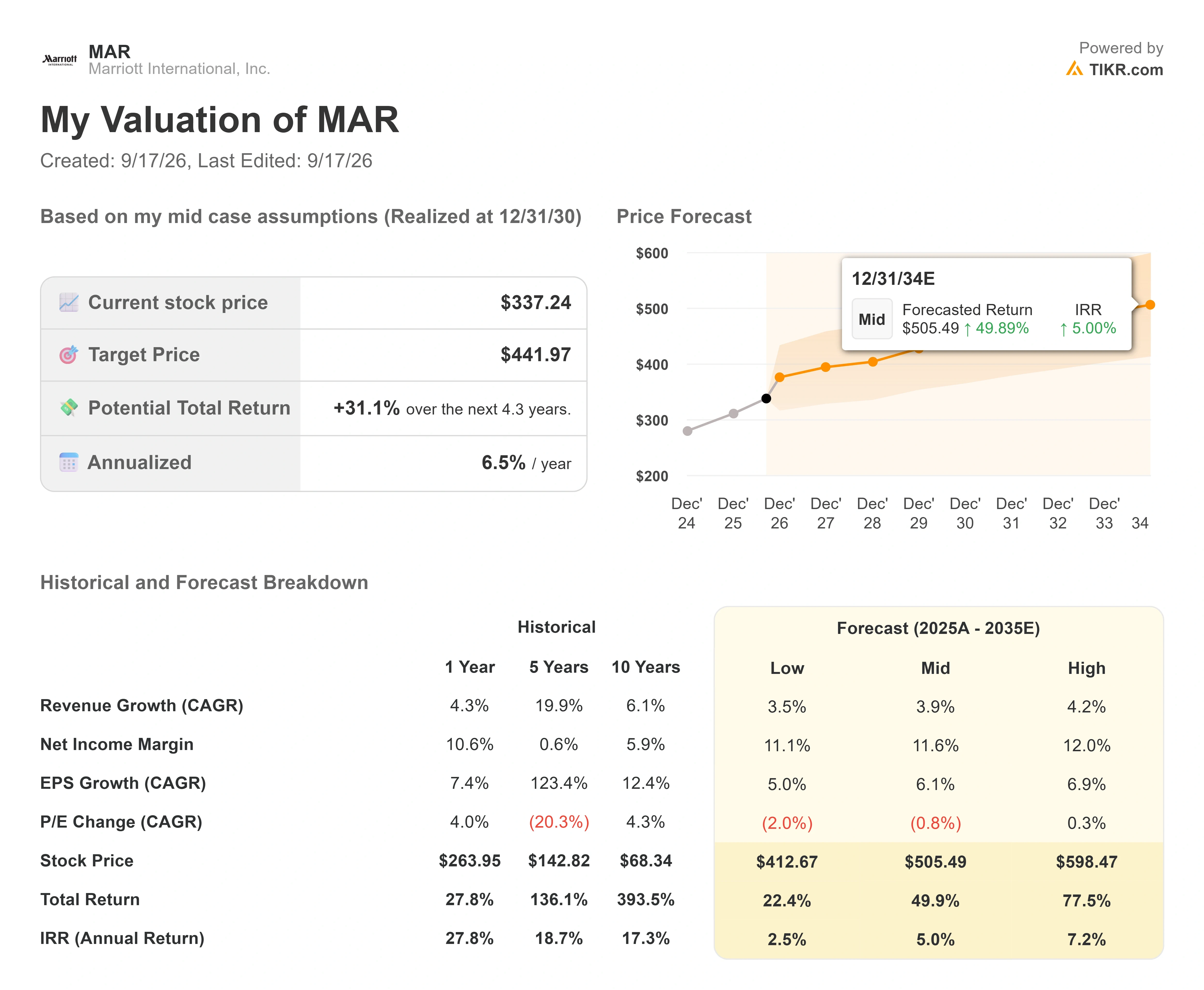
- Current Price: $337.24
- Target Price (Mid): ~$440
- Potential Total Return: ~31%
- Annualized IRR: ~6.5% / year
See analysts’ growth forecasts and price targets for Marriott stock (It’s free!) >>>
The TIKR mid-case values Marriott at around $440, realized by the end of 2030, for a total return near 31% and an IRR of roughly 6.5% per year. Two revenue drivers carry it: net unit growth, guided toward the low end of the 4.5% to 5% range this year but backed by a record pipeline, and RevPAR gains now running ahead of plan after July lifted the full-year outlook to 3% to 3.5%. The margin driver is the fee mix, as co-branded credit card and franchise fees pull net income margins toward roughly 12%.
The primary risk is the multiple. The forecast assumes almost no help from valuation and builds in slight P/E compression, so the return has to come from earnings. The upside: demand breadth and the 2028 step-up in credit card economics push fees above plan, lifting the target toward the high case near $600. The downside: a premium multiple meets a demand wobble or a sharper Middle East relapse, and a fairly priced stock drifts.
Conclusion
The next test is the third-quarter report on November 3. Watch two lines. First, whether July’s RevPAR strength held: a global pace near 5% to 6% would confirm the acceleration is structural rather than a World Cup and easy-comparison sugar high. Second, whether management holds net unit growth at the low end of its 4.5% to 5% range despite the Middle East construction delays. A quarter that pairs sustained RevPAR with steady unit growth gives the Street a reason to close the gap to the model. A fade back toward 3% would say the market’s caution was right all along.
See what stocks billionaire investors are buying so you can follow the smart money with TIKR.
Should You Invest in Marriott?
The only way to really know is to look at the numbers yourself. TIKR gives you free access to the same institutional-quality financial data that professional analysts use to answer exactly that question.
Pull up Marriott, and you’ll see years of historical financials, what Wall Street analysts expect for revenue and earnings in the quarters ahead, how valuation multiples have moved over time, and whether price targets are trending up or down.
You can build a free watchlist to track Marriott alongside every other stock on your radar. No credit card required. Just the data you need to decide for yourself.
Analyze Marriott on TIKR Free →
Looking for New Opportunities?
- See what stocks billionaire investors are buying so you can follow the smart money.
- Analyze stocks in as little as 5 minutes with TIKR’s all-in-one, easy-to-use platform.
- The more rocks you overturn… the more opportunities you’ll uncover. Search 100K+ global stocks, global top investor holdings, and more with TIKR.
Disclaimer:
Please note that the articles on TIKR are not intended to serve as investment or financial advice from TIKR or our content team, nor are they recommendations to buy or sell any stocks. We create our content based on TIKR Terminal’s investment data and analysts’ estimates. Our analysis might not include recent company news or important updates. TIKR has no position in any stocks mentioned. Thank you for reading, and happy investing!