Key Stats for Sandisk Stock
- Current Price (Model entry): $1,530.90
- Target Price (Mid): ~$3,180
- Street Target: ~$2,125
- Potential Total Return: ~108%
- Annualized IRR: ~17% / year
Now Live: Discover how much upside your favorite stocks could have using TIKR’s new Valuation Model (It’s free) >>>
What Happened?
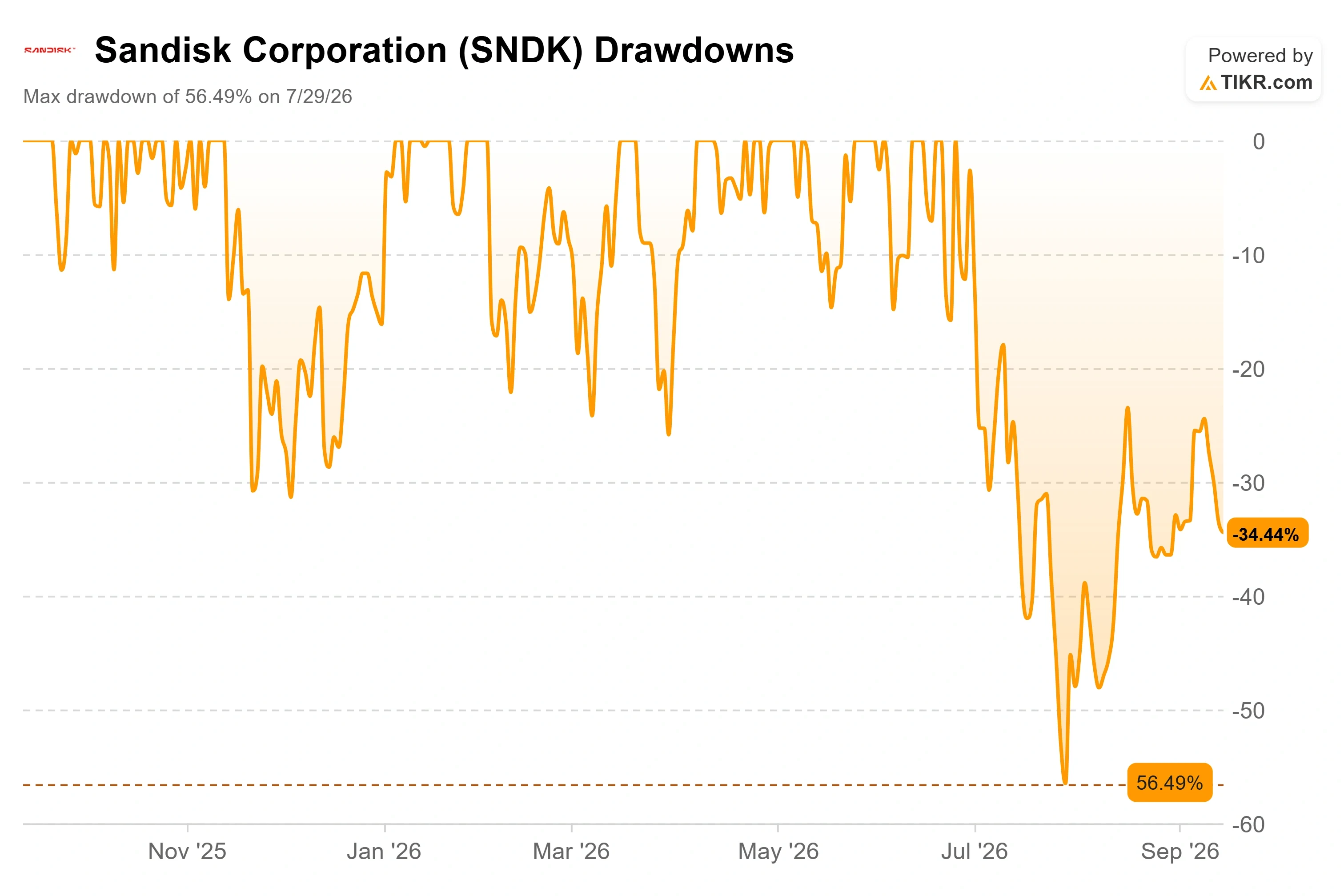
Sandisk Corporation (SNDK) closed at $1,519.97 on September 16, and nothing that pushed it there had anything to do with Sandisk. The stock is now down about 35% from the $2,354 intraday high it set on June 22, and it has not recovered from a selloff that began earlier this week. Over September 13 and 14, the chief executives of Anthropic and OpenAI both argued publicly that AI capability should advance more deliberately, and the memory complex read that as a threat to the demand curve underwriting its entire re-rating. Sandisk fell 4.98% on the 14th and has drifted around $1,520 since. Rising 10-year Treasury yields and a risk-off tone ahead of the Fed added to the pressure.
The discomfort is real, because a stock up more than 600% this year has a long way to fall if the story cracks. But the fear is about a future spending curve, not about anything the business has reported. That gap, between a sentiment shock and a set of fundamentals that just printed a record, is where the question lives. TIKR’s valuation model uses a $1,530.90 entry price, close to where shares trade now.
The Selloff Came From an Essay
Six weeks ago, Sandisk closed its best quarter as an independent company. Fiscal fourth-quarter revenue hit $8,965 million, up 372% year over year, with datacenter revenue more than doubling sequentially to $2.98 billion. For the full fiscal year, datacenter revenue rose 437% to $5.15 billion. Non-GAAP earnings reached $39.25 per share. Management paired the print with an additional $14 billion buyback authorization, lifting remaining capacity to $15.5 billion, against a balance sheet that carries net cash rather than net debt.
None of that changed on September 14. What changed was a debate about how fast AI should scale. The read-through to memory is genuinely uncertain: a slower training frontier could, in time, compress the memory content per AI server, the part of the thesis holding the highest expectations. That is the bear argument, and it deserves stating plainly. The counterweight is that no hyperscaler has cut capital spending, and the essays that triggered the selling were about pace and safety.
CEO David Goeckeler spent his September 9 appearance at the Goldman Sachs Communacopia conference on exactly this point. As inference scales, he argued, “our data center becomes more than half of the NAND market,” a shift he said changes how the whole market prices and consumes flash. His view separates the demand worry investors are pricing from the one Sandisk is actually betting on: not the training frontier, but inference at scale, where larger models and longer context lengths pull the workload toward the most scalable memory available.
See historical and forward estimates for Sandisk stock (It’s free!) >>>
The Contracts Are Built to Hold When Pricing Doesn’t
What makes this drawdown different from a normal memory-cycle scare is how Sandisk now sells its bits. Over roughly nine months, it signed eight long-term customer partnerships, which it calls New Business Model agreements, covering nearly $94 billion in minimum contracted revenue disclosed in its August 5 earnings release. These are not the quarterly price negotiations that made NAND a cyclical trap for two decades. CFO Luis Visoso described contracts running as long as five years, specified by year, quarter, and month, and backed by third-party financial guarantees that pay Sandisk if a customer walks.
Asked whether roughly two-thirds of the business in a downside scenario would sit at an 80% gross margin with the rest at prevailing prices, Goeckeler answered: “Yes, that’s an easy way to think about it. I totally agree.” That is a floor most memory companies have never had. It does not make Sandisk immune to a NAND price collapse, and the remaining third still rides the spot market. What it does is narrow the range of bad outcomes, the exact variable a sentiment-driven selloff ignores. That protection is why the Street has not blinked: coverage runs 16 Buy, 4 Outperform, 3 Hold, 1 Underperform, and 1 Sell, with a mean target near $2,125, about 39% above today’s price. The live debate is no longer whether Sandisk can execute, but whether NAND pricing holds when the contracted book converts to revenue over the next 18 to 24 months.
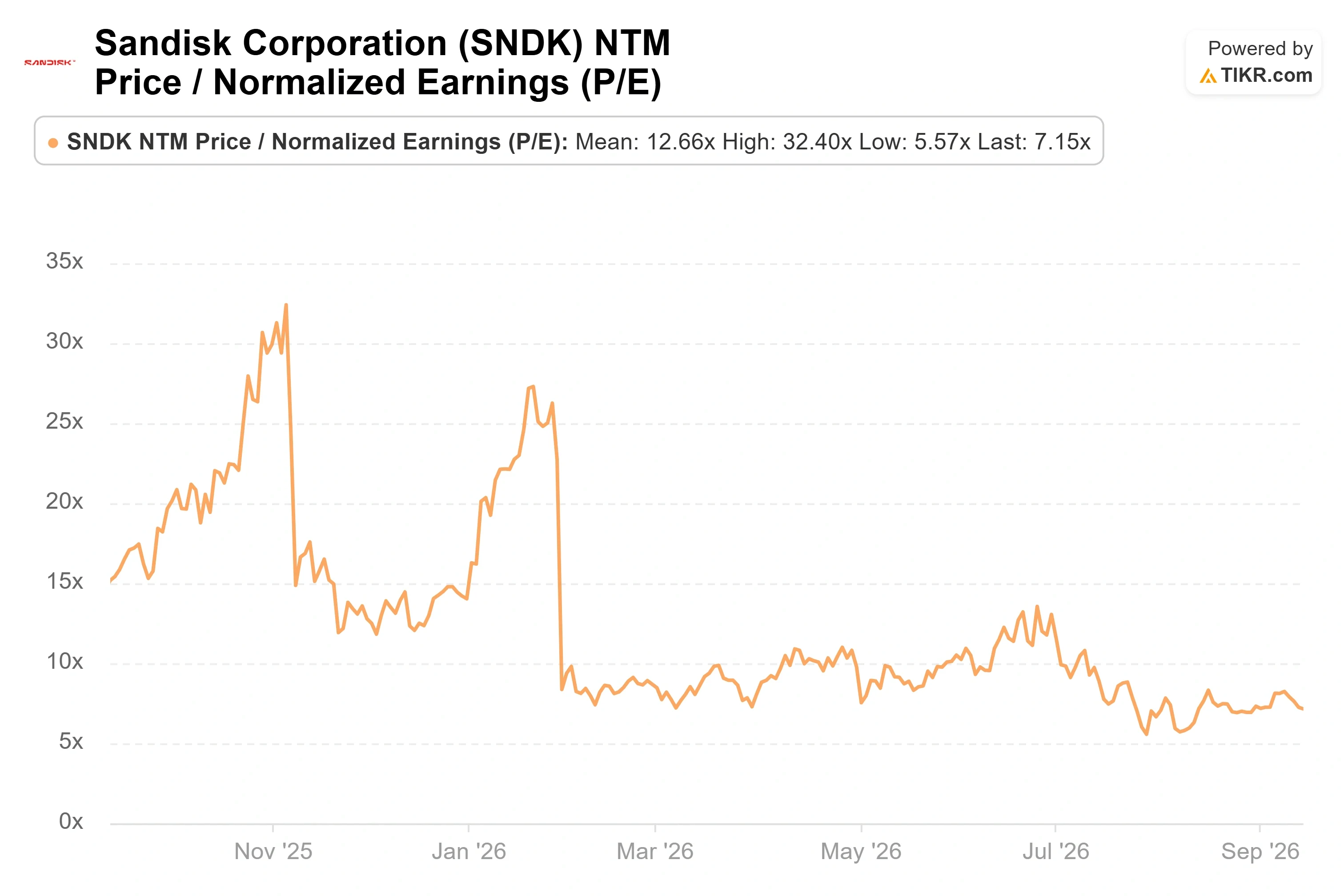
Near $1,520, the stock trades at 7.15x next-twelve-months earnings, a discount to former parent Western Digital at 20.50x and a premium to Samsung Electronics at 3.99x. The comparison cuts both ways: Sandisk earns a premium to Samsung’s diversified, lower-margin mix, while the gap to Western Digital reflects how much faster the market expects Sandisk’s near-term earnings to grow, which mechanically shrinks the forward multiple. On a P/E ratio basis, a company growing into its numbers this fast rarely looks expensive on forward figures.
See how Sandisk performs against its peers in TIKR (It’s free!) >>>
TIKR Advanced Model Analysis
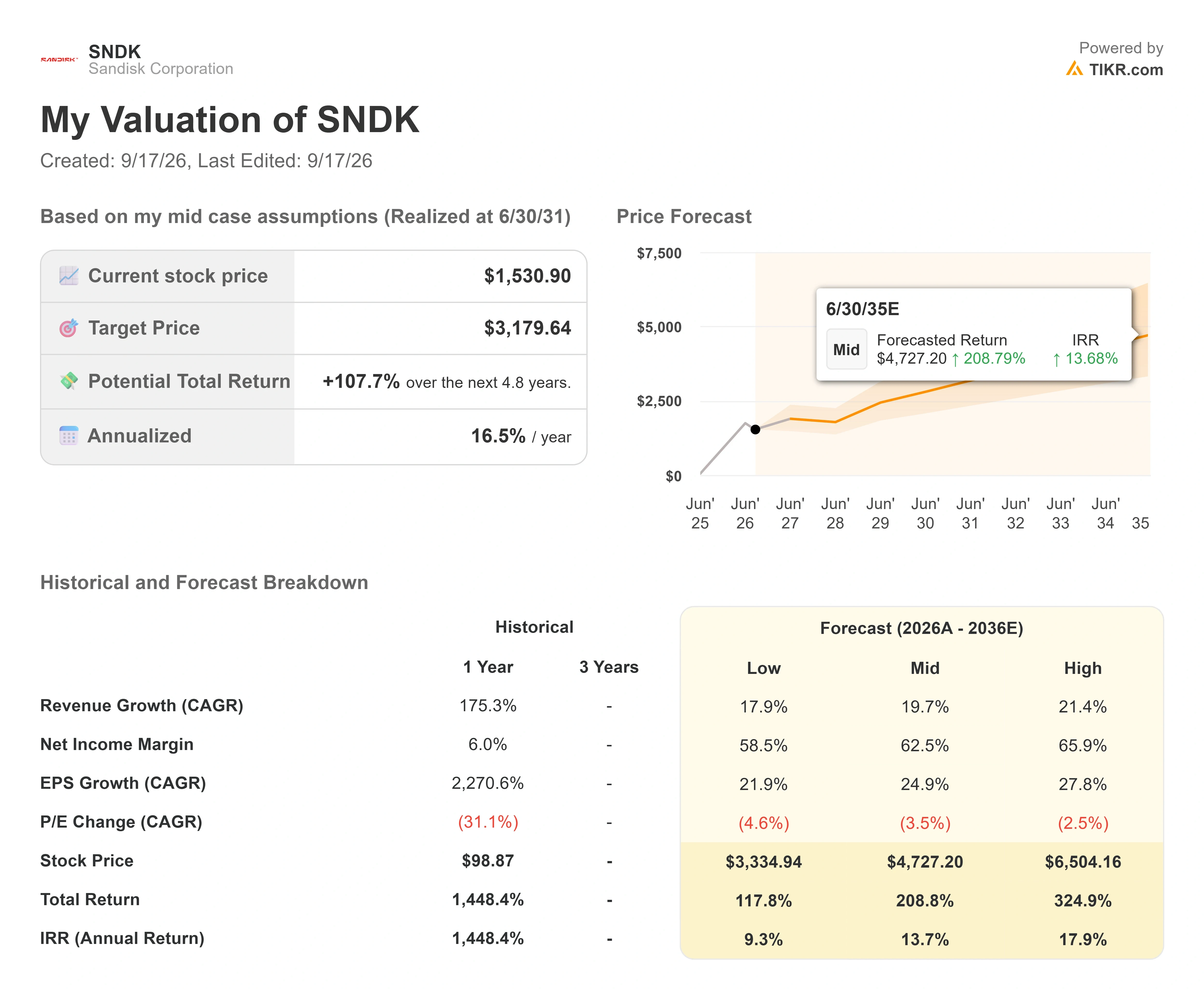
- Current Price (Model entry): $1,530.90
- Target Price (Mid): ~$3,180
- Potential Total Return: ~108%
- Annualized IRR: ~17% / year
See analysts’ growth forecasts and price targets for Sandisk stock (It’s free!) >>>
At the August Investor Day, TIKR’s mid-case valued Sandisk below the then-current price and called it overpriced. After a 35% drawdown and a wave of upward estimate revisions, the same mid case now points to roughly $3,180, about 108% above that entry, or around 17% annualized over 4.8 years. The stock fell into the model, rather than the model rising to meet it.
Two drivers carry that number: datacenter mix shift, as that segment moves past half of NAND demand, and the contracted NBM book, converting nearly $94 billion in minimum revenue into recognized sales. The margin driver is the 80% gross-margin floor locked across two-thirds of BiCS supply, supporting a mid-case net income margin near 63%.
- Primary risk: NAND pricing. If AI spending slows and the spot third of the book resets lower, the low case cuts the annualized return to roughly 9%.
- Upside: inference demand keeps outrunning supply, and the contracted floors prove conservative, lifting the annualized return toward the high case near 18%.
- Downside: a genuine memory-price collapse arrives before the contracts insulate earnings, and the multiple compresses faster than the book can grow.
Conclusion
The next real test is fiscal first-quarter 2027, guided to revenue of $10.30 billion to $10.80 billion and non-GAAP EPS of $44.00 to $46.00. The top of that range would confirm contracted pricing is flowing through as promised and that September was sentiment, not signal. The low end, or any softening in datacenter growth commentary, would hand the bears their first piece of hard evidence. Until that print, this is a stock trading on a debate about a spending curve nobody can yet measure, sitting 35% below its high with a downside floor most of its peers cannot claim.
See what stocks billionaire investors are buying so you can follow the smart money with TIKR.
Should You Invest in Sandisk?
The only way to really know is to look at the numbers yourself. TIKR gives you free access to the same institutional-quality financial data that professional analysts use to answer exactly that question.
Pull up Sandisk, and you’ll see years of historical financials, what Wall Street analysts expect for revenue and earnings in the quarters ahead, how valuation multiples have moved over time, and whether price targets are trending up or down.
You can build a free watchlist to track Sandisk alongside every other stock on your radar. No credit card required. Just the data you need to decide for yourself.
Analyze Sandisk on TIKR Free →
Looking for New Opportunities?
- See what stocks billionaire investors are buying so you can follow the smart money.
- Analyze stocks in as little as 5 minutes with TIKR’s all-in-one, easy-to-use platform.
- The more rocks you overturn… the more opportunities you’ll uncover. Search 100K+ global stocks, global top investor holdings, and more with TIKR.
Disclaimer:
Please note that the articles on TIKR are not intended to serve as investment or financial advice from TIKR or our content team, nor are they recommendations to buy or sell any stocks. We create our content based on TIKR Terminal’s investment data and analysts’ estimates. Our analysis might not include recent company news or important updates. TIKR has no position in any stocks mentioned. Thank you for reading, and happy investing!