
Key Stats for Amgen Stock
- Current Price: $375.65
- Target Price (Mid): ~$495
- Street Target: ~$388
- Potential Total Return: ~32%
- Annualized IRR: ~6.6% / year
Now Live: Discover how much upside your favorite stocks could have using TIKR’s new Valuation Model (It’s free) >>>
What Happened?
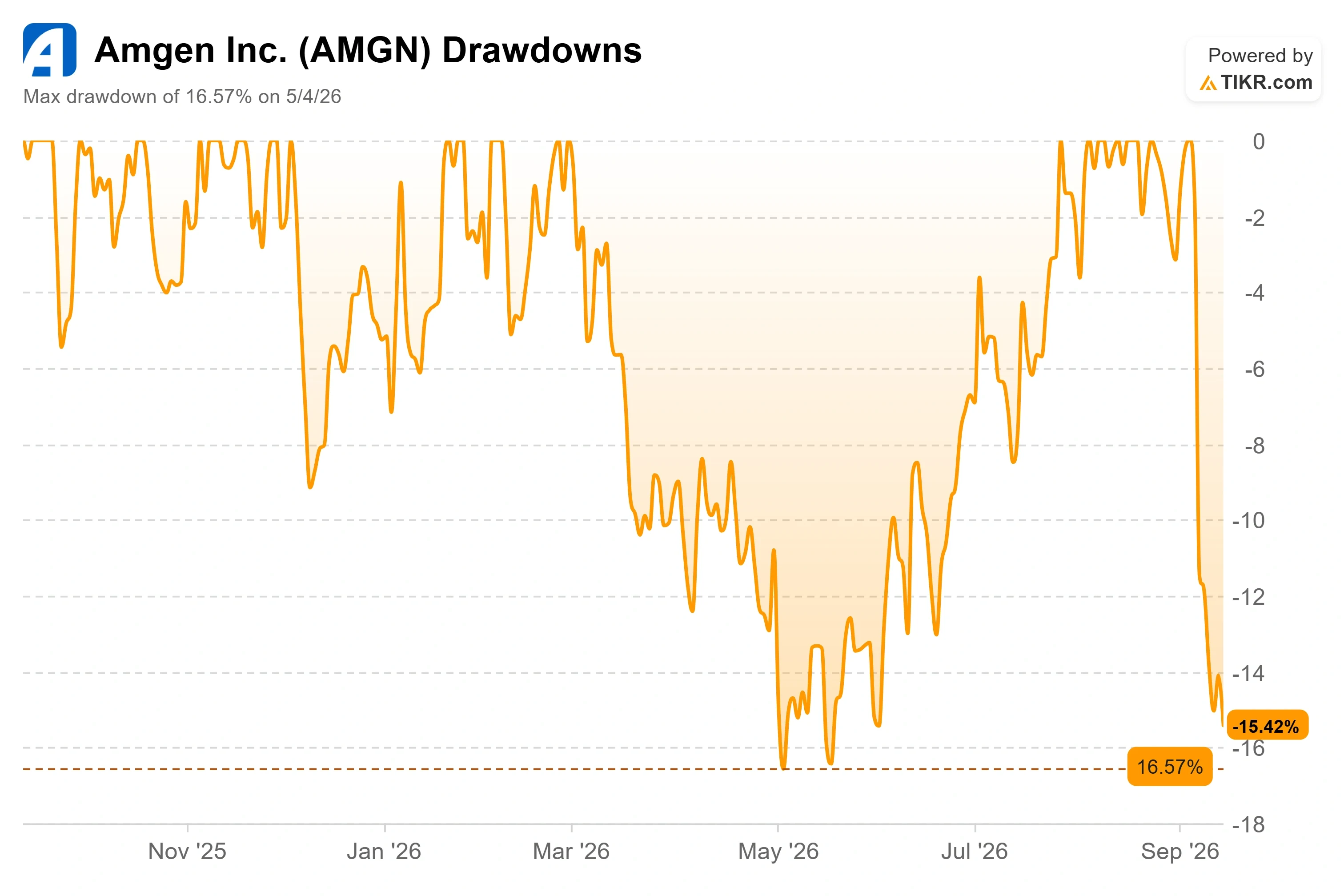
Amgen (AMGN) fell 10.08% on September 8 to close at $393.17, its worst single-day decline since October 2000. If you searched why the stock cratered, the answer is unusual: the trigger was a failed trial at Novartis, not at Amgen. On September 4, Novartis said its Lp(a)-lowering drug pelacarsen lowered the target lipid but did not reduce heart attacks, strokes, or cardiovascular deaths in its pivotal study. Amgen runs its own Lp(a) drug, olpasiran, on the same core premise, so the market marked both down. Shares kept sliding to $375.65 by September 15, roughly 15% below the all-time high of $444.12 set on September 3.
A drug still in testing got cheaper by association, erasing tens of billions in value while Amgen’s actual earnings did not change. The real issue is whether the selloff priced in a genuine problem or simply removed an easy assumption the market had made for free.
A Setback to a Thesis
For years, the assumption was that lowering Lp(a), a genetically driven cardiovascular risk factor, would cut cardiac events. Novartis lowered it by roughly 80% and still missed, which does not disprove the hypothesis but removes the market’s confidence that a deep reduction automatically pays off.
At the Morgan Stanley Global Healthcare Conference on September 15, R&D chief James Bradner noted that olpasiran cuts Lp(a) by about 95% to 99%, versus the 70% to 80% pelacarsen achieved, and targets a higher-risk population starting at 200 nmol/L rather than 150. He added that Amgen entered the Novartis readout with “a predefined set of actions.” Whether a deeper cut clears a threshold that 80% did not is unproven, and Bradner did not claim otherwise. Amgen’s own outcomes data from the OCEAN(a) study is expected around 2027, with published estimates ranging from late 2026 into 2028.
On September 8, Amgen said its cancer drug IMDELLTRA hit its primary overall-survival endpoint in the Phase 3 DeLLphi-305 study, in combination with AstraZeneca’s durvalumab, as a first-line maintenance treatment for extensive-stage small cell lung cancer. Detailed figures are not out yet, so the magnitude is still pending. Days later, on September 14, the FDA cut IMDELLTRA’s required post-dose monitoring to 6 to 8 hours from 22 to 24, a change that makes the drug far easier to give in community settings.
See historical and forward estimates for Amgen stock (It’s free!) >>>
What Investors Are Buying at $375
Shares trade near 23 times trailing earnings and about 16 times forward earnings, with a dividend yield of around 2.7% and a payout ratio near 60% that covers it comfortably. Against biotech peers, that forward multiple sits below AbbVie near 17 times and roughly level with Gilead near 16 times, even though Amgen carries a broader late-stage pipeline than either. The base business backs it: Q2 2026 revenue rose 9.5% to $10.05 billion, adjusted EPS of $6.29 beat the Street by about 12%, and the six growth drivers grew 26% to make up nearly 70% of product sales. Repatha keeps compounding, with new VESALIUS-CV data published in Circulation on August 31 showing a 20% cut in death risk for high-risk patients without a prior cardiac event.
Amgen faces loss-of-exclusivity pressure as Prolia and Enbrel erode under biosimilars and Medicare price-setting. BMO cited that when it moved to Market Perform on September 8, flagging the roughly 34% run this year and the patent headwinds ahead. HSBC followed with a Hold, cutting its target to $425 and arguing the stock had simply re-rated to fair value. Neither downgrade was about olpasiran. Both asked whether a name at record highs could keep outrunning its own patent cliff, a question the obesity candidate MariTide is being built to answer.

See how Amgen performs against its peers in TIKR (It’s free!) >>>
TIKR Advanced Model Analysis
- Current Price: $375.65
- Target Price (Mid): ~$495
- Potential Total Return: ~32%
- Annualized IRR: ~6.6% / year

See analysts’ growth forecasts and price targets for Amgen stock (It’s free!) >>>
TIKR’s mid-case model puts fair value near $495 by the end of 2030, implying about 32% total upside and around 6.6% a year over the next 4.3 years. This is the base case, not a bull scenario, because Amgen’s appeal is durable cash flow rather than fast growth. The revenue CAGR assumption of around 3.5% sits well below the company’s 7.6% five-year average, crediting biosimilar erosion on Prolia and Xgeva even as IMDELLTRA, Repatha, and the rare-disease franchises expand. The margin driver is a net income margin holding near 35%, in line with history and confirming that profitability is the sturdy part of this business.
The primary risk is the patent cliff outrunning the new launches: if MariTide disappoints or biosimilar erosion accelerates, the growth assumption breaks and the multiple compresses. The upside is that the growth drivers and MariTide carry the company through the loss-of-exclusivity wall while olpasiran, priced at almost nothing today, still has a shot. At around 6.6% a year plus a covered dividend, the model frames Amgen as a steady holding that got cheaper, not a coiled spring.
Conclusion
The next real test is a data point. Novartis is expected to present the full pelacarsen dataset at the American Heart Association meeting in November, and analysts will dissect whether the Lp(a) hypothesis failed outright or only at an 80% reduction. A clean explanation that leaves room for deeper cuts would ease pressure on olpasiran; a broad mechanism failure would not. Watch November, and watch whether the growth drivers hold their 26% pace when Q3 prints.
See what stocks billionaire investors are buying so you can follow the smart money with TIKR.
Should You Invest in Amgen?
The only way to really know is to look at the numbers yourself. TIKR gives you free access to the same institutional-quality financial data that professional analysts use to answer exactly that question.
Pull up Amgen, and you’ll see years of historical financials, what Wall Street analysts expect for revenue and earnings in the quarters ahead, how valuation multiples have moved over time, and whether price targets are trending up or down.
You can build a free watchlist to track Amgen alongside every other stock on your radar. No credit card required. Just the data you need to decide for yourself.
Looking for New Opportunities?
- See what stocks billionaire investors are buying so you can follow the smart money.
- Analyze stocks in as little as 5 minutes with TIKR’s all-in-one, easy-to-use platform.
- The more rocks you overturn… the more opportunities you’ll uncover. Search 100K+ global stocks, global top investor holdings, and more with TIKR.
Disclaimer:
Please note that the articles on TIKR are not intended to serve as investment or financial advice from TIKR or our content team, nor are they recommendations to buy or sell any stocks. We create our content based on TIKR Terminal’s investment data and analysts’ estimates. Our analysis might not include recent company news or important updates. TIKR has no position in any stocks mentioned. Thank you for reading, and happy investing!