Key Stats for Pegasystems Stock
- Current Price: $37.63
- Target Price (Mid): ~$50
- Street Target: ~$43
- Potential Total Return: ~33%
- Annualized IRR: ~7% / year
Now Live: Discover how much upside your favorite stocks could have using TIKR’s new Valuation Model (It’s free) >>>
What Happened?
Pegasystems (PEGA) did something most beaten-down software companies avoid: it explained, in plain terms, exactly how it lost its own year. Speaking at Citi’s Global TMT Conference on September 8, CFO Ken Stillwell conceded that annual contract value growth will land near 10% for 2026, not the 15% guided in January, and that the shortfall traces to a sales-execution stumble rather than collapsing demand. The stock closed at $37.63 on September 15, roughly 46% below where it traded a year ago.
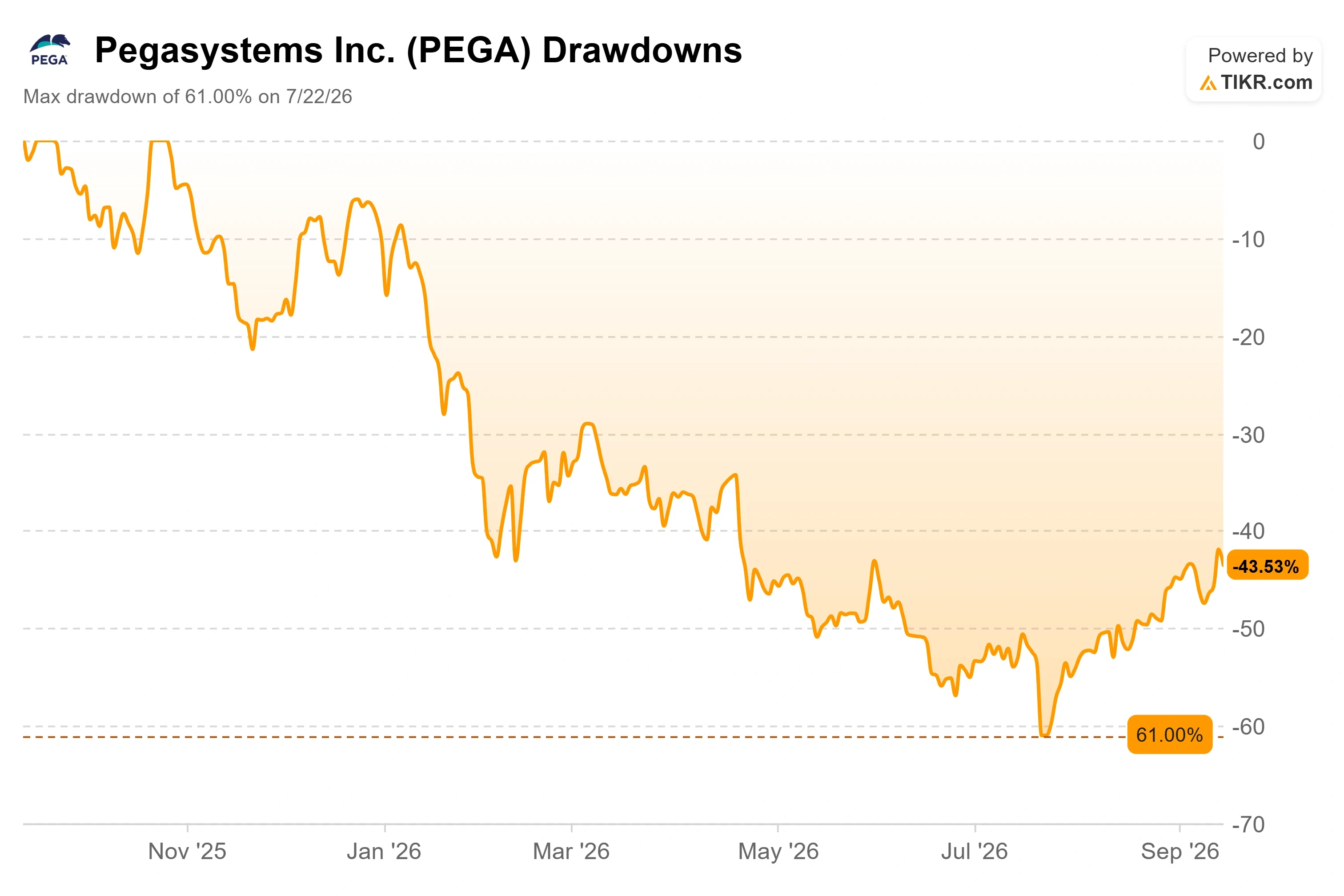
That gap between a broken share price and a merely slower business is what investors are trying to price. The shares bottomed at a 61% drawdown on July 22, the session after a weak Q2 print, and have since clawed back to the high $30s. The conference filled in the missing piece: management’s own account of what went wrong, what is fixable, and which costs are one-time.
See historical and forward estimates for Pegasystems stock (It’s free!) >>>
The Miss Was Self-Inflicted, and Management Said So
Stillwell did not hide behind the macro. He described a company that has historically sold to people it already knew, an account-manager motion built on 20-year relationships, that failed to pivot fast enough when AI confusion swept through its buyers early in the year. “I don’t think we did a good job of executing that,” he said of the outbound, new-logo push set as a 2026 priority. The team leaned in hard only in late June, “too late to actually make a difference in Q2.” A named internal failure is something investors can track, which a vague blame on the market never is.
He also explained why the year could not self-correct. Pega’s campaigns run over two or three quarters, so anything closing in the back half had to be in the pipeline months earlier. With no short pipe to conversion, the company front-loaded too little net new ACV and had no runway to recover inside the year. A demand cliff would look different: total ACV still grew, cloud momentum continued, and reported Q2 revenue of $420.72 million came in just 1.8% below the Street. The problem was the shape of the year, not the size of the market.
A Partner That Now Sells Pega as Its Own Product
On August 28, Coforge announced an expanded partnership that lets it build, package, brand, and commercially deliver Pega-powered solutions under its own name, a shift from simply reselling the software. The stock reaction was muted, but the strategic read tracks the “new workflows, new buyers” expansion Stillwell called the growth unlock. A global services firm putting its own brand on the platform widens the top of the funnel without Pega adding salespeople.
This is an announced commercial agreement, so it belongs in the thesis as a distribution catalyst rather than a number. It matters because Pega’s fix depends on reaching buying centers it has never touched. Stillwell was explicit that growth requires selling “to new use cases that we have not sold to,” including financial institutions Pega has never worked with.
Pega shipped Infinity ’26, its AI-native development environment, about 30 days before the conference, and Stillwell offered a striking proof point: an app that once took roughly 2,000 hours to build took Pega’s own engineers 45 hours with the new tooling. He was candid that clients are not there yet, and the remaining hurdle is adoption, but a shorter build cycle is how a wider funnel turns into closed revenue.

See how Pegasystems performs against its peers in TIKR (It’s free!) >>>
The Cash Story Is Intact, With One Asterisk That Clears in 2027
Free cash flow is where the bull case actually lives, and Stillwell defended it directly. He acknowledged 2026 FCF will land below the original $575 million guide, partly because lower ACV leaves little room to recover within the year. But he flagged a larger distortion investors keep missing: legal costs tied to the Appian litigation. Pega settled its shareholder and derivative suits this year, and modeled roughly $30 million of legal spend but now expects $70 million to $90 million, a swing he did not add back when guiding. He was clear that the drag is “very much episodic” and will not repeat into 2027 and 2028, with only the Appian retrial in Q1 2027 outstanding. Net cash on the balance sheet means nothing forces management’s hand while the rebuild plays out.
A permanent margin problem and a one-time legal bill look identical in a single year of cash flow, yet they earn very different multiples. The peer set frames how much the market is discounting: Pega trades at 10.7x NTM EV/EBITDA against Workday at 12.2x, SAP at 15.9x, and Appian, its courtroom rival, at a far richer 24.0x. That discount only holds if the growth reset proves permanent.
There is a second, less-discussed reason it might not. Stillwell spent much of the conference on how Pega prices AI, and it is a real differentiator: the company charges a fixed cost per transaction and absorbs the token risk itself, routing each step to the cheapest model that clears the job. “Predictability for AI does not mean free AI. It means predictable AI,” he said. For enterprise buyers afraid of runaway model bills, a vendor that fixes the cost is selling something rivals cannot easily match, and that is the pricing wedge the go-to-market rebuild is meant to carry into new accounts.
TIKR Advanced Model Analysis
- Current Price: $37.63
- Target Price (Mid): ~$50
- Potential Total Return: ~33%
- Annualized IRR: ~7% / year

See analysts’ growth forecasts and price targets for Pegasystems stock (It’s free!) >>>
The TIKR Valuation Model uses the mid-case scenario. It points to a fair value near $50 by the end of 2030, a total return of around 33%, and an IRR near 7% per year from today’s price. That return is steady rather than spectacular, which is the honest read on a name where the growth reset is real but the cash engine is not broken.
Two drivers carry the revenue line: cloud ACV converting locked backlog into recurring revenue, and the new logo and new workflow expansion that the Coforge deal and Infinity ’26 are meant to accelerate. The model assumes forward revenue growth of around 7% annually, below Pega’s historical pace but consistent with the reset guide. The margin driver is the subscription mix maturing past its revenue-recognition drag, which the model carries toward a net income margin near 22%. The primary risk is the one the guide cut named: the execution fix taking longer than a year to show up in ACV, leaving the reset looking structural. On the upside, back-half pipeline converts, the legal drag rolls off, and normalized cash flow re-rates a stock trading at a discount to every peer; on the downside, ACV stalls in the high single digits, the peer discount hardens, and that ~7% annualized return is what patient holders collect while they wait.
Conclusion
The next print, Q3 2026 results due October 20, is where this resolves. Watch one number above the headlines: net new ACV. Management framed the whole year around back-half concentration, so a Q3 that shows outbound activity converting into closed contracts confirms the fix is working, and the guide cut reads as noise. If ACV lands soft again with no new-logo traction, the reset looks structural, and the discount that looks like an opportunity today starts to look like a value trap.
See what stocks billionaire investors are buying so you can follow the smart money with TIKR.
Should You Invest in Pegasystems?
The only way to really know is to look at the numbers yourself. TIKR gives you free access to the same institutional-quality financial data that professional analysts use to answer exactly that question.
Pull up Pegasystems, and you’ll see years of historical financials, what Wall Street analysts expect for revenue and earnings in the quarters ahead, how valuation multiples have moved over time, and whether price targets are trending up or down.
You can build a free watchlist to track Pegasystems alongside every other stock on your radar. No credit card required. Just the data you need to decide for yourself.
Analyze Pegasystems on TIKR Free →
Looking for New Opportunities?
- See what stocks billionaire investors are buying so you can follow the smart money.
- Analyze stocks in as little as 5 minutes with TIKR’s all-in-one, easy-to-use platform.
- The more rocks you overturn… the more opportunities you’ll uncover. Search 100K+ global stocks, global top investor holdings, and more with TIKR.
Disclaimer:
Please note that the articles on TIKR are not intended to serve as investment or financial advice from TIKR or our content team, nor are they recommendations to buy or sell any stocks. We create our content based on TIKR Terminal’s investment data and analysts’ estimates. Our analysis might not include recent company news or important updates. TIKR has no position in any stocks mentioned. Thank you for reading, and happy investing!