


Key Stats for Aon Stock
- Current Price: $304.67
- Target Price (Mid): ~$425
- Street Target: ~$383
- Potential Total Return: ~40%
- Annualized IRR: ~8% / year
Now Live: Discover how much upside your favorite stocks could have using TIKR’s new Valuation Model (It’s free) >>>
What Happened?
Aon plc (AON) closed at $304.67 on September 15, a whisker above a 52-week low and roughly 20% below where it traded in the spring. The reason is not a bad quarter or a lost client. It is a deal. On August 31, Aon agreed to buy USI Insurance Services from KKR for $17 billion in cash, funded entirely with new debt, and the stock fell about 9.5% to $321.52 that session. In the two weeks since, after a $13.5 billion bond sale closed the financing, shares have drifted lower still.
The market has now had time to study this deal, and its verdict was to sell the stock down to its cheapest level in a year. Is that fear creating an opportunity, or is the market seeing a leverage problem the bulls are talking past?
The Market Punished the Funding
Almost nobody argues that Aon overpaid for the wrong asset. USI is the tenth-largest U.S. insurance broker, with roughly $3 billion in annual revenue and about 10,500 employees, and it slots into the middle-market push Aon began with its 2024 purchase of NFP.
What spooked the market was the balance sheet. Aon is funding the full $17 billion with debt, and management said buybacks take a back seat to paying that debt down. For a stock investors valued partly for its steady repurchases, pausing the buyback removed a familiar source of support. The all-cash structure was deliberate. At the KBW Insurance Conference on September 10, CEO Greg Case said the choice was about keeping the upside with existing shareholders: with the stock this cheap, he argued, spreading the benefit to new equity holders would be painful, so Aon chose debt it can pay down fast.
Deutsche Bank called the reaction overdone the day after the deal, keeping a buy rating even as other shops trimmed targets. The bond market was unbothered too. Aon’s $13.5 billion offering drew about $65 billion in orders, and the spread on the 30-year piece tightened as demand rolled in. That reception came with a catch: most tranches must be redeemed at 101% if the USI deal falls through, which de-risks the notes for buyers and makes the order book less a verdict on Aon’s credit than it first appears. Ratings agencies held Aon at investment grade through the raise.

See historical and forward estimates for Aon stock (It’s free!) >>>
What $395 Million Has to Do to Justify the Price
Aon puts the net price at about 14.5 times USI’s trailing EBITDA, a multiple that already counts $395 million in expected annual synergies. That is the number the deal has to earn, and Case called it a floor, not a hope. “We are committed to the $395 million,” he told the conference. “Those who know Aon know what that means in our world.” He described 23 revenue initiatives and 10 cost initiatives built by Aon’s interim CFO, and said Aon accepted almost none of the usual seller adjustments that inflate these deals.
Case pointed to what that 2024 integration produced: new business among the top 400 producers up 22%, client retention up 200 basis points in two years, and producer retention higher after the deal than before it. “It isn’t because we’re a bunch of nice guys,” he said. “It’s because they get more stuff.” The argument is that Aon’s data and analytics engine makes an acquired book grow faster. Aon also gave itself an exit valve during that deal, selling NFP’s wealth arm for roughly $2.7 billion mid-integration, a reminder that it treats return on invested capital as a discipline.
Chairman Lester Knight bought 20,000 shares for about $6.5 million in early September, disclosed in an SEC Form 4 filing, buying into the weakness rather than waiting for proof. The risk is timing. Aon has told investors the deal is dilutive to adjusted earnings in 2027 before turning accretive in 2028. Investors are being asked to wait through a dilutive year on faith in a synergy number, with the debt on the balance sheet and the buyback muted. The reward, if Case is right, is a $6.5 billion middle-market platform he called maybe the greatest value-creation opportunity of his 20-year tenure. The market has heard confident integration pitches before, and it wants proof before it pays up.
Cheaper Than Its Peers, For a Reason that the Market Can Price
Aon now trades at about 11.7 times forward EV/EBITDA, below Marsh & McLennan at 12.6 times and roughly in line with Willis Towers Watson at 11.7 times, based on TIKR peer data. On forward earnings, Aon sits at 15.7 times against Marsh’s 16.4 times. A quality compounder trading at a discount to its largest peer is not the historical norm for Aon, which long carried a premium. The discount is the deal. The market is pricing the leverage and the integration risk, and it will keep pricing them until the synergy math shows up in results.
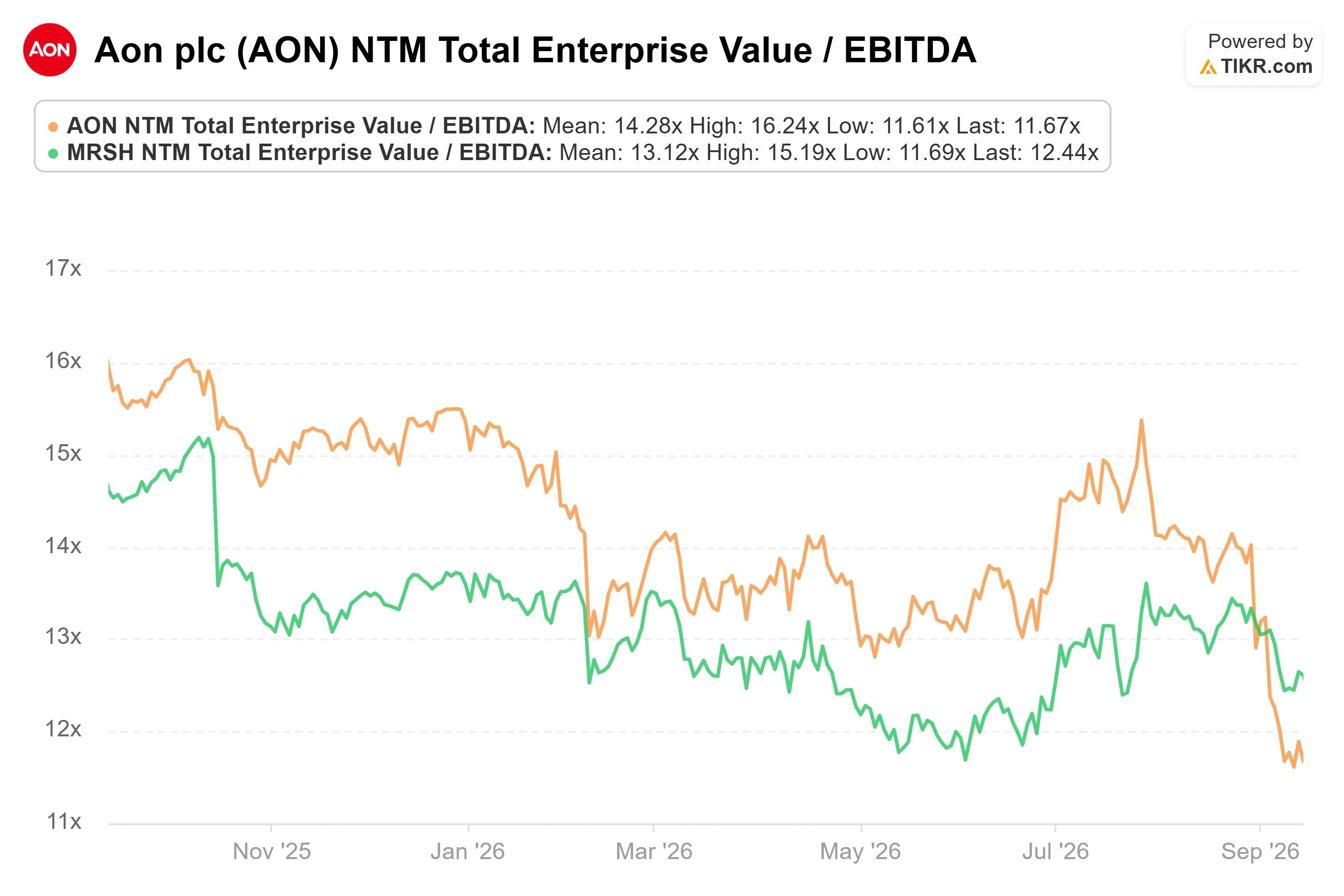
See how Aon performs against its peers in TIKR (It’s free!) >>>
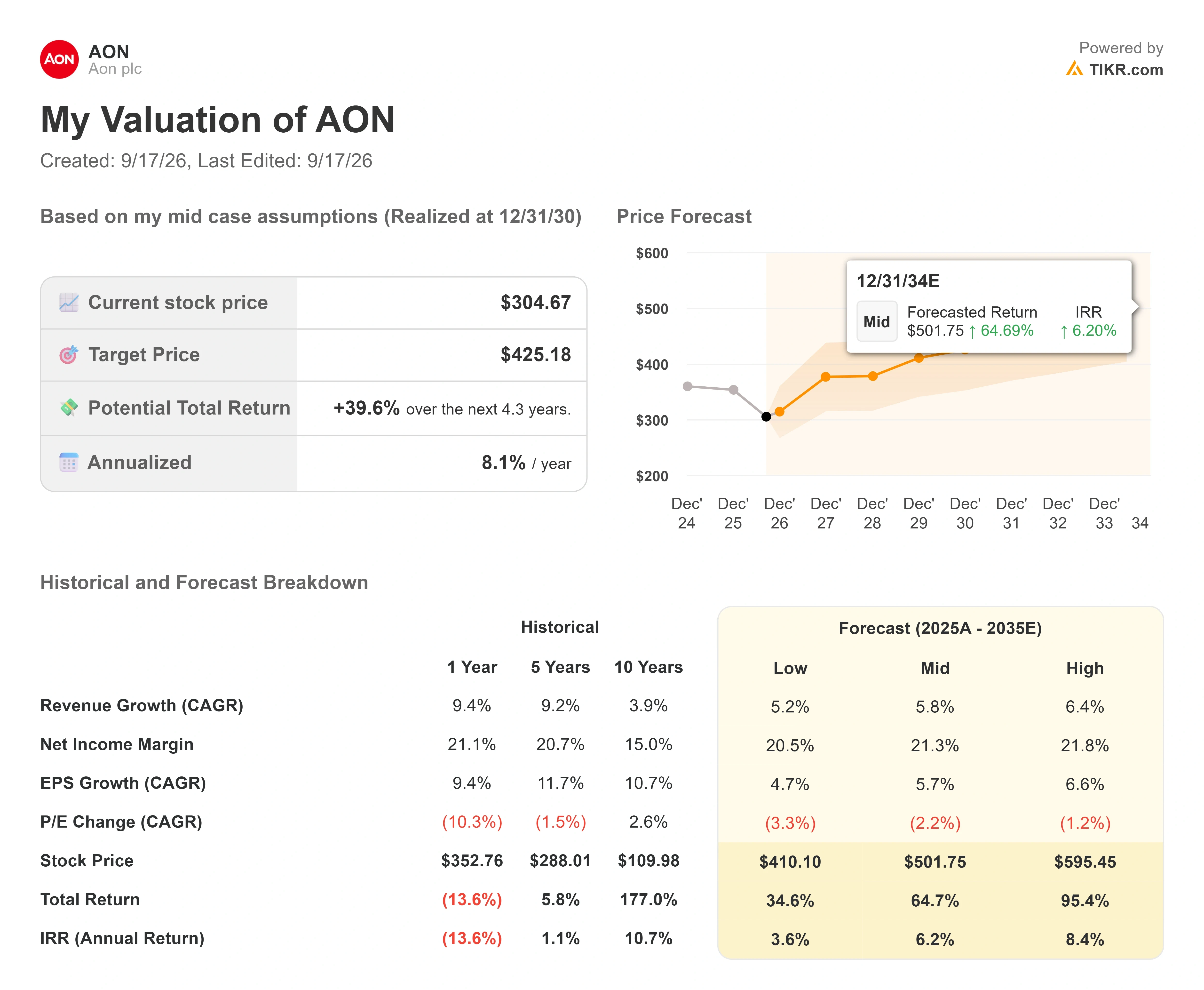
TIKR Advanced Model Analysis
- Current Price: $304.67
- Target Price (Mid): ~$425
- Potential Total Return: ~40%
- Annualized IRR: ~8% / year
See analysts’ growth forecasts and price targets for Aon stock (It’s free!) >>>
The TIKR mid-case values Aon at around $425 over roughly the next four years, an implied total return near 40%, or about 8% annualized. I use the mid case because it holds Aon to conservative assumptions and still clears a reasonable return, the honest way to answer a valuation question on a stock the market has just marked down.
Two drivers carry the revenue line. The first is Commercial Risk, the segment Case says ran above 10% organic in two of the last four quarters in the U.S. commercial risk. The second is the middle-market expansion now anchored by USI on top of NFP. The margin driver is Aon Business Services, the analytics and cost engine management credits for both synergy capture and operating leverage. The primary risk is integration and leverage: a $17 billion debt-funded deal that dilutes earnings in 2027 leaves little room for a stumble, and a paused buyback removes the cushion.
The upside case is that USI compounds like NFP did, synergies land at or above $395 million, and the discount to peers closes as execution shows up. The downside case is that integration drags, leverage lingers, and the stock stays cheap because the proof the market wants never arrives on schedule.
Conclusion
The number to watch is $395 million, and the date is Aon’s late-October third-quarter report. That print will not yet show USI, since the deal closes in the fourth quarter, but it will show whether the core business is still compounding at mid-single-digit organic growth while management carries the debt. Good looks like organic growth holding at 5% or better with guidance intact. Bad looks like a slip below that, or any softening in the confidence around the synergy target, which would signal the integration is already harder than promised. Until the synergies convert from a slide into reported EBITDA, this remains a stock the market prices for risk.
See what stocks billionaire investors are buying so you can follow the smart money with TIKR.
Should You Invest in Aon?
The only way to really know is to look at the numbers yourself. TIKR gives you free access to the same institutional-quality financial data that professional analysts use to answer exactly that question.
Pull up Aon, and you’ll see years of historical financials, what Wall Street analysts expect for revenue and earnings in the quarters ahead, how valuation multiples have moved over time, and whether price targets are trending up or down.
You can build a free watchlist to track Aon alongside every other stock on your radar. No credit card required. Just the data you need to decide for yourself.
Looking for New Opportunities?
- See what stocks billionaire investors are buying so you can follow the smart money.
- Analyze stocks in as little as 5 minutes with TIKR’s all-in-one, easy-to-use platform.
- The more rocks you overturn… the more opportunities you’ll uncover. Search 100K+ global stocks, global top investor holdings, and more with TIKR.
Disclaimer:
Please note that the articles on TIKR are not intended to serve as investment or financial advice from TIKR or our content team, nor are they recommendations to buy or sell any stocks. We create our content based on TIKR Terminal’s investment data and analysts’ estimates. Our analysis might not include recent company news or important updates. TIKR has no position in any stocks mentioned. Thank you for reading, and happy investing!


