Key Stats for Cisco Stock
- Current Price: $112.36
- Target Price (Mid): ~$142
- Street Target: ~$138
- Potential Total Return: ~27% (over ~4.9 years)
- Annualized: ~5% / year
Now Live: Discover how much upside your favorite stocks could have using TIKR’s new Valuation Model (It’s free) >>>
What Happened?
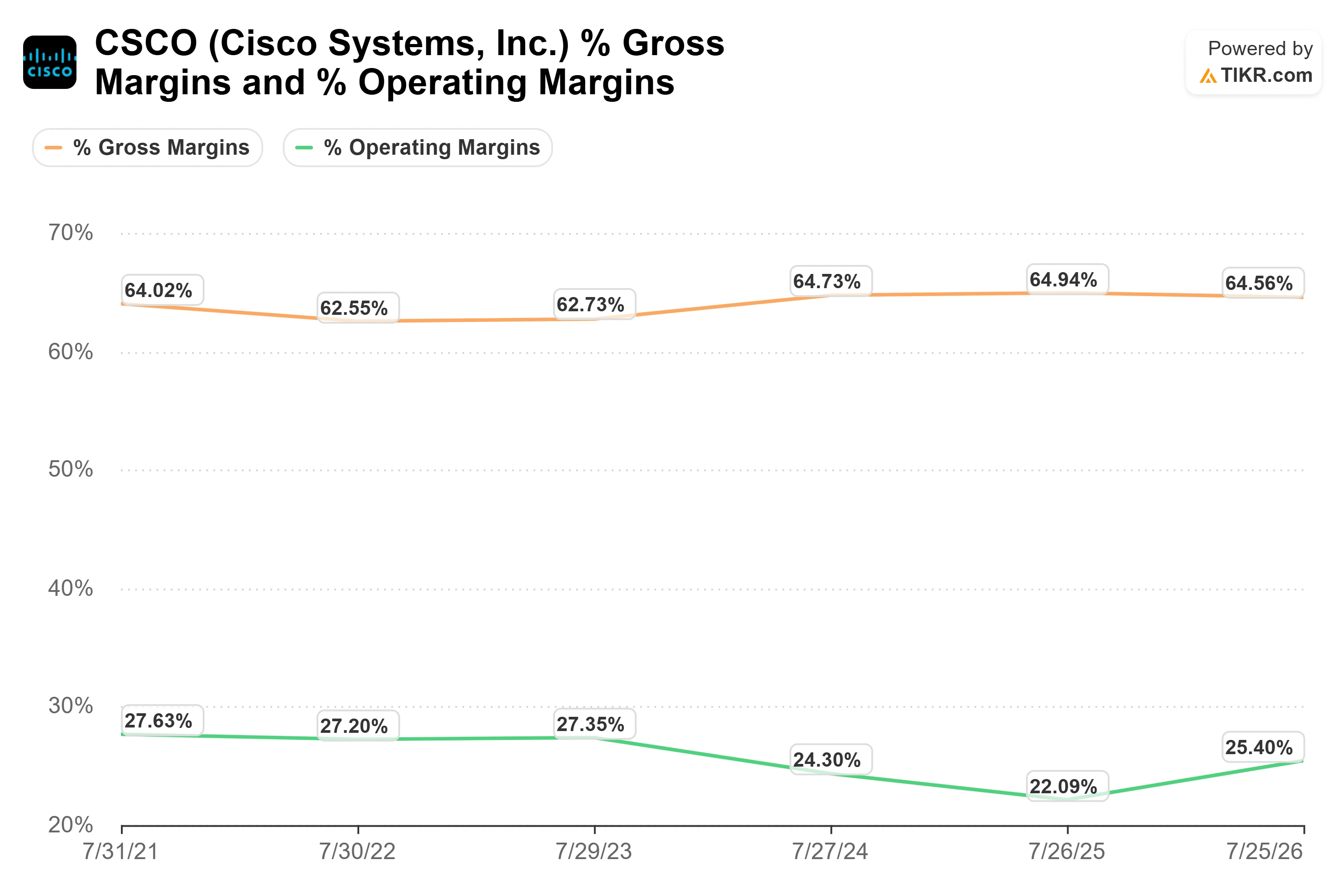
Cisco Systems (CSCO) closed the best fiscal year in its history, and the stock kept sliding after the report. Shares sit at $112.36, down about 14% from the $130.37 intraday high they touched in June, even after record fourth-quarter revenue of $17.3 billion reported on August 12, up 18% year over year, beating both the revenue and profit lines Wall Street expected. The problem was not the growth. It was the price of it: non-GAAP gross margin fell 210 basis points year over year to 66.3%, and product gross margin dropped 270 basis points to 64.8%. Investors took a record quarter and sold it, and shares closed down 8.4% the next session, on August 13, at $113.47.
Each dollar of its booming AI hardware business carries a thinner margin than the software and services investors spent a decade learning to value. On August 25, Cisco leaned further into exactly that trade-off, and the question for anyone buying here is whether the growth is worth the margin it costs.
The Margin Fear, and Why It May Miss How Cisco Earns
Total product orders rose 35% year over year in the fourth quarter, networking orders 40%, the eighth straight quarter of double-digit growth. Orders from service provider and cloud customers grew 95%, hyperscaler AI orders reached $9.3 billion for fiscal 2026 (about 4.5 times the prior year), and management now expects AI infrastructure revenue of $7.5 billion in fiscal 2027, up from about $4 billion. On the call, CEO Chuck Robbins argued the buildout is durable because AI “scale-across” traffic, linking data centers that have hit power limits, runs “roughly 14x what it might have been before.”
So why sell a record? Because Cisco was up more than 60% year to date going into the print, and the fresh news was about cost. When a premium stock delivers the expected growth but shows margins slipping underneath it, the marginal buyer leaves. Piper Sandler flagged that “peak growth × peak multiple” may already be visible as comparisons toughen.
CFO Mark Patterson noted that gross margin fell 210 basis points year over year while operating expenses fell 370 basis points as a share of revenue, lifting operating margin (gross margin actually rose 30 basis points from the prior quarter). Robbins was blunter: the hyperscale business grows at triple-digit rates while “our expenses to actually capture that growth are minimal in addition to what we spend today.” A low-margin order that costs almost nothing extra to win is still highly profitable at the operating margin line, which Cisco guided near 35% for fiscal 2027, a company high. The bet is coherent, but it is still a bet: if hardware mix climbs faster than scale offsets it, a premium stock has no cushion.

See historical and forward estimates for Cisco stock (It’s free!) >>>
A Strategic Step That Widens the Same Risk
On August 25, Cisco expanded its Secure AI Factory with Nvidia through a partnership with Supermicro, adding validated rack-scale, liquid-cooled server systems sold inside Cisco’s own AI portfolio starting in October 2026. Strategically, it matters: it gives Cisco an Nvidia Cloud Partner–compliant full-stack architecture that Neoclouds and sovereign clouds screen for before signing. It moved Supermicro shares more than Cisco’s, so it is not a near-term catalyst for the stock. It is a signal of direction, and the direction is more hardware, the exact ingredient that pressured margins this quarter.
Cisco trades near 21.8x NTM earnings and 16.2x NTM EV/EBITDA, well below Arista Networks at about 43.5x and 34x and Ciena at roughly 51.7x and 35.5x. Some gap is deserved, since Cisco grows slower and carries a heavier legacy mix. But a company compounding AI orders at this rate, at half its closest peers’ multiples, is not priced for the super cycle management keeps describing.
See how Cisco performs against its peers in TIKR (It’s free!) >>>
TIKR Advanced Model Analysis
- Current Price: $112.36
- Target Price (Mid): ~$142
- Potential Total Return: ~27% (over ~4.9 years)
- Annualized: ~5% / year

See analysts’ growth forecasts and price targets for Cisco stock (It’s free!) >>>
TIKR’s mid-case model, realized at July 31, 2031, targets around $142, a total return of roughly 27% over about 4.9 years, or close to 5% annualized. That measured number tells you something: at $112, the model already credits Cisco for the super cycle rather than betting on a re-rating.
- Revenue drivers: AI infrastructure scaling toward the guided $7.5 billion in fiscal 2027, and the broad campus and enterprise refresh, where orders grew 20% with every product category up.
- Margin driver: operating leverage from the hyperscale business.
- Primary risk: hardware mix compressing profitability faster than scale offsets it.
- Upside: AI revenue overshoots $7.5 billion, and operating margin expands past 35%, pushing toward the high-case path near $195.
- Downside: memory costs and mix keep gross margin sliding, growth normalizes, and a premium multiple compresses on a stock already offering a modest return.
Conclusion
The next test is November 12, when Cisco reports fiscal first-quarter results. It already guided to $18 billion to $18.2 billion in revenue and $1.32 to $1.34 in EPS, so the beat is nearly expected. Watch gross margin against the 65% to 66% guide instead. Hold that line, or better, and Patterson’s operating-leverage argument gets the proof it needs. Slip below it while hardware mix keeps rising, and the market’s margin fear stops being a worry and becomes a trend. Cisco spent a year proving it can win the orders. The number that decides the stock now is the one it keeps on them.
See what stocks billionaire investors are buying so you can follow the smart money with TIKR.
Should You Invest in Cisco?
The only way to really know is to look at the numbers yourself. TIKR gives you free access to the same institutional-quality financial data that professional analysts use to answer exactly that question.
Pull up Cisco, and you’ll see years of historical financials, what Wall Street analysts expect for revenue and earnings in the quarters ahead, how valuation multiples have moved over time, and whether price targets are trending up or down.
You can build a free watchlist to track Cisco alongside every other stock on your radar. No credit card required. Just the data you need to decide for yourself.
Looking for New Opportunities?
- See what stocks billionaire investors are buying so you can follow the smart money.
- Analyze stocks in as little as 5 minutes with TIKR’s all-in-one, easy-to-use platform.
- The more rocks you overturn… the more opportunities you’ll uncover. Search 100K+ global stocks, global top investor holdings, and more with TIKR.
Disclaimer:
Please note that the articles on TIKR are not intended to serve as investment or financial advice from TIKR or our content team, nor are they recommendations to buy or sell any stocks. We create our content based on TIKR Terminal’s investment data and analysts’ estimates. Our analysis might not include recent company news or important updates. TIKR has no position in any stocks mentioned. Thank you for reading, and happy investing!