


Key Stats for Tesla Stock
- Current Price: $345.82
- Target Price (Mid): ~$1,610
- Street Target: ~$390
- Potential Total Return: ~365%
- Annualized IRR: ~42% / year
Now Live: Discover how much upside your favorite stocks could have using TIKR’s new Valuation Model (It’s free) >>>
What Happened?
Tesla (TSLA) just won permission to flood Las Vegas with driverless cars, and the approval says more about the stock’s problem than its promise. On August 20, the Nevada Transportation Authority unanimously cleared Tesla to run up to 5,000 autonomous vehicles across Clark County, erasing the 10-car interim cap regulators had set weeks earlier. Shares rose 5.14% on August 21, a day after the Nevada vote and the same day China folded Tesla into a sweeping, industry-wide recall covering more than 4.3 million vehicles across nine automakers, roughly 2.98 million of them Teslas, over door handles that can be hard to open after a crash. The stock rose anyway.
Investors are pricing Tesla on autonomy, not on the car business, which is why a 5,000-car robotaxi approval lifted the stock while its share of a multi-million-car recall barely registered. By the August 26 close, shares sat at $345.82, and that is the price the autonomy story now has to justify. Because the permit ceiling is not the real constraint. Tesla’s tracked unsupervised robotaxi fleet, across every U.S. city it serves, is roughly 20 active vehicles. Whether that fleet and the software behind it can scale fast enough to support 181 times forward earnings is the only question that matters
The Permit Says 5,000. The Trackers Say 20
The Authority extended Tesla’s authority to the entire county, with room to request a wider geofence later, and Tesla told regulators that paid rides could begin within about 30 days, pending inspections and fare approval. On paper, Tesla now holds close to the fleet ceiling it first requested.
The operating reality is smaller by orders of magnitude. As of the most recent third-party tracking through mid-2026, Tesla’s active unsupervised fleet was about 20 vehicles nationwide, down from a peak near 25 in late April. Dallas and Houston have sat at a handful of cars each since launch. Ten more robotaxis in Las Vegas would lift the tracked national fleet by roughly 50%, which shows how early this is.
On the Q2 call, VP of AI Ashok Elluswamy said the fleet had driven more than 380,000 unsupervised miles across six cities with, by Tesla’s own count, “0 notable incidents.” He framed the multi-city strategy as proof the software generalizes: “We just want to like both prove to ourselves and to other folks that it is working across a lot of different cities without too much effort per city.”
See historical and forward estimates for Tesla stock (It’s free!) >>>
Why the Fleet Stays Small on Purpose
Elon Musk has tied real scaling to reliability. His term for it on the call was the “march of nines,” the climb toward enough consecutive nines of reliability to pull human oversight at volume. “Ideally, you want 99.999999% reliable,” he said, calling that progression “the only thing really constraining our growth in robotaxi.” A 5,000-car approval changes nothing until that curve gets there.
The Cybercab adds a concrete second brake. Because it is a new chassis, Tesla must accumulate driving data specific to that vehicle before deploying it widely, so the first Cybercabs run retrofitted with steering wheels and pedals to calibrate the platform. Musk said the count stays low until that data exists, then will “increase dramatically.” Production only began in Q2. The purpose-built robotaxi meant to make the economics work is itself in the flat part of its ramp.
A Multiple Only Autonomy Can Justify
CFO Vaibhav Taneja said Tesla exited Q2 with its largest order backlog since 2023, and that FSD reached nearly 1.5 million paid customers globally, with about 55% of North American deliveries leaving the lot with FSD enabled. Energy storage deployed 13.5 GWh in the quarter, up 53% sequentially. These are the higher-margin software and services streams the bull case is built on.
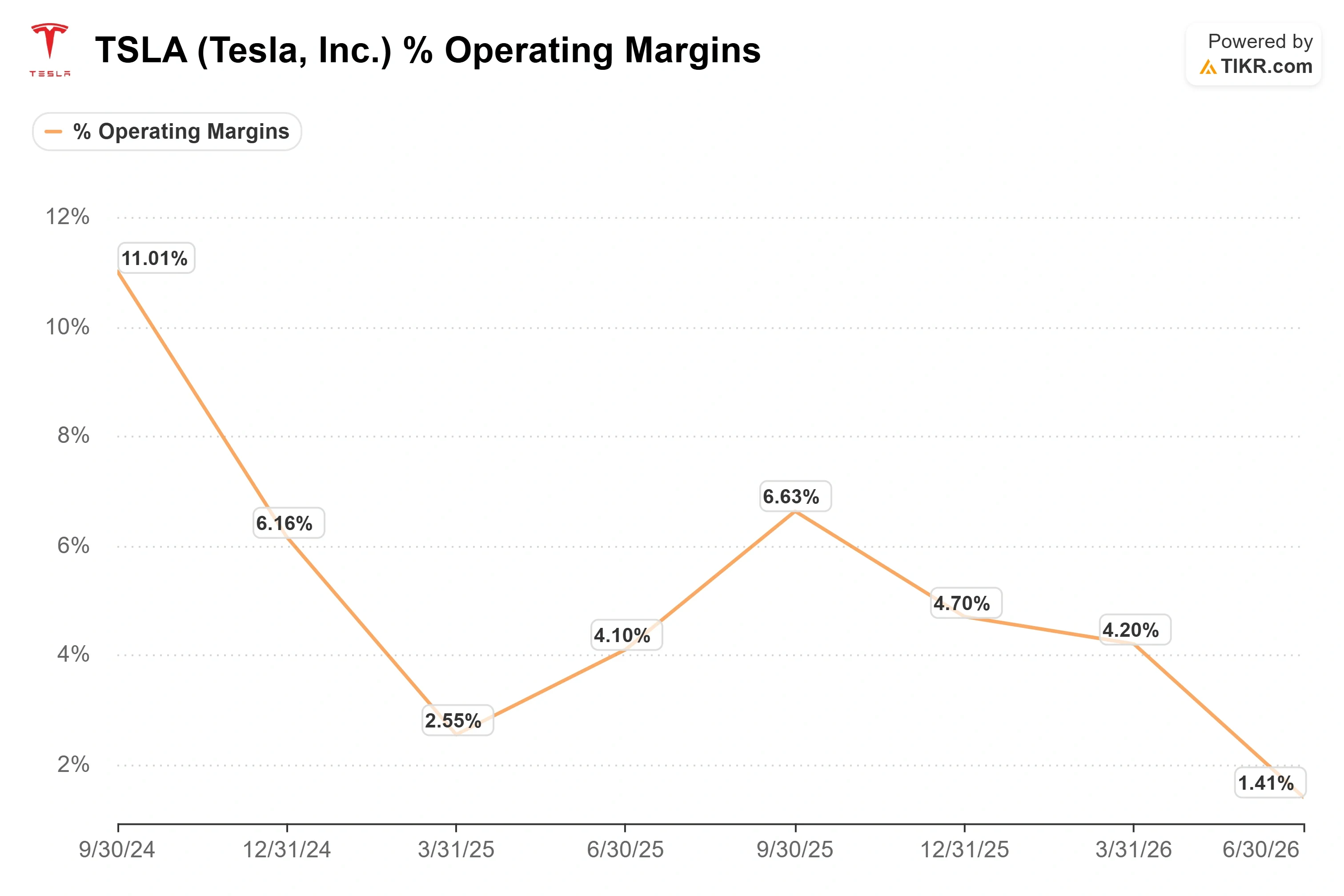
Q2 revenue hit a record $28.24 billion, up 25.5% year over year and 6.6% above consensus, yet operating margin was just 1.4%, down from 4.1% a year earlier, and EBIT of $398 million missed estimates by more than 70%. Adjusted EPS of $0.33 missed by roughly 39%, and free cash flow was negative $1.09 billion as 2026 CapEx guidance topped $25 billion, funded partly by up to $30 billion in new debt capacity. Tesla is selling more cars than ever and earning almost nothing on them, by design, because every dollar is redirected into the next platform. On the Q1 call, Musk said robotaxi “likely will not see material revenue until at least 2027,” so the spending runs years ahead of the payoff.
Tesla trades at 181.67 times NTM earnings and 77.38 times NTM EV/EBITDA. General Motors sits at 0.96 times forward EV/revenue and Ford at 1.09 times, against Tesla’s 12.04 times and a peer median of 0.66 times. That is more than 18 times the median on a sales basis, a premium the car business cannot defend. It is a call option on autonomy and robotics, and the Nevada approval keeps the option alive without yet proving it pays.

See how Tesla performs against its peers in TIKR (It’s free!) >>>
TIKR Advanced Model Analysis
- Current Price: $345.82
- Target Price (Mid): ~$1,610 by 2030
- Potential Total Return: ~365%
- Annualized IRR: ~42% / year

See analysts’ growth forecasts and price targets for Tesla stock (It’s free!) >>>
Two drivers carry the revenue line. First, autonomy monetization: FSD’s nearly 1.5 million paid subscribers today, with robotaxi fares layering on once the fleet scales past its current ~20 cars. Second, energy storage, growing off that 53% sequential jump toward a mid-to-low 20% gross margin as data-center demand builds. The margin driver is net income margin recovering toward roughly 20% by 2030 as software and energy grow faster than the auto base.
The primary risk is time: free cash flow stays negative through the heaviest CapEx years, and every slip in the reliability curve or the Cybercab ramp pushes the payoff further out while spending continues. Upside: if unsupervised FSD generalizes and the fleet compounds as management claims, today’s 181x multiple looks cheap in hindsight. Downside: autonomy stays perpetually “next year,” the car business keeps earning single-digit margins, and the stock re-rates toward the peers it now trades at 18 times.
Conclusion
Watch the fleet count, not the permit ceiling. The number that confirms or breaks this thesis is unsupervised vehicles actually on the road, and the catalyst that moves it is FSD v15, the software rewrite Musk has tied all aggressive scaling to. If the tracked national fleet is still near 20 cars when Tesla reports Q3 on approximately October 28, the Nevada approval was theater. If v15 ships and the count starts compounding, the autonomy story earns its multiple.
See what stocks billionaire investors are buying so you can follow the smart money with TIKR.
Should You Invest in Tesla?
The only way to really know is to look at the numbers yourself. TIKR gives you free access to the same institutional-quality financial data that professional analysts use to answer exactly that question.
Pull up Tesla, and you’ll see years of historical financials, what Wall Street analysts expect for revenue and earnings in the quarters ahead, how valuation multiples have moved over time, and whether price targets are trending up or down.
You can build a free watchlist to track Tesla alongside every other stock on your radar. No credit card required. Just the data you need to decide for yourself.
Looking for New Opportunities?
- See what stocks billionaire investors are buying so you can follow the smart money.
- Analyze stocks in as little as 5 minutes with TIKR’s all-in-one, easy-to-use platform.
- The more rocks you overturn… the more opportunities you’ll uncover. Search 100K+ global stocks, global top investor holdings, and more with TIKR.
Disclaimer:
Please note that the articles on TIKR are not intended to serve as investment or financial advice from TIKR or our content team, nor are they recommendations to buy or sell any stocks. We create our content based on TIKR Terminal’s investment data and analysts’ estimates. Our analysis might not include recent company news or important updates. TIKR has no position in any stocks mentioned. Thank you for reading, and happy investing!


