

Key Stats for Intel Stock
- Current Price: $88.24
- Target Price (Mid): ~$198
- Street Target: ~$115
- Potential Total Return: ~124%
- Annualized IRR: ~20% / year
Now Live: Discover how much upside your favorite stocks could have using TIKR’s new Valuation Model (It’s free) >>>
What Happened?
Intel Corporation (INTC) sold $23 billion of stock this month, and the buyers are already underwater. The company priced 210.5 million shares at $95 on August 10, upsized from a planned $15 billion after the book drew more than $100 billion in orders, and underwriters exercised their full over-allotment the next day, lifting total issuance to about 242 million shares. Twelve trading days later, the stock changed hands near $88, below the price every institution paid.
That is the backdrop CFO Dave Zinsner walked into at the Deutsche Bank Technology Conference on August 26. The question hanging over the stock is simple to state and hard to answer: does the dilution buy something worth owning, or did Intel sell a piece of itself at a top that is already gone? His answer was that the capital comes first and the build follows.

See historical and forward estimates for Intel stock (It’s free!) >>>
“The Capital Raise Precedes Capital Investment”
Zinsner did not treat the raise as defensive. “The capital raise precedes capital investment,” he said. Intel already lifted 2026 capital spending to around $20 billion from $18 billion, with 2027 set to move significantly higher, and constrained substrates mean the company has to commit cash to suppliers before the revenue arrives.
As data center workloads move from training to inference to agentic, compute shifts back toward CPUs, and Zinsner put the CPU requirement for an agentic setup at four to six times a standard training cluster. It shows in the numbers: Intel’s Data Center and AI revenue grew 59% year over year to $6.3 billion in the second quarter, inside a quarter where total revenue rose about 25% to $16.1 billion and beat the Street by nearly 12%. A server business shrinking on units a year ago now has units and pricing rising together.
The constraint is supply: for this year, next year, and possibly into 2028, Zinsner said the story “is going to be less about competitive performance of CPUs and more about can you get the CPUs to the customer.” Intel plans to more than double output at its Intel 3 fab in Ireland next year to chase that gap.
The 14A Signal That Convinced the Cynics
The forward-looking part of the session was 14A, the node after 18A, and the tell was who is designing on it. Intel let its own product teams choose whether to build internally or go outside, and Zinsner called those internal customers “probably the most cynical bunch out of anybody.” They are now designing on 14A. External foundry engagement has moved past reviewing data to asking how much capacity they can reserve, with CEO Lip-Bu Tan meeting customers weekly.
That is why Intel committed to high-volume 14A manufacturing in 2028 and is spending against it now. The 0.9 process design kit lands in October, and Zinsner said 14A defect density is tracking better than any prior node, a level Intel has not seen since its 22-nanometer node, one of the best it ever shipped. Risk production starts in 2027, so the orders cannot wait.
Advanced packaging is the second leg, and here Zinsner gave numbers that the market has ignored. Intel’s EMIB-T technology should become a business worth multiple billions of dollars per customer per year, ramping in late 2027 and hitting its stride by 2029. He guided its margins to roughly 40% gross and 30% operating, with low capital intensity that makes its return on invested capital “phenomenal.” His proof point: Tan hired Seok-Hee, the former CEO of SK Hynix, to run it.

See how Intel performs against its peers in TIKR (It’s free!) >>>
The Margin Math the Selloff Ignored
Intel’s client CPU share fell below 70% for the first time since the 1990s, landing at 69.7% as AMD took a record 30.3%, per Mercury Research, and the stock dropped on the news. And the raise created a supply overhang that has kept shares below the $95 offer price. Zinsner’s answer to both was margins. Intel entered 2026 with a plan that had “a three on it,” meaning high-30s gross margin, and he pushed the businesses past it.
Gross margin printed 41.8% on a non-GAAP basis last quarter, and he now calls the company “comfortably in the 40s,” with a path he framed toward something that “starts with a five.” The drag is honest: foundry, advanced packaging, and the new ASIC business all run near 40% gross margin, so each weighs on the blend even as it grows.
Intel Foundry grew revenue 31% last quarter to about $5.8 billion, but external customers were only around $293 million of it, and the unit posted an operating loss estimated near $2.1 billion. Zinsner is driving foundry to breakeven by the end of 2027 while admitting that more customer wins mean more startup costs and could push the crossover into 2028. More success extends the losses before it ends them. That trade is why Intel trades near 53 times forward earnings, per TIKR data, against roughly 43 times for AMD and 19 times for Nvidia.
Paying the highest multiple in the group for the business with the deepest losses only works if the foundry inflects, the same wager the cash flow line makes, with analysts modeling free cash flow negative through 2027 before it turns sharply positive later in the decade. This is a turnaround premium, priced for the turnaround to land. The Street has not taken a side on it: TIKR shows 12 buys, and 2 outperform against 32 holds, 1 underperform, and 1 sell, a mean target near $115 that implies roughly 30% upside but sits on a recommendation split with no conviction either way.
TIKR Advanced Model Analysis
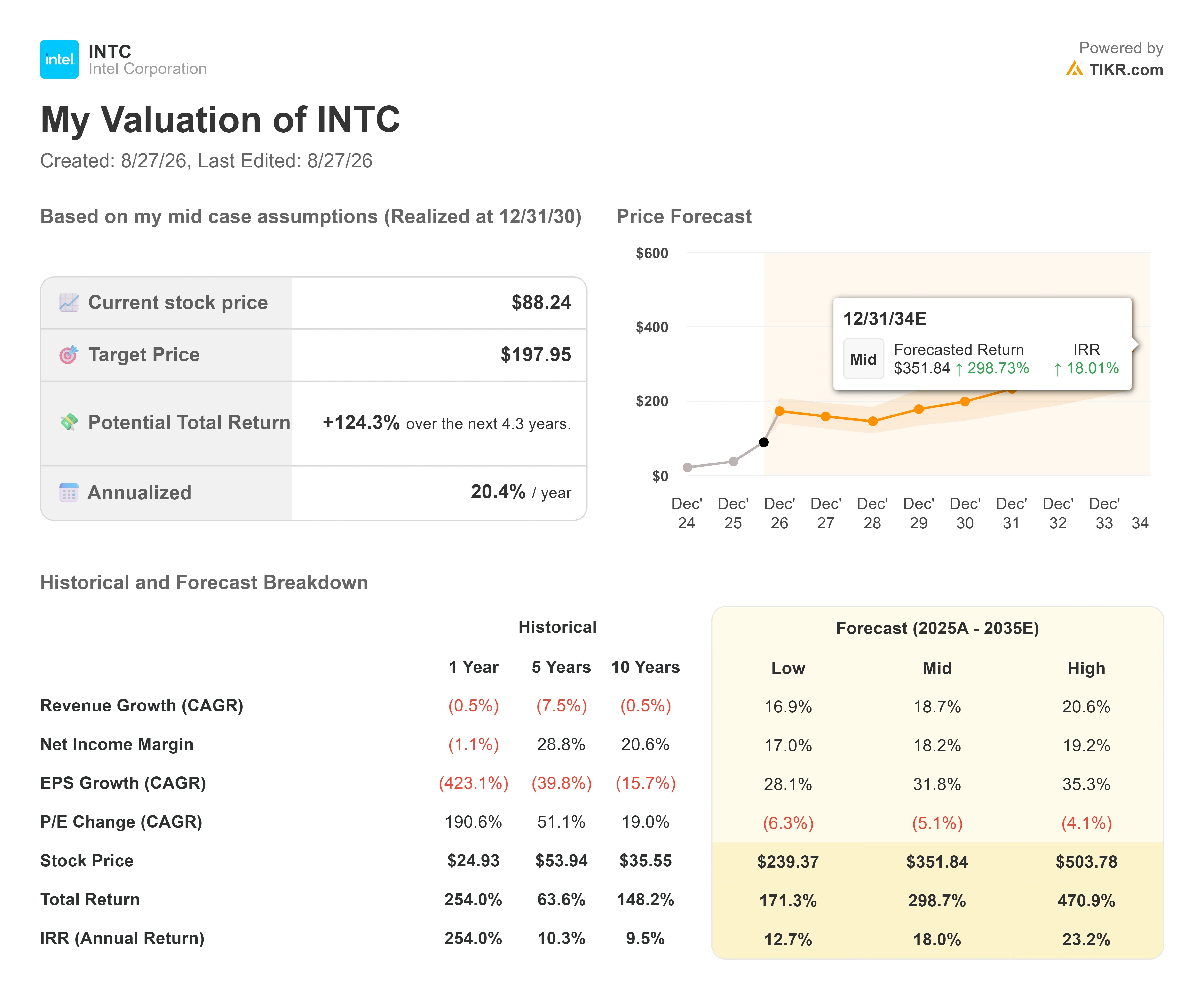
- Current Price: $88.24
- Target Price (Mid): ~$198
- Potential Total Return: ~124%
- Annualized IRR: ~20% / year
See analysts’ growth forecasts and price targets for Intel stock (It’s free!) >>>
The model points to a share price around $198 by the end of 2030, a total return near 124%, and roughly 20% per year. Two drivers carry the revenue line: the data center CPU cycle, where units and ASP per core are rising together for the first time in years, and the external foundry and packaging ramp led by 14A and EMIB-T. The margin driver is factory utilization and node mix, as weaker older nodes give way to 18A and 14A with better yields. The primary risk is the foundry loss elongating: every external win adds startup cost before profit, and a breakeven that slips deep into 2028 drags the free cash flow turn out with it. The upside is that CPU supply constraints and clean 18A and 14A ramps let Intel convert its manufacturing ownership into shares and margin at once. The downside is that Foundry keeps burning $2 billion a quarter while external revenue stalls near $300 million, and the premium multiple compresses toward its peers.
Conclusion
The Q3 report, due in late October near the same window as the 14A 0.9 process design kit, is where words become receipts. Watch two numbers. Gross margin holding in the 40s confirms the story Zinsner is selling; a slip toward the high 30s breaks it. And foundry external revenue climbing off roughly $293 million would show the 14A conviction is turning into orders, while a flat line says the weekly meetings are still just meetings. The raise gave Intel the cash to place its bets. The next print starts showing whether they pay.
See what stocks billionaire investors are buying so you can follow the smart money with TIKR.
Should You Invest in Intel?
The only way to really know is to look at the numbers yourself. TIKR gives you free access to the same institutional-quality financial data that professional analysts use to answer exactly that question.
Pull up Intel, and you’ll see years of historical financials, what Wall Street analysts expect for revenue and earnings in the quarters ahead, how valuation multiples have moved over time, and whether price targets are trending up or down.
You can build a free watchlist to track Intel alongside every other stock on your radar. No credit card required. Just the data you need to decide for yourself.
Looking for New Opportunities?
- See what stocks billionaire investors are buying so you can follow the smart money.
- Analyze stocks in as little as 5 minutes with TIKR’s all-in-one, easy-to-use platform.
- The more rocks you overturn… the more opportunities you’ll uncover. Search 100K+ global stocks, global top investor holdings, and more with TIKR.
Disclaimer:
Please note that the articles on TIKR are not intended to serve as investment or financial advice from TIKR or our content team, nor are they recommendations to buy or sell any stocks. We create our content based on TIKR Terminal’s investment data and analysts’ estimates. Our analysis might not include recent company news or important updates. TIKR has no position in any stocks mentioned. Thank you for reading, and happy investing!


