Key Takeaways
- Vertiv Holdings Co (VRT) and Eaton Corp (ETN) sell power and cooling equipment that almost every data center needs, regardless of which artificial intelligence company wins the race.
- Both companies posted record backlogs and raised full-year guidance in their second-quarter 2026 earnings calls, signaling strong future demand.
- Valuation multiples for both stocks are near their historical highs, meaning investors are already pricing in a lot of future growth.
Now Live: Discover how much upside your favorite stocks could have using TIKR’s new Valuation Model (It’s free)>>>
Every time a company breaks ground on a new data center, two names tend to show up in the paperwork: Vertiv and Eaton.
Neither company builds chips or trains AI models. Instead, they sell the equipment that keeps those chips running and cool.
That makes them a classic picks-and-shovels play.
During the California Gold Rush, the miners who struck it rich weren’t always guaranteed a payday, but the people selling picks and shovels made money either way.
Applied to today’s AI boom, the idea is simple.
Instead of betting on which AI company wins, investors can bet on the physical buildout itself, since nearly every data center needs the same core equipment no matter who occupies it.
Estimate a company’s fair value instantly (Free with TIKR) >>>
What Vertiv and Eaton do?
Vertiv makes the power and cooling systems that keep data centers running and stop servers from overheating. Its products include uninterruptible power supplies, liquid cooling systems, and thermal management technology, according to the company’s business description.
Eaton makes the electrical equipment that safely moves power through those buildings, including switchgear, circuit protection, and power distribution products, per the company’s filings.
Together, the two companies cover a data center from the electrical grid down to the chip. Eaton CEO Paulo Sternadt described this as a “grid to chip” strategy on the company’s July 31 earnings call.
Backlogs point to years of locked-in demand
A useful number to watch for either stock is backlog. That’s the value of orders already booked but not yet delivered.
A rising backlog means a company already has future business lined up, even before it ships another product.
Eaton’s total U.S. data center backlog has grown to 307 gigawatts, or 15 years of backlog at 2025 build rates, up from 12 years in the company’s prior update, Sternadt said on the call. Only about 20% of that backlog converts near term, meaning most of it stretches into 2028 and beyond.
Eaton’s Electrical segment backlog was up 43% year over year in the second quarter, Chief Financial Officer Dave Foster said.
Book-to-bill, a measure comparing new orders to what’s shipped, came in at 1.2 for the company overall and 1.3 for its Americas electrical business, meaning orders are outpacing deliveries.
Vertiv doesn’t disclose backlog the same way, but its deferred revenue, tied to customer deposits on large projects, rose sharply in the quarter.
CFO Craig Chamberlin said the increase reflects project advance payments and milestone collections tied to large-scale infrastructure orders, according to the company’s July 29 earnings call.
See what analysts think about Vertiv stock right now (Free with TIKR) >>>
The numbers behind the growth story
Eaton posted second quarter revenue of $8.5 billion, up 21% year over year, with adjusted earnings per share of $3.15, beating guidance by 10 cents at the midpoint, according to the company’s earnings release. Data center orders inside its Electrical Americas segment grew about 65%, Foster said.
Vertiv’s second quarter net sales rose 24% year over year to $3.274 billion, with an adjusted operating margin of 22.6%, up 410 basis points from a year earlier, according to the company’s earnings materials. Adjusted free cash flow jumped 234% to $925 million.

Both companies raised full-year guidance. Eaton now expects adjusted EPS of $13.50 at the midpoint, up from a prior $13.28. Vertiv raised its full-year adjusted EPS outlook to $6.70, up 60% from 2025.
Revenue projections tell a similar growth story.
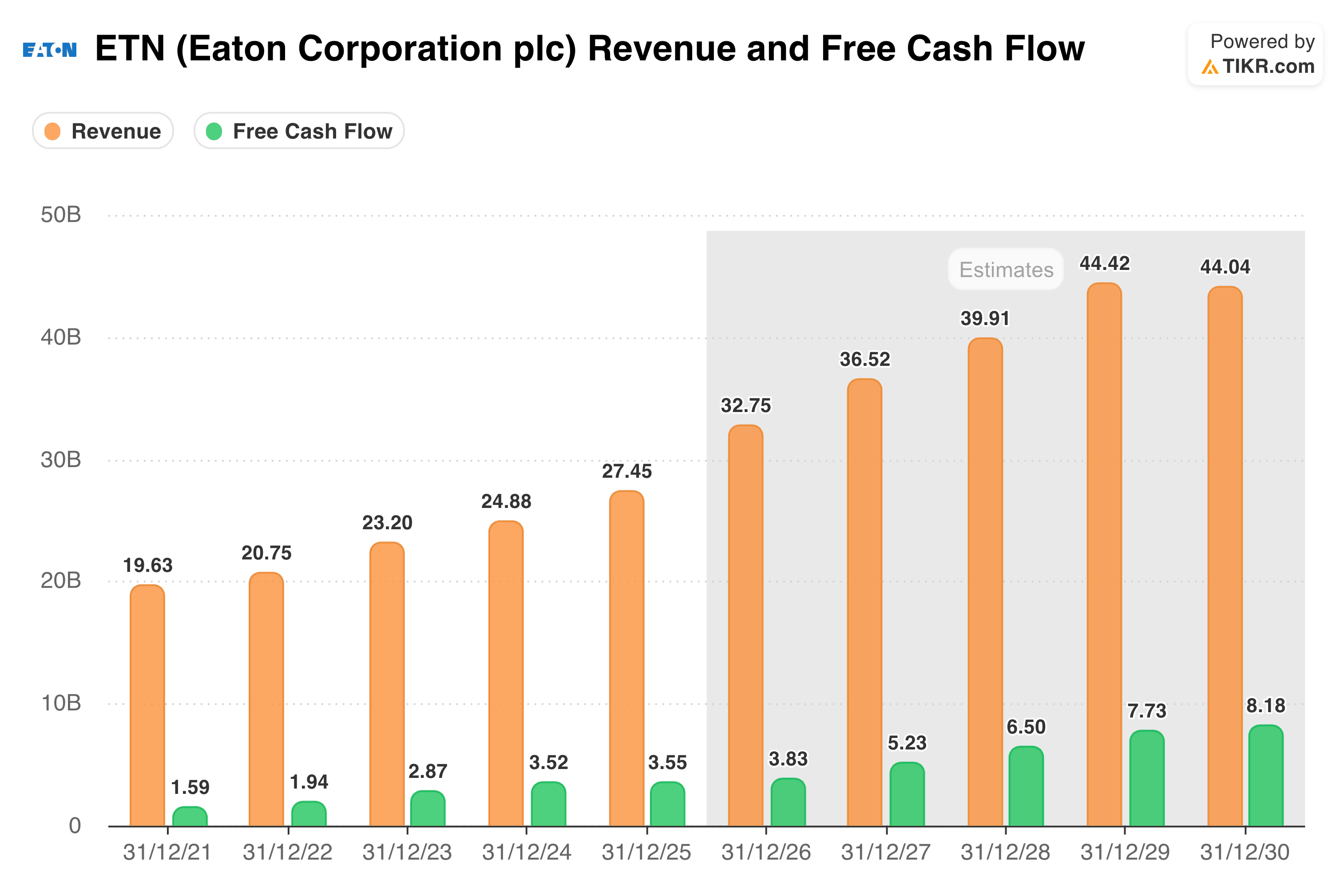
Eaton’s revenue is expected to climb from $27.45 billion in 2025 to $44.04 billion by 2030, per TIKR.com estimates.
Vertiv’s revenue is projected to grow from $10.23 billion in 2025 to $25.67 billion over the same stretch.
See analysts’ full growth forecasts and estimates for Eaton stock (It’s free) >>>
What the valuation numbers say
None of this means the stocks are cheap. Vertiv’s forward price-to-earnings ratio recently sat at 33.76 times, above its historical mean of 26.32 times, according to TIKR.com data.
Eaton’s forward P/E was 27.96 times, also above its long-term average of 20.95 times.

One valuation model built on TIKR.com projects Eaton reaching $635.20 by the end of 2030 under a mid-case scenario, a potential 51.4% total return, or about 10% annualized.
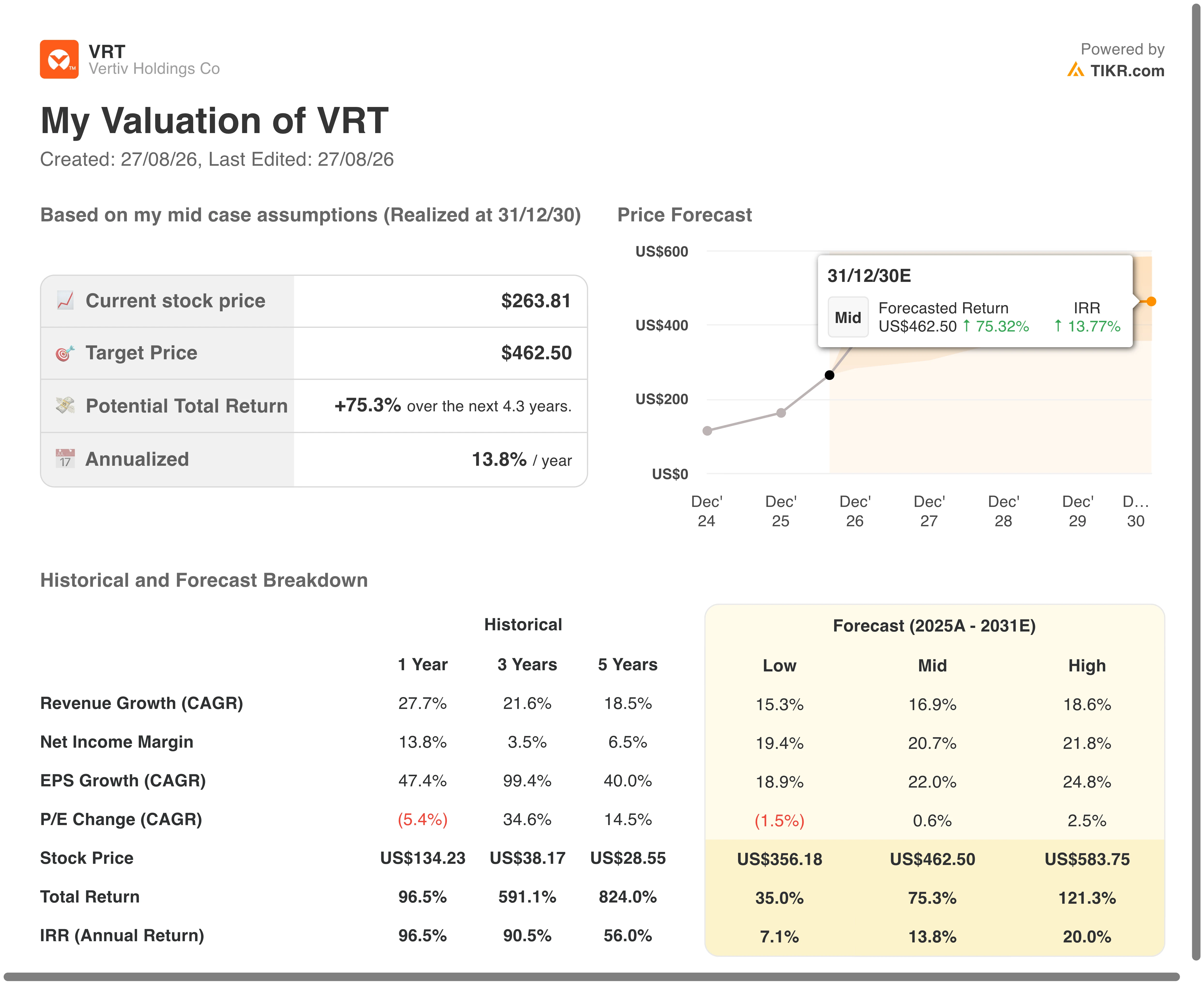
For Vertiv, the same type of model shows a $462.50 target, implying a 75.3% total return, or roughly 13.8% annualized.
The pitch for both stocks isn’t about predicting which AI company or chip maker comes out on top. It’s about the physical infrastructure that has to get built regardless of the winner.
Investors weighing these names should compare growth, profitability, and backlog trends using a financials tab, check how much of that growth is already priced in through a valuation tab, and review analyst estimates before deciding if the current price still leaves room to run.
See a stock’s true value in under 60 seconds (Free with TIKR) >>>
How Much Upside Does Vertiv Stock Have From Here?
With TIKR’s new Valuation Model tool, you can estimate a stock’s potential share price in under a minute.
All it takes is three simple inputs:
- Revenue Growth
- Operating Margins
- Exit P/E Multiple
If you’re not sure what to enter, TIKR automatically fills in each input using analysts’ consensus estimates, giving you a quick, reliable starting point.
From there, TIKR calculates the potential share price and total returns under Bull, Base, and Bear scenarios so you can quickly see whether a stock looks undervalued or overvalued.
See a stock’s true value in under 60 seconds (Free with TIKR) >>>
Looking for New Opportunities?
- See what stocks billionaire investors are buying so you can follow the smart money.
- Analyze stocks in as little as 5 minutes with TIKR’s all-in-one, easy-to-use platform.
- The more rocks you overturn… the more opportunities you’ll uncover. Search 100K+ global stocks, global top investor holdings, and more with TIKR.
Disclaimer:
Please note that the articles on TIKR are not intended to serve as investment or financial advice from TIKR or our content team, nor are they recommendations to buy or sell any stocks. We create our content based on TIKR Terminal’s investment data and analysts’ estimates. Our analysis might not include recent company news or important updates. TIKR has no position in any stocks mentioned. Thank you for reading, and happy investing!