
Key Stats for Snap Stock
- Current Price: $5.92
- Target Price (Mid): ~$9.20
- Street Target: ~$7.40
- Potential Total Return: ~56%
- Annualized IRR: ~11% / year
Now Live: Discover how much upside your favorite stocks could have using TIKR’s new Valuation Model (It’s free) >>>
What Happened?
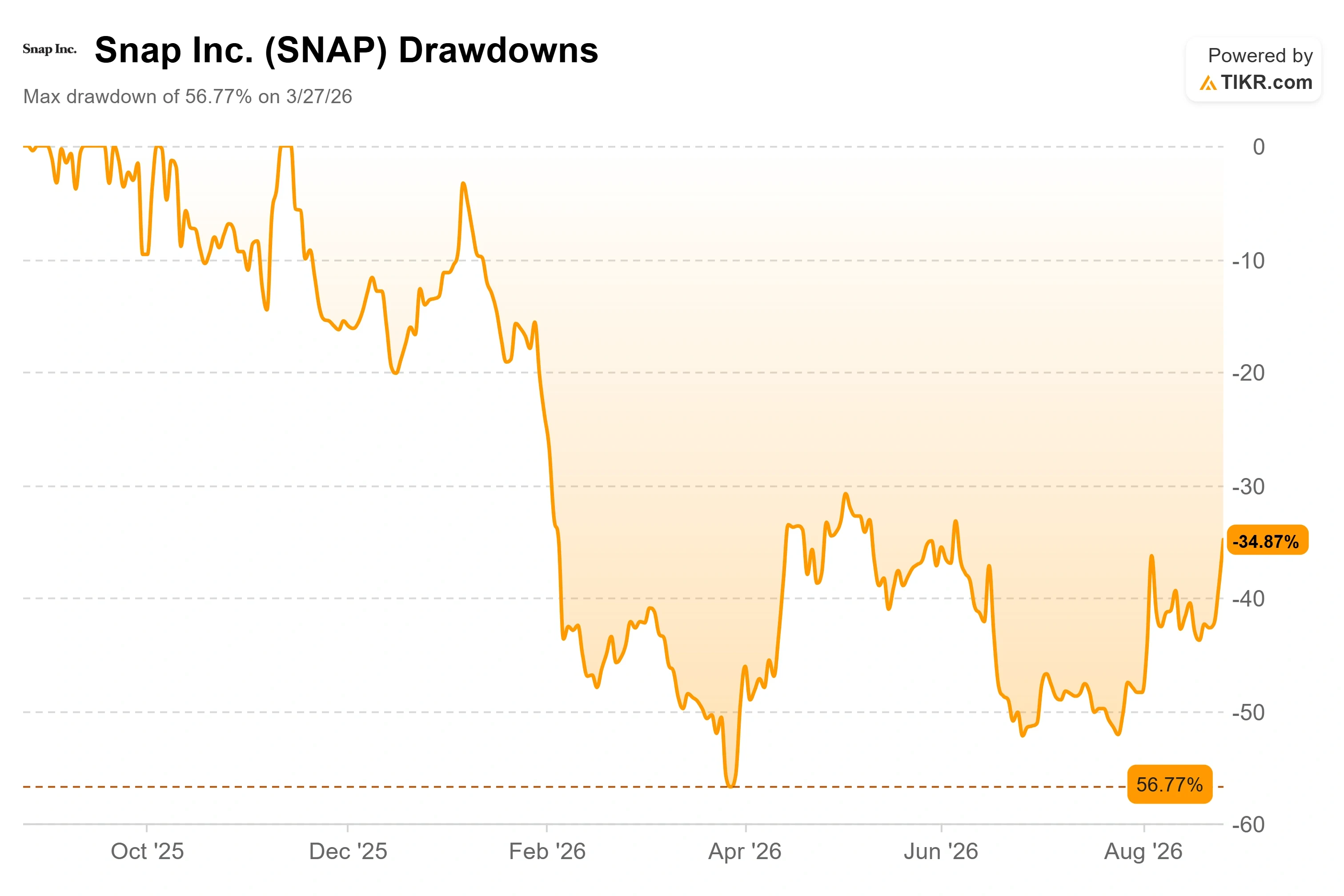
Snap Inc. (SNAP) has spent most of 2026 as a stock people bet against, and it just spent a month reminding them why that trade is dangerous. Shares closed at $5.92 on August 25, up 7% on the day and roughly 26% above their late-July lows near $4.69. The move traces back to one night: Snap’s second-quarter report on August 3, which beat on revenue, adjusted profit, and cash flow while still posting a narrower net loss, and sent the stock up almost 15% in a single session.
The question is whether a company that has destroyed shareholder value for years has actually changed, or whether this is another sharp bounce in a stock that has served up several of them. Management spent the call arguing it is the former, and it reframed the entire investment case around a single number to make that argument.
The Metric Snap Wants You to Judge It On Now
On the Q2 call, it changed the assignment. Chief Executive Officer and Co-Founder Evan Spiegel said free cash flow per share “will be our primary financial objective going forward,” and Chief Financial Officer Doug Hott built his remarks around the same idea, tying it to operating discipline, capital allocation, and dilution control. The “per share” part is the point: Snap wants credit for generating cash and for not diluting shareholders while it does.
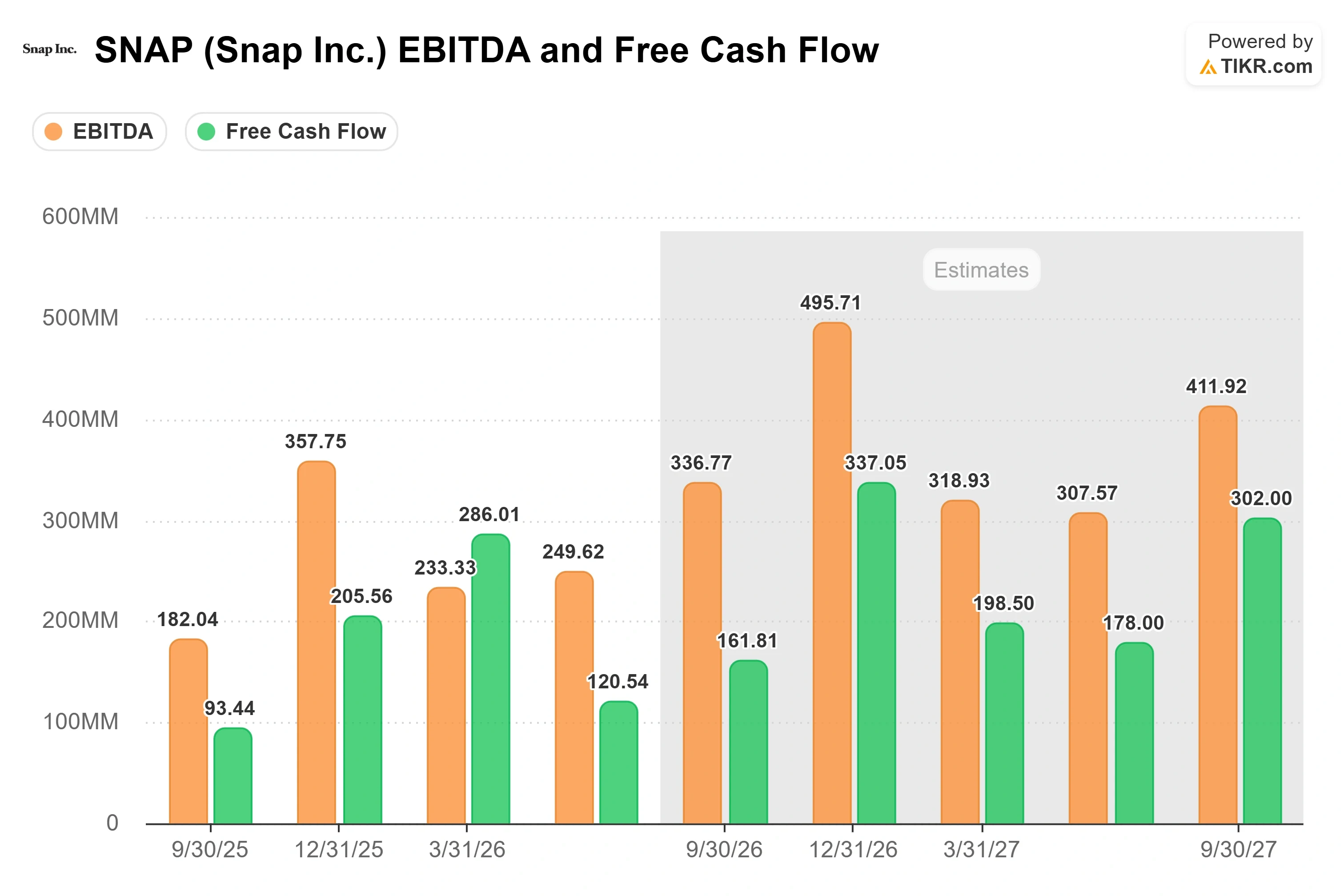
The company generated $120.5 million in free cash flow in Q2 and has now posted positive free cash flow for eight consecutive quarters, reaching roughly $714 million over the trailing twelve months, per TIKR. The engine was operating leverage: revenue rose 19% year over year to $1.6 billion while Snap held total adjusted cost growth to just 4%, a gap Hott credited to the restructuring completed earlier in the quarter.
Adjusted EBITDA came in at $250 million against a $185 million Street estimate, a 35% beat, per TIKR. On the bottom line, Snap still posted a GAAP net loss of $164 million, though it narrowed from a year earlier and came in better than the Street feared. Gross margin expanded seven percentage points year over year to 58%. The mix matters, though: advertising revenue grew just 9%, helped by World Cup spending that Hott said will normalize in Q3, while other revenue, which includes Snapchat+ and the newer Lens+ subscription, grew 85% to $316 million. Fewer than 3% of monthly users pay today, against a 7% to 12% industry norm Spiegel cited, so the more durable revenue stream is still small.
See historical and forward estimates for Snap stock (It’s free!) >>>
Two Upgrades and a Legal Cloud That Did Not Lift
Wall Street turned more constructive after the print, with several shops raising estimates and price targets on the improved efficiency and cash generation. That shift helps explain why the stock kept grinding higher for weeks rather than fading, as post-earnings pops on Snap often have.
On August 10, the Ninth Circuit Court of Appeals ruled that Meta, Google, TikTok, and Snap cannot use Section 230 to escape thousands of lawsuits alleging their platforms were designed to be addictive to young users. Hott addressed the overhang directly, citing “several trials scheduled in the United States later this year” and warning that outcomes could bring product changes, higher compliance costs, and legal payments. This is a real risk, not a formality: the ruling clears the path toward trial rather than settling anything, and the allegations remain unproven. A company whose core audience skews young cannot treat youth-safety litigation as background noise.
Snap trades at roughly 8 times NTM profit versus about 11 times for Pinterest and 19 times for Reddit, per TIKR’s Competitors data. The discount is earned, not a mystery: those peers are consistently profitable, while Snap guides to sustained positive net income only from 2027 onward. The market is pricing Snap as the platform that still has to prove it, and after years of missed turns, that skepticism is fair.
See how Snap performs against its peers in TIKR (It’s free!) >>>
TIKR Advanced Model Analysis
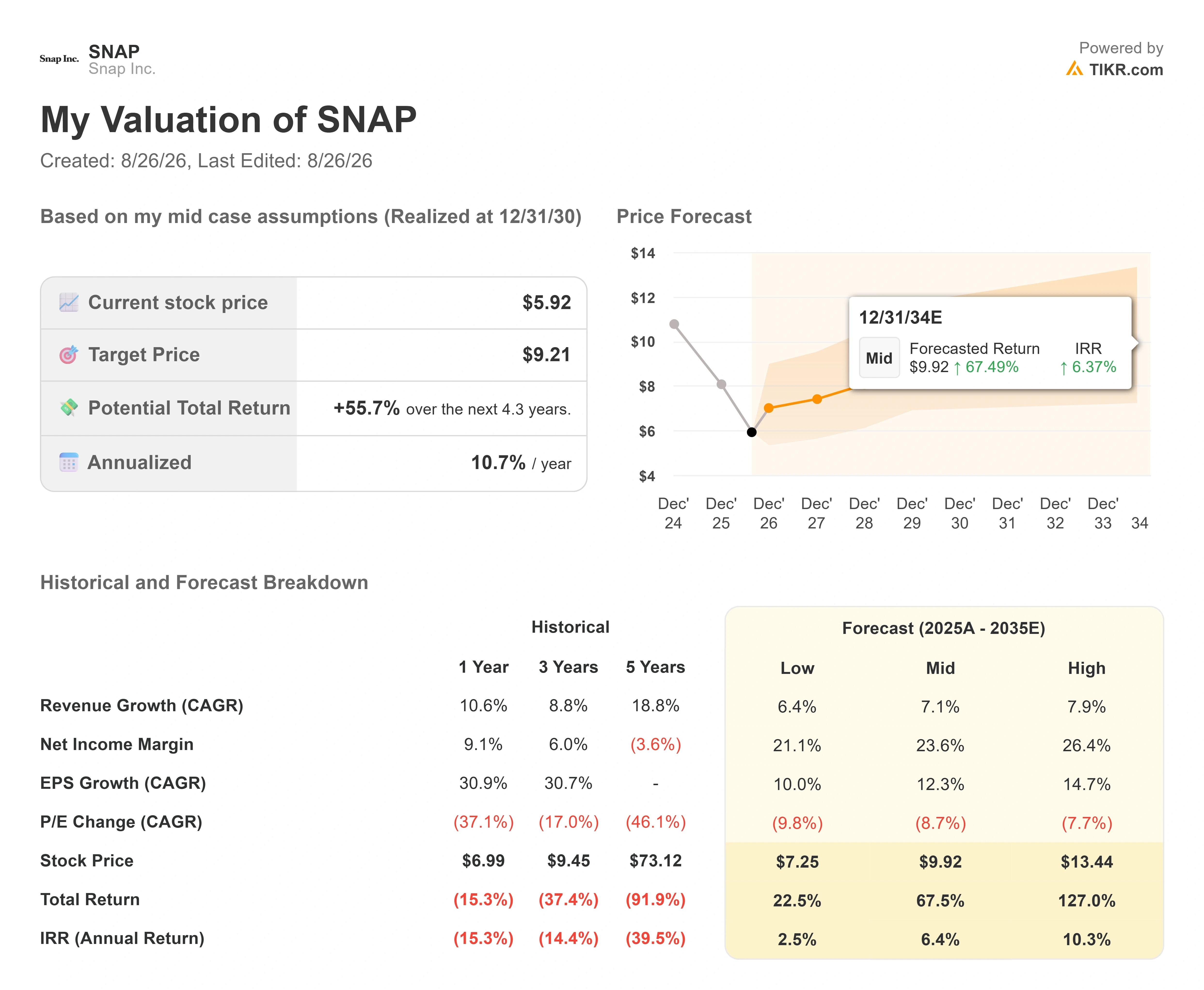
- Current Price: $5.92
- Target Price (Mid): ~$9.20
- Potential Total Return: ~56%
- Annualized IRR: ~11% / year
See analysts’ growth forecasts and price targets for Snap stock (It’s free!) >>>
TIKR’s mid-case valuation points to a price of around $9.20, implying roughly 56% total upside and an annualized return near 11% realized over about 4.3 years. This is a longer-horizon framework, not a 2026 target, and the output is a scenario built on stated assumptions rather than a forecast.
Two revenue drivers carry the case: continued double-digit growth in direct-response advertising as Smart Campaign Solutions improve conversions, and the fast-growing subscription and Lens+ base that lifts other revenue well above the pace of the ad business. The margin driver is operating leverage, with the mid case assuming net income margin climbing toward the low-20s percent range as the restructured cost base holds. The primary risk is the youth-safety litigation, which could force product changes or impose costs that break that margin path.
The upside is a business that compounds free cash flow per share while its multiple slowly re-rates toward its profitable peers. The downside is a legal outcome or an engagement stall that strands Snap as a low-growth, low-multiple platform exactly as the numbers finally turn. TIKR’s low case sits near $7.25, and the high case above $13, a wide spread that honestly reflects how much still hinges on execution.
Conclusion
The next real test is Q3, which Snap is expected to report on October 15. Watch two things. First, whether revenue lands inside the $1.70 billion to $1.74 billion guide once World Cup spending rolls off, since a clean number there tells you the ad recovery is organic rather than an event-driven blip. Second, whether adjusted EBITDA hits the $300 million to $350 million management guided, which would confirm that the restructuring savings are flowing through. A quarter inside both ranges makes the free-cash-flow story credible heading into 2027. A revenue miss with the World Cup gone would tell you the August run got ahead of the business.
See what stocks billionaire investors are buying so you can follow the smart money with TIKR.
Should You Invest in Snap?
The only way to really know is to look at the numbers yourself. TIKR gives you free access to the same institutional-quality financial data that professional analysts use to answer exactly that question.
Pull up Snap, and you’ll see years of historical financials, what Wall Street analysts expect for revenue and earnings in the quarters ahead, how valuation multiples have moved over time, and whether price targets are trending up or down.
You can build a free watchlist to track Snap alongside every other stock on your radar. No credit card required. Just the data you need to decide for yourself.
Looking for New Opportunities?
- See what stocks billionaire investors are buying so you can follow the smart money.
- Analyze stocks in as little as 5 minutes with TIKR’s all-in-one, easy-to-use platform.
- The more rocks you overturn… the more opportunities you’ll uncover. Search 100K+ global stocks, global top investor holdings, and more with TIKR.
Disclaimer:
Please note that the articles on TIKR are not intended to serve as investment or financial advice from TIKR or our content team, nor are they recommendations to buy or sell any stocks. We create our content based on TIKR Terminal’s investment data and analysts’ estimates. Our analysis might not include recent company news or important updates. TIKR has no position in any stocks mentioned. Thank you for reading, and happy investing!