


Key Stats for Netflix Stock
- Current Price: $82.23
- Target Price (Mid): ~$167
- Street Target: ~$94
- Potential Total Return: ~104%
- Annualized IRR: ~18% / year
Now Live: Discover how much upside your favorite stocks could have using TIKR’s new Valuation Model (It’s free) >>>
What Happened?
Netflix (NFLX) spent two decades keeping competitors out of its walled garden. Now it is reportedly negotiating to let some of them in. The New York Times reported on August 24 that Netflix is in talks to carry rival services like Comcast’s Peacock and Fox One inside its own app. Shares rose on the report and closed at $82.23 on August 25, up 2.77% on the day, part of a climb off the stock’s July low.
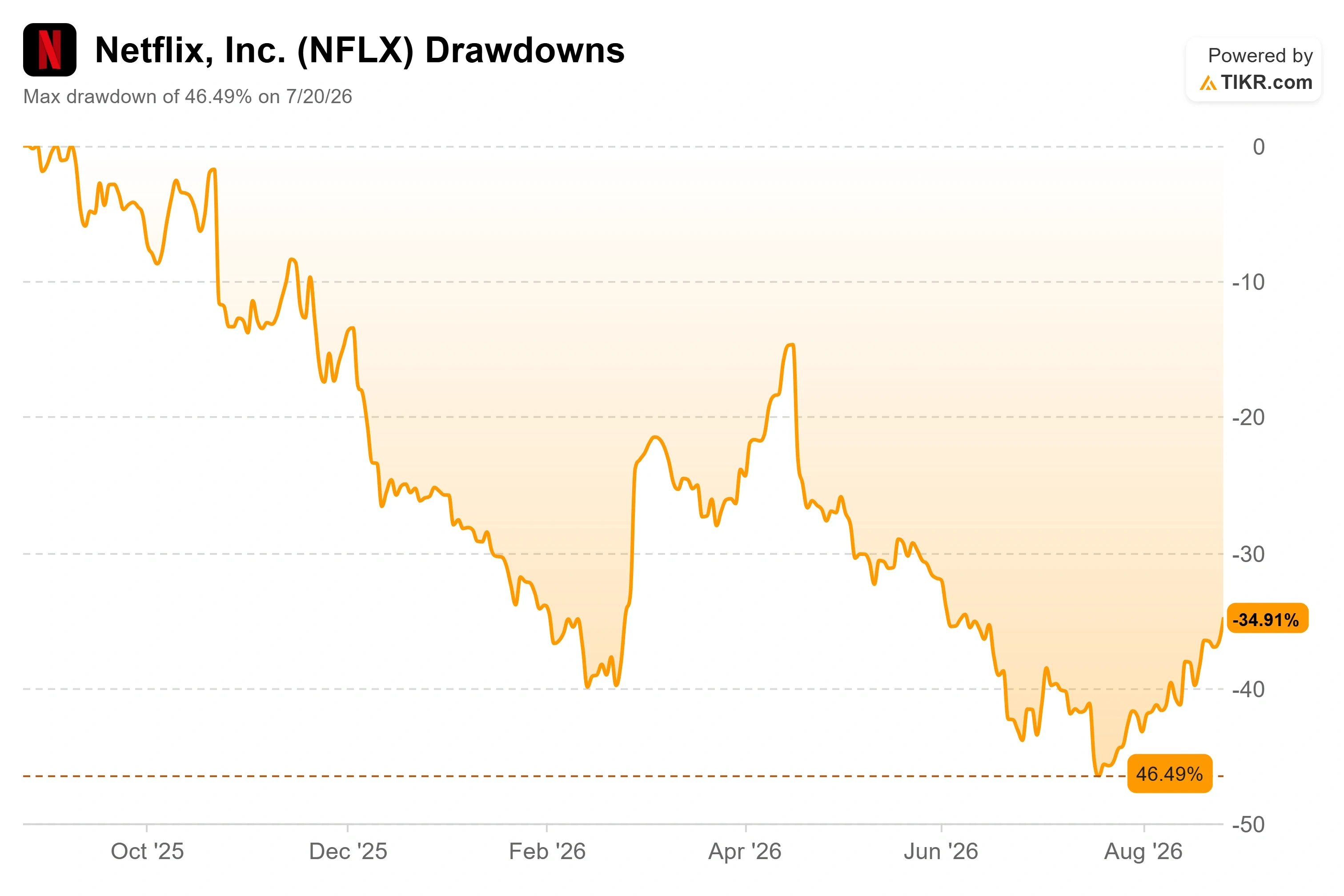
Netflix set a max drawdown of 46.49% on July 20, its trough on a closing basis, and even after the bounce, the stock still sits about 35% below its 52-week high of $126.71. The market punished Netflix all year for decelerating growth. The rival-streamer report, a fresh Bill Ackman stake, and a Wolfe Research target hike have flipped short-term sentiment. Whether any of it fixes the growth worry is the harder question.
Why Netflix Would Open the Doors It Spent 20 Years Closing
Roughly one-third of new streaming subscriptions are now sold through larger third-party platforms rather than direct sign-ups, a share up about 60% over three years, according to measurement firm Antenna, as reported by The Daily Upside. Amazon’s Prime Video and Roku already sell rival subscriptions this way, and YouTube recently struck a five-year deal to fold Peacock into its $16-per-month Premium tier. Hosting rivals would let Netflix capture a cut of subscriptions it currently loses, while the rival services gain discovery and lower acquisition costs, and give up some revenue and customer control in return.
In June, it integrated French broadcaster TF1’s live channels and on-demand shows into its French service. On the Q2 2026 earnings call, co-CEO Greg Peters framed the move as continuity, not reversal: “Since the very beginning when we launched our streaming service, we’ve always sought to expand the entertainment offering we’ve got in that service.” That reframes a Peacock or Fox One deal as the same monetization playbook Netflix has always run, now pointed at other companies’ content.
No deal is imminent, though, and Netflix has not decided whether it would sell full subscriptions or simply host the content. This is a reported negotiation, and the stock is rallying on a strategy.
See historical and forward estimates for Netflix stock (It’s free!) >>>
The Growth Problem the Rally Hasn’t Solved
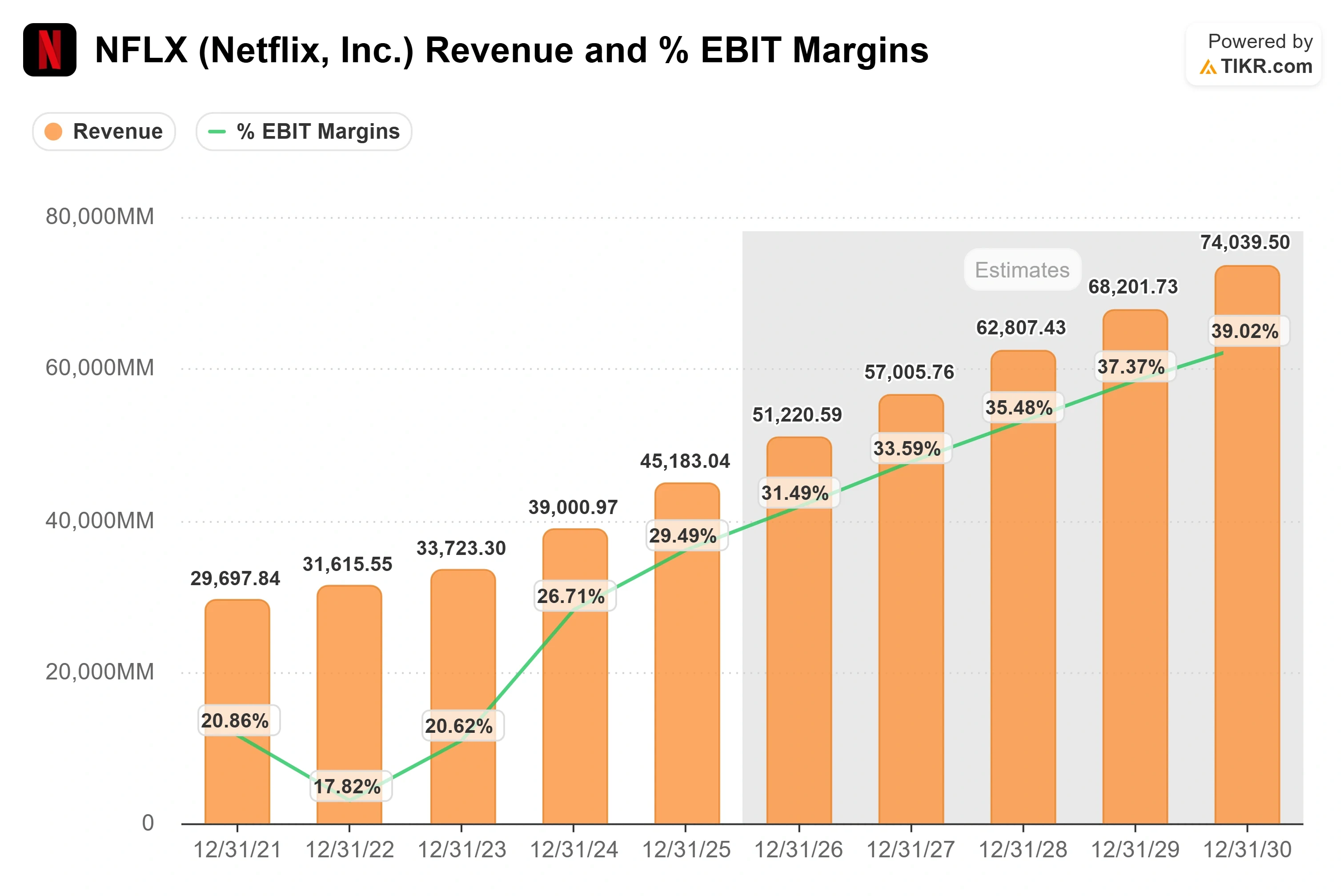
Netflix grew revenue 13.4% year over year in Q2 2026 to $12.56 billion, a solid result but a clear step down from 15.6% in 2024. CFO Spence Neumann guided to 13% to 14% full-year growth, roughly 12% FX-neutral, or about $6 billion of incremental revenue. That is a maturing rate for a stock long priced as hypergrowth. Free cash flow fell 32.7% year over year in Q2 on higher cash taxes and one-time Warner Bros. termination payments.
Advertising is the offset, with the ad tier scaling toward a widely reported roughly $3 billion in ad revenue this year. Peters called the gap between ad-tier and standard revenue per member “essentially near-term underrealized revenue growth,” closable through better fill rates and new ad products. On engagement, the debate that dogged the stock this year, he pushed back: viewing hours grew 2% in the first half of 2026 versus 1.5% in 2025, and he argued raw hours understate value because live events drive acquisition out of proportion to watch time.
On NTM EV/EBITDA, Netflix trades at 18.89x against Disney at 9.81x and Warner Bros. Discovery at 11.97x, per TIKR’s Competitors data, while Spotify sits richer at 26.81x on similar growth. Netflix’s 29.7% LTM EBIT margin and 49.5% return on equity justify a premium to the legacy names. Whether it should expand from here is what the model has to answer. The institutional vote is turning, though: Bill Ackman’s Pershing Square disclosed a new 3.15 million-share stake, about 4.9% of the fund, and called Netflix the streaming winner, notable given the fund lost more than $400 million on the stock in 2022. Wolfe Research raised its target to $95 from $84 on August 25.
See how Netflix performs against its peers in TIKR (It’s free!) >>>
TIKR Advanced Model Analysis
- Current Price: $82.23
- Target Price (Mid): ~$167
- Potential Total Return: ~104%
- Annualized IRR: ~18% / year

See analysts’ growth forecasts and price targets for Netflix stock (It’s free!) >>>
The mid-case scenario targets around $167, a potential total return of roughly 104%, or about 18% annualized over the next 4.3 years. It rests on assumptions below Netflix’s own history, not heroic ones:
- Revenue drivers: advertising, scaling toward a reported $3 billion this year with room to close the ARM gap, and international pricing power, where Netflix is under 45% penetrated in an estimated 800 million addressable households.
- Margin driver: content discipline, with content spend guided up about 10% this year, slower than revenue, which is how operating margins keep expanding.
- Primary risk: engagement growth stays soft, and the feared deceleration hardens into a plateau, pressuring the growth rate and the multiple at once.
The upside is a company compounding revenue at a low-double-digit rate while margins and cash flow climb, and the multiple holds. The downside is a maturing Netflix repriced as a slower-growth media business, its premium to Disney and Warner Bros. Discovery compressing toward the peer group.
Conclusion
The rival-streamer report and the Ackman stake gave Netflix its best stretch in months, but neither will confirm or break the thesis. The next real test is Q3 2026 earnings, expected in mid-October. The number that matters is not headline EPS but FX-neutral revenue growth against the 13% to 14% full-year guide, plus whether advertising is tracking toward its roughly $3 billion goal. Growth holding at 12% or better FX-neutral, with ads on pace, says the deceleration is orderly, and the model’s assumptions are conservative. A slip below that, or another free-cash-flow air pocket, hands the value-trap case its evidence. The strategy pivot is interesting.
See what stocks billionaire investors are buying so you can follow the smart money with TIKR.
Should You Invest in Netflix?
The only way to really know is to look at the numbers yourself. TIKR gives you free access to the same institutional-quality financial data that professional analysts use to answer exactly that question.
Pull up Netflix, and you’ll see years of historical financials, what Wall Street analysts expect for revenue and earnings in the quarters ahead, how valuation multiples have moved over time, and whether price targets are trending up or down.
You can build a free watchlist to track Netflix alongside every other stock on your radar. No credit card required. Just the data you need to decide for yourself.
Analyze Netflix on TIKR Free →
Looking for New Opportunities?
- See what stocks billionaire investors are buying so you can follow the smart money.
- Analyze stocks in as little as 5 minutes with TIKR’s all-in-one, easy-to-use platform.
- The more rocks you overturn… the more opportunities you’ll uncover. Search 100K+ global stocks, global top investor holdings, and more with TIKR.
Disclaimer:
Please note that the articles on TIKR are not intended to serve as investment or financial advice from TIKR or our content team, nor are they recommendations to buy or sell any stocks. We create our content based on TIKR Terminal’s investment data and analysts’ estimates. Our analysis might not include recent company news or important updates. TIKR has no position in any stocks mentioned. Thank you for reading, and happy investing!


