Key Takeaways
- Constellation Energy has signed roughly 920 megawatts of new long-term nuclear contracts since its last earnings call, deals averaging 18.5 years with investment-grade customers, including a first-of-its-kind nuclear deal with Walmart.
- Vistra posted second-quarter adjusted EBITDA of nearly $1.8 billion, up more than 30% year over year, and is backing its own AI power push through the new Helix Digital Infrastructure venture with KKR, NVIDIA, and the Kuwait Investment Authority.
- Based on mid-case valuation models, Constellation carries a higher projected annualized return of 14.8% through 2030 versus 8.8% for Vistra, though Constellation also trades at a richer earnings multiple.
Now Live: Discover how much upside your favorite stocks could have using TIKR’s new Valuation Model (It’s free)>>>
Everyone is obsessed with who makes the best AI chip. Fewer people are asking a simpler question: what happens when there isn’t enough electricity to turn those chips on?
Data centers need power around the clock, in massive and growing amounts. That single fact is starting to matter more than which company has the fastest processor. It turns electricity providers, not just chipmakers, into gatekeepers for the entire AI buildout.
Two companies sit right at the center of this story: Constellation Energy (CEG) and Vistra Corp (VST).
Both sell electricity to a country that suddenly cannot get enough of it. But they are betting on very different paths to get there.
Estimate a company’s fair value instantly (Free with TIKR) >>>
Two power companies, two different strategies
Constellation runs the largest fleet of nuclear power plants in the country. Nuclear plants run at near-full output nearly every hour of the year, which is what data centers need. That reliability is why big customers are lining up to buy power straight from Constellation’s reactors.
Vistra takes a broader approach. It mixes nuclear generation with natural gas plants and a large retail electricity business that sells power directly to households and businesses.
That mix gives Vistra more moving parts, and more ways to profit as demand rises.
Constellation stock leans hard into nuclear demand
Constellation’s second-quarter results, detailed on its Aug. 6 earnings call, show how much momentum is building.
The company posted adjusted operating earnings of $2.55 per share, up 64 cents from a year earlier, and raised its full-year guidance to a range of $11.50 to $12.50 per share, up from $11 to $12.
The nuclear fleet ran at a 93% capacity factor in the quarter, generating 40 terawatt hours of electricity, and hit above 99% during a July heat wave, according to CEO Joe Dominguez.
Since its last call, Constellation signed about 920 megawatts of new long-term nuclear contracts, with an average length of 18.5 years and investment-grade customers.
That includes a landmark deal with Walmart, its first-ever nuclear power purchase agreement. Roughly 30% of Constellation’s clean baseload output is now locked into long-term agreements.
The company is also restarting its Crane facility, the site once known as Three Mile Island, after the Nuclear Regulatory Commission approved a new fuel licensing request, with return to service targeted for the second half of 2027.
On the balance sheet side, Constellation has deployed $2.2 billion toward share buybacks so far this year and still has $2.8 billion in authorization left, according to CFO Shane Smith.

TIKR data shows Constellation’s revenue climbing from $23.57 billion in 2024 to an estimated $43.52 billion by 2030, with free cash flow turning from-$5.03 billion to an estimated $7.48 billion over that same stretch.
See analysts’ full growth forecasts and estimates for CEG stock (It’s free) >>>
Vistra bets on scale and flexibility
Vistra’s Aug. 7 earnings call told a different but equally strong story.
Adjusted EBITDA hit $1.767 billion in the second quarter, up more than 30% from $1.35 billion a year earlier. CEO Jim Burke pointed to record summer peak demand in both PJM and ERCOT, the two big grids Vistra serves.
Vistra reaffirmed 2026 guidance of $6.8 billion to $7.6 billion in adjusted EBITDA and is maintaining a 2027 midpoint opportunity range of $7.4 billion to $7.8 billion, a figure that does not yet include its pending Cogentrix acquisition or the premium pricing expected from its nuclear power deal with Meta.
The company also launched Helix Digital Infrastructure, a joint venture with KKR, NVIDIA and the Kuwait Investment Authority built to pair power supply with data center land and infrastructure. Vistra plans to commit up to $1 billion to the platform over time.
Vistra has also been aggressive about returning cash, retiring about 171 million shares since 2021 at an average price near $38, with more than $6.5 billion returned to shareholders total, according to CFO Kris Moldovan.

Per TIKR estimates, Vistra’s revenue is projected to grow from $17.22 billion in 2024 to $26.57 billion by 2030, with free cash flow rising from $2.49 billion to $6.52 billion over the same period.
See what analysts think about CEG stock right now (Free with TIKR) >>>
Which energy stock already prices in the power boom

Constellation trades around $279.52 with a mid-case target of $508.65, implying an 82% total return and a 14.8% annualized rate through 2030, based on TIKR valuation models.
Its forward price-to-earnings ratio currently sits at 22.64 times, below its historical mean of 26.14 times.
Vistra trades near $140.03, with a mid-case target of $202.16, implying a 44.4% total return and an 8.8% annualized rate.
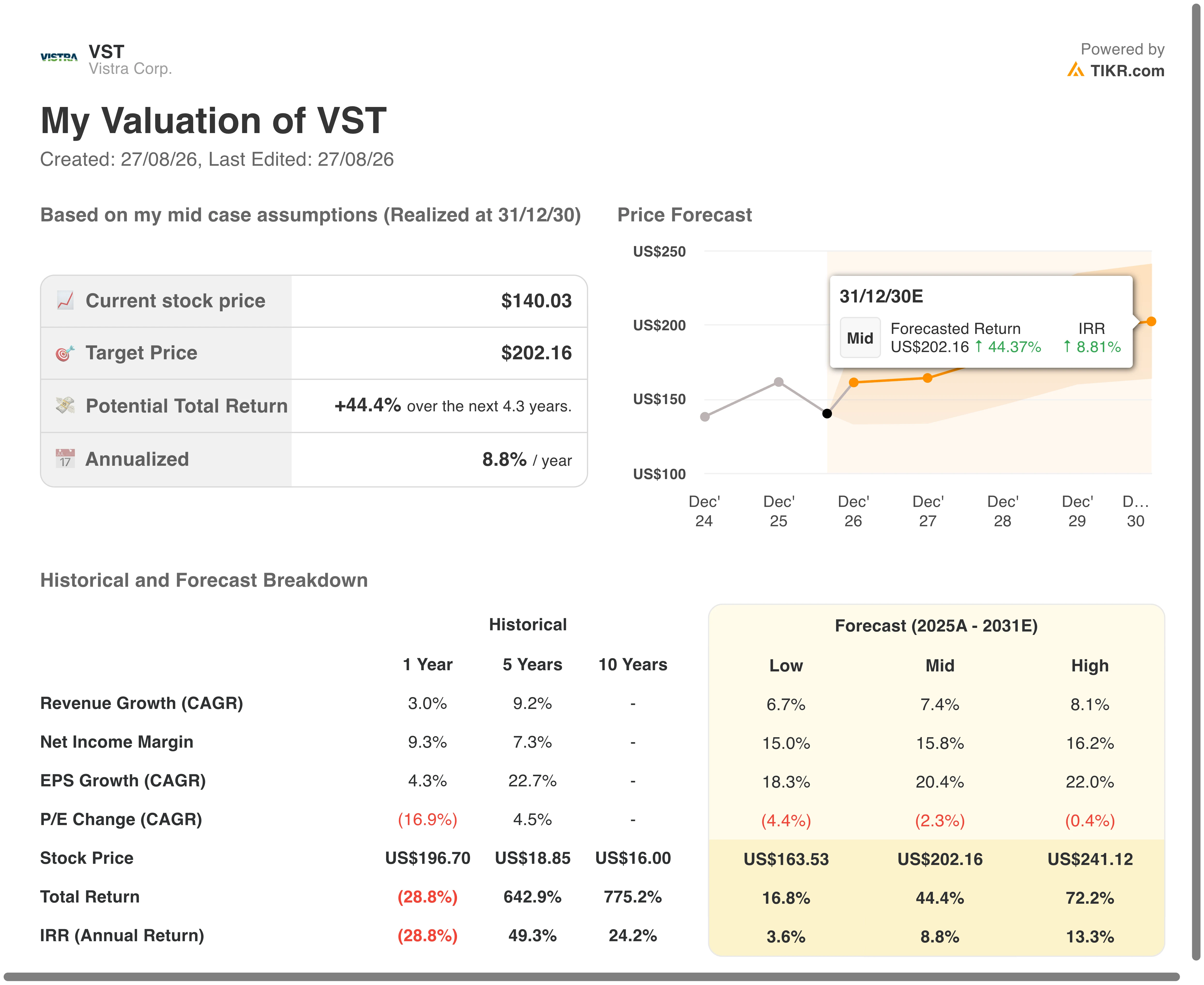
Its forward earnings multiple of 13.60 times is well below its historical mean of 17.76 times, suggesting the market may be undervaluing its growth relative to its own history.
In plain terms, Constellation offers a more direct, purer bet on nuclear scarcity, while Vistra offers diversification and a cheaper entry point relative to its past valuation range. Both are effectively selling the same scarce resource. The question for investors is which flavor of that scarcity they want to own.
See a stock’s true value in under 60 seconds (Free with TIKR) >>>
How Much Upside Does Vistra Stock Have From Here?
With TIKR’s new Valuation Model tool, you can estimate a stock’s potential share price in under a minute.
All it takes is three simple inputs:
- Revenue Growth
- Operating Margins
- Exit P/E Multiple
If you’re not sure what to enter, TIKR automatically fills in each input using analysts’ consensus estimates, giving you a quick, reliable starting point.
From there, TIKR calculates the potential share price and total returns under Bull, Base, and Bear scenarios so you can quickly see whether a stock looks undervalued or overvalued.
See a stock’s true value in under 60 seconds (Free with TIKR) >>>
Looking for New Opportunities?
- See what stocks billionaire investors are buying so you can follow the smart money.
- Analyze stocks in as little as 5 minutes with TIKR’s all-in-one, easy-to-use platform.
- The more rocks you overturn… the more opportunities you’ll uncover. Search 100K+ global stocks, global top investor holdings, and more with TIKR.
Disclaimer:
Please note that the articles on TIKR are not intended to serve as investment or financial advice from TIKR or our content team, nor are they recommendations to buy or sell any stocks. We create our content based on TIKR Terminal’s investment data and analysts’ estimates. Our analysis might not include recent company news or important updates. TIKR has no position in any stocks mentioned. Thank you for reading, and happy investing!