
Key Stats for Walmart Stock
- Current Price: $104.34
- Target Price (Mid): ~$150
- Street Target: ~$128
- Potential Total Return: ~44%
- Annualized IRR: ~8.5% / year
Now Live: Discover how much upside your favorite stocks could have using TIKR’s new Valuation Model (It’s free) >>>
What Happened?
Walmart (WMT) beat on revenue, beat on earnings, and raised full-year guidance on August 20. The stock fell 9% anyway, sliding from about $114 to under $104 in a single session. What matters now is not the reaction, but what it did to the math: a name that looked expensive all year just reset to $104, roughly 23% below its 52-week high of $135. From that lower entry, TIKR’s model sees a path to about $150 by early 2031.
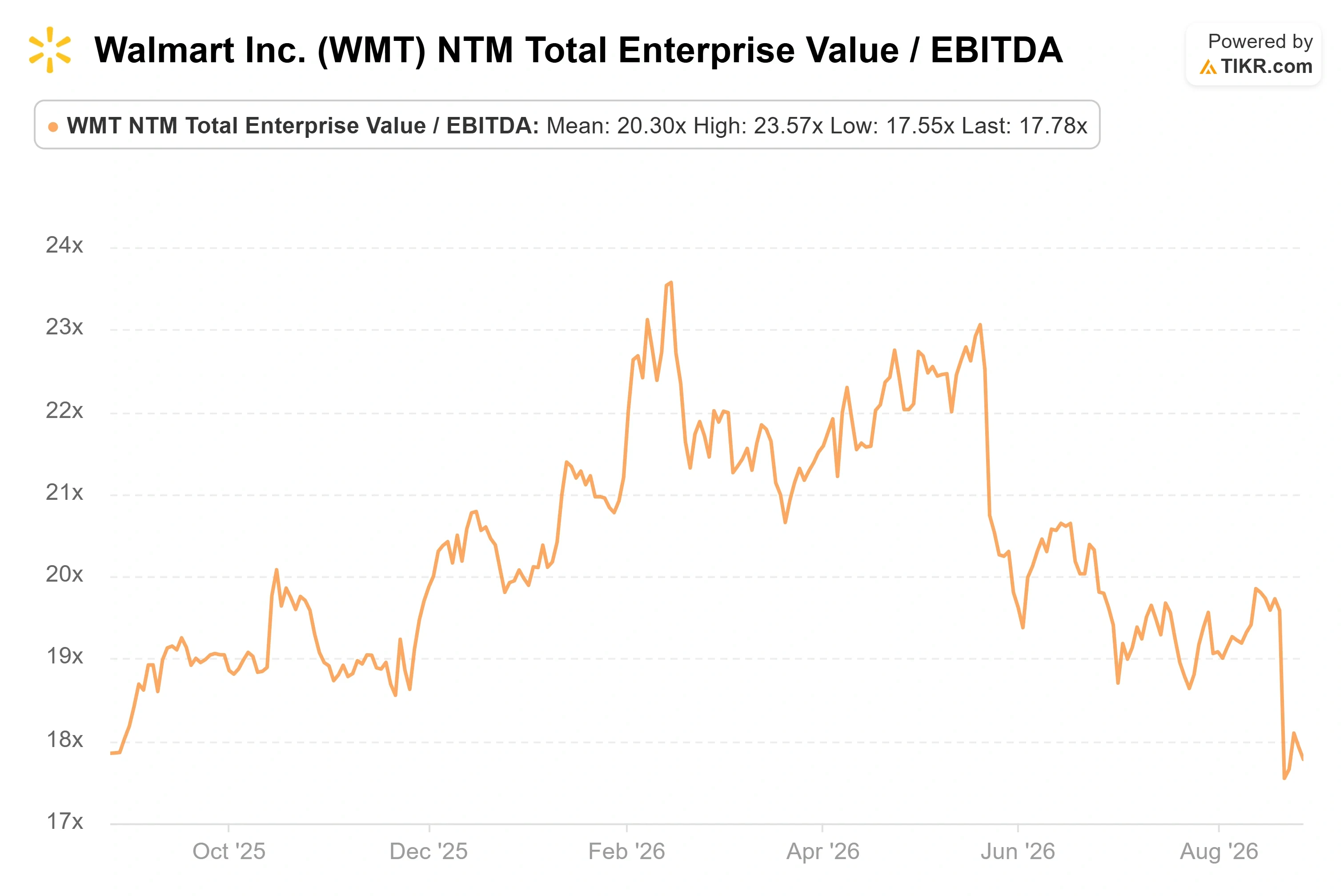
That reset is the story. The P/E ratio still sits near 35 times forward earnings, but the NTM EV/EBITDA has fallen to 17.8x from over 22x at the April peak. For a business the market prices at a premium specifically because its profit mix is improving, a 9% haircut on a quarter that confirmed the improvement is the kind of move that lifts forward returns without breaking the thesis.
The Beat the Market Distrusted, and the Lag Underneath It
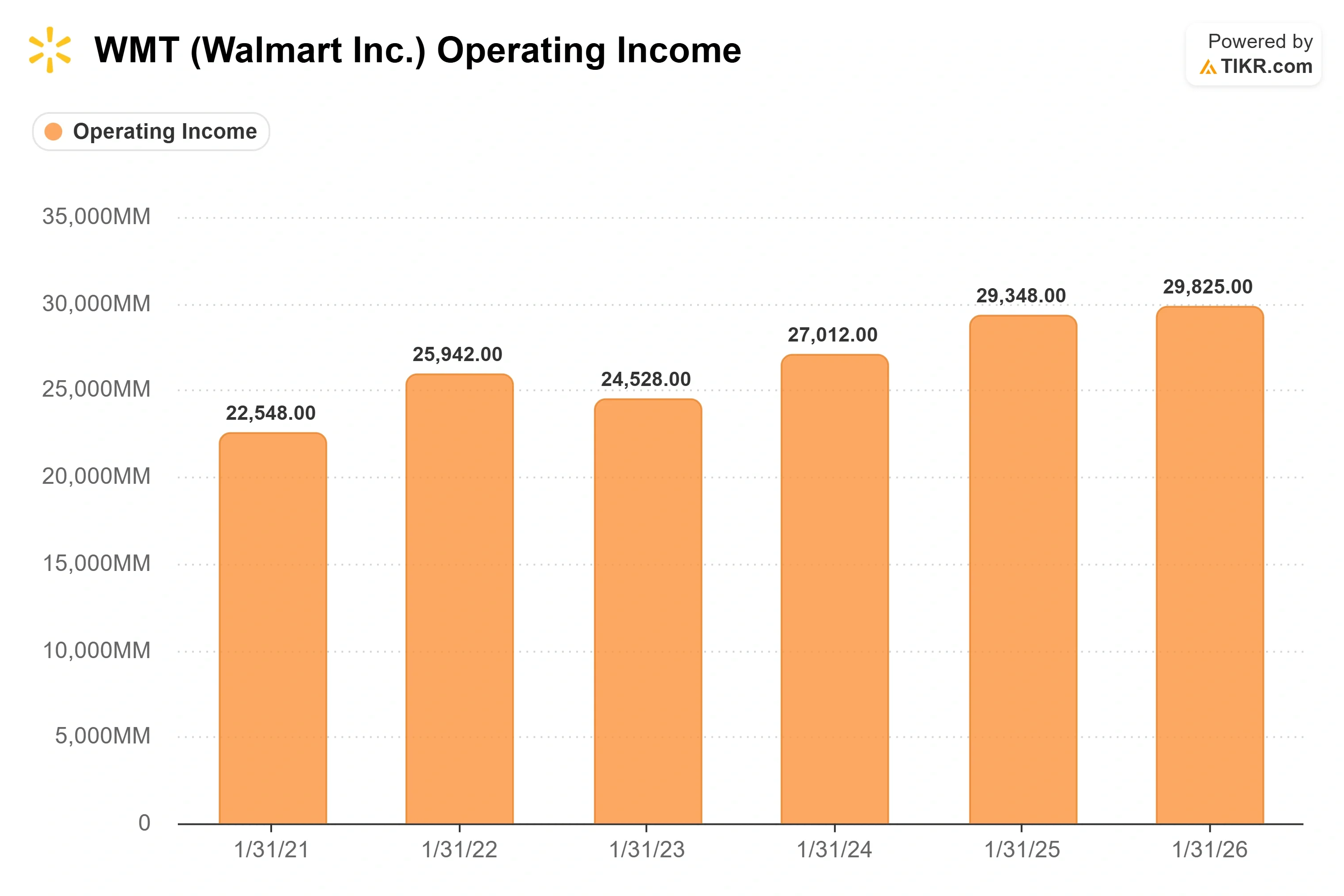
U.S. comparable sales grew just 2.6%, short of the 3.5% the Street wanted, and roughly 750 basis points of the 17.4% operating income growth came from one-time tariff refunds. CEO John Furner was direct that the refund money is temporary: “our intent was to deploy much of that back into price, and that’s what we’re doing.” That reinvestment is why Q3 operating income guidance looks soft at 2% to 4%, and why CFO John David Rainey asked investors to judge Q2 and Q3 together, where growth averages closer to 10% per quarter.
U.S. comps ran about 2.5%, yet operating income grew 10% excluding tariffs, four times the pace of revenue. “We haven’t done that level of profit growth relative to the U.S. comp in 2 decades,” Rainey said. The soft comp itself was largely mechanical: new maximum fair price drug regulation cut U.S. comp by about 125 basis points, a pharmacy headwind that hits the top line without denting profit, since pharmacy customers spend roughly three times more than the average shopper.
Walmart is spending refund and rollback dollars now, betting the payback arrives later. The company exited Q1 near 7,000 rollbacks, against a normal level of about 5,000, and ended Q2 at 11,000. Rainey cautioned that the benefit of lower prices does not come “in the immediate period.” That lag is the whole gamble: lower prices are meant to build durable share, but the volume that repays them shows up over months.
See historical and forward estimates for Walmart stock (It’s free!) >>>
Why the Premium Can Survive at $104
Whether 35 times earnings is deserved comes down to one belief: that incremental margins keep climbing. Rainey argued they will, noting advertising is outgrowing e-commerce “not by a small margin, by a large margin on a larger base,” and that Walmart’s incremental margins are now growing at twice the rate of the overall business margin. Global advertising grew 38%, marketplace 52%, and membership nearly 17% to an all-time high, all several times faster than the retail base and at far higher margins. The Vibe acquisition adds a new pool of small and mid-sized advertisers that the company could not previously reach. Walmart’s structural edge helps here too: its 25.2% gross margin runs well above warehouse-club peers like Costco, which earns its returns on membership rather than product markup.
If the payback lag stretches, or a strained consumer keeps trading down through 2027 as fuel costs bite, the margin expansion that justifies the multiple slows, and a 35x stock has little room to absorb disappointment.
See how Walmart performs against its peers in TIKR (It’s free!) >>>
TIKR Advanced Model Analysis
- Current Price: $104.34
- Target Price (Mid): ~$150
- Potential Total Return: ~44%
- Annualized IRR: ~8.5% / year

See analysts’ growth forecasts and price targets for Walmart stock (It’s free!) >>>
TIKR’s mid-case values Walmart at roughly $150 per share, realized at the end of January 2031. That works out to about 44% total return over the next 4.4 years, or roughly 8.5% a year including dividends.
Two revenue drivers carry the forecast:
- The high-margin commerce stack. Advertising, marketplace, and membership growing well ahead of the retail base.
- International. China and India led constant-currency growth near 8%, and Walmart is now exporting its U.S. platform playbook abroad.
The margin driver is rising incremental margins as digital businesses scale at low marginal cost, lifting net income margin from about 3.6% toward the higher end of the model’s range. The primary risk is price investment overshooting its payback, where rollbacks and refunds compress margins faster than volume and share gains restore them.
- Upside: incremental margins climb as management suggests, and Walmart compounds earnings far faster than its ~4% revenue growth, earning its premium.
- Downside: a stretched consumer and sustained price investment flatten the margin curve, leaving a 35x stock stranded on a low-growth top line.
Conclusion
The number to watch is the Q3 print in mid-November, around November 18, and the metric that matters is not headline EPS but U.S. comp sales. Management promised the price investments made in late July would translate into stronger back-half sales. A U.S. comp that reaccelerates toward 3.5%, excluding pharmacy, would confirm the lag is working, and the share gains are sticking. A comp stuck near 2.5% with margins still under price-investment pressure would say the payback is slipping, and at 35 times earnings, that is the outcome the stock can least afford.
See what stocks billionaire investors are buying so you can follow the smart money with TIKR.
Should You Invest in Walmart?
The only way to really know is to look at the numbers yourself. TIKR gives you free access to the same institutional-quality financial data that professional analysts use to answer exactly that question.
Pull up Walmart, and you’ll see years of historical financials, what Wall Street analysts expect for revenue and earnings in the quarters ahead, how valuation multiples have moved over time, and whether price targets are trending up or down.
You can build a free watchlist to track Walmart alongside every other stock on your radar. No credit card required. Just the data you need to decide for yourself.
Analyze Walmart on TIKR Free →
Looking for New Opportunities?
- See what stocks billionaire investors are buying so you can follow the smart money.
- Analyze stocks in as little as 5 minutes with TIKR’s all-in-one, easy-to-use platform.
- The more rocks you overturn… the more opportunities you’ll uncover. Search 100K+ global stocks, global top investor holdings, and more with TIKR.
Disclaimer:
Please note that the articles on TIKR are not intended to serve as investment or financial advice from TIKR or our content team, nor are they recommendations to buy or sell any stocks. We create our content based on TIKR Terminal’s investment data and analysts’ estimates. Our analysis might not include recent company news or important updates. TIKR has no position in any stocks mentioned. Thank you for reading, and happy investing!