
Key Stats for KVUE Stock
- Past week performance: +0.8%
- 52-week range: $14 to $21
- Valuation model target price: $23
- Implied upside: +19.3% over 2.3 years
See where Kenvue’s margins could head as tariffs ease with a free TIKR Guided Valuation Model (It’s free) >>>
A First Miss in a While, and a Bigger Story Underneath
Kenvue (KVUE) missed Wall Street’s Q2 estimates for the first time in several quarters. Adjusted diluted earnings per share rose 9% year over year to $0.31, just below the $0.32 consensus. Net sales grew 3% to $3.96 billion, also slightly below expectations. It was a modest shortfall, and the stock barely moved.

Margin pressure drove the miss. Adjusted gross margin compressed 70 basis points to 60.2%, because inflation, tariffs, and unfavorable currency swings outweighed pricing gains and supply-chain productivity. Management flagged that the environment remains volatile, citing variability tied to the Middle East conflict in a recent SEC filing.
Kenvue is still mid-spinoff from Johnson & Johnson and, at the same time, being acquired by Kimberly-Clark. Investors have stayed patient with near-term bumps as long as the strategic picture holds. That picture got a lift in July, when the FDA approved Tylenol with Naproxen, the first fixed-dose combination of acetaminophen and naproxen sold over the counter. The agency also granted Kenvue three years of exclusivity on the formulation, so no generic can enter that category during the window.
If the Kimberly-Clark deal closes as planned, this quarter’s miss will likely matter less than whether new products can defend pricing power. Kenvue declared its regular $0.21 quarterly dividend in the meantime, signaling that capital return priorities haven’t shifted.
Compare Kenvue’s margin trajectory against Procter & Gamble (It’s free) >>>
Is KVUE Stock Undervalued Heading Into the Kimberly-Clark Deal?
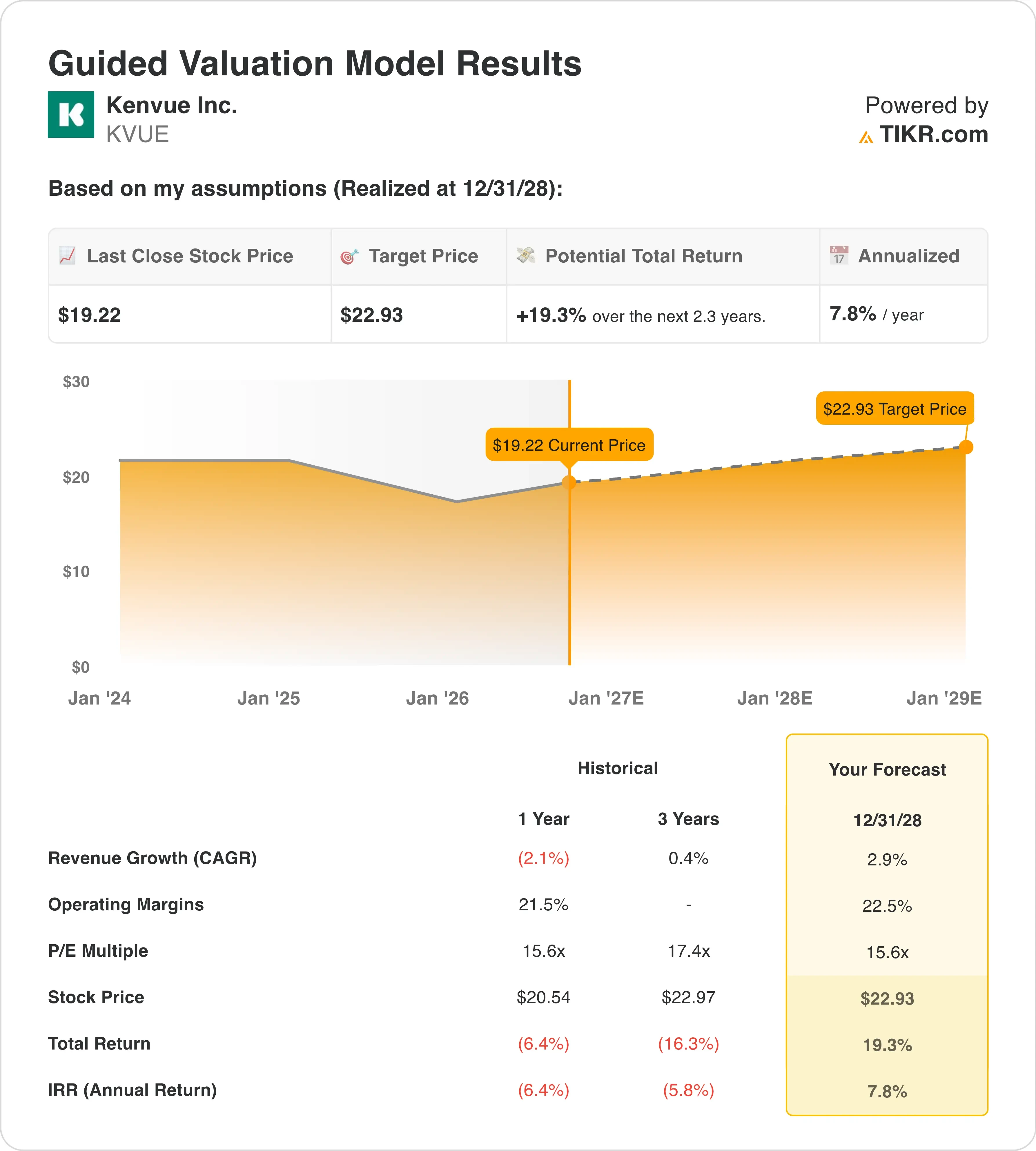
Under valuation model assumptions realized through 12/31/28, the stock is modeled using:
- Revenue Growth (CAGR): 2.9%
- Operating Margins: 22.5%
- Exit P/E Multiple: 15.6x
Based on these inputs, the model estimates a target price of $23, implying a 19.3% total return from the current share price and an annualized return of 7.8% over the next 2.3 years.
That’s a modest but respectable setup for a consumer staples name, closer to moderately attractive than to a bargain. Kenvue’s own trailing operating margin came in at 19.6%, below the model’s 22.5% assumption, so the undervaluation case depends on margins actually recovering as tariff and inflation pressure eases.

Kenvue’s growth profile looks slow next to faster-moving beauty names, but that’s simply the nature of a portfolio built around Tylenol, Listerine, and Band-Aid. The pending Kimberly-Clark deal makes the setup more interesting, because a completed merger could reset how the market values Kenvue’s brands entirely. Until then, the stock trades more like a defensive holding than a growth story.
Estimate a company’s fair value instantly (Free with TIKR) >>>
How Kenvue Stacks Up Against Procter & Gamble and Kimberly-Clark
Kenvue competes directly with two of the largest consumer products companies in the world. Procter & Gamble (PG) posted a core operating margin of 23.6% for its most recent fiscal year, even after a 70 basis point decline from tariffs and cost pressure. Kimberly-Clark (KMB), the company acquiring Kenvue, posted an operating margin near 15% in its latest quarter, well below both peers, as it navigated a distribution center fire and false social media claims about diaper quality in China.

Kenvue’s 19.6% trailing margin lands between its two largest rivals, ahead of Kimberly-Clark but behind Procter & Gamble’s scale advantages. Where Kenvue holds an edge is brand concentration. Tylenol, Listerine, Neutrogena, and Band-Aid are all top-two players in their categories, giving Kenvue pricing power that a sprawling conglomerate like P&G has to spread across dozens of brands. The new Tylenol exclusivity strengthens that edge for at least three years.
What’s Driving KVUE Stock Going Forward?
The Kimberly-Clark acquisition remains the biggest catalyst on the horizon. Regulatory approvals are progressing, and South Africa’s Competition Tribunal conditionally cleared the deal in August. If it closes as planned, the combined company would become one of the largest consumer health businesses in the world.
Tylenol with Naproxen gives Kenvue a real product catalyst independent of the merger. Backed by eight clinical studies and marketed for 12-hour relief in under 30 minutes, the launch targets a category where branded products often lose share to store brands. Three years of exclusivity buys Kenvue time to build loyalty before generics can respond.
Litigation risk still lingers. Kenvue and other drugmakers must face “maximum strength” claims tied to decongestant advertising in ongoing U.S. litigation, a headline risk worth watching even though it hasn’t moved the stock much yet.
Because tariffs remain the swing factor for margins, watch whether Q3 shows gross margin stabilizing. A rebound toward the high 60s would support the model’s 22.5% margin assumption and suggest this quarter’s miss was a blip.
Should You Invest in Kenvue?
The only way to really know is to look at the numbers yourself. TIKR gives you free access to the same institutional-quality financial data that professional analysts use to answer exactly that question.
Pull up KVUE, and you’ll see years of historical financials, what Wall Street analysts expect for revenue and earnings in the quarters ahead, how valuation multiples have moved over time, and whether price targets are trending up or down.
You can build a free watchlist to track KVUE alongside every other stock on your radar. No credit card required. Just the data you need to decide for yourself.
Analyze KVUE stock on TIKR Free→
Disclaimer:
Please note that the articles on TIKR are not intended to serve as investment or financial advice from TIKR or our content team, nor are they recommendations to buy or sell any stocks. We create our content based on TIKR Terminal’s investment data and analysts’ estimates. Our analysis might not include recent company news or important updates. TIKR has no position in any stocks mentioned. Thank you for reading, and happy investing!