

Key takeaways:
- The market already tested this thesis. On July 23, 2026, Alphabet beat on every headline metric — sales up 24%, Google Cloud up 82%, operating income up 30% — yet the stock fell 7% purely on capex guidance and the company’s first-ever negative free cash flow quarter. Days later, Amazon, Meta, and Microsoft faced the same investor scrutiny.
- Combined 2026 capex across the four largest hyperscalers has climbed to roughly $720–745 billion (near $835 billion including Oracle), with Alphabet, Amazon, and Meta all raising guidance mid-year.
- Earnings concentration now runs deeper than market-cap concentration. Alphabet, Amazon, and Meta alone are estimated to drive close to 70% of the dollar increase in S&P 500 earnings growth expectations for 2026.
- The dependency radiates outward. Nvidia’s top four customers now account for 61% of its revenue (up from roughly 36% a year earlier), Broadcom’s AI chip sales are projected to roughly double, and memory makers, data center REITs, and power/cooling suppliers are all effectively leveraged to the same four capex budgets.
Now Live: Discover how much upside your favorite stocks could have using TIKR’s new Valuation Model (It’s free) >>>
On July 23, 2026, Alphabet beat on every headline number that matters. Sales grew 24%. Google Cloud revenue jumped 82%. Operating income surged 30%. Gemini crossed 950 million monthly active users. And the stock fell 7% in a single session.
The reason had nothing to do with Alphabet’s results and everything to do with its guidance.
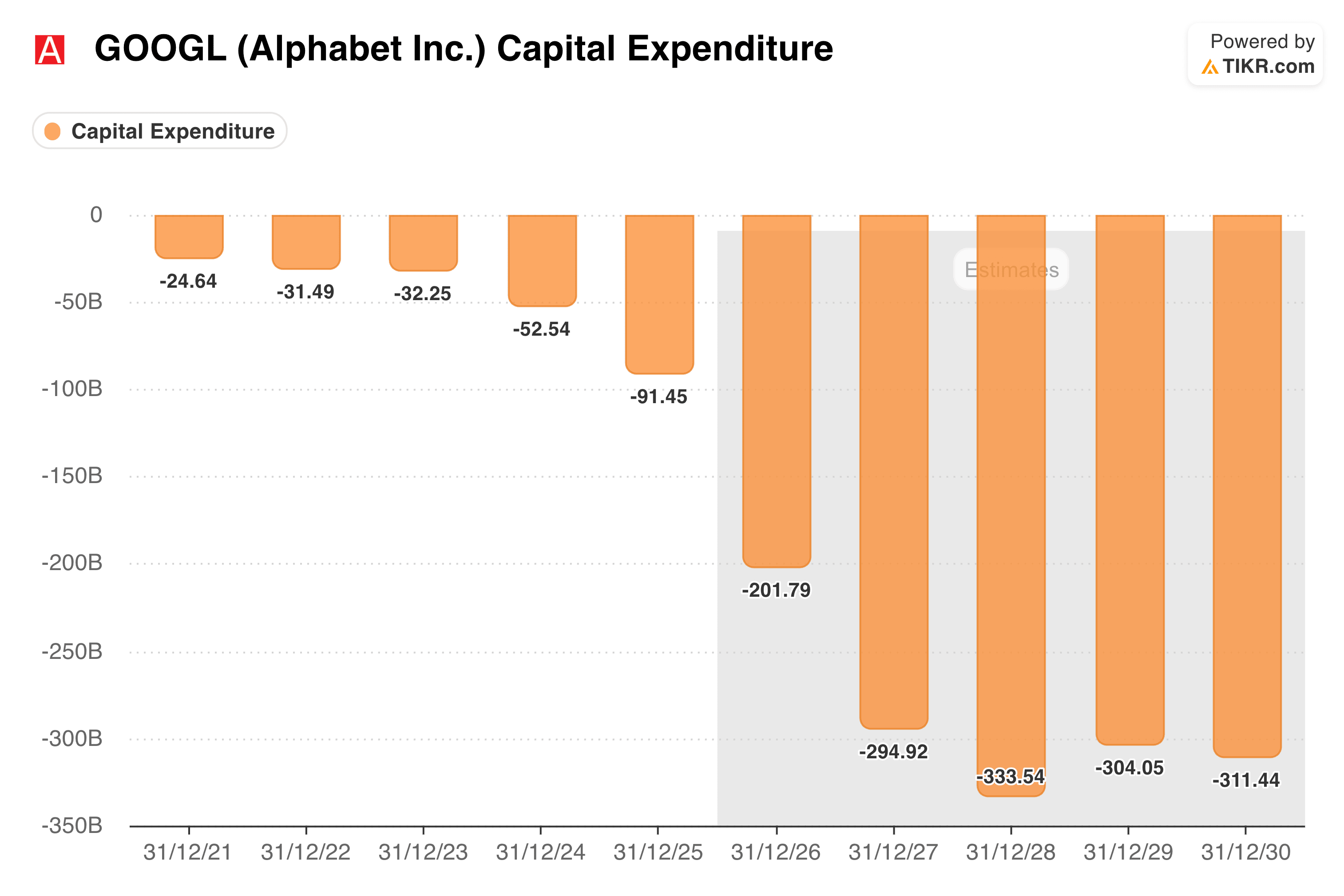
Management raised 2026 capital expenditure to a range of $195 billion to $205 billion, told investors spending would “increase significantly” again in 2027, and reported that free cash flow had gone negative for the first time in the company’s history as a public company after quarterly capex nearly doubled to $45 billion. Investors didn’t punish a miss.
They punished a spending number.
Days later, Amazon, Meta, and Microsoft walked into their own earnings reports facing the same skeptical question analysts had just aimed at Alphabet: what happens to all of this if the return on investment doesn’t show up fast enough?
That’s the exact scenario Michael Batnick flagged a few weeks earlier, and it’s worth sitting with, because it’s a different kind of risk than the one most retail investors are trained to look for.
The exchange
The setup came on the July 2026 episode of Animal Spirits, the podcast Ben Carlson and Michael Batnick host for Ritholtz Wealth Management.
Carlson was making the bullish case: S&P 500 profit margins have kept climbing despite tariffs, war, higher energy prices, supply chain disruptions, and inflation, and AI should push margins even higher from here.
Batnick’s pushback was simple. “The obvious way it stops is if the hyperscalers pull back,” he said, “because a lot of the earnings are coming from their spending.”
Carlson replied that he was talking about margins, not earnings — a fair technical distinction. But Batnick’s underlying point doesn’t need Carlson to be wrong to matter. He wasn’t forecasting that Microsoft, Meta, Alphabet, and Amazon will cut capex.
He was naming the single load-bearing assumption sitting underneath the current earnings cycle: a huge and growing share of S&P 500 profit growth is now downstream of four companies’ decisions about how much to spend building AI infrastructure.
See analysts’ growth forecasts and price targets for Alphabet stock (It’s free!) >>>
Why this is a different kind of concentration risk
TIKR readers are used to thinking about concentration through market cap — the “top 10 stocks are roughly a third of the index” framing that gets repeated every time the S&P 500 makes a new high.
That framing is true, but it measures the wrong thing for this particular risk. A basket of ten large stocks can be diversified in what actually drives their earnings even while it’s concentrated in index weight.
What Batnick is describing is concentration by earnings driver: one spending decision, made by a small number of companies, that shows up as revenue and profit growth across a much wider swath of the market.
Combined 2026 capex guidance across Microsoft, Alphabet, Amazon, and Meta now sits at roughly $720 billion to $745 billion — and closer to $835 billion if Oracle’s fiscal 2027 guidance is folded in.
Every dollar of that either lands as revenue at a chipmaker, a memory producer, a data center landlord, a power and cooling supplier, or an industrial name selling into the buildout, or it doesn’t get spent at all.
Alphabet, Amazon, and Meta alone are estimated to account for roughly 70% of the dollar-term increase in S&P 500 earnings expectations for calendar year 2026 — driven largely by cloud and AI infrastructure results (Google Cloud up 82% year-over-year, AWS growth accelerating to its fastest pace in 15 quarters).
Layer on the second-order effects and the exposure widens further:
- Nvidia: data center revenue hit $75.2 billion in the quarter ended April 26, 2026, up 92% year-over-year. Its top four customers — almost certainly the same hyperscalers in question — now account for roughly 61% of total revenue, with the single largest customer alone at 22%. A year earlier, that concentration was closer to 36% across three customers at about 12% each. The dependency has tightened even as those same customers ramp their own custom silicon programs.
- Broadcom: AI chip sales are projected to more than double to roughly $16 billion in the September 2026 quarter, almost entirely driven by hyperscaler and custom-silicon demand.
- Memory: Micron, Samsung, and SK Hynix are all racing to add HBM capacity for an “AI memory supercycle” that exists because data centers need it — Micron posted record revenue in its most recent quarter on the strength of that demand.
- Power, cooling, and REITs: names like Vertiv, Digital Realty, and Equinix are effectively pure-play bets on data center construction continuing at its current clip.
None of these companies show up in the “top 10 by market cap” conversation the same way Nvidia or Microsoft do.
But their earnings are just as tied to the same four capex budgets — which means the real concentration in today’s market is wider and deeper than the headline weighting numbers suggest.
See how Alphabet performs against its peers in TIKR (It’s free!) >>>
The market is already pricing the doubt, not the event
Batnick wasn’t predicting a pullback — he was naming a structural dependency. But the Alphabet reaction shows the market doesn’t need an actual capex cut to punish the trade.
It only needs a credible reason to doubt the return on the spending that’s already happened. Alphabet beat estimates across the board and still fell 7% because investors zeroed in on negative free cash flow and an open-ended spending trajectory rather than the operating results.
Amazon, Meta, and Microsoft faced the same line of questioning within days.
That’s the mechanism worth watching, and it’s a more useful lens than trying to guess whether Satya Nadella or Sundar Pichai will announce a formal capex slowdown.
Guidance language, free cash flow trends, and return-on-invested-capital disclosures on the next several hyperscaler earnings calls are likely to matter more to markets than the headline revenue and EPS lines — because that’s precisely what happened in July.
What this means for how you read the tape
For TIKR readers, the practical takeaway isn’t “sell everything tied to AI infrastructure.” Capex guidance has moved higher, not lower, at every hyperscaler that has reported this cycle, and the demand signals — cloud growth rates, Nvidia’s order book, Broadcom’s custom silicon backlog — remain strong.
The takeaway is about how to measure exposure. Screening a portfolio for “AI stocks” by sector or market cap weight will miss most of the real dependency.
The more useful exercise is mapping which holdings’ earnings growth — semiconductors, memory, data center REITs, power and cooling suppliers, even industrials selling generators and transformers — ultimately traces back to the same four capex budgets, and then watching the guidance commentary, free cash flow trajectories, and stated ROI timelines on those companies’ earnings calls as closely as the headline beat-or-miss.
Ben Carlson’s margin argument may well be correct on its own terms — margins and earnings are genuinely different things, and one can keep rising even if the other doesn’t.
But Michael Batnick identified the fault line underneath the entire earnings story, and the market showed in real time, within weeks of that podcast airing, that it agrees the fault line is real. It didn’t wait for a hyperscaler to actually pull back.
See analysts’ growth forecasts and price targets for Alphabet stock (It’s free) >>>
Looking for New Opportunities?
- See which stocks billionaire investors are buying to follow the smart money.
- Analyze stocks in as little as 5 minutes with TIKR’s all-in-one, easy-to-use platform.
- The more rocks you overturn… the more opportunities you’ll uncover. Search 100K+ global stocks, global top investor holdings, and more with TIKR.
Disclaimer:
Please note that the articles on TIKR are not intended to serve as investment or financial advice from TIKR or our content team, nor are they recommendations to buy or sell any stocks. We create our content based on TIKR Terminal’s investment data and analysts’ estimates. Our analysis might not include recent company news or important updates. TIKR has no position in any of the stocks mentioned. Thank you for reading, and happy investing!


