

Key Takeaways
- PYPL closed at $52.71 on September 16, 2026, almost exactly where it traded before takeover speculation began. The Advent-Stripe consortium’s roughly $53 billion bid collapsed on August 27-28, and the stock has since recovered nearly all of that drop.
- Free cash flow margin rebounded to 20.44% in the second quarter of 2026 from a 10.81% trough in the first quarter, the clearest sign yet that PayPal’s cost-savings program is starting to show up in cash generation.
- Buy ratings have fallen from 16 to 4 over the past fifteen months while Holds climbed from 21 to 33, even as Street’s mean price target rose after the deal died, a structural erosion that predates and outlasts the M&A headlines.
- At the September 9 Goldman Sachs conference, CEO Enrique Lores guided third-quarter branded checkout down to a 1-2% range, citing a bigger and longer-lasting European tariff hit than management had modeled just six weeks earlier, which is why NTM P/E still sits at 9.50x against a three-year mean of 12.67x.
PayPal’s Takeover Premium Never Really Left, and Neither Did the Skepticism
When Bloomberg reported on August 27 that Advent International and Stripe had walked away from their $60.50-per-share offer, PYPL fell about 13% in a single session. Six weeks later, the stock has mostly closed the gap. It closed at $52.71 on September 16, versus $43.18 at the end of June, before the bid speculation had even peaked, and versus $61.47 the night before the collapse hit the tape.

Street’s own numbers tell a similar story. The mean price target actually rose after the deal died, from $51.57 on June 30 to $57.07 by September 16, and the target-to-price ratio compressed from 119.4% to 108.3%. That compression is not analysts turning bearish. It is the stock catching up to where analysts already thought it belonged. If the collapse of a $53 billion buyout was supposed to strip out a speculative premium and leave the shares cheaper on fundamentals, the price action says that premium was smaller, and shorter-lived, than the initial 13% drop implied.
What has not recovered is conviction. Buy ratings have fallen in a straight line for well over a year, from 16 in June 2025 to just 4 now, while Holds rose from 21 to 33 over the same stretch. That decline started long before Stripe and Advent ever approached PayPal in April 2026. It is a slower, structural story about the Street losing patience with PayPal’s core business, and the deal saga was mostly a distraction from it.
PayPal’s Cost Cuts Are Finally Showing Up in Cash Flow
The more interesting development sits in the cash-flow statement rather than the deal headlines.
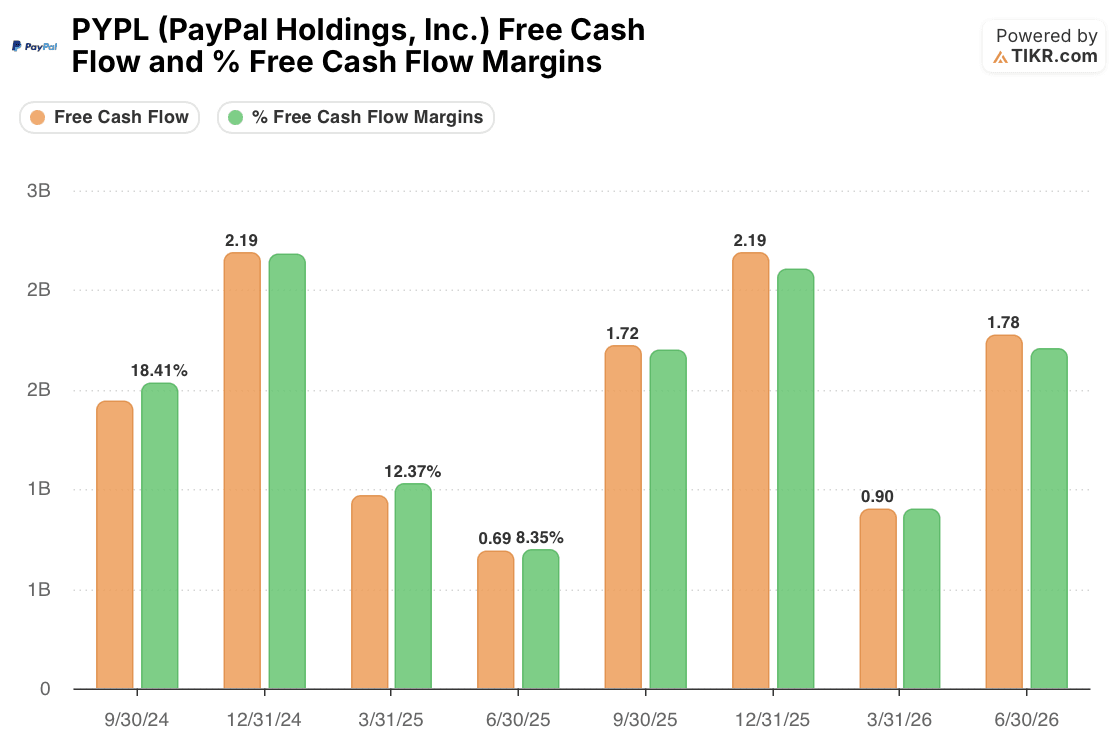
Free cash flow fell to a first-quarter 2026 low of $0.90 billion, a 10.81% margin, its weakest showing in the past two years. By the second quarter it recovered to $1.78 billion and a 20.44% margin, close to the 25.24% margin PayPal posted back in the fourth quarter of 2025.
That rebound lines up with what management described on the Q2 call: a $1.5 billion-plus, multiyear cost-savings program, with roughly $400 million of run-rate savings already identified for this year and organizational layers removed as of the summer. CFO Jamie Miller was explicit that savings are meant to self-fund reinvestment into Venmo, Braintree, and financial services rather than requiring fresh spending. A margin move from 10.81% to 20.44% in a single quarter is early evidence the mechanism is working, though it is still short of the 25%-plus margins PayPal generated as recently as last December, and management itself says savings become “more meaningful” only in the fourth quarter.
PYPL’s Branded Checkout Is the Recurring Excuse Cash Flow Can’t Fix
The reason Street’s ratings keep drifting toward Hold despite improving cash generation is sitting in the guidance itself. On the Q2 2026 earnings call, management described branded checkout as stabilizing at 2% currency-neutral growth for a second consecutive quarter and raised full-year guidance on the strength of it. Six weeks later, at the Goldman conference, Lores walked that back: European cross-border volume, much of it China-linked, took a tariff and de-minimis hit that ran between 0.5 and 1 point worse than modeled, and for longer than expected. Third-quarter branded checkout is now guided to a 1-2% range instead of a clean 2%.
This is not the first time PayPal has offered a version of “checkout is stabilizing,” only for a new headwind, first Apple Pay and Google Pay encroachment, then general macro softness, now tariffs, to reset the goalposts. Financial services, Buy Now Pay Later, Venmo, and Braintree are genuinely growing in the double digits and mid-teens, and diversification away from checkout is a real strategic shift.
But checkout still anchors the branded network both of those businesses lean on, and a market that has watched this stabilization narrative repeat itself has good reason to wait for two or three clean quarters before moving ratings back to Buy.
What Would Actually Move PYPL Stock’s Multiple From Here

At 9.50x NTM normalized earnings, PayPal trades well below its three-year mean of 12.67x and closer to the 7.31x low it touched in early 2026 than to anything resembling a growth multiple. That is not a post-collapse anomaly. The multiple was already compressed through most of 2025 and only briefly touched 11x during the height of takeover speculation this spring, before settling back near current levels once the deal died.
The market was never pricing PYPL as an acquisition target for long, and it is not pricing it as an operational turnaround story either. It is pricing a company whose cost discipline is real but unproven at scale, sitting behind a checkout business that keeps needing a new excuse.
The next real test is the October Q3 report. If free cash flow margin continues climbing back toward the 25% PayPal generated last December, and if branded checkout holds the 1-2% range rather than sliding toward the low end again, the setup for a multiple re-rating gets meaningfully better. If checkout disappoints again, or the promised fourth-quarter savings do not show up in margin, 9.50x will look less like a value opportunity and more like a business the Street has correctly priced as stuck.
Should You Invest in PayPal Holdings, Inc.?
The only way to really know is to look at the numbers yourself. TIKR gives you free access to the same institutional-quality financial data that professional analysts use to answer exactly that question.
Pull up PYPL stock and you’ll see years of historical financials, what Wall Street analysts expect for revenue and earnings in the quarters ahead, how valuation multiples have moved over time, and whether price targets are trending up or down.
You can build a free watchlist to track PayPal Holdings, Inc. alongside every other stock on your radar. No credit card required. Just the data you need to decide for yourself.
Access Professional Tools to Analyze PYPL stock on TIKR for Free →
Looking for New Opportunities?
- See what stocks billionaire investors are buying so you can follow the smart money.
- Analyze stocks in as little as 5 minutes with TIKR’s all-in-one, easy-to-use platform.
- The more rocks you overturn… the more opportunities you’ll uncover. Search 100K+ global stocks, global top investor holdings, and more with TIKR.
Disclaimer:
Please note that the articles on TIKR are not intended to serve as investment or financial advice from TIKR or our content team, nor are they recommendations to buy or sell any stocks. We create our content based on TIKR Terminal’s investment data and analysts’ estimates. Our analysis might not include recent company news or important updates. TIKR has no position in any stocks mentioned. Thank you for reading, and happy investing!


