Key Takeaways
- AMD fell more than 4% on September 14 after Anthropic, OpenAI and xAI executives publicly warned about the pace of AI development, then rebounded to roughly $549 by September 17, up more than 7% on the day.
- Wall Street’s price targets never wavered during the panic. The mean 12-month target rose from about $500 in late June to $617 by mid-September, with the analyst count and buy ratings both climbing through the same window.
- AMD’s gross margin has held in a tight 54.5% to 56.8% band for four straight quarters, showing no sign yet of the Instinct-driven dilution management has been flagging.
- Free cash flow margin nearly halved, from 25.0% in the March 2026 quarter to 13.5% in June, even as revenue grew 50% year over year, the real test of whether the 2027 growth story converts to cash as fast as it converts to revenue.
A Selloff That Didn’t Change AMD’s Numbers
On September 14, AI stocks worldwide sold off after Anthropic CEO Dario Amodei published an essay urging AI companies to slow the pace of capability development, a view Elon Musk and Sam Altman both said they shared.
Altman also confirmed OpenAI would delay its IPO over safety concerns. The selloff landed on top of an already jittery macro backdrop, with the 10-year Treasury yield briefly clearing 5% for the first time since 2023 ahead of a widely expected Fed rate hike. Nvidia fell 3.4%, AMD fell more than 4%, and the Philadelphia semiconductor index dropped as much as 6%. Not everyone bought the panic. Michael Burry called the warnings “hype and puffery” and “cover for real uncontrollable slowing growth.”
What actually happened to AMD next is the more useful data point. By September 17, the stock had rebounded to roughly $549, up more than 7% intraday.
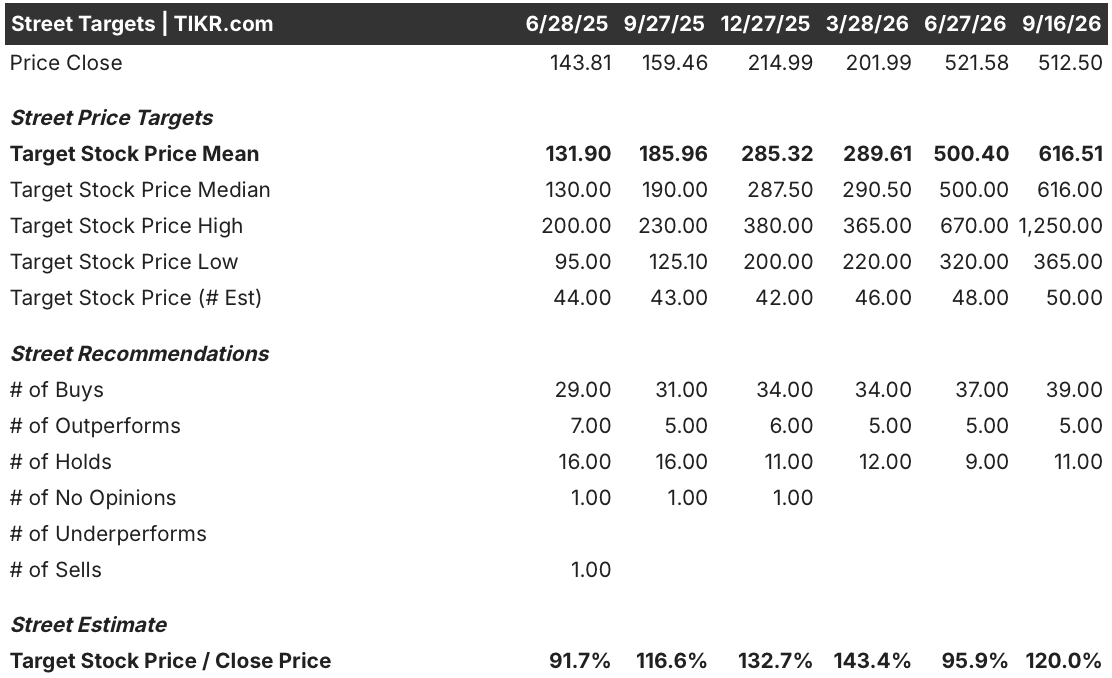
More telling, TIKR’s Street Analysts Targets data shows the mean price target rose from $500.40 on June 27 to $616.51 by September 16, two days after the crash, with the number of estimates climbing from 48 to 50 and buy ratings rising from 37 to 39. Analysts had every opportunity to trim numbers into that selloff and instead did the opposite. That’s a meaningful signal that the scare was macro sentiment layered onto a rate story, not a reassessment of AMD’s own trajectory.
AMD’s Gross Margin Hasn’t Cracked, Yet
CFO Jean Hu has said plainly, on the Q2 earnings call and at three subsequent investor conferences, that AMD’s gross margin path depends on the mix between high-margin EPYC server CPUs and lower-margin Instinct GPUs, and that margin will step down slightly as MI450 volume builds through Q4 2026 and into 2027. That’s a specific, testable claim, and the trailing data doesn’t yet show the damage. The 43.2% trough in the June 2025 quarter was a one-time $800 million inventory charge tied to MI308 export restrictions on China shipments, not a structural mix shift.
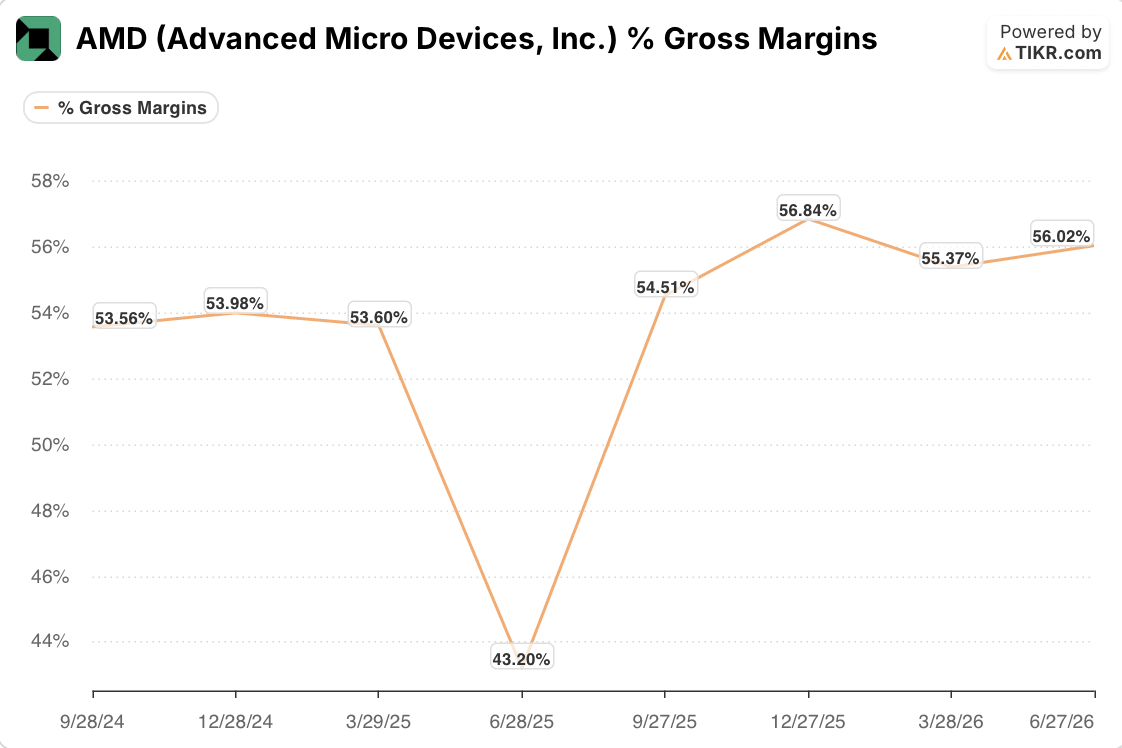
Margin recovered to 54.51% by September 2025, peaked at 56.84% in December, and has held between 55% and 57% for four consecutive quarters, landing at 56.02% in June 2026, exactly in line with the 56% guided for Q3. Data Center revenue rose from 42% to 58% of total sales over that same year, and margin barely moved.
For now, that’s a point in the bulls’ favor, but Helios shipments only began ramping in September, so the dilution management has been describing is still ahead of the reported numbers, not behind them.
The AMD Cash Number That Already Moved
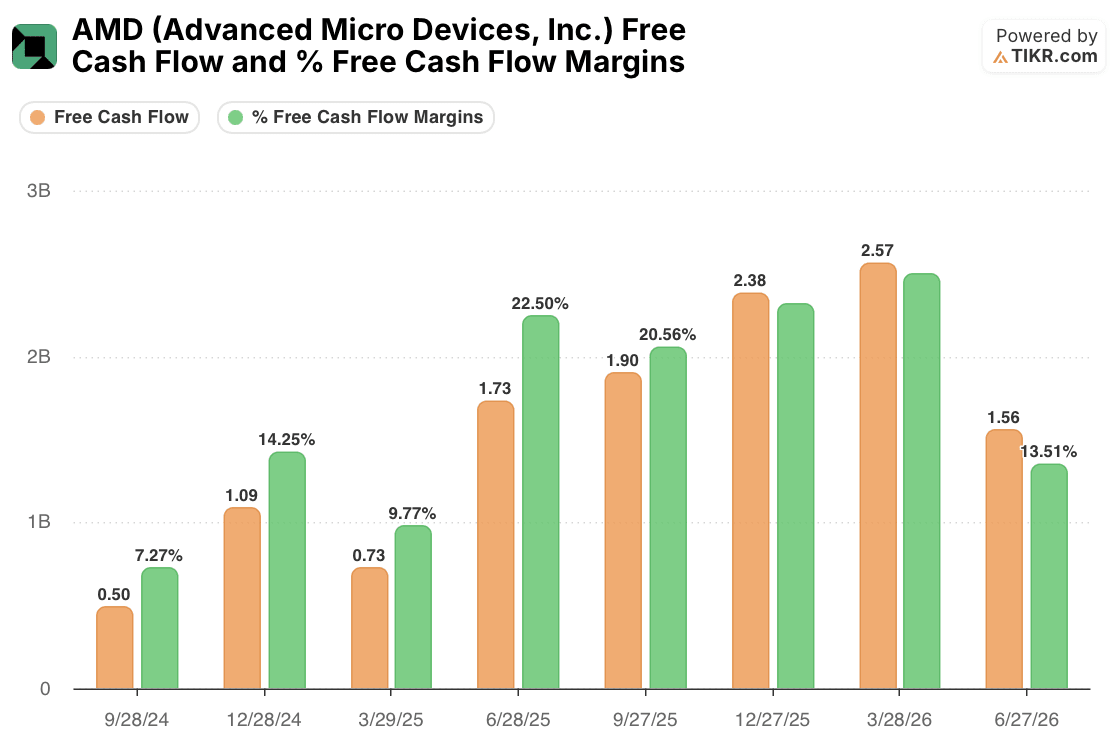
While gross margin stayed calm, free cash flow did not. AMD generated $2.57 billion of free cash flow in the March 2026 quarter, a 25.0% margin and the best in the recorded series. In June, the same quarter Data Center revenue more than doubled year over year and management raised its 2030 TAM estimate to $220 billion for server CPUs and $1.4 trillion for AI accelerators, free cash flow fell to $1.56 billion and the margin nearly halved to 13.5%.
That drop isn’t explained by slowing revenue, which grew 13% sequentially and 50% year over year in the same quarter. It lines up instead with what Hu has described repeatedly: AMD is buying its own manufacturing equipment and arranging capacity consignment to lock down server CPU supply, on top of the wafer, advanced packaging and HBM commitments needed to ramp Helios. That capex is landing on the cash flow statement now, well ahead of the Helios and Venice revenue it’s meant to support.
What Would Actually Break the Thesis
AMD’s growth case, a Data Center segment guided to more than double in 2027 on Venice server CPUs and Helios GPUs backed by up to 2 gigawatts from Anthropic and a gigawatt each from OpenAI and Meta, remains fully intact and untouched by the September selloff.
What would actually change the picture isn’t another round of AI-safety headlines. It’s whether free cash flow margin keeps sliding through the next two or three quarters as Helios volume builds into a period management itself says will carry gross margin “slightly below corporate average.”
One quarter of FCF compression tied to a capacity buildout isn’t damning by itself, and AMD stayed free-cash-flow positive even through the 2025 export-control charge.
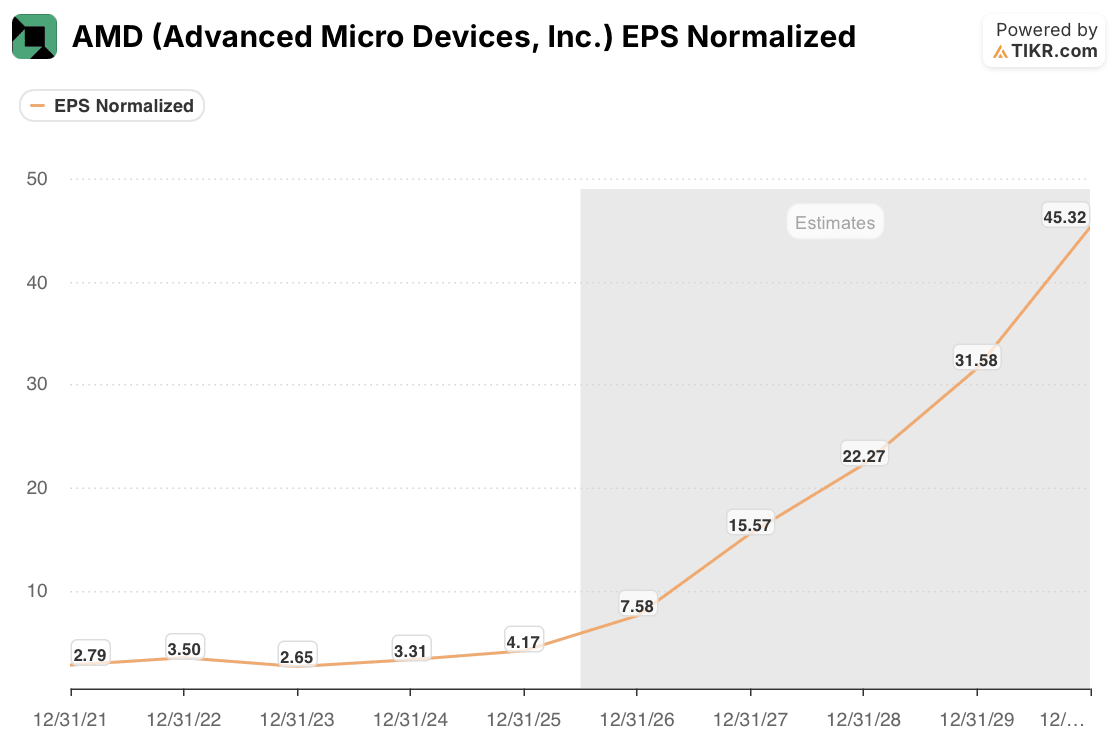
But the Street’s numbers, a mean target near $617 and consensus normalized EPS estimates rising from $7.58 in 2026 to more than $45 by 2030, are pricing a company that converts this revenue and margin growth into cash roughly as fast as it books it. The next one or two quarters of free cash flow margin, not the next AI-safety headline, will show whether that assumption holds.
Should You Invest in Advanced Micro Devices, Inc.?
The only way to really know is to look at the numbers yourself. TIKR gives you free access to the same institutional-quality financial data that professional analysts use to answer exactly that question.
Pull up AMD stock and you’ll see years of historical financials, what Wall Street analysts expect for revenue and earnings in the quarters ahead, how valuation multiples have moved over time, and whether price targets are trending up or down.
You can build a free watchlist to track Advanced Micro Devices, Inc. alongside every other stock on your radar. No credit card required. Just the data you need to decide for yourself.
Access Professional Tools to Analyze AMD stock on TIKR for Free →
Looking for New Opportunities?
- See what stocks billionaire investors are buying so you can follow the smart money.
- Analyze stocks in as little as 5 minutes with TIKR’s all-in-one, easy-to-use platform.
- The more rocks you overturn… the more opportunities you’ll uncover. Search 100K+ global stocks, global top investor holdings, and more with TIKR.
Disclaimer:
Please note that the articles on TIKR are not intended to serve as investment or financial advice from TIKR or our content team, nor are they recommendations to buy or sell any stocks. We create our content based on TIKR Terminal’s investment data and analysts’ estimates. Our analysis might not include recent company news or important updates. TIKR has no position in any stocks mentioned. Thank you for reading, and happy investing!