Key Stats for TSLA Stock
- Past week performance: -0.8%
- 52-week range: $297 to $499
- Valuation model target price: $531
- Implied upside: 42.8% over 2.3 years
Weigh Tesla’s robotaxi hopes against analysts’ actual margin forecasts (It’s free) >>>
A Truck Arrives, a Robot Stalls, and Europe Waits
Tesla (TSLA) stock slipped about 0.8% this week, closing near $372 on Friday. The shares sit roughly 25% below their 52-week high of $499 and have lost 16% over the past year. News flow was mixed. Investors seemed torn between product milestones and fresh delays.
The good news came from Nevada. Tesla began delivering its Semi electric truck to first customers, almost nine years after its unveiling. However, it gave no production targets or pricing at the event. Tesla has said the dedicated factory can eventually build up to 50,000 trucks a year.
Two setbacks offset that milestone. The EU postponed its October vote on Full Self-Driving (Supervised), pushing a decision to December at the earliest. Reports also said Optimus, Tesla’s humanoid robot, faces problems with its complex hands and supplier quality as output scales. Tesla is targeting 1,000 robots a week by year-end.
Management had flagged that ramp risk. “Optimus will follow the sort of normal S-curve of a manufacturing ramp, but the initial portion of the S-curve will be quite flat and long,” CEO Elon Musk said on the Q2 earnings call. If TSLA stock is going to reclaim its highs, investors likely need proof that the flat part of that curve is ending.
Compare Tesla’s delivery growth with its shrinking operating margins (It’s free) >>>
Tesla Is Priced for a Future Its Margins Have Not Reached
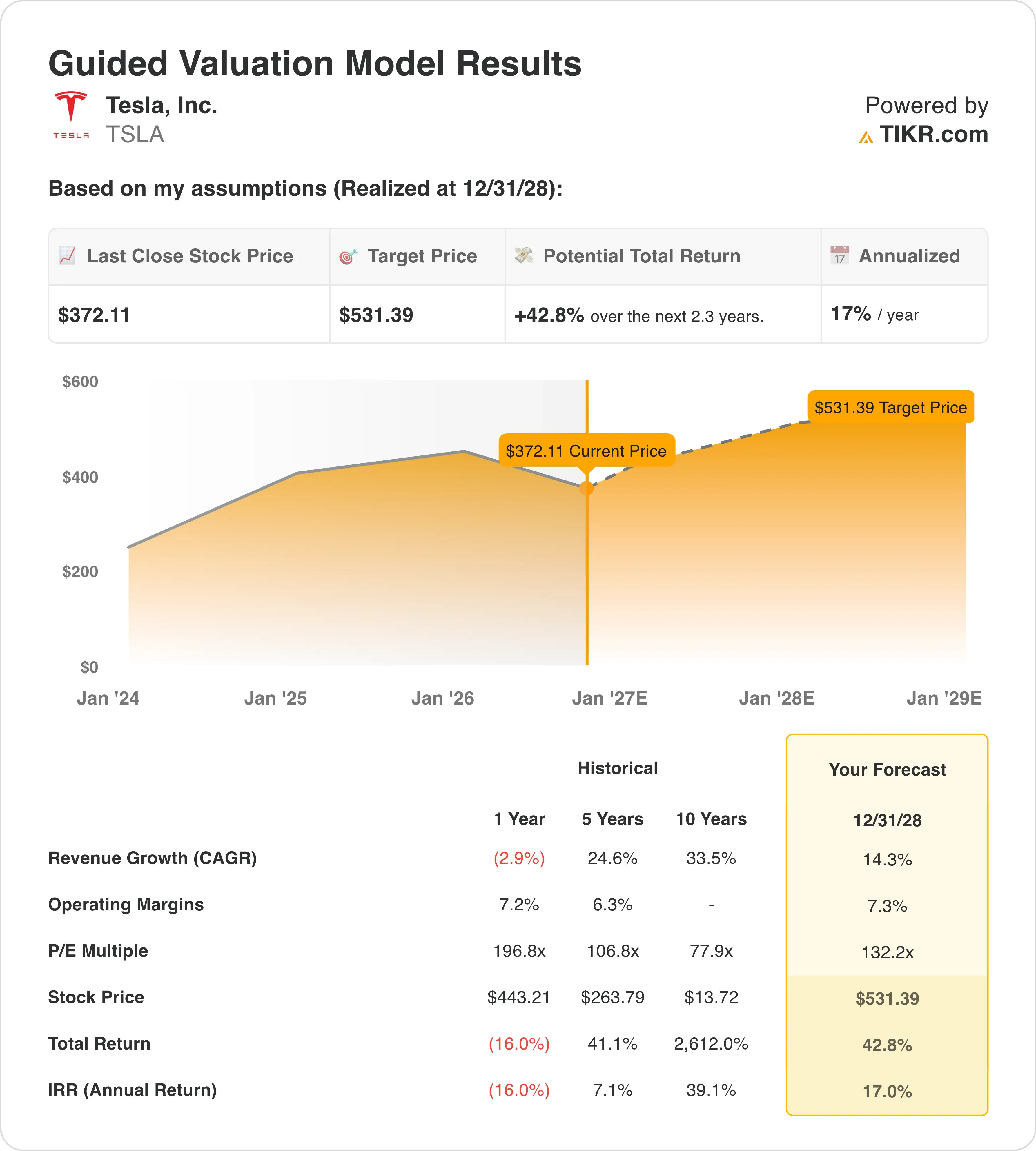
Under valuation model assumptions realized through 12/31/28, the stock is modeled using:
- Revenue Growth (CAGR): 14.3%
- Operating Margins: 7.3%
- Exit P/E Multiple: 132.2x
Based on these inputs, the model estimates a target price of $531, implying 42.8% total upside from the current share price of $372 and a 17.0% annualized return over the next 2.3 years.
A 17.0% annual return looks attractive on paper. But the path depends almost entirely on the multiple. The model uses an exit P/E of 132.2x, below last year’s 196.8x yet far above the 77.9x 10-year average. In other words, investors must keep paying a steep premium for Tesla’s future bets.
The fundamentals tell a harder story. Operating margin fell to 1.4% in Q2 as costs rose and capex jumped 142% to $5.8 billion. The model assumes margins recover only to 7.3%, close to last year’s 7.2%. So this remains a margin compression story, not yet a recovery.
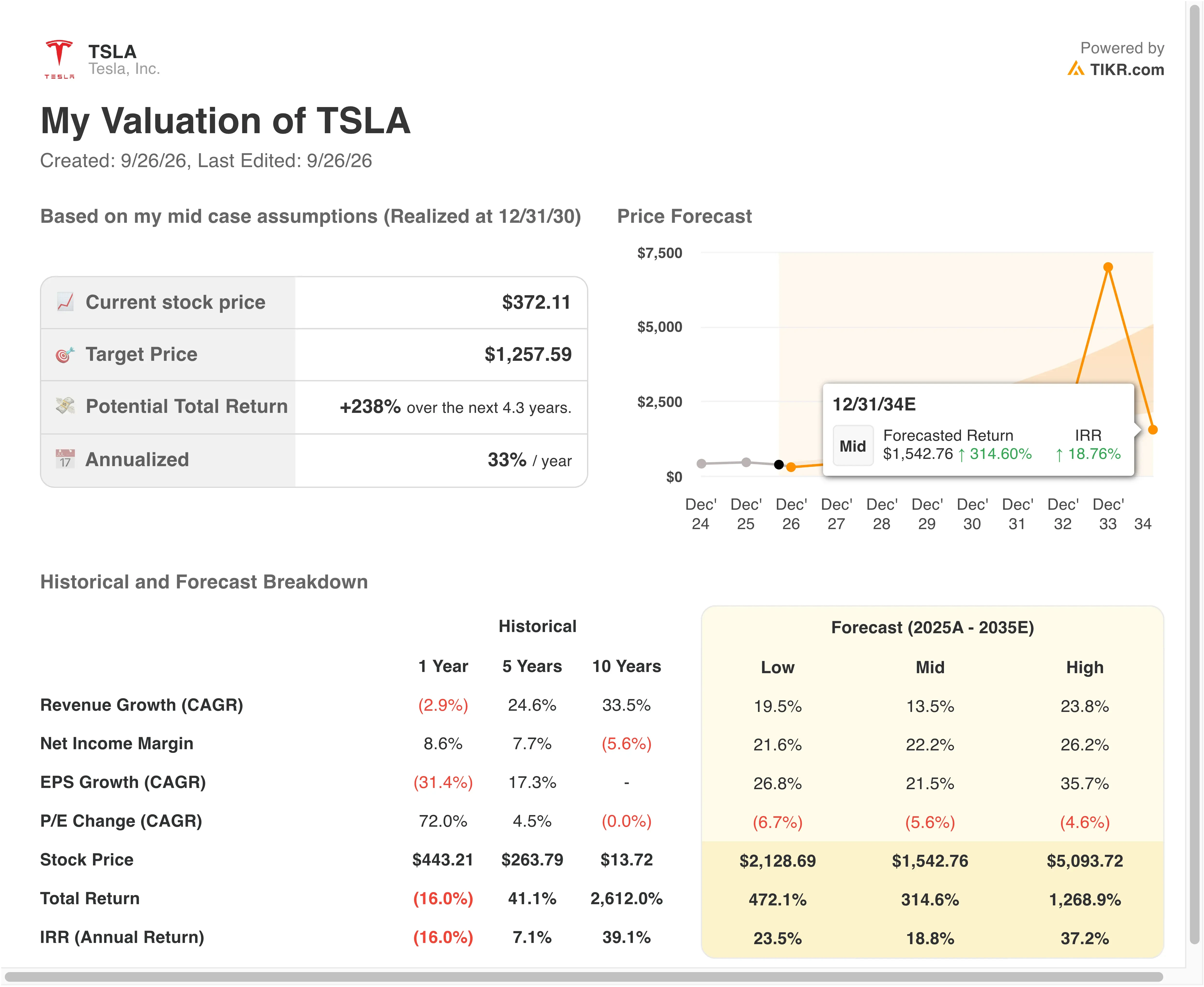
Revenue growth of 14.3% a year looks plausible. Q2 revenue rose 26% to $28.2 billion on record deliveries of 480,126 vehicles. Analysts expect 12.9% annual revenue growth over the next two years, close to the model input. Growth is not the main problem.
The valuation gap is the real issue. Tesla trades at 195.3x forward earnings, a premium built on robotaxis and robots rather than car sales. That makes the stock highly sensitive to any delay in Cybercab, FSD, or Optimus.
BYD Sells More Cars, but Tesla Owns the Autonomy Narrative
BYD (1211) remains Tesla’s biggest rival in electric vehicles. Its first-half revenue fell 7.1% to 344.8 billion yuan, about $50.9 billion, as a price war hit China sales. Still, gross margin improved to 18.9%, helped by more profitable exports. Tesla’s Q2 gross margin was lower at 16.8%.
Growth trends currently favor Tesla. Its Q2 revenue grew 26%, while BYD’s Q2 revenue fell 3.2%. Yet BYD’s overseas push is real, with exports up 67.8% to roughly 792,000 vehicles in the first half. That puts BYD in direct competition with Tesla across Europe and Asia.
Autonomy competition comes from Nvidia’s ecosystem. Nvidia (NVDA) supplies self-driving platforms to BYD, Geely, and Nissan for Level 4 vehicles, which drive without human input in set areas. Lucid (LCID) and Bolt plan to deploy 25,000 autonomous vehicles across Europe. Uber (UBER) and Nvidia also plan a robotaxi fleet starting in Los Angeles and San Francisco in 2027.
Tesla’s moat is data and vertical integration. It has nearly 1.5 million paid FSD customers feeding real driving data into its models. However, rivals do not need to match Tesla alone, because Nvidia sells them the tools. That makes speed of execution Tesla’s most important advantage.
Determine if Cybercab and Optimus can support Tesla’s demanding valuation >>>
What’s Driving TSLA Stock Going Forward?
Q3 earnings, expected around October 21, are the next major test. Tesla already reported record Q2 deliveries, so investors will focus on profitability. Automotive gross margin, excluding regulatory credits, fell to 16.3% in Q2. Any rebound there would ease concerns about the core business.
Regulation will shape the autonomy timeline. The EU vote on FSD Supervised could return in December. Meanwhile, a Belgian safety group found the system often misreads speed limits, which could complicate approval. In the U.S., the National Highway Traffic Safety Administration opened an audit query covering about 1,000 Cybercab vehicles.
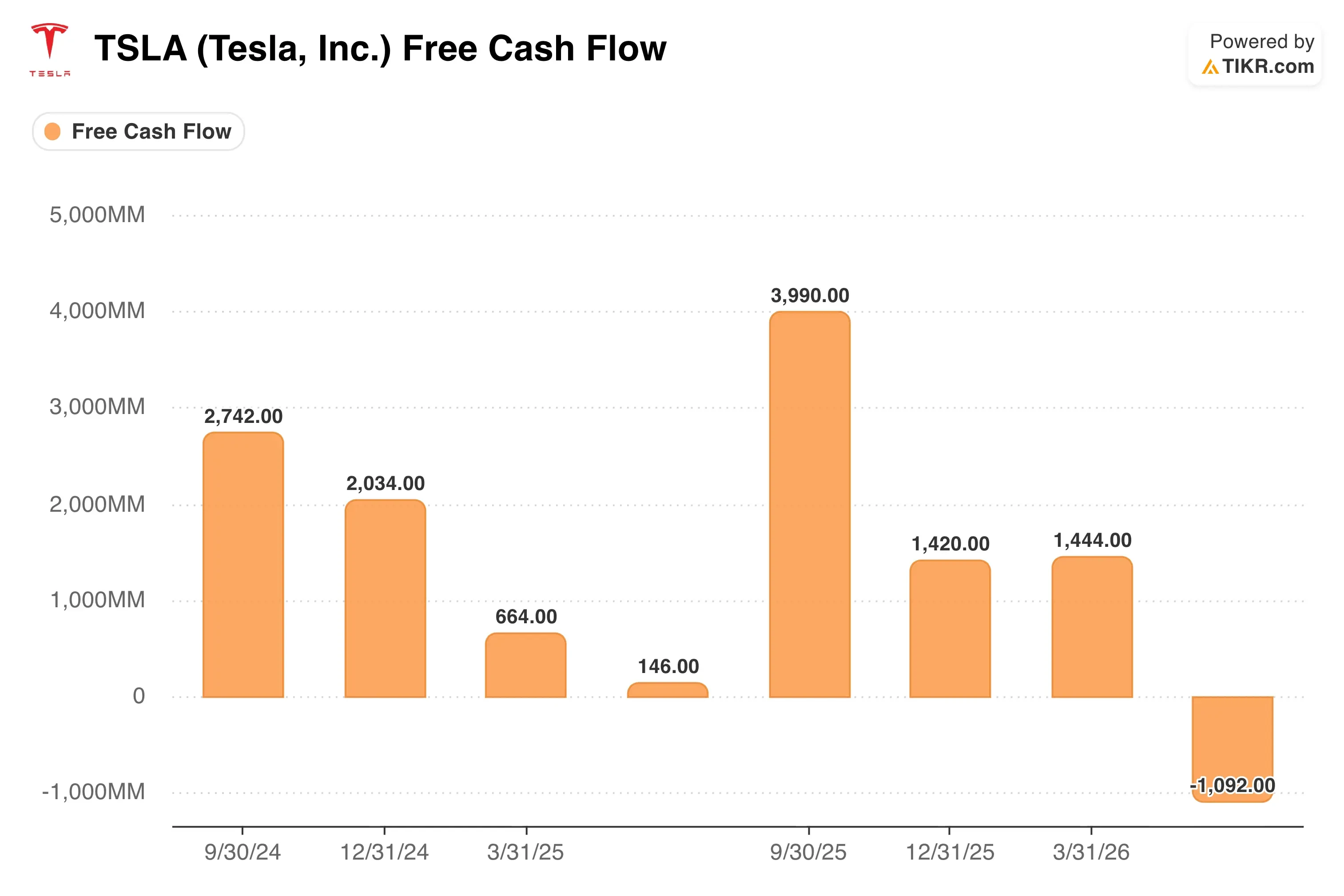
Spending will stay heavy. Tesla expects capex above $25 billion in 2026, and its CFO said spending will grow for the next two or three years. That money funds factories for Cybercab, Optimus, Semi, and batteries. Because free cash flow turned -$1.1 billion in Q2, investors want returns to show up soon.
The SpaceX connection adds a wildcard. Reports in July said Tesla weighed selling its China business to pave the way for a potential SpaceX merger. Nothing is confirmed, although the idea keeps Tesla tied to the wider Musk ecosystem.
Estimate a company’s fair value instantly (Free with TIKR) >>>
Should You Invest in Tesla?
The only way to really know is to look at the numbers yourself. TIKR gives you free access to the same institutional-quality financial data that professional analysts use to answer exactly that question.
Pull up TSLA, and you’ll see years of historical financials, what Wall Street analysts expect for revenue and earnings in the quarters ahead, how valuation multiples have moved over time, and whether price targets are trending up or down.
You can build a free watchlist to track TSLA alongside every other stock on your radar. No credit card required. Just the data you need to decide for yourself.
Analyze TSLA stock on TIKR Free→
Disclaimer:
Please note that the articles on TIKR are not intended to serve as investment or financial advice from TIKR or our content team, nor are they recommendations to buy or sell any stocks. We create our content based on TIKR Terminal’s investment data and analysts’ estimates. Our analysis might not include recent company news or important updates. TIKR has no position in any stocks mentioned. Thank you for reading, and happy investing!