Key Takeaways
- Bitcoin mining generated about 92% of Riot’s segment revenue in Q2 2025. By Q2 2026, that share had fallen to about 65%, as mining revenue dropped 19% year over year to $113.7 million.
- Riot has secured roughly $9.8 billion in contracted data center revenue with AMD and a leading frontier AI lab, which management estimates will generate about $520 million in average annual revenue once both projects are fully deployed in June 2028.
- Total debt has stayed broadly flat for five straight quarters while free cash flow remained negative. In the first half of 2026, Riot sold Bitcoin to help fund operations and the equity portion of its data-center build rather than raising new debt or common equity.
Riot’s mining share is shrinking while its lease book grows. Track Riot Platforms’ segment revenue mix on TIKR for free →
Riot Platforms Stock Still Moves With Bitcoin. Its Revenue Increasingly Doesn’t
Riot Platforms (RIOT) rose 3.8% on September 21 as Bitcoin touched a seven-month high, moving in step with the rest of the crypto miners. The next morning, Bitcoin slipped from a near eight-month high, and Riot appeared again in Reuters’ list of crypto-linked stocks trading lower. By the September 25 close, RIOT sat at $23, down 2.04% on the day.
That pattern tells the market’s version of the story: Riot is a Bitcoin stock. The segment numbers tell a different one.
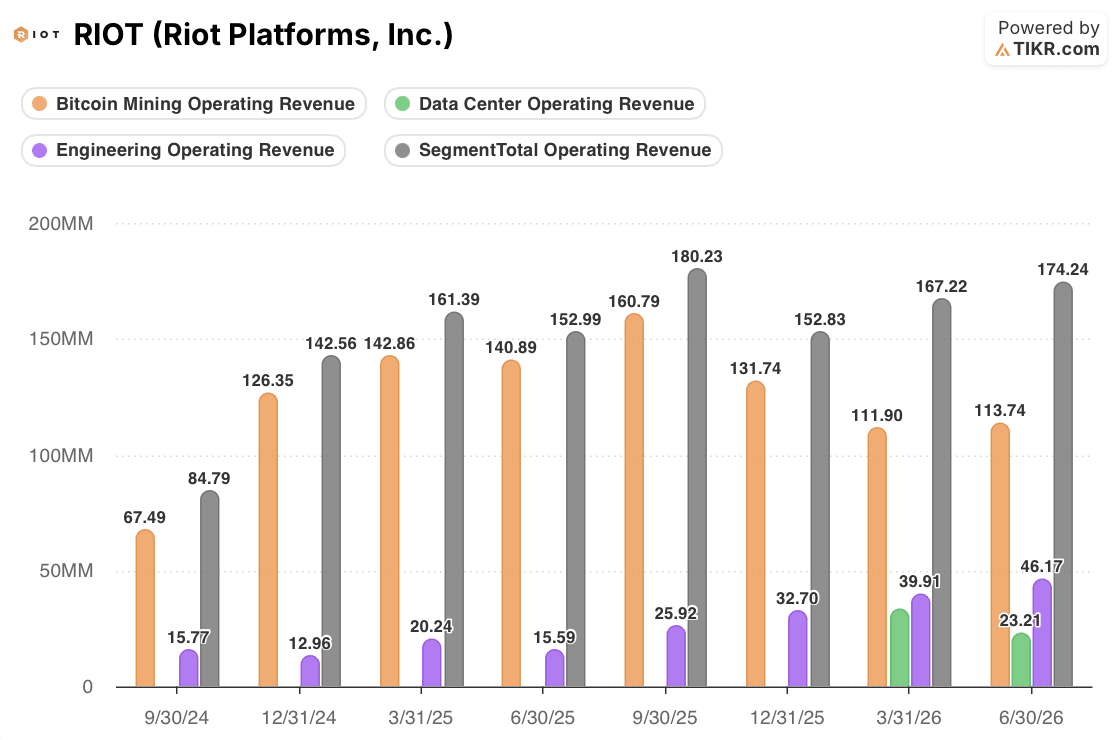
In Q2 2025, Bitcoin mining brought in $140.9 million of Riot’s $153.0 million in segment revenue. A year later, it brought in $113.7 million of $174.2 million. Total segment revenue grew 14% over that stretch while mining revenue fell 19%.
The gap was filled by businesses that don’t depend on the Bitcoin price. Engineering, which builds switchgear and power distribution units, reached $46.2 million in TIKR’s segment data, up from $15.6 million a year earlier. That figure includes sales to Riot’s own projects; management reported $37.3 million in external engineering revenue, still more than triple the prior year. Data Center added $23.2 million.
That Data Center line needs context. Only about $4.9 million was lease-related revenue from AMD, including variable power reimbursement, while the balance came from tenant fit-out work. The other $18.3 million was cost-plus tenant fit-out work that will rise and fall with construction. The recurring piece is still small. What matters is where it is heading.
Engineering revenue tripled while mining fell 19%. See Riot Platforms’ full segment history on TIKR for free →
Bitcoin Is Becoming Riot’s Funding Source, Not Its Destination
The balance sheet shows how the pivot is being paid for.
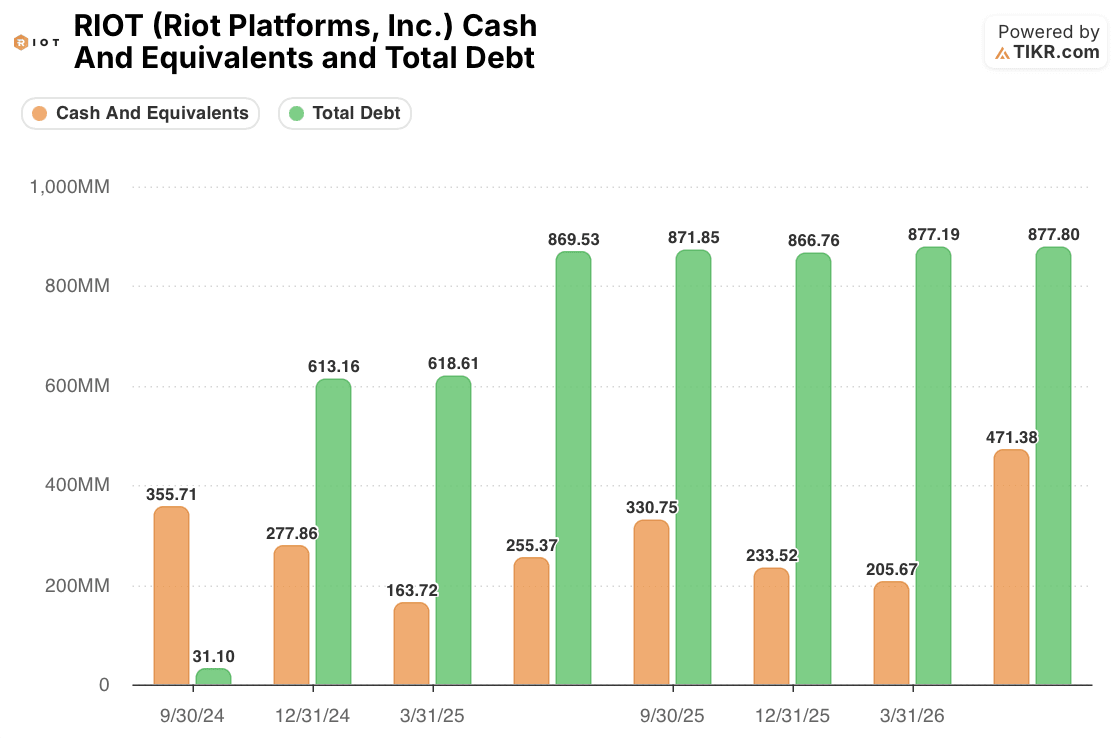
Total debt jumped from $31.1 million in September 2024 to $869.5 million by June 2025, then barely moved, ending Q2 2026 at $877.8 million.
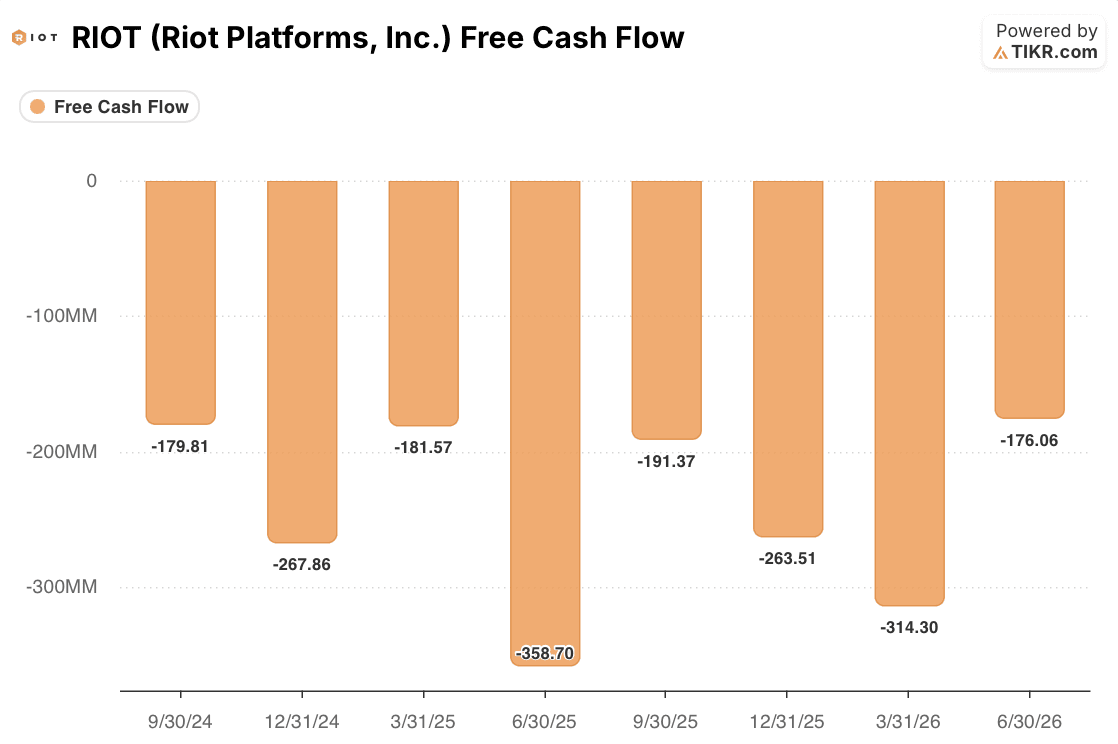
Over the same four quarters, free cash flow was negative every period, totaling about $945 million. Part of the disconnect is accounting: Riot recognizes mined Bitcoin as revenue when earned, while it receives cash proceeds when it later sells the coins. Still, cash and equivalents rose to $471.4 million in June, and management said no common equity was issued in the quarter.
Bitcoin sales helped fund the gap. Riot ended June with 11,380 coins worth $666 million, although 5,821 of those coins were restricted as collateral for its Bitcoin-backed credit facility. Those coins are the equity check for a build that should eventually produce about $520 million in average annual lease revenue. For scale, Q2 mining revenue annualizes to roughly $455 million.
Bitcoin still matters, but through a different channel. A lower price shrinks the treasury funding construction; it no longer defines the long-term revenue base the way it once did. Management expects debt financing to cover 80% to 90% of the AI-lab project’s estimated $2.1 billion to $2.3 billion cost, leaving a net equity need of $30 million to $280 million after the planned $180 million AMD term loan.
That flat debt line is about to change, and the Q3 report is the next test. The key items are whether the expected AMD term loan closed, how much of the $573 million Morgan Stanley interim facility has been drawn and refinanced, and whether Corsicana’s nonbinding LOI progresses to a signed lease. Rising debt matched by rising recurring lease revenue would confirm the shift. A stalled Corsicana deal or slipping December 2027 delivery would push the stock back toward being judged on Bitcoin alone.
Riot’s debt is about to rise as the lab build begins. Watch Riot Platforms’ debt and cash flow on TIKR for free →
Disclaimer:
Please note that the articles on TIKR are not intended to serve as investment or financial advice from TIKR or our content team, nor are they recommendations to buy or sell any stocks. We create our content based on TIKR Terminal’s investment data and analysts’ estimates. Our analysis might not include recent company news or important updates. TIKR has no position in any stocks mentioned. Thank you for reading, and happy investing!