Key Stats — RTX Corporation (RTX) | Q1 2026 Earnings
- Current price: ~$187
- Q1 2026 adjusted revenue: $22.1B, up 9% YoY (10% organic)
- Q1 2026 adjusted EPS: $1.78, up 21% YoY
- Q1 2026 free cash flow: $1.3B, up ~$500M YoY
- FY2026 revenue guidance (updated): $92.5B–$93.5B (raised from $92B–$93B)
- FY2026 adjusted EPS guidance (updated): $6.70–$6.90 (raised from $6.60–$6.80)
- FY2026 free cash flow guidance: $8.25B–$8.75B (maintained)
- TIKR model price target: ~$212
- Implied upside: ~13%
Earnings Breakdown

RTX Corporation stock (RTX) opened Q1 2026 with adjusted revenue of $22.1B and adjusted EPS of $1.78, up 9% and 21% year-over-year respectively, with growth across all three channels.
Raytheon was the decisive driver, posting 9% organic sales growth to $6.9B and expanding operating margins by 150 basis points year-over-year, according to Nathan Ware, Vice President of Investor Relations, on the Q1 2026 earnings call.
Raytheon’s operating margin for Q1 reached 12.2%, according to Neil Mitchill, Chief Financial Officer, on the Q1 2026 earnings call, driven by favorable program mix in land and air defense systems and munitions output up over 40% year-over-year.
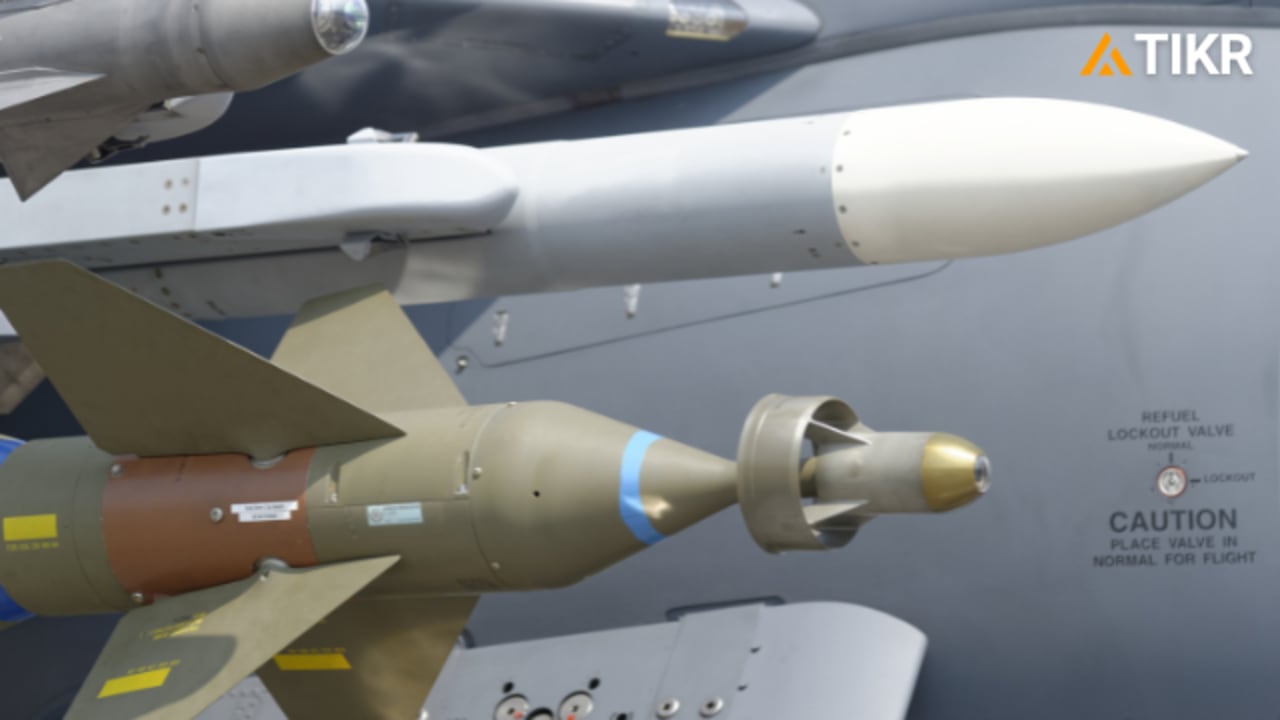
RTX signed five landmark framework agreements with the Department of War covering Tomahawk, AMRAAM, and the Standard Missile family, which management described as providing firm demand signals to support production ramps well above current rates over the next decade.
Collins Aerospace delivered Q1 revenue of $7.6B, up 10% organically, with commercial OE up 15% and commercial aftermarket up 7%, expanding operating margins by 10 basis points despite a 130 basis point tariff headwind.
Pratt & Whitney reported Q1 revenue of $8.2B, up 10% organically, led by 19% growth in commercial aftermarket and 7% growth in military engines, with PW1100 AOGs declining approximately 15% from year-end on the back of 23% year-over-year MRO output growth.
RTX raised its full-year adjusted sales outlook by $500M to a range of $92.5B–$93.5B and increased its adjusted EPS guidance by $0.10 on both ends to $6.70–$6.90, while maintaining free cash flow guidance of $8.25B–$8.75B.
The company’s backlog reached a record $271B, up 25% year-over-year, with a book-to-bill of 1.14 for the quarter, and the framework agreements cited by management are not yet finalized or reflected in that figure.
RTX paid down $500M of debt in the quarter and recorded $170M of powder-metal-related compensation within free cash flow, which the company characterized as tracking to its full-year deleveraging expectations.
Financials
RTX Corporation stock is showing a clear margin recovery arc through the trailing four quarters on the income statement, with operating leverage building despite persistent tariff headwinds across all three segments.

Gross margin came in at 19.5% in Q4 2025, the most recent full quarter on the income statement, down from 20.4% in Q3 2025, reflecting elevated cost of goods sold as defense volume mix shifted.
Operating margins trended from 11.8% in Q1 2025 to 11.5% in Q2, 12.8% in Q3, and 11.0% in Q4, with RTX Corporation stock’s consolidated segment margins expanding 70 basis points year-over-year in Q1 2026 per the transcript.
Q1 2026 EBIT reached $3B on revenue of $22.1B, representing a 13.7% EBIT margin, up from 13.1% in Q1 2025, with segment operating profit of $2.9B up 14% year-over-year.
Productivity was the central lever: RTX grew organic sales and segment profit double digits with only a 1% increase in headcount, according to Neil Mitchill on the Q1 2026 earnings call, with $32M of year-over-year productivity improvement at Raytheon alone in the quarter.
What Does the Valuation Model Say?
The TIKR model prices RTX Corporation stock at approximately $212, implying roughly 13% upside from the current price of ~$187 under mid-case assumptions realized through December 2030.
The mid-case model assumes a revenue CAGR of 3.6%, a net income margin of 10.8%, and an EPS CAGR of 4.8% through 2035, with P/E multiple compression of 3.2% annually as the current defense valuation normalizes.
The Q1 report reinforces the mid-case: guidance was raised, Raytheon’s margin profile exceeded expectations, and the framework agreement pipeline represents demand not yet in the backlog that could tilt the model toward the high-case $291 target over time.
The investment case for RTX Corporation stock is modestly stronger after this print, though the model’s 13% implied return over roughly five years reflects a stock already pricing in execution without yet pricing in upside from the framework agreements.

The central tension in RTX Corporation stock after Q1: the framework agreements create a decade of potential demand visibility, but the investment return depends almost entirely on whether supply chain capacity and agreement finalization arrive on schedule.
What Has to Go Right
- Raytheon’s five framework agreements with the Department of War for Tomahawk, AMRAAM, and the Standard Missile family must convert from draft to final contracts, translating the $271B backlog narrative into firm multi-year revenue
- Munitions output growth of over 40% YoY must be sustained as supply chain requirements scale, with Raytheon’s 12 consecutive quarters of material growth providing evidence of durability
- GTF Advantage entry into service later in 2026 must proceed on schedule, with the Hot Section Plus retrofit unlocking aftermarket pricing power that Pratt’s current low-double-digit aftermarket margins have yet to fully reflect
- Commercial aftermarket demand at Pratt and Collins must hold through potential air travel softness, supported by the fact that 50% of the V2500 fleet has not yet had a second shop visit
What Could Still Go Wrong
- Framework agreements are not finalized or in the backlog, meaning the production ramp-up and associated capital investment are proceeding without contracted revenue to underwrite them
- Tariff exposure across all three segments produced a 130 basis point headwind at Collins and a 50 basis point headwind at Pratt in Q1, with RTX absorbing approximately $500M in IEEPA tariff costs since those tariffs were imposed, and refunds remain unconfirmed
- Negative engine margins on GTF OE deliveries will ramp over the next several quarters as material allocation shifts back toward original equipment, creating a near-term drag on Pratt margins even as aftermarket grows
- Commercial provisioning and mods-and-upgrades at Collins are the channels management identified as most exposed to airline capacity discipline, with any demand softness flowing directly into the roughly 40% of Collins revenue that is aftermarket
Should You Invest in RTX Corporation?
The only way to really know is to look at the numbers yourself. TIKR gives you free access to the same institutional-quality financial data that professional analysts use to answer exactly that question.
Pull up RTX stock and you’ll see years of historical financials, what Wall Street analysts expect for revenue and earnings in the quarters ahead, how valuation multiples have moved over time, and whether price targets are trending up or down.
You can build a free watchlist to track RTX Corporation alongside every other stock on your radar. No credit card required. Just the data you need to decide for yourself.
Access Professional Tools to Analyze RTX stock on TIKR for Free →