Key Stats for HOOD Stock
- Past-Week Performance: -10%
- 52-Week Range: $30 to $154
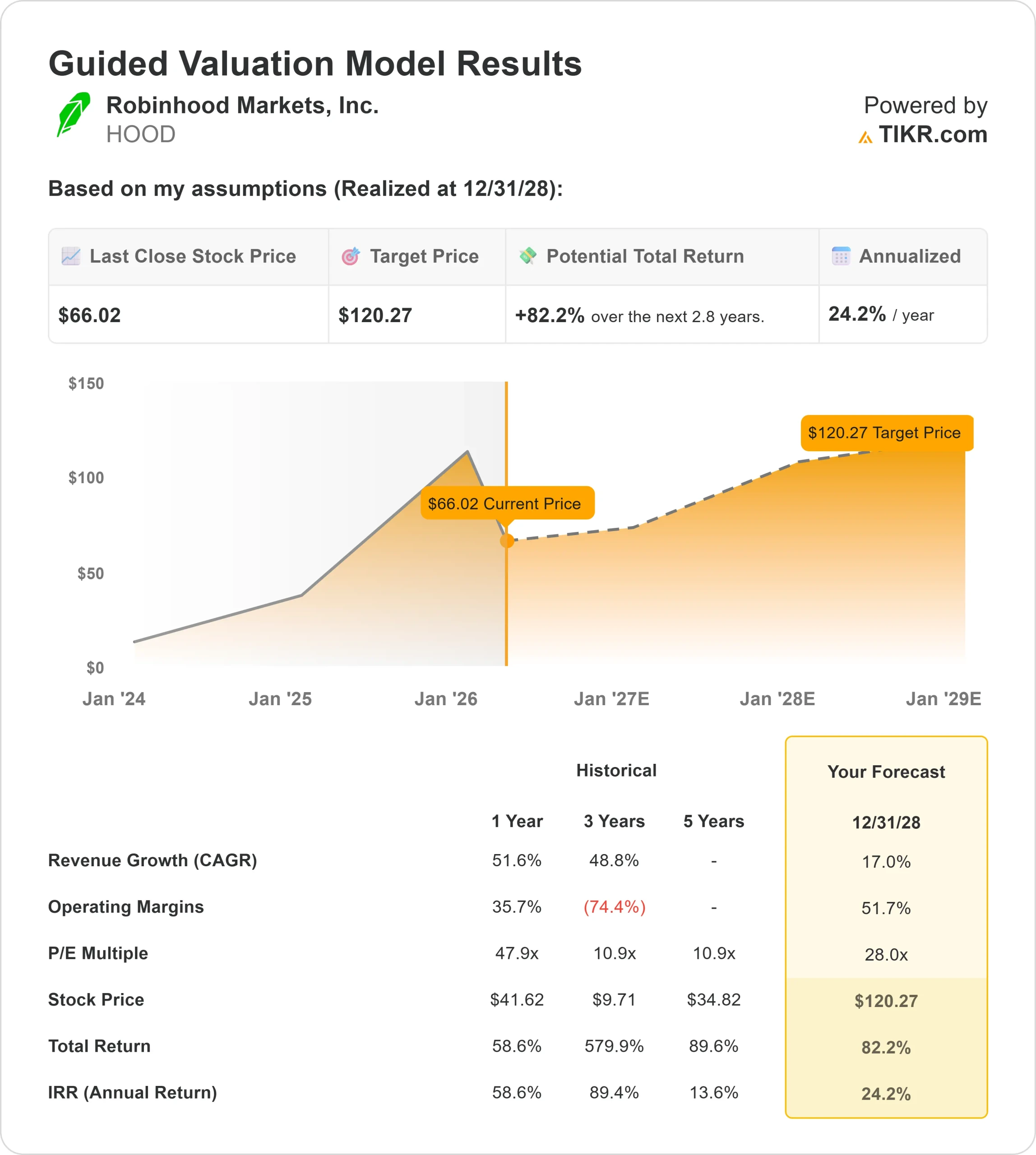
- Valuation Model Target Price: $113
- Implied Upside: 71%
Analyze your favorite stocks like Robinhood Markets with TIKR (It’s free) >>>
What Happened?
Robinhood Markets stock fell about 10% this week, closing near $65 per share, as investors reassessed the company’s reliance on trading-driven revenue as crypto activity cooled and expectations normalized following the stock’s strong run earlier this year.
The stock declined primarily because analysts reset expectations and investors grew cautious about slowing trading-driven revenue.
Goldman Sachs cut its price target to $91 from $102 while maintaining a Buy rating, while Jefferies initiated coverage with a Buy rating and an $88 target, both signaling a more measured upside outlook.
At the same time, easing crypto volatility and more normalized trading volumes weighed on sentiment, which matters because Robinhood generates a large portion of its revenue from transaction activity like options and crypto trades.
In contrast, competitors like Charles Schwab and Interactive Brokers rely more heavily on stable revenue streams such as interest income on client cash and advisory fees, which tend to hold up better during periods of lower trading activity.
At the Citizens JMP Technology Conference, Robinhood highlighted strong customer engagement despite market volatility, with CFO Shiv Verma noting the platform generated over $6 billion in net deposits in February alone and more than $10 billion year-to-date, while equities and options trading rose year-over-year and crypto activity increased month-over-month.
Verma said customers are “net buyers” as they reposition portfolios during volatility. The company also pointed to continued momentum, reporting $68 billion in net deposits in 2025 with a 35% annualized growth rate and targeting 20%+ annualized deposit growth going forward.
Institutional positioning remained active but mixed based on recent filings, reflecting a more selective backdrop after the stock’s earlier gains.
Assenagon Asset Management increased its stake by 22% to about 686,000 shares worth roughly $78 million, while Nordea Investment Management raised its holdings by 5% to about 713,000 shares valued near $82 million.
Wealth Enhancement Advisory Services also increased its stake by 26% to about 366,000 shares worth roughly $44 million, while Park National Corp boosted its position by 137% to about 132,000 shares.
Value Robinhood Markets instantly (Free with TIKR) >>>
Is HOOD Undervalued?
Under valuation assumptions, the stock is modeled using:
- Revenue Growth (CAGR): 17%
- Operating Margins: 52%
- Exit P/E Multiple: 26x
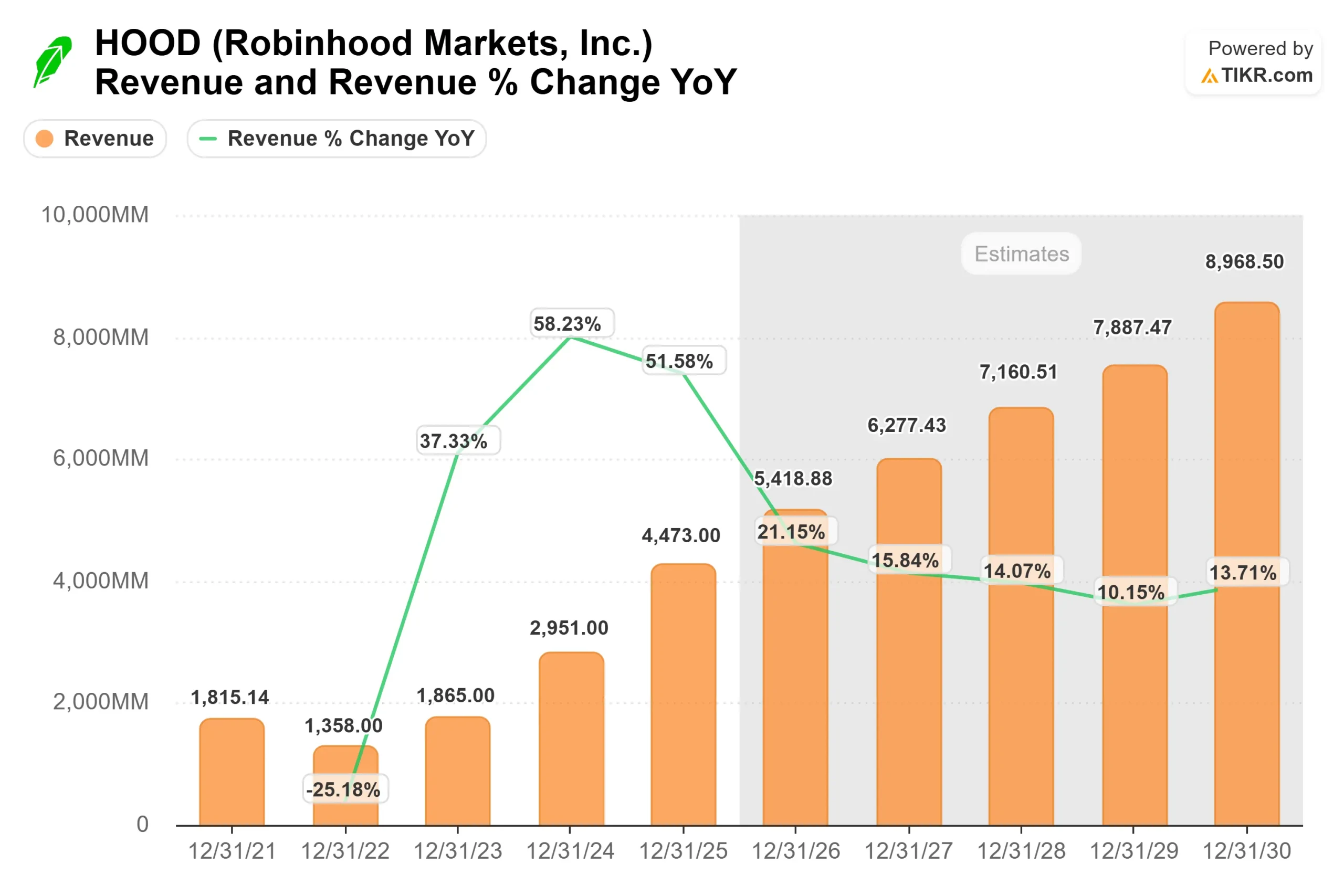
Robinhood’s growth outlook is increasingly tied to improving the quality of its revenue rather than just trading volumes.
Expansion in net interest income, which comes from interest earned on customer cash balances and margin loans, is becoming a more stable earnings driver compared to historically volatile crypto and options trading activity.
See analysts’ growth forecasts and price targets for Robinhood Markets (It’s free) >>>
Product expansion is also becoming a key driver of future growth. Retirement accounts, Robinhood Gold subscriptions, and broader wallet functionality can increase revenue per user while improving retention, helping the platform evolve into a more complete financial ecosystem rather than just a trading app.
At the same time, operating leverage is improving as revenue scales faster than costs, supporting higher long-term margins.
That margin expansion depends on maintaining strong engagement even during periods of lower market volatility, making user activity trends a key factor in near-term performance.
Near-term results remain tied to trading conditions, but longer-term upside depends on successfully shifting toward recurring and interest-based revenue streams while maintaining strong user growth and engagement.
At current levels, Robinhood appears undervalued, with future performance driven by revenue diversification, sustained engagement, and continued product expansion beyond trading.
How Much Upside Does HOOD Stock Have From Here?
Investors can estimate Robinhood Markets’ potential share price, or what any stock could be worth, in under a minute using TIKR’s New Valuation Model tool.
All it takes is three simple inputs:
- Revenue Growth
- Operating Margins
- Exit P/E Multiple
From there, TIKR calculates the potential share price and total returns under Bull, Base, and Bear scenarios so you can quickly see whether a stock looks undervalued or overvalued.
If you’re not sure what to enter, TIKR automatically fills in each input using analysts’ consensus estimates, giving you a quick, reliable starting point.
Value Robinhood Markets in under 60 seconds with TIKR (It’s free) >>>