Key Stats for Visa Stock
- Past-30-Day Performance: -6%
- 52-Week Range: $294 to $376
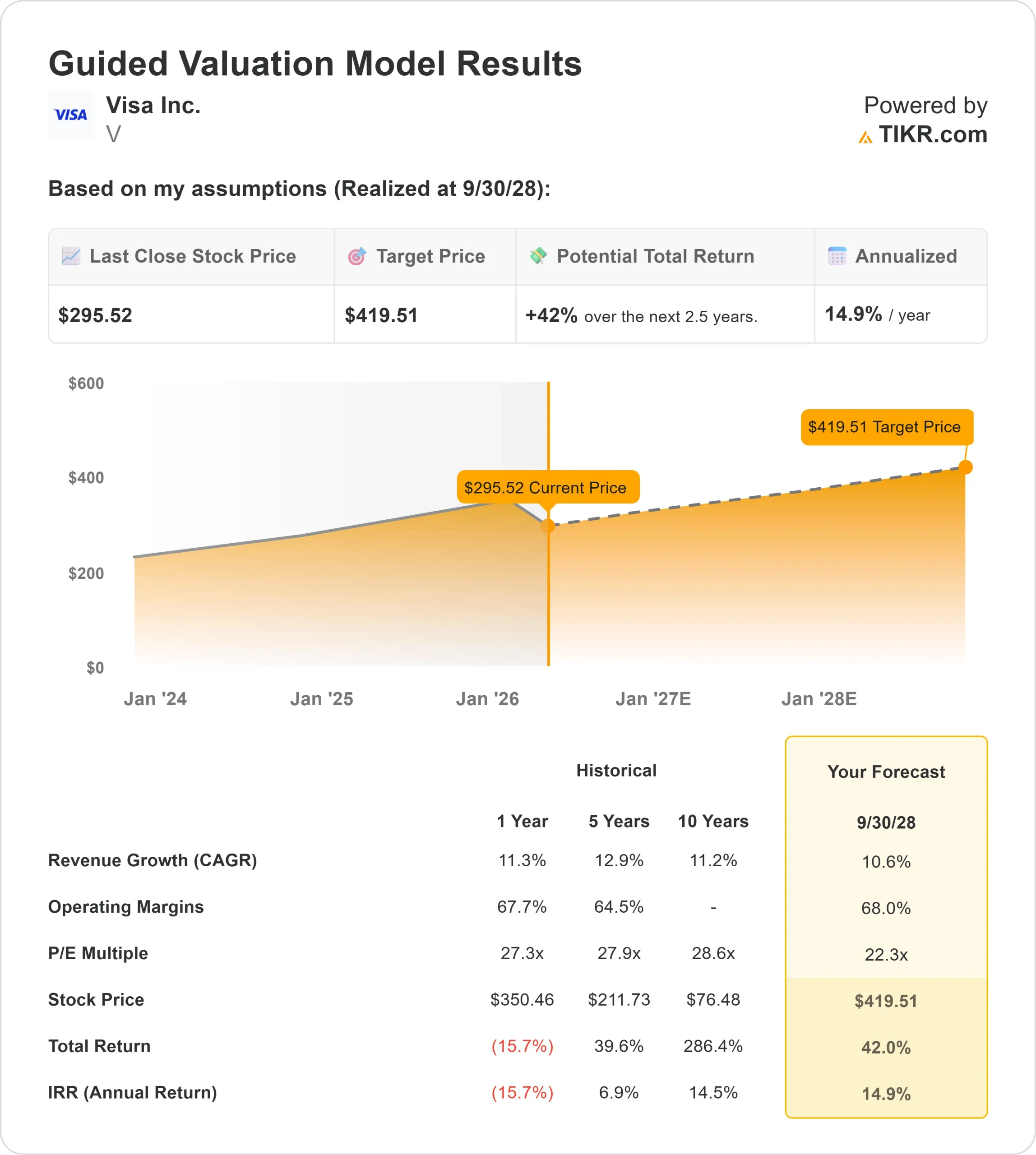
- Valuation Model Target Price: $420
- Implied Upside: 42%
Analyze your favorite stocks like Visa with TIKR (It’s free) >>>
What Happened?
Visa is at the center of a broader debate in 2026 as payment stocks are increasingly being judged on whether steady consumer spending can still support premium valuations after years of strong performance, alongside competitors like Mastercard, which operates a similar global payments network and often trades at a slightly higher valuation, and fintech platforms such as PayPal and Block, which are growing faster in some areas but typically generate lower margins and more volatile earnings.
Visa Inc. stock fell about 6% over the past 30 days, trading near $300 per share, primarily because investors are reassessing its premium valuation as growth normalizes and there are fewer near-term catalysts to drive upside, even though the underlying business continues to show stable payment volumes and consistent consumer spending.
This month, Visa highlighted resilient demand trends at a Wolfe FinTech Forum, with Chief Product and Strategy Officer Jack Forestell saying consumer spending remains “stability and resilience,” as U.S. payment volume rose 8% in January, including 9% credit growth and 6% debit growth, showing that transaction activity remains steady across categories despite broader macro uncertainty.
Visa also announced a collaboration with Pinwheel to expand its subscription management tools, allowing issuers to embed card switching and cancellation features across more than 100 major merchants directly within banking apps, with rollout expected in North America in summer 2026, reinforcing Visa’s push into higher-margin value-added services.
Institutional activity remained active but mixed. Moody National Bank Trust Division cut its stake by 18.5%, Congress Asset Management trimmed holdings by 1.8%, and DAVENPORT & Co LLC reduced its position by 1.6%, while SG Americas Securities significantly increased its stake by 121.7% to about $1.1 billion, and new positions were initiated by Pensionfund Sabic and Clear Trail Advisors, keeping overall institutional ownership elevated at about 82%.
Value Visa instantly (Free with TIKR) >>>
Is Visa Undervalued?
Under valuation assumptions, the stock is modeled using:
- Revenue Growth (CAGR): 10.6%
- Operating Margins: 68.0%
- Exit P/E Multiple: 22.3x
Visa operates a global payments network that earns a small fee every time a transaction is processed, which means its growth depends on total payment volume rather than lending risk, making the business more stable and scalable than traditional financial companies.

See analysts’ growth forecasts and price targets for Visa (It’s free) >>>
Future growth is expected to come from cross-border transactions, which carry higher fees and margins, along with continued expansion in digital payments and e-commerce, where more transactions shift away from cash into Visa’s network.
The company is also expanding into value-added services such as fraud prevention, data analytics, and tokenization, which generate higher-margin revenue and deepen integration with banks and merchants.
Because Visa’s network has high fixed costs, additional transaction volume tends to translate efficiently into profit growth, helping sustain strong margins even as overall growth moderates.
At current levels, Visa appears modestly undervalued, with future performance likely driven by steady payment volume growth, expansion of higher-margin services, and continued global shift toward digital payments.
How Much Upside Does Visa Stock Have From Here?
Investors can estimate Visa’s potential share price, or what any stock could be worth, in under a minute using TIKR’s New Valuation Model tool.
All it takes is three simple inputs:
- Revenue Growth
- Operating Margins
- Exit P/E Multiple
From there, TIKR calculates the potential share price and total returns under Bull, Base, and Bear scenarios so you can quickly see whether a stock looks undervalued or overvalued.
If you’re not sure what to enter, TIKR automatically fills in each input using analysts’ consensus estimates, giving you a quick, reliable starting point.