


Key Takeaways
- CFO Jeremy Barnum confirmed on the Q2 2026 call that the Board intends to raise the quarterly dividend to $1.65 per share starting in the third quarter, a move made from a position of strength: $16.9 billion in net income and a 23% ROTCE.
- JPMorgan stock has paid $1.50 per share for four straight quarters after moving up from $1.40, and the coming step to $1.65 would mark its first increase since that run began.
- The payout ratio last printed at 20.52%, down sharply from a 33.91% peak two quarters earlier, while JPMorgan stock yields 1.90% against a longer-run mean of 2.22%.
- TIKR’s mid-case model puts JPMorgan stock’s target price at $428 by the end of 2030, a 23% total return worth 5% annualized from today’s $349 share price.
See how JPMorgan stock’s payout history lines up against a dividend that just moved higher. Explore JPM’s dividend data on TIKR for free →
JPMorgan Stock’s Dividend Hike Rides on a Record Quarter, Not Just Capital Discipline
JPMorgan Chase (JPM) reported second-quarter 2026 results that gave the Board cover to raise its dividend well before the earnings call itself confirmed it.
Barnum opened by noting the firm delivered net income of $16.9 billion, EPS of $6.14 and an ROTCE of 23%, then pointed straight to the payout decision: “As you saw in our CCAR press release in June, the Board intends to increase the quarterly dividend to $1.65 per share effective in the third quarter.”
That declaration sits on top of a quarter that ran hot across nearly every line. Revenue climbed 15% year on year, driven mostly by Markets and higher fees across Asset & Wealth Management and the Consumer bank.
Expenses rose by the same 15%, which Barnum tied to volume and revenue related costs plus continued hiring. Credit stayed contained: $2.5 billion in credit costs, $2.4 billion in net charge offs and a modest $149 million reserve build.
The firm’s standardized CET1 ratio landed at 14%, down slightly from the prior quarter as net income was outpaced by higher risk-weighted assets and capital returned to shareholders.
CEO Jamie Dimon was blunt about the capital return debate later on the call, telling analysts he wants to move away from the phrase “money returned to shareholders” entirely, framing buybacks and dividends as investment decisions rather than a scoreboard.
He also flagged $40 billion of excess capital the firm has largely put to work, citing everything from European expansion to the firm’s Security and Resiliency Initiative as competing uses for that cash.
The dividend increase to $1.65 did not arrive as an isolated gesture. It landed inside a quarter where Investment Banking fees rose 30%, Markets equities revenue jumped 86% and the firm raised its full-year expense outlook by $2.5 billion because the business was simply generating more to spend.
See the full breakdown behind that $1.65 dividend decision, from the $16.9 billion net income figure to the 23% ROTCE that funded it. Track JPM’s earnings on TIKR for free →
JPMorgan Stock’s Payout Ratio Just Fell to Its Lowest Point in Two Years
The payout ratio tells a story the dividend trajectory alone does not.
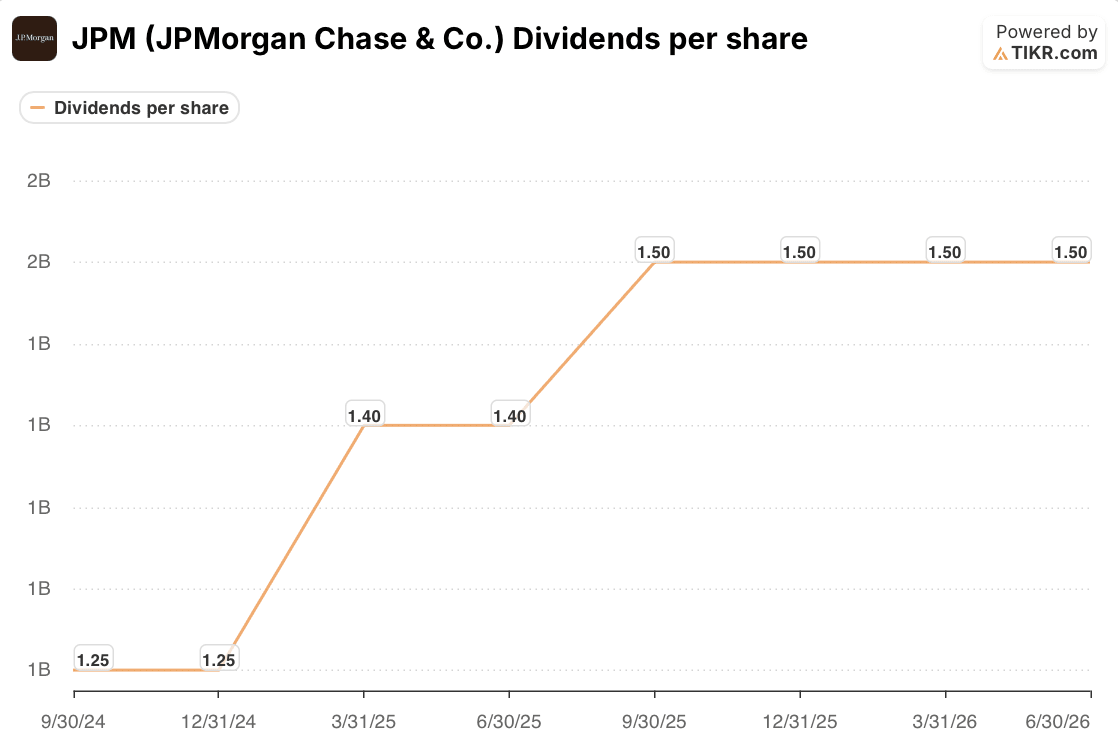
JPMorgan stock held its dividend at $1.50 per share across four consecutive quarters, from 9/30/25 through 6/30/26, after stepping up from $1.40 the two quarters before that and $1.25 the two quarters before that. The move to $1.65 confirmed on the Q2 call will be the first change to that figure in a year.
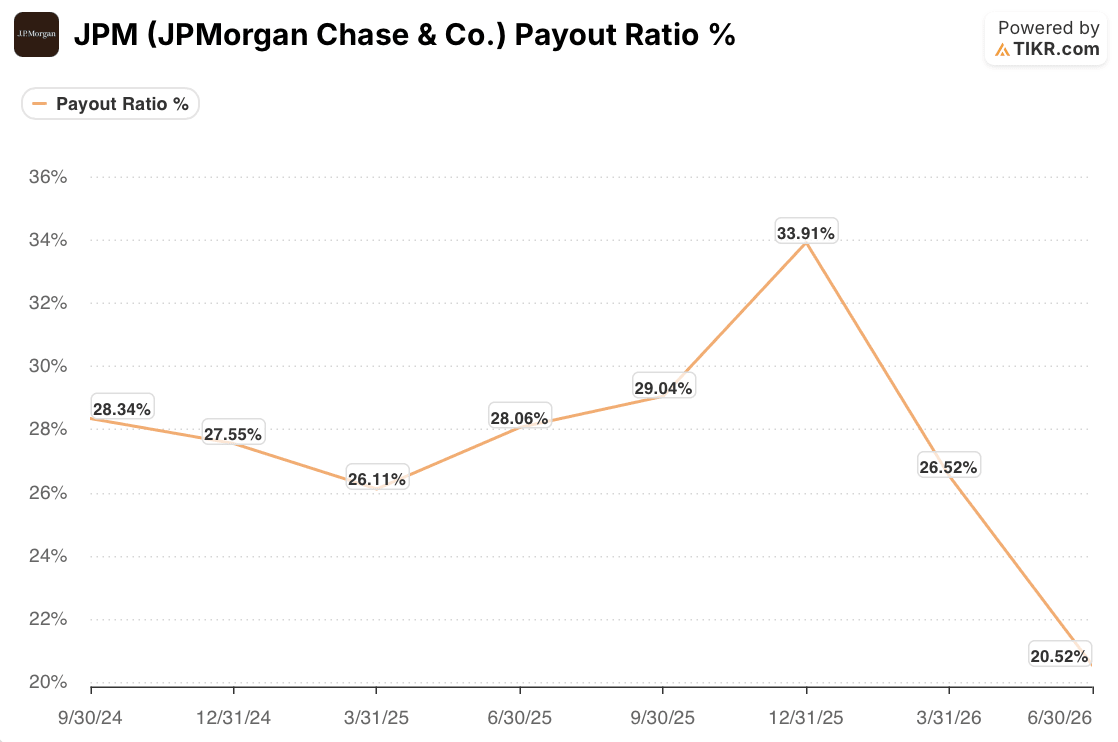
What makes the timing notable is where the payout ratio sits right now. It climbed as high as 33.91% two quarters ago, then dropped to 26.52% and most recently to 20.52%, the lowest reading across the entire stretch shown. A payout ratio drifting that far below 30% while earnings keep expanding is the kind of setup that gives a board room to raise the dividend without straining coverage, and it lines up with exactly what Barnum announced on the call.
The earlier spike to 33.91% is worth sitting with rather than skipping past. It suggests there was a point where earnings growth briefly lagged the dividend commitment, only for the ratio to snap back hard as net income accelerated again. That kind of swing says more about the denominator moving than about any strain on the payout itself, since the dividend per share barely moved across the same window.
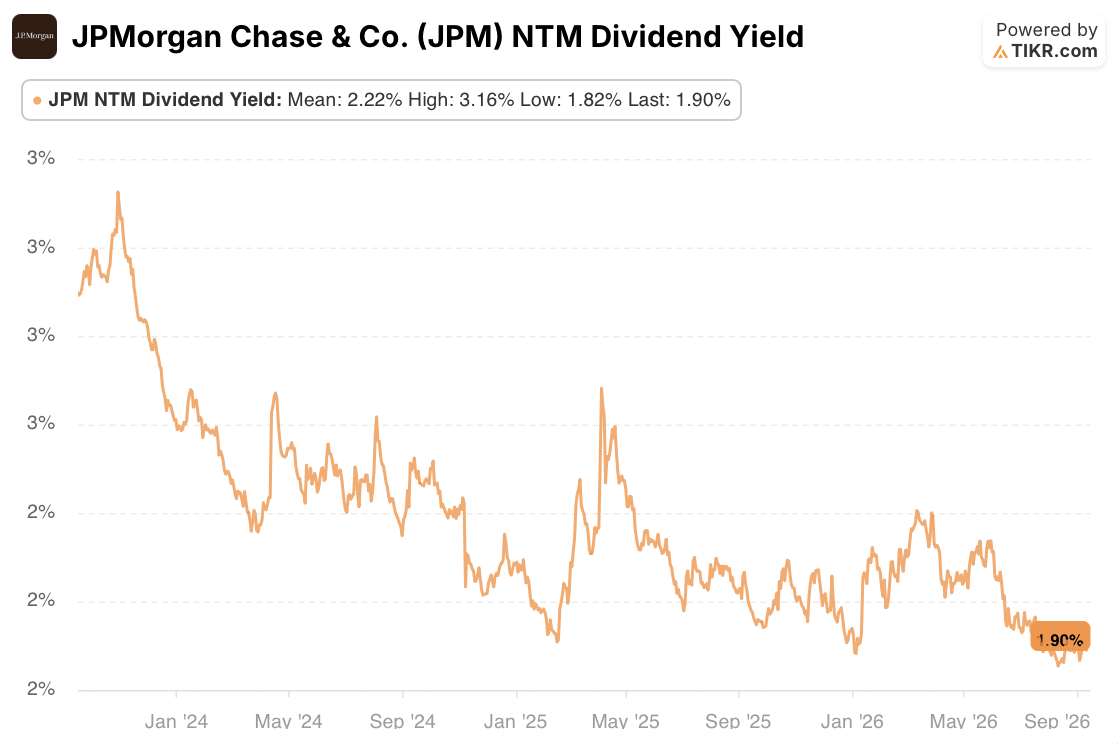
Set against that backdrop, JPMorgan stock’s 1.90% yield looks thin next to the 2.22% mean and well off the 3.16% high in the data. That gap is not a warning sign here. It reflects a share price that has run well ahead of a dividend that, until the Q3 increase, had been flat for a year. Income-focused buyers are not getting paid much today for holding JPMorgan stock, but a payout ratio sitting near 20% says the board has room to keep closing that gap through further increases rather than through price weakness alone.
Put the three together and the read is straightforward. The dividend trajectory shows a company that raises deliberately rather than reflexively, the payout ratio shows ample room under the increase just announced, and the yield shows a stock priced more for total return than for income today.
TIKR’s Model Puts JPMorgan Stock’s Target at $428 Through 2030
TIKR’s mid-case valuation model puts JPMorgan stock’s target price at $428 by the end of 2030, a 23% total return from today’s $349 share price, working out to 5% annualized.
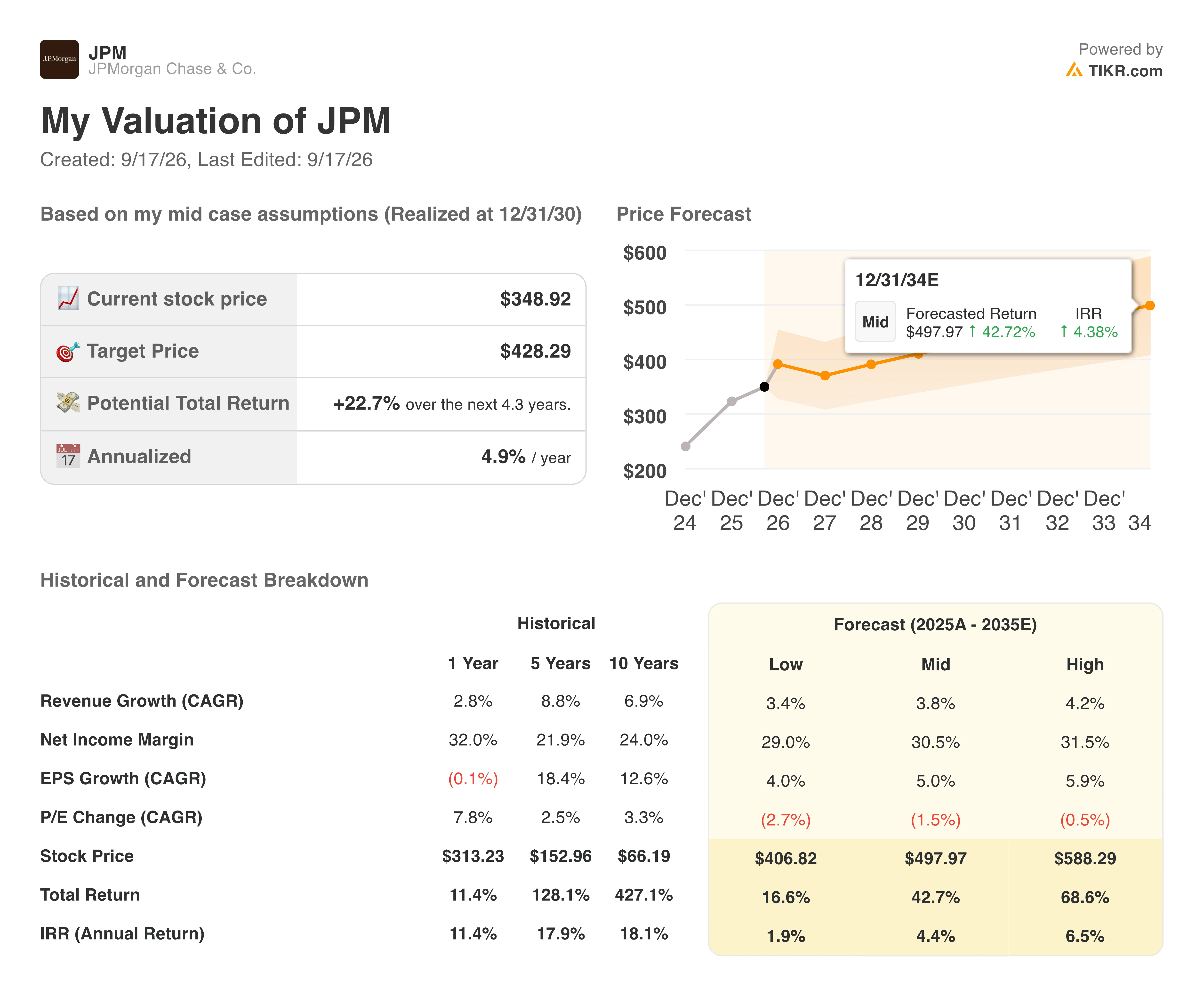
That return profile positions JPMorgan stock as a steady compounder rather than a re-rating story, with the dividend increase to $1.65 contributing to total return without carrying the target on its own.
The case for reaching $428 rests on the business picture management laid out on the call: revenue up 15%, Investment Banking fees up 30%, Markets equities revenue up 86% and a full-year NII outlook raised to roughly $105.5 billion, all while credit costs stayed contained and the CET1 ratio held at 14%.
See exactly how JPMorgan stock’s $428 target and 23% projected return break down. Model JPM stock on TIKR for free →
Should You Invest in JPMorgan Chase & Co.?
The only way to really know is to look at the numbers yourself. TIKR gives you free access to the same institutional-quality financial data that professional analysts use to answer exactly that question.
Pull up JPMorgan Chase & Co. stock and you’ll see years of historical financials, what Wall Street analysts expect for revenue and earnings in the quarters ahead, how valuation multiples have moved over time, and whether price targets are trending up or down.
You can build a free watchlist to track JPMorgan Chase & Co. alongside every other stock on your radar. No credit card required. Just the data you need to decide for yourself.
Access Professional Tools to Analyze JPM stock on TIKR for Free →
Looking for New Opportunities?
- See what stocks billionaire investors are buying so you can follow the smart money.
- Analyze stocks in as little as 5 minutes with TIKR’s all-in-one, easy-to-use platform.
- The more rocks you overturn… the more opportunities you’ll uncover. Search 100K+ global stocks, global top investor holdings, and more with TIKR.
Disclaimer:
Please note that the articles on TIKR are not intended to serve as investment or financial advice from TIKR or our content team, nor are they recommendations to buy or sell any stocks. We create our content based on TIKR Terminal’s investment data and analysts’ estimates. Our analysis might not include recent company news or important updates. TIKR has no position in any stocks mentioned. Thank you for reading, and happy investing!


