Key Takeaways
- AAOI posted $191.9 million in Q2 2026 revenue, up 86% year over year and its fifth straight record quarter, with Q3 guidance implying roughly 130% year-over-year growth at the midpoint.
- The company spent $565.5 million on capital investments in that same June quarter, and TIKR data show free cash flow fell to negative $563.7 million, the deepest single-quarter cash burn in at least two years.
- Weighted average diluted shares outstanding have nearly doubled since late 2024, climbing from 42.3 million to 81.6 million, funded largely through two separate at-the-market equity programs launched within months of each other.
- CFO Stefan Murry and SVP Joshua Yeh each sold shares twice between early August and mid-September as the stock fell roughly 35% from its late-June high, even as Street price targets kept climbing to a mean of $163.40 by mid-September.
Applied Optoelectronics’ Capacity Story Is Real, But It Is Not Cheap to Build
Applied Optoelectronics (AAOI) is not exaggerating its position in the AI infrastructure buildout. Management told investors on the Q2 2026 earnings call that demand for 800G and 1.6 terabit transceivers is “bounded almost entirely by production capacity,” not by customer appetite, and that forecast demand will outpace the company’s production capacity through mid-2027. Revenue climbed 86% year over year to $191.9 million in the June quarter, non-GAAP profitability returned for the first time in several quarters at $0.06 per diluted share, and the company reiterated a roughly $1.1 billion full-year 2026 revenue target.
But that growth is expensive to manufacture. Non-GAAP gross margin came in at 29.8% for the quarter, and CFO Stefan Murry told the Rosenblatt Technology Summit on August 18 that year-end margin would likely land in the “low to mid-30s,” a step down from where the company had previously pointed investors, because a customer’s memory shortage is expected to cut 100G revenue by $20 million to $25 million in the third quarter and expedite fees tied to the 1.6T ramp have added cost. Management still frames 40% gross margin as achievable by the end of 2027, but the near-term trajectory is moving the wrong direction even as revenue accelerates.
How Applied Optoelectronics Nearly Doubled Its Share Count in Two ATM Programs
The gap between AOI’s revenue growth and its cash generation shows up clearly in TIKR’s data.
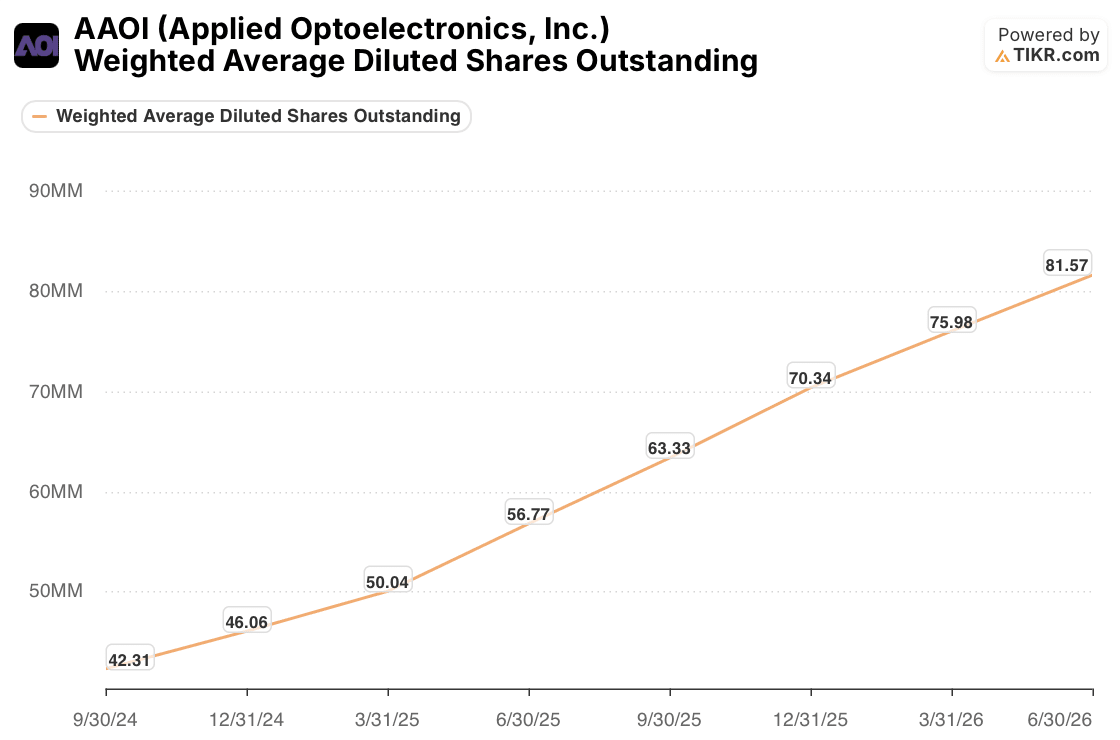
Weighted average diluted shares outstanding rose from 42.3 million in the quarter ended September 2024 to 81.6 million in the quarter ended June 2026, a 93% increase in under two years. That dilution has tracked two distinct at-the-market equity programs: one initiated in May 2026 that had already raised $538.8 million net by the August earnings call, and a second $600 million program entered on August 21 with Raymond James and Needham as sales agents.
The capital is going toward real assets.
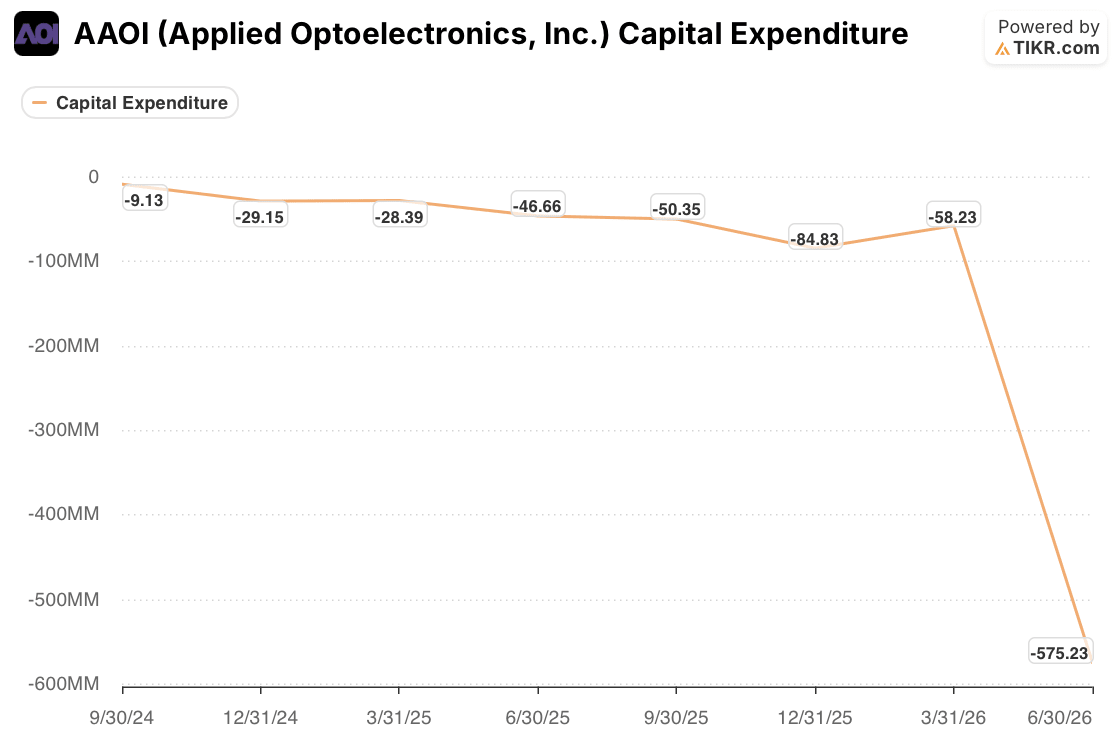
Capital expenditure hit $575.2 million in the June quarter alone, close to the $565.5 million in capital investments management disclosed on the call, including $280 million in equipment prepayments.
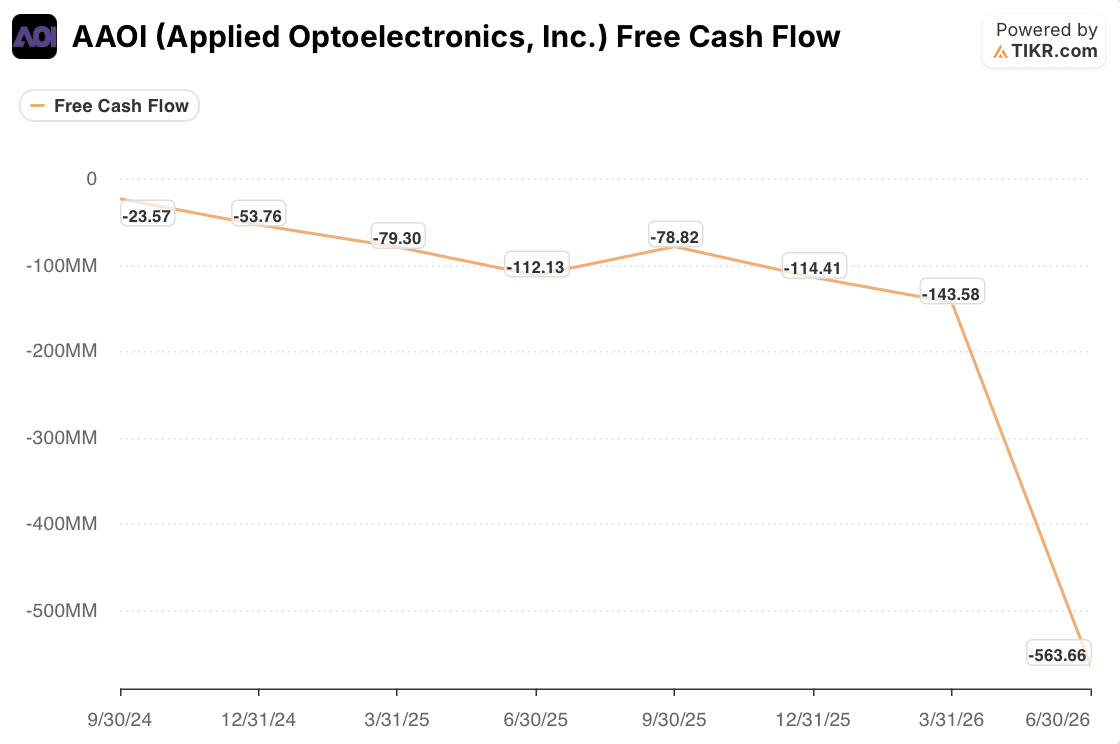
AAOI’s cash-flow data show free cash flow deteriorating steadily from negative $23.6 million in September 2024 to negative $563.7 million in June 2026, a burn rate that has scaled roughly in step with the capacity buildout rather than narrowing as revenue has grown.
The balance sheet still has room, with cash and short-term investments at $508.8 million and non-convertible debt at $92.8 million as of June 30, but Murry told the Rosenblatt audience that “raising everything on the back of equity for the foreseeable future is not our plan,” a statement that arrived roughly three weeks after the company opened a second $600 million ATM window.
Insiders Have Been Selling AAOI Stock Into the Same Rally That Funded the Dilution
While Applied Optoelectronics was raising equity, two of its own executives were reducing their stakes. CFO Stefan Murry sold 4,000 shares on August 10 at $144.79 and another 4,000 shares on September 10 at $105.33, trimming his direct holdings from 375,168 to 367,168 shares. SVP and Asia General Manager Joshua Yeh sold 4,715 shares on August 4 at $126.50 and 6,000 shares on August 18 at $147.73, cutting his direct stake from 383,498 to 377,498 shares.
Both rounds of selling landed inside a window when AOI stock ran from roughly $110 in late July toward a peak near $148 in late June trading before sliding back to $96.74 by mid-September, a decline of about 35% from that high, a drop that accelerated after the August 21 ATM filing sent shares down 11.8% in a single session.
What is notable is that sell-side conviction did not fall with the stock.
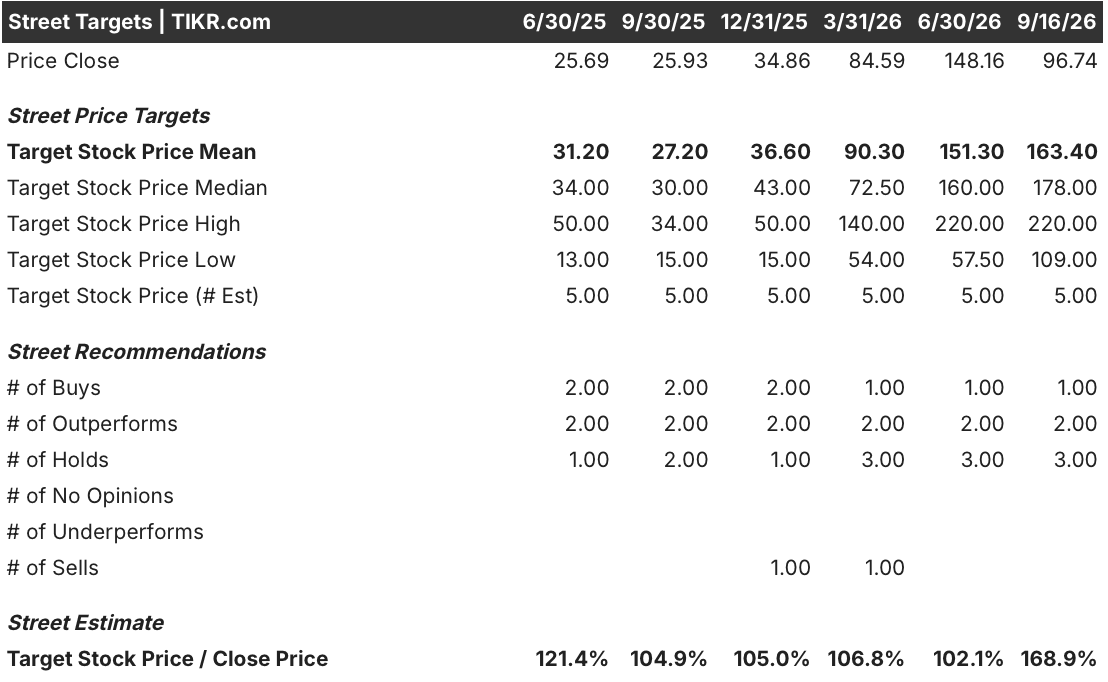
TIKR’s Street Analysts Targets show the mean price target rising from $151.30 as of June 30 to $163.40 by September 16, even as the actual share price fell from $148.16 to $96.74 over the same window. The ratio of target price to closing price jumped from about 102% to 169%, the widest gap in the table’s history, while the number of “buy” ratings among covering analysts fell from two to one and holds rose to three.
Analysts are not abandoning the growth case, but the rating mix has grown more cautious even as headline targets climbed, which suggests the target increases lean more on updated revenue models than on fresh conviction about the stock’s near-term path.
What Would Have to Be True for the Dilution to Pay Off
None of this means AOI’s core thesis is broken. The company’s domestic manufacturing footprint is a genuine structural advantage that management and outside analysts alike have tied directly to the geopolitical uncertainty around Chinese-made data center components, and a $1.1 billion revenue year funded partly by equity is not automatically value-destructive if the capacity being built earns an adequate return. Murry’s own framing on the Rosenblatt call, that current capex investments carry roughly nine to ten month paybacks, is the kind of specific, checkable claim that will either hold up in coming quarters or will not.
The open question for shareholders is whether per-share value is being created fast enough to offset a share count that has nearly doubled in under two years. Gross margin needs to resume its upward path rather than continue drifting toward the low end of the 29% to 33% range the company has now guided to, and free cash flow needs to stop deepening even as the heaviest phase of the Texas buildout plays out through 2027. Management has said it wants financing to shift away from equity toward operating cash flow, customer prepayments, and debt, but by its own account those customer contribution and debt discussions remain unresolved.
The next two quarterly cash-flow statements and the pace of any further ATM issuance will show whether that shift is actually happening or whether dilution remains the default lever every time capacity needs to expand.
Should You Invest in Applied Optoelectronics, Inc.?
The only way to really know is to look at the numbers yourself. TIKR gives you free access to the same institutional-quality financial data that professional analysts use to answer exactly that question.
Pull up AAOI stock and you’ll see years of historical financials, what Wall Street analysts expect for revenue and earnings in the quarters ahead, how valuation multiples have moved over time, and whether price targets are trending up or down.
You can build a free watchlist to track Applied Optoelectronics, Inc. alongside every other stock on your radar. No credit card required. Just the data you need to decide for yourself.
Access Professional Tools to Analyze AAOI stock on TIKR for Free →
Looking for New Opportunities?
- See what stocks billionaire investors are buying so you can follow the smart money.
- Analyze stocks in as little as 5 minutes with TIKR’s all-in-one, easy-to-use platform.
- The more rocks you overturn… the more opportunities you’ll uncover. Search 100K+ global stocks, global top investor holdings, and more with TIKR.
Disclaimer:
Please note that the articles on TIKR are not intended to serve as investment or financial advice from TIKR or our content team, nor are they recommendations to buy or sell any stocks. We create our content based on TIKR Terminal’s investment data and analysts’ estimates. Our analysis might not include recent company news or important updates. TIKR has no position in any stocks mentioned. Thank you for reading, and happy investing!