


Key Takeaways for HealthEquity Stock as of August 2026
- Sell-the-Beat: HealthEquity stock closed down 11% on August 27 after Q2 FY2027 revenue of $350.7M and non-GAAP EPS of $1.24 both topped estimates, yet shares still fell from $104 to $93 the same day.
- Guidance Ceiling: The raised full-year non-GAAP EPS range of $4.66 to $4.73 landed almost exactly on the ~$4.72 Street consensus already built into shares before the print.
- Street Still Bullish: Analyst coverage on HQY stock stands at 10 buys, 5 outperforms, and 1 sell, with the mean target of $119 sitting 27% above the post-earnings close.
- Model Gap: TIKR values HQY stock at $117, a 26% total return from $93.
Why HealthEquity Stock Fell 11% After Beating on Revenue and EPS
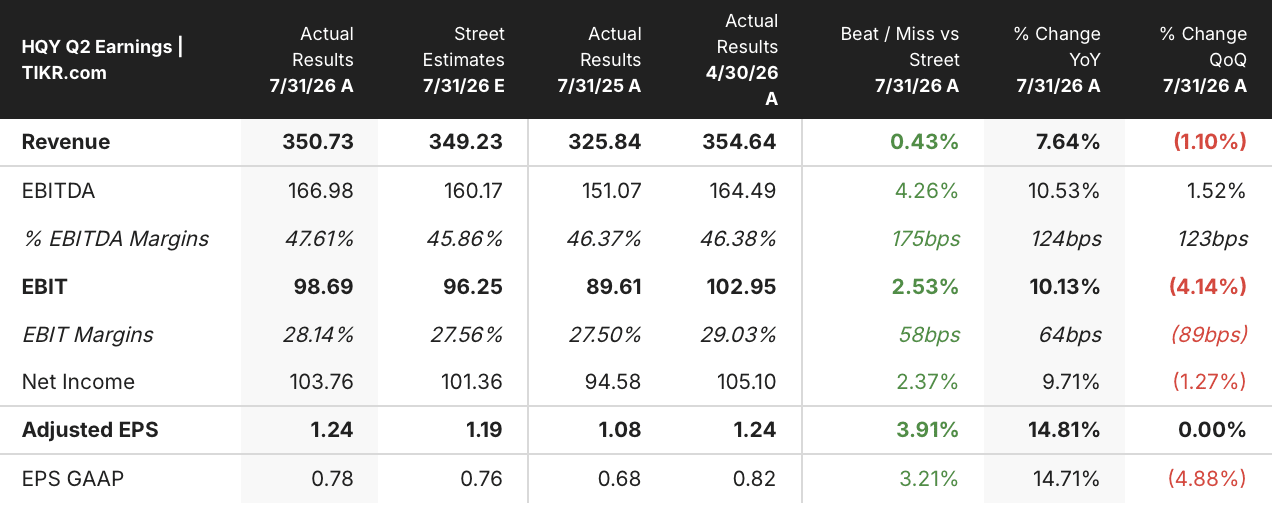
HealthEquity (HQY) stock fell 11% on Thursday, August 27, 2026, sliding from a $104 close to $93 as the company’s fiscal second-quarter report crossed the tape. The quarter beat on every headline number analysts track.
Revenue climbed 8% year over year to $350.7 million, non-GAAP earnings per share reached $1.24 against a $1.19 consensus, and GAAP earnings per share hit $0.78. Adjusted EBITDA margin set a record at 48%, and HSA accounts grew to 10.7 million.
None of the underlying growth metrics buckled, either. New HSA sales rose 24% year over year to a Q2 record, investing HSAs climbed 20%, and invested HSA assets grew 28%, the kind of numbers that normally support a stock trading at a premium.
Management also raised full-year guidance. HealthEquity now expects fiscal 2027 revenue of $1.411 billion to $1.421 billion and non-GAAP earnings per share of $4.66 to $4.73, up from its prior range. That new ceiling landed almost exactly on the roughly $4.72 the Street already had modeled, so the raise confirmed expectations rather than exceeding them.
Timing made the gap worse. HealthEquity stock had already climbed 27%, from $82 at the end of April to $104 the day before earnings, as investors bid up a name coming off a strong first quarter. A stock trading near its highs needs a reason to keep climbing, and an in-line raise is not one.
The company had also leaned into its own stock during the quarter, repurchasing $108 million of shares at an average price below $90, a level the post-earnings close now sits just above. That buying happened before the print, but it shows management priced HealthEquity stock as cheap well before the market agreed.
CFO James Lucania pointed to headline price erosion as one reason the raise carried a ceiling. Discussing pricing pressure in HealthEquity’s core service line, he told analysts the erosion is “a headwind to service revenue” and that competitors “don’t stand still either.” That pressure caps how fast the highest-margin segment of the business can grow even as accounts expand.
CEO Scott Cutler added a second note of caution around the record margin print. Asked how much further profitability could climb, he said the company is “just at the beginning” of the AI-driven efficiencies management has been touting, an answer that reads as reassurance about the runway but offers no near-term acceleration for investors already pricing one in.
None of it points to a broken business. It points to a stock that had priced in the beat before management delivered it, and got repriced the moment the raise turned out to be ordinary.
HealthEquity Stock Holds a 10 Buy, 5 Outperform Street Rating
Wall Street stayed bullish on HealthEquity stock heading into the print, and coverage has not shifted since. Fifteen analysts track the name, split into 10 buys, 5 outperforms, and 1 sell, with no holds or underperforms on the board. Targets range from a $105 low to a $135 high, with a $120 median and a $119 mean, putting the average target 27% above HealthEquity stock’s $93 post-earnings close.
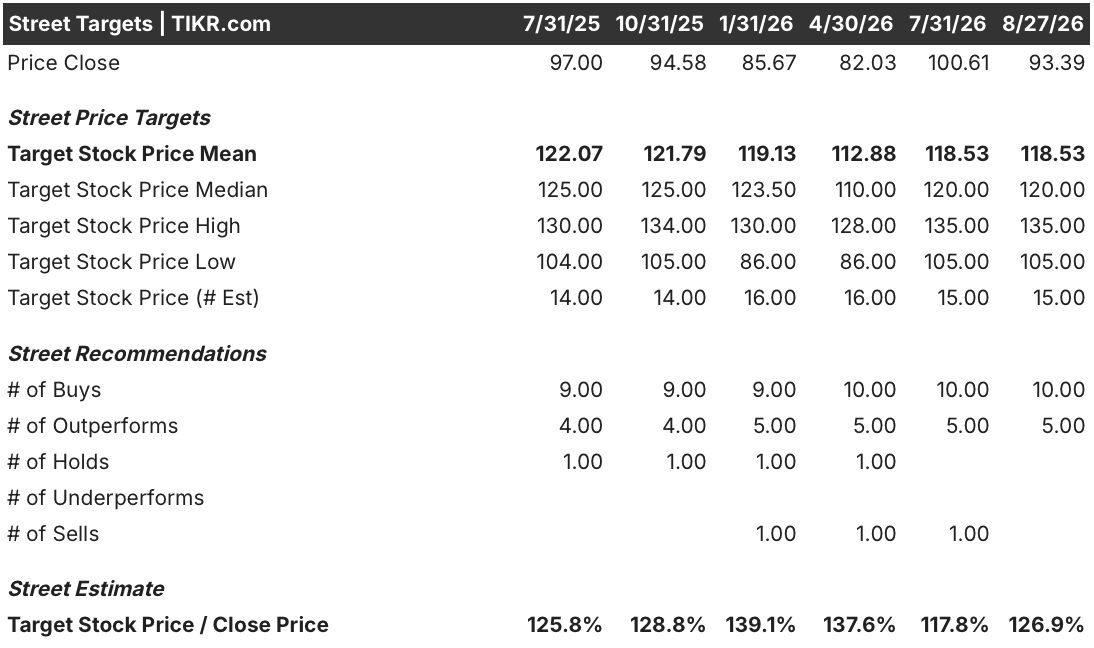
That mean target has not moved. It stood at $118.53 on July 31, the same figure the table shows for August 27, meaning this snapshot captures targets set before analysts had a chance to revise them for the quarter. A year earlier, the mean target ran higher at $122 even as HealthEquity stock traded near $97, then slid to $113 by April as the stock itself fell to $82 over three straight quarters.
Coverage has held between 14 and 16 analysts throughout that stretch, and the ratings mix has drifted modestly more bullish, from 9 buys and 4 outperforms in mid-2025 to 10 buys and 5 outperforms now. Analysts spent a year cutting targets as the stock fell and lifting them as it recovered, tracking the price rather than leading it. The 27% gap that remains says the Street has not yet decided whether Thursday’s drop changes that pattern.
TIKR Values HealthEquity Stock at $117, Pricing In Steady HSA Growth
TIKR’s mid-case model values HealthEquity stock at $117 by January 2031, implying 26% total return from the current price of $93, or 5% annualized over 4.4 years.
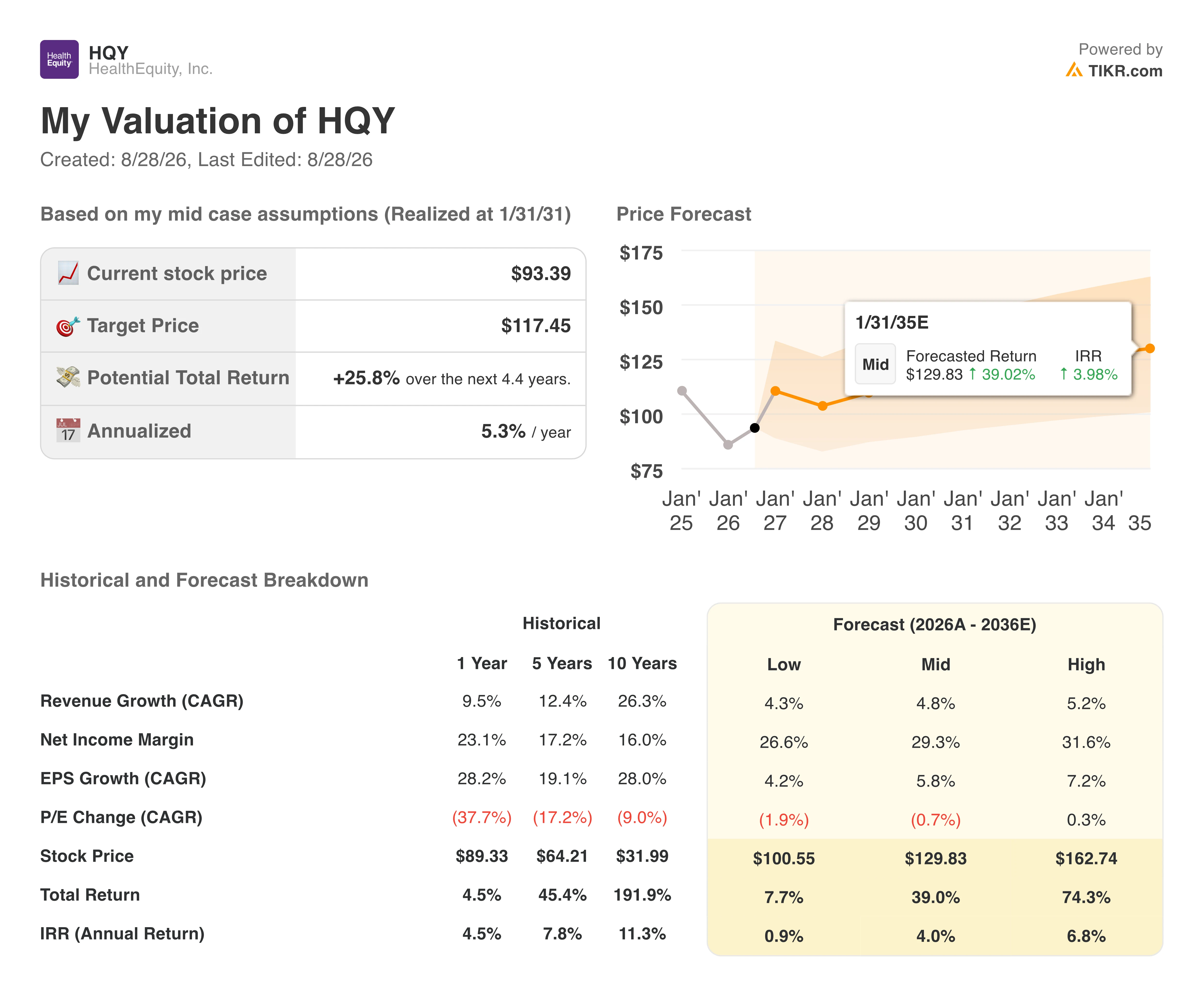
That path puts HealthEquity stock’s expected return well below the growth-stock returns the company posted over the past decade, positioning it now as a steadier compounder rather than a high-multiple grower.
The target does not require HealthEquity to reaccelerate. It asks for a continuation of what already showed up in the second quarter: high single-digit HSA account growth and service costs falling as AI absorbs more member contacts. That is a lower bar than the market demanded when it sold off an in-line guidance raise, which is why a Street mean target 27% above the post-earnings price has not budged.
Should You Invest in HealthEquity, Inc.?
The only way to really know is to look at the numbers yourself. TIKR gives you free access to the same institutional-quality financial data that professional analysts use to answer exactly that question.
Pull up HealthEquity, Inc. stock and you’ll see years of historical financials, what Wall Street analysts expect for revenue and earnings in the quarters ahead, how valuation multiples have moved over time, and whether price targets are trending up or down.
You can build a free watchlist to track HealthEquity, Inc. alongside every other stock on your radar. No credit card required. Just the data you need to decide for yourself.
Access Professional Tools to Analyze HQY stock on TIKR for Free →
Looking for New Opportunities?
- See what stocks billionaire investors are buying so you can follow the smart money.
- Analyze stocks in as little as 5 minutes with TIKR’s all-in-one, easy-to-use platform.
- The more rocks you overturn… the more opportunities you’ll uncover. Search 100K+ global stocks, global top investor holdings, and more with TIKR.
Disclaimer:
Please note that the articles on TIKR are not intended to serve as investment or financial advice from TIKR or our content team, nor are they recommendations to buy or sell any stocks. We create our content based on TIKR Terminal’s investment data and analysts’ estimates. Our analysis might not include recent company news or important updates. TIKR has no position in any stocks mentioned. Thank you for reading, and happy investing!


