Key Takeaways
- Duke Energy yields 3.9% and Southern Company yields 3.8%, and both pay out about two-thirds of their adjusted earnings as dividends.
- Both have raised their dividends by 2 cents a quarter each year since 2020, and Duke has paid a dividend for 100 straight years.
- Southern guides to 8% to 9% a year earnings growth through 2028, compared with 5% to 7% a year through 2030 for Duke.
- Duke plans $10 billion of new stock for 2027 to 2030, while Southern needs $1.1 billion more by 2030 and says its dividend growth could speed up later.
For utility income, Duke Energy (DUK) and Southern Company (SO) look like near twins. Both serve the fast-growing Southeast, both yield close to 4%, and both raise their dividends by 2 cents a quarter a year.
They cover their dividends in pretty similar fashion, too. Each pays out roughly two-thirds of adjusted earnings, which is the key measure for utilities. Since utilities fund new plants and power lines with debt and new stock, free cash flow often runs negative, so dividends are set around earnings instead. So if you’re a retiree looking for utility income, which dividend makes more sense?
| Metric | Duke Energy (DUK) | Southern Company (SO) |
|---|---|---|
| Forward dividend yield | 3.9% | 3.8% |
| Annual dividend | $4.34 | $3.04 |
| 5-yr dividend growth | 2.0% a year | 3.0% a year |
| Streak | 100 years of dividends; raises for “over 20” years | 25 straight years of raises |
| Payout ratio of normalized EPS, 2025 | 67% | 68% |
| Payout ratio of normalized EPS, 2026 consensus | 65% | 66% |
| Net debt ÷ EBITDA, TTM | 5.4x | 5.1x |
Source: TIKR, prices at the Sept. 30, 2026 close and consensus as of Oct. 1, 2026; streaks from the companies’ releases and calls.
Duke is building on a massive scale
Adjusted EPS climbed to $1.43 in the second quarter from $1.25 the year prior, which was boosted by regulators who allowed the company to recover its grid investments. This spending now sits at the heart of a $103 billion capital plan through 2030. As CEO Harry Sideris put it on the call, “…We’re executing on the industry’s largest regulated capital plan, deploying more than $1 billion per month.”
Demand is slower to show up: weather-normal retail sales rose just 0.4% in the first half. The bet is 7.8 gigawatts of signed data-center contracts, which start taking power in late 2027 and 2028 on minimum-take terms.
Duke’s dividend is right where the company wants it, at 60% to 70% of adjusted EPS. It paid out 67% of normalized EPS in 2025 and is expected to land around 65% this year.
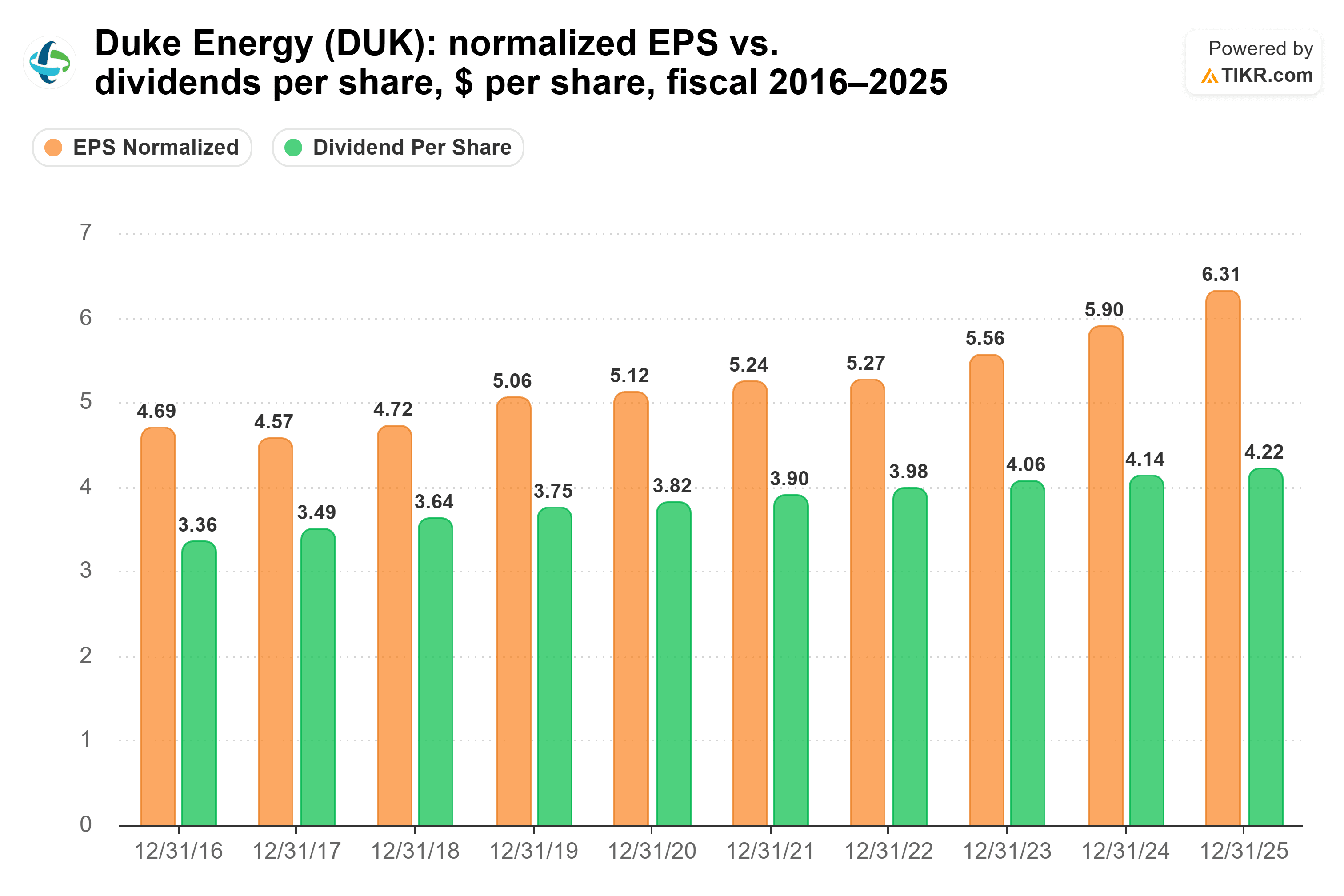
The gap between earnings and the dividend stayed between about $1.10 and $1.50 a share through 2023, then widened to $2.09 by 2025 as earnings picked up. I like where that’s heading.
The catch is how Duke plans to pay for all of this growth. The company expects to issue $10 billion of new stock from 2027 through 2030, while the $2 billion in equity units it sold in August will convert into shares by 2029. That means more shares outstanding, which can slow earnings growth on a per-share basis.
Analyze your favorite stocks like The Southern Company with TIKR (It’s free) >>>
Southern’s demand is already here
Southern is chasing the same data-center boom, but with more of the demand already under contract. Adjusted EPS climbed to $1.13 in the second quarter, up from $0.92 a year earlier. Retail sales, adjusted for weather, also grew 2.3% in the first half. CFO David Poroch called that “the highest retail sales growth through June we have seen in nearly two decades.”
The bigger story for me is what’s already been signed. Southern has more than 17 gigawatts of large-load contracts lined up through the mid-2030s, with minimum bills built in. That includes 3.2 gigawatts for OpenAI near Savannah. The company expects EPS to grow 8% to 9% annually from 2026 through 2028, backed by an $81 billion capital plan.
Its payout is 68% of 2025’s normalized EPS and 66% of 2026’s consensus, a touch higher than Duke’s.
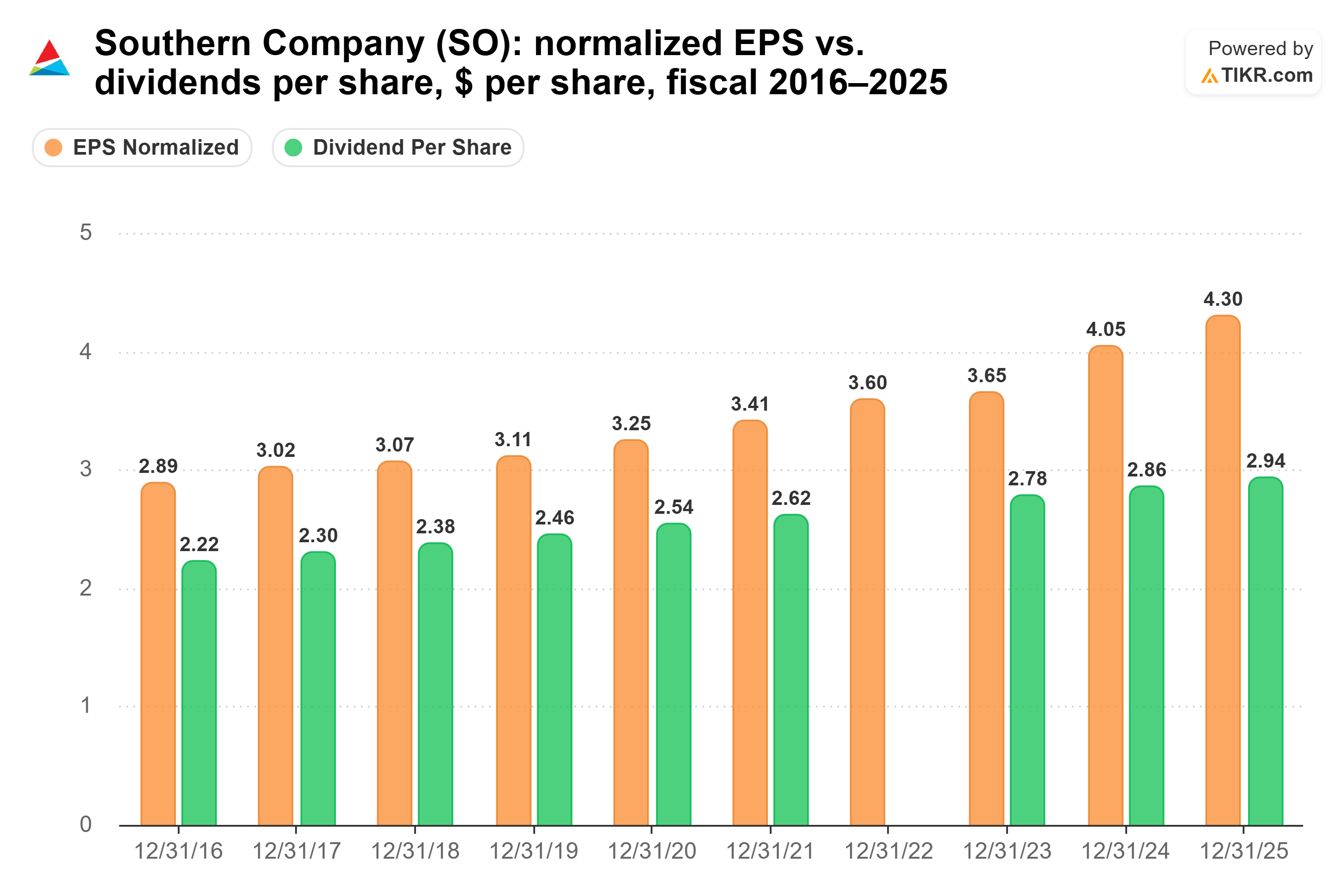
Duke paid a $3.98 dividend in 2022. Since 2016, the gap between what the company earned and what it paid out in dividends has roughly doubled, from $0.67 to $1.36 per share in 2025. Most of that improvement came after 2021, giving Duke more room between earnings and the dividend.
Poroch expects a few modest dividend increases to bring the payout ratio down into the low to mid-60% range. From there, he says the company could revisit the pace of dividend growth, potentially raising the annual increase.
The bigger question is where future growth comes from. Base rates are frozen in Georgia through 2028 and Alabama through 2029, so Southern will need sales growth and new plants to keep earnings moving. The company has also issued stock, increasing the share count about 3.3% in a year. At least that pressure is easing, with only $1.1 billion more in equity needs through 2030.
So which dividend wins?
For retirees looking for utility income, Southern is the one I’d lean toward. The starting income is almost identical, at 3.8% versus 3.9%. But Southern has more growth already under contract, a faster earnings outlook, and far less new stock to issue through 2030. If the payout ratio comes down as expected, there’s also room for dividend growth to pick up. That matters to me.
That doesn’t mean Duke’s dividend is in trouble. The payout remains within its target range, and Duke has paid a dividend for 100 straight years. It also offers a slightly higher yield and a cheaper valuation, at 16.9 times forward earnings versus 17.8 for Southern. I just prefer the utility that needs less new equity to fund its growth.
The faster dividend increases are still only a possibility, and they are a few years away if the board approves them. For now, I’d budget for 2-cent raises and treat anything more as upside.
So what is Southern Company stock actually worth?
TIKR lets you forecast the future price of any stock in less than a minute. Just enter a few assumptions into TIKR’s valuation model and see what Southern Company could be worth. Start from Wall Street consensus estimates, or adjust the inputs to reflect your own view of the business. It’s free to use.
Value Southern Company for free
Disclaimer:
Please note that the articles on TIKR are not intended to serve as investment or financial advice from TIKR or our content team, nor are they recommendations to buy or sell any stocks. We create our content based on TIKR Terminal’s investment data and analysts’ estimates. Our analysis might not include recent company news or important updates. TIKR has no position in any of the stocks mentioned. Thank you for reading, and happy investing!