Key Takeaways
- Target and Walmart have each raised their dividends for more than 50 straight years, and Target yields 3% against Walmart’s 1%.
- Target’s last four raises were about 2% each, while Walmart’s raises have averaged about 9% a year over the last three years.
- Walmart’s cash dividend payout ratio is 57% over the last twelve months and 68% forward, against 46% and 66% for Target, whose last full year ran at 72%.
- Target’s sales have turned up under a new CEO, while Walmart’s growth is coming from e-commerce, advertising and membership.
Target (TGT) raised its dividend 1.8% in June, which puts 2026 on track to be its 55th straight year of raises. Walmart (WMT) is right behind it at 53 straight years.
That’s where the similarity ends. Target yields 3.0% compared with Walmart’s 1.0%, but its last four increases have been only 1.8% to 1.9% each. Walmart, meanwhile, has raised its dividend by about 9% a year over the past three years.
So which one is the better dividend stock?
| Metric | Walmart (WMT) | Target (TGT) |
|---|---|---|
| Forward dividend yield | 1.0% | 3.0% |
| 5-yr dividend growth | 5.5% a year | 11.0% a year |
| Last raise | +5.3% (Feb. 2026) | +1.8% (June 2026) |
| Streak of annual raises | 53 years | 55th year on track in 2026 |
| Cash dividend payout ratio, TTM | 57% | 46% |
| Cash dividend payout ratio, forward | 68% | 66% |
| Net debt ÷ EBITDA | 1.33x | 1.49x |
Source: TIKR, prices at the Sept. 30, 2026 close, last twelve months reported, and consensus; streaks and raises from company releases.
Walmart: growing on several fronts
Walmart’s revenue rose 5.9% in the three months to July, led by its newer businesses: e-commerce up 23%, advertising 38% and membership fees 17%. As CEO John Furner put it on the call, “We’re investing heavily in price because customers need us to and because we believe it drives market share gains over time.”
That growth funds a well-covered dividend: a 57% cash dividend payout ratio over the last twelve months.
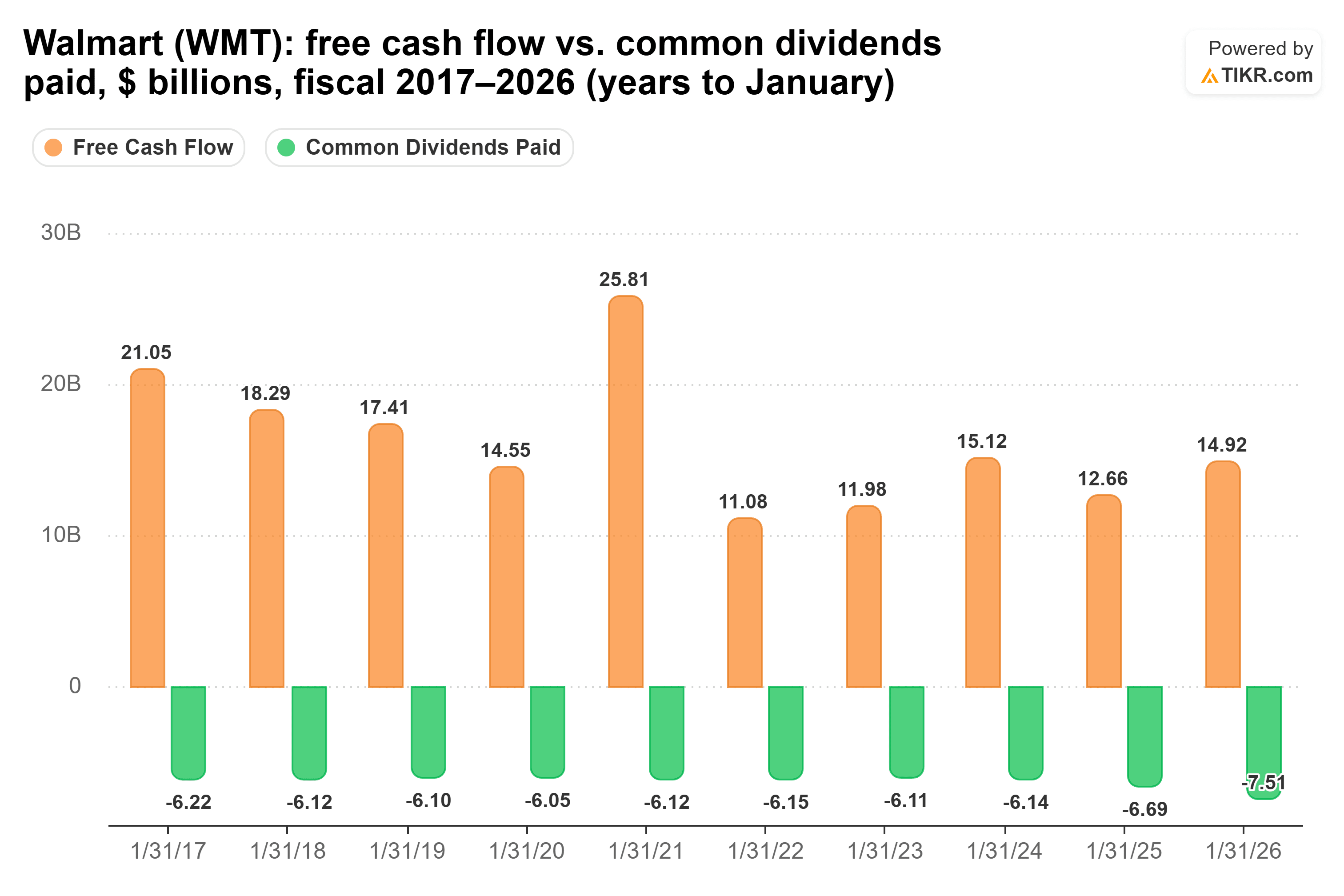
Free cash flow covered the dividend by at least 1.8 times in each of the past ten years. That is about as consistent as dividend coverage gets.
The forward payout ratio is higher at 68%, with analysts expecting free cash flow to drop 22% this fiscal year as capex increases. CFO John David Rainey sees things differently: “Even with this increase, we expect to generate double-digit growth in free cash flow this year.” Nine analysts make the estimate, and last year’s estimate came within 3%.
Walmart’s biggest drawback is the starting yield. A $10,000 investment generates about $100 a year today. If the dividend grows around 6% annually, that would rise to roughly $172 in year 10, or about a 1.7% yield on your original cash. At 34.6 times forward earnings, you’re also relying on the share price.
Target: the turnaround has started
For its part, Walmart is building on growth it already has, while Target is trying to recover from a down year, with net sales falling 1.7% in the year to January 2026. New Target CEO Michael Fiddelke is spending about $2 billion more this year, including roughly $5 billion in capex, up from $3.7 billion.
So far in 2026, the extra spending is showing results, as comparable sales rose 3.8% last quarter, and Target raised its sales outlook to about 5% growth.
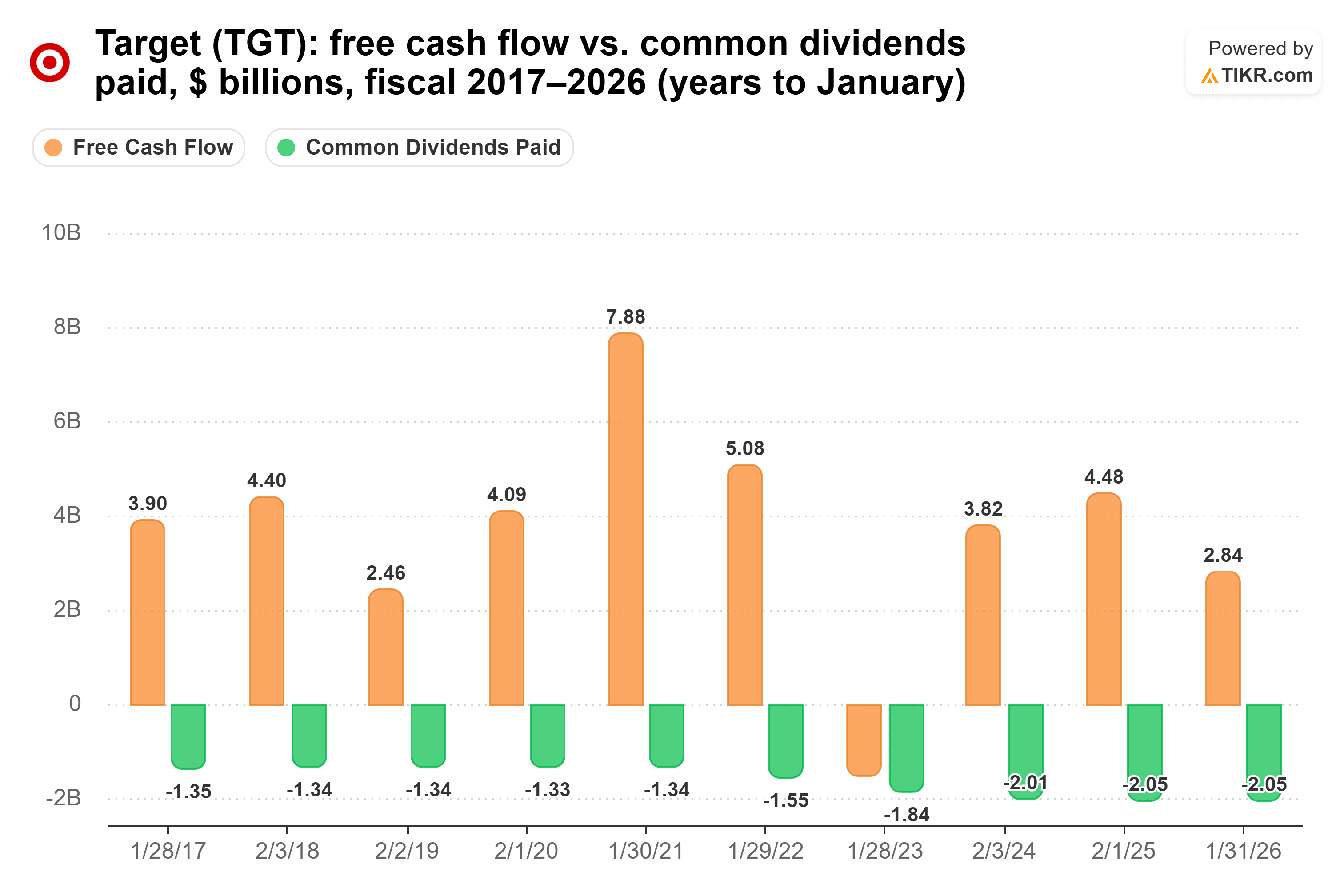
But Target’s dividend coverage is less comfortable than Walmart’s. Its cash dividend payout ratio is only 46% over the last 12 months, helped by a one-time $994 million tariff refund, and 66% forward. In the year to January 2026, as capex climbed, the payout ratio reached a much thinner 72%.
Weigh Walmart’s premium valuation against 5 years of analyst forecasts with TIKR (It’s free) >>>
Free cash flow covered the dividend in nine of ten years, but went negative in the year to January 2023, and last year left the least room of the rest. Covered, with a lot less cushion than Walmart’s.
Target’s 11% five-year growth rate includes raises of 32% in 2021 and 20% in 2022; the four since were 1.8% to 1.9%. CFO Jim Lee is balancing the dividend “with our goal of moving towards a 40% payout ratio over time,” against about 60% of last year’s adjusted EPS. My read: raises stay small while earnings catch up.
Even so, Target pays more upfront. A $10,000 investment will generate about $300 a year today and, with 1.8% annual growth, about $352 in year 10. Even if Walmart’s dividend grows 9.2% a year, matching its three-year rate, the payout would reach only about $221, but most importantly wouldn’t catch up with Target around 2042, a not-so-insignificant 12-year gap between the two time periods.
The risk is an uneven turnaround, as chief merchandising officer Cara Sylvester said on the call: “In Others, including home and apparel, our performance is not where it needs to be, and the work will continue into 2027 and beyond.”
So which dividend wins?
For me, Walmart is still the better dividend stock. Its free cash flow has covered the dividend comfortably for a decade, its CFO expects that cash to grow this year, and its growth comes from e-commerce, advertising and membership. I’d expect a dividend backed by that to keep growing at a healthy pace.
That doesn’t mean Target’s dividend is in trouble. Its forward payout ratio is roughly in line with Walmart’s, sales are growing again, and at 16.9 times forward earnings, the stock trades at about half Walmart’s valuation. If you’re looking for income today, Target pays roughly three times as much and has kept raising its dividend for well over a decade. However, Walmart’s advantage, at least for me, is the overall business itself. Frankly speaking, have more confidence in where that dividend can go from here.
Of course, Target’s comeback is only a couple of quarters old. If sales keep climbing and its payout nears that 40% goal, its raises could speed up again and I could very well swing my thoughts back in Target’s favor.
So what is Walmart stock actually worth?
TIKR lets you forecast the future price of any stock in less than a minute. Just enter a few assumptions into TIKR’s valuation model and see what Walmart could be worth. Start from Wall Street consensus estimates, or adjust the inputs to reflect your own view of the business. It’s free to use.
Disclaimer:
Please note that the articles on TIKR are not intended to serve as investment or financial advice from TIKR or our content team, nor are they recommendations to buy or sell any stocks. We create our content based on TIKR Terminal’s investment data and analysts’ estimates. Our analysis might not include recent company news or important updates. TIKR has no position in any of the stocks mentioned. Thank you for reading, and happy investing!