Key Stats for DPZ Stock
- Past week performance: -0.3%
- 52-week range: $282 to $464
- Valuation model target price: $433
- Implied upside: 26.8% over 2.3 years
Model Domino’s own same-store sales assumptions with TIKR’s Guided Valuation Model (It’s free) >>>
A Quiet Week Masks a Bigger Story
Domino’s Pizza (DPZ) shares moved little this week, but the stock still sits about 27% below its 52-week high of $464, and the reasons why matter more than any single week’s move. The pizza chain’s Q2 results were genuinely mixed. Revenue beat expectations, but adjusted earnings per share of $4.07 missed consensus, and U.S. same-store sales growth slowed sharply to just 0.1% from 3.4% a year earlier.
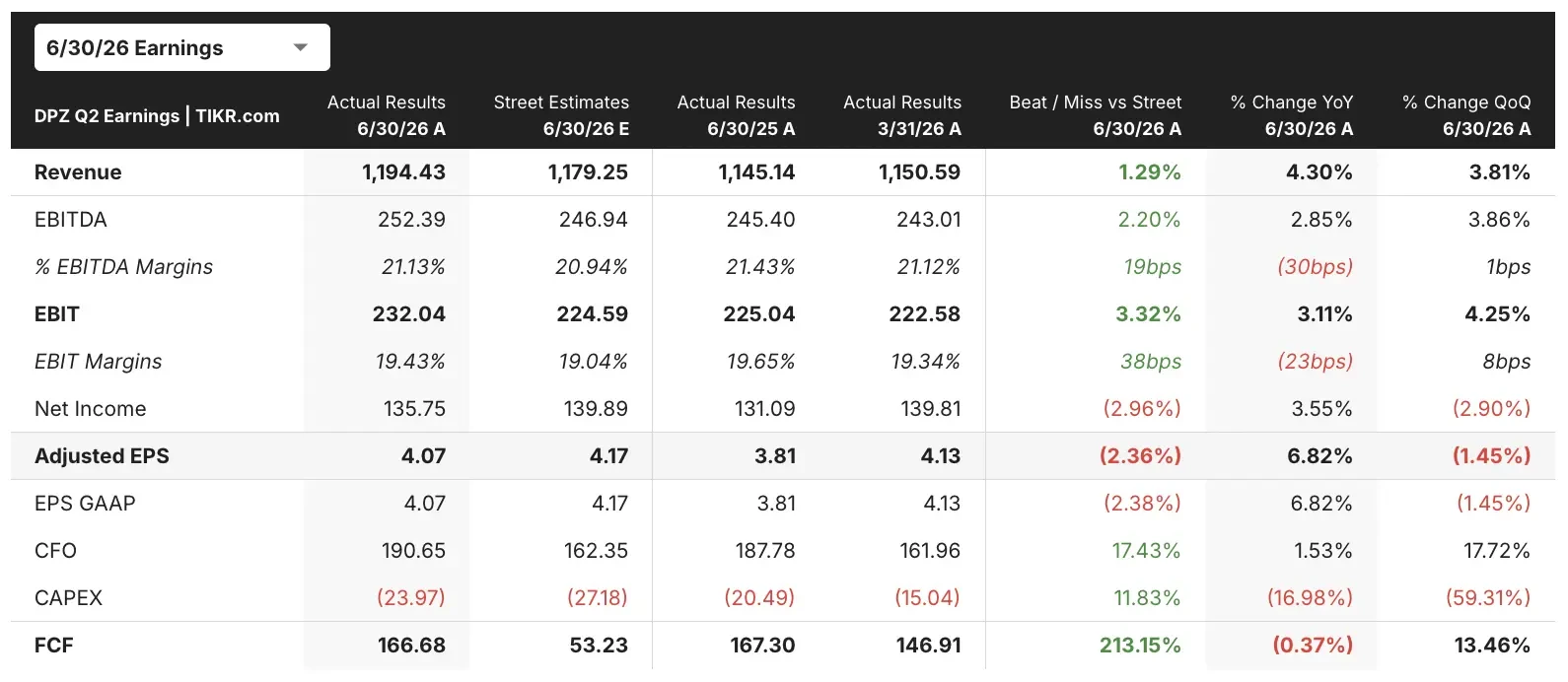
International same-store sales fell 0.1% as well, though management pointed to strength in specific markets like China and India even as the company’s largest international franchisee weighed on the overall figure. Domino’s still added 183 international stores during the quarter and reaffirmed its target of roughly 800 net international stores for the year. On the domestic side, the company trimmed its U.S. net store addition target to about 175 from prior plans, citing pressure on franchisee profitability rather than a change in long-term opportunity.
CEO Russell Weiner told investors on the earnings call that order counts drive long-term success, a message he has repeated for years. He noted that order counts grew meaningfully across both delivery and carryout during the quarter, even though average ticket weakened enough to hold same-store sales nearly flat. The board also declared a quarterly dividend of $1.99 per share and continued its buyback program, repurchasing roughly $156 million worth of stock in the quarter alone.
Going forward, the real test for Domino’s is whether order count growth can eventually translate back into stronger same-store sales once ticket pressure eases.
See analysts’ growth forecasts and price targets for DPZ (It’s free) >>>
Is DPZ a Value Play After the Pullback?
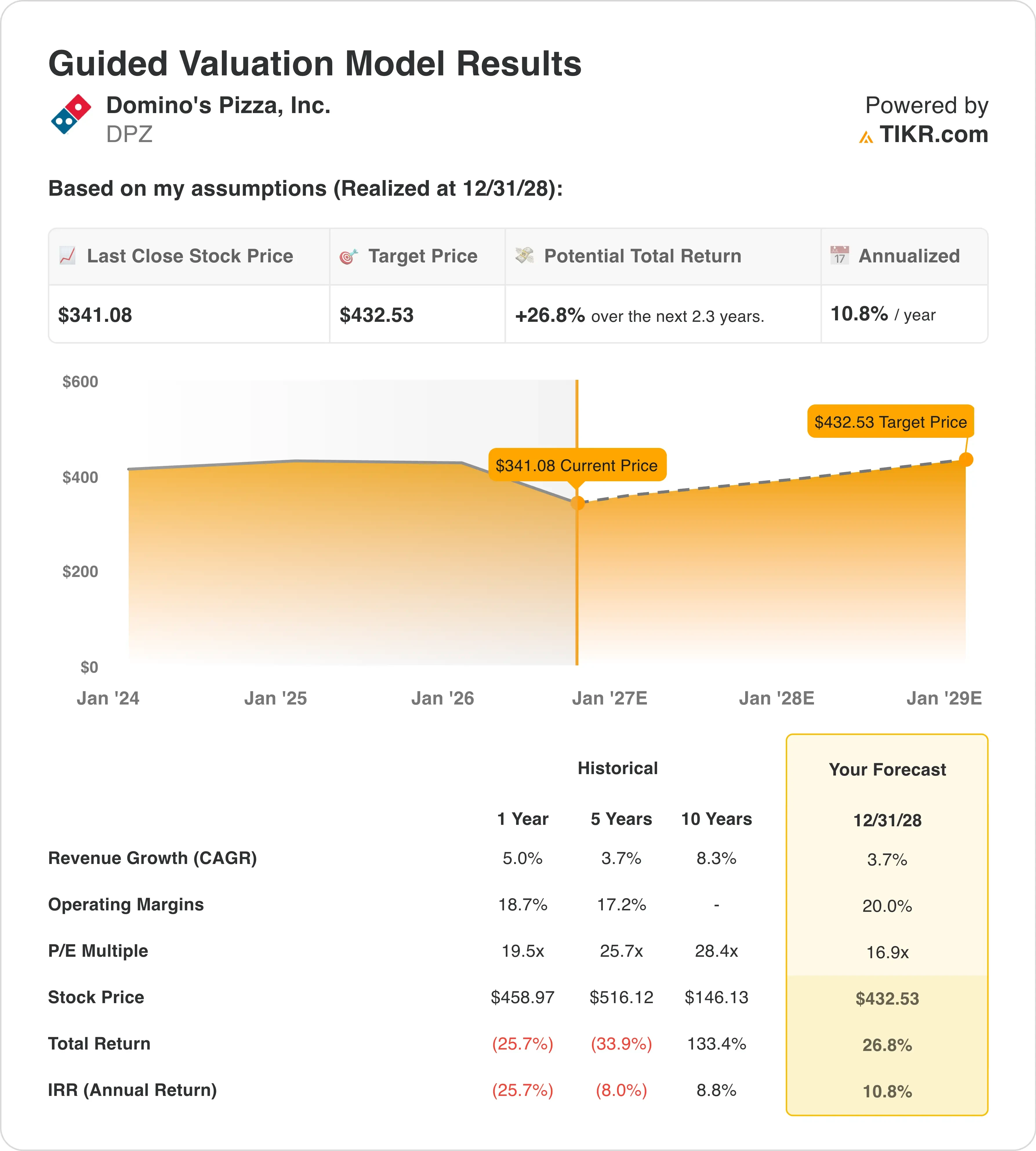
Under valuation model assumptions realized through 12/31/28, the stock is modeled using:
- Revenue Growth (CAGR): 3.7%
- Operating Margins: 20.0%
- Exit P/E Multiple: 16.9x
Based on these inputs, the model estimates a target price of $433, implying 26.8% total upside from the current share price and a 10.8% annualized return over the next 2.3 years.
That 10.8% annualized return lands in moderately attractive territory, and it comes at a moment when the stock already trades well below its highs, which is exactly the setup value-oriented investors tend to look for. A forward P/E multiple near 17x is meaningfully cheaper than Domino’s own five-year average multiple in the mid-20s, suggesting the market has already priced in a good deal of pessimism around slowing same-store sales.
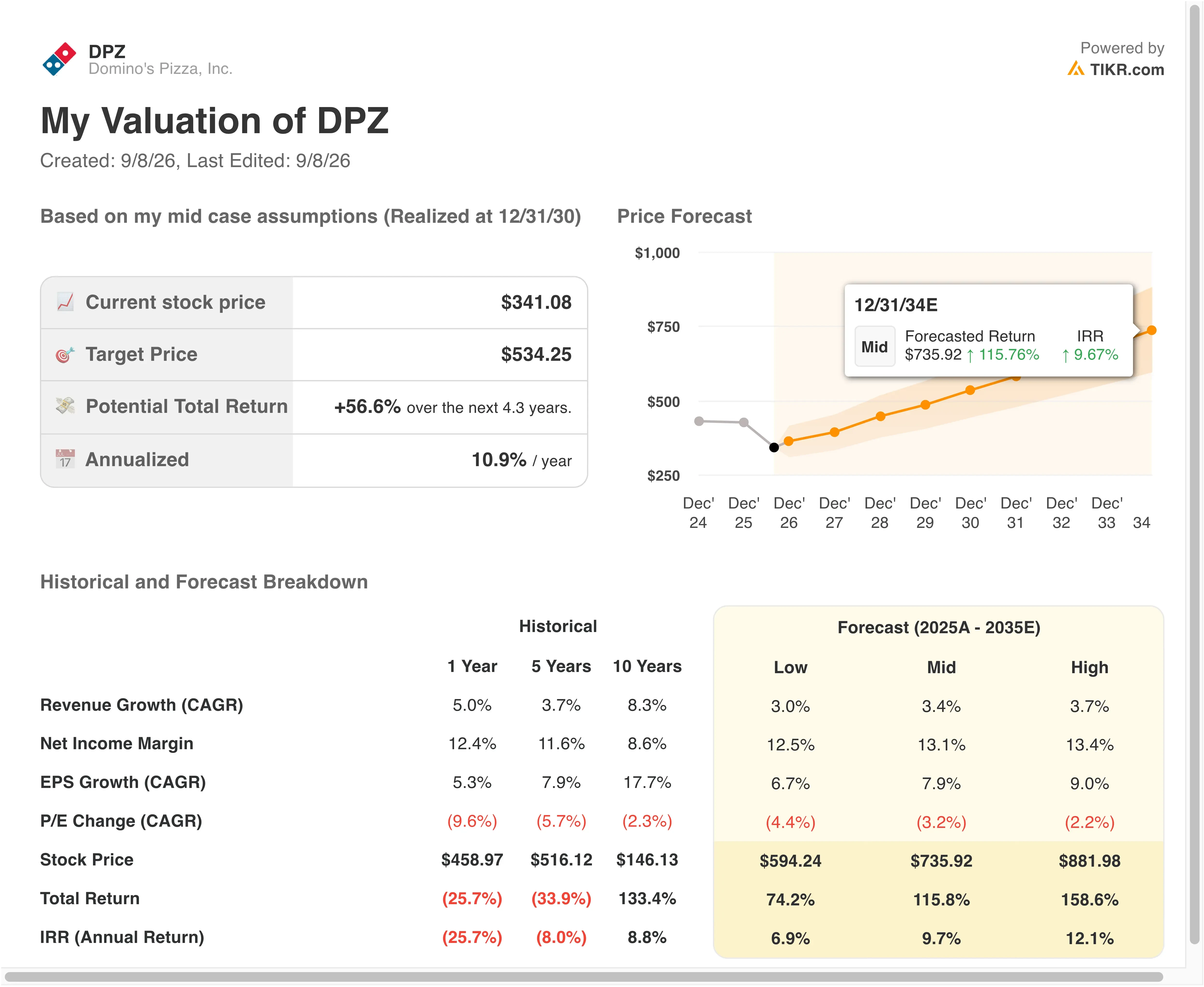
Revenue growth assumptions of 3.7% look conservative given Domino’s long-term development pipeline, especially internationally, where unit growth continues even as comparable sales growth has softened.
Operating margins near 20% are consistent with recent results, and the company’s heavy reliance on franchised units keeps that margin profile relatively stable compared to peers with more company-owned exposure. The main risk to this valuation case is whether U.S. ticket pressure persists long enough to drag down the multiple further before growth reaccelerates.
See how Domino’s valuation compares to its historical range (Free with TIKR) >>>
Domino’s Versus a Struggling Pizza Category
The clearest sign of how relatively well Domino’s is holding up comes from Yum Brands’ (YUM) Pizza Hut division, which Yum agreed to sell for $2.7 billion combined to Yum China and LongRange Capital after years of underperformance. Pizza Hut’s system sales were flat in its most recent quarter with operating profit down 12%, a sharp contrast to Domino’s positive, if modest, U.S. comparable sales growth of 0.1% over the same period.
Papa John’s (PZZA) tells an even starker story. North America comparable sales fell 8.3% in its most recent quarter, driven almost entirely by lower order volume, and the company suspended its quarterly dividend starting in the third quarter to preserve capital for its turnaround. Papa John’s also cut its full-year outlook, now guiding North America comparable sales to decline 6% to 8% for the year, a sharp reversal from where the category stood just a year earlier.
Against that backdrop, Domino’s slight same-store sales growth and continued dividend payments look far stronger by comparison, even though the headline numbers themselves were far from perfect this quarter.
What’s Driving DPZ Stock Going Forward?
The India hygiene issue is the most immediate overhang to watch. Maharashtra’s food safety regulator temporarily suspended licenses at four Domino’s outlets in mid-August after finding pest control failures and other violations, part of a broader crackdown on chain restaurants in the region. The closures appear temporary and tied to remediation rather than a systemic problem, but continued media attention could weigh on sentiment in one of Domino’s key growth markets.
New product innovation is the other major catalyst heading into the back half of the year. Domino’s plans to launch a new signature pizza aimed at a consumer occasion the brand does not currently serve well, following a premium product line earlier in the year that did not fully resonate with customers. Because pricing discipline remains central to management’s strategy, any new launch will need to drive order volume without further pressuring average ticket.
Longer term, the pizza industry itself has historically grown just 1% to 2% annually, according to management commentary on the call, which means Domino’s growth increasingly depends on taking share from struggling rivals like Papa John’s and the soon-to-be-divested Pizza Hut rather than relying on category expansion alone.
Build your own Domino’s turnaround scenario (Free with TIKR) >>>
Should You Invest in Domino’s Pizza?
The only way to really know is to look at the numbers yourself. TIKR gives you free access to the same institutional-quality financial data that professional analysts use to answer exactly that question.
Pull up DPZ, and you’ll see years of historical financials, what Wall Street analysts expect for revenue and earnings in the quarters ahead, how valuation multiples have moved over time, and whether price targets are trending up or down.
You can build a free watchlist to track DPZ alongside every other stock on your radar. No credit card required. Just the data you need to decide for yourself.
Analyze DPZ stock on TIKR Free→
Disclaimer:
Please note that the articles on TIKR are not intended to serve as investment or financial advice from TIKR or our content team, nor are they recommendations to buy or sell any stocks. We create our content based on TIKR Terminal’s investment data and analysts’ estimates. Our analysis might not include recent company news or important updates. TIKR has no position in any stocks mentioned. Thank you for reading, and happy investing!