Key Stats for RTX Stock
- Current Price: $200.79
- Target Price (Mid): ~$247
- Street Target: ~$235
- Potential Total Return: ~23%
- Annualized IRR: ~5% / year
Now Live: Discover how much upside your favorite stocks could have using TIKR’s new Valuation Model (It’s free) >>>
What Happened?
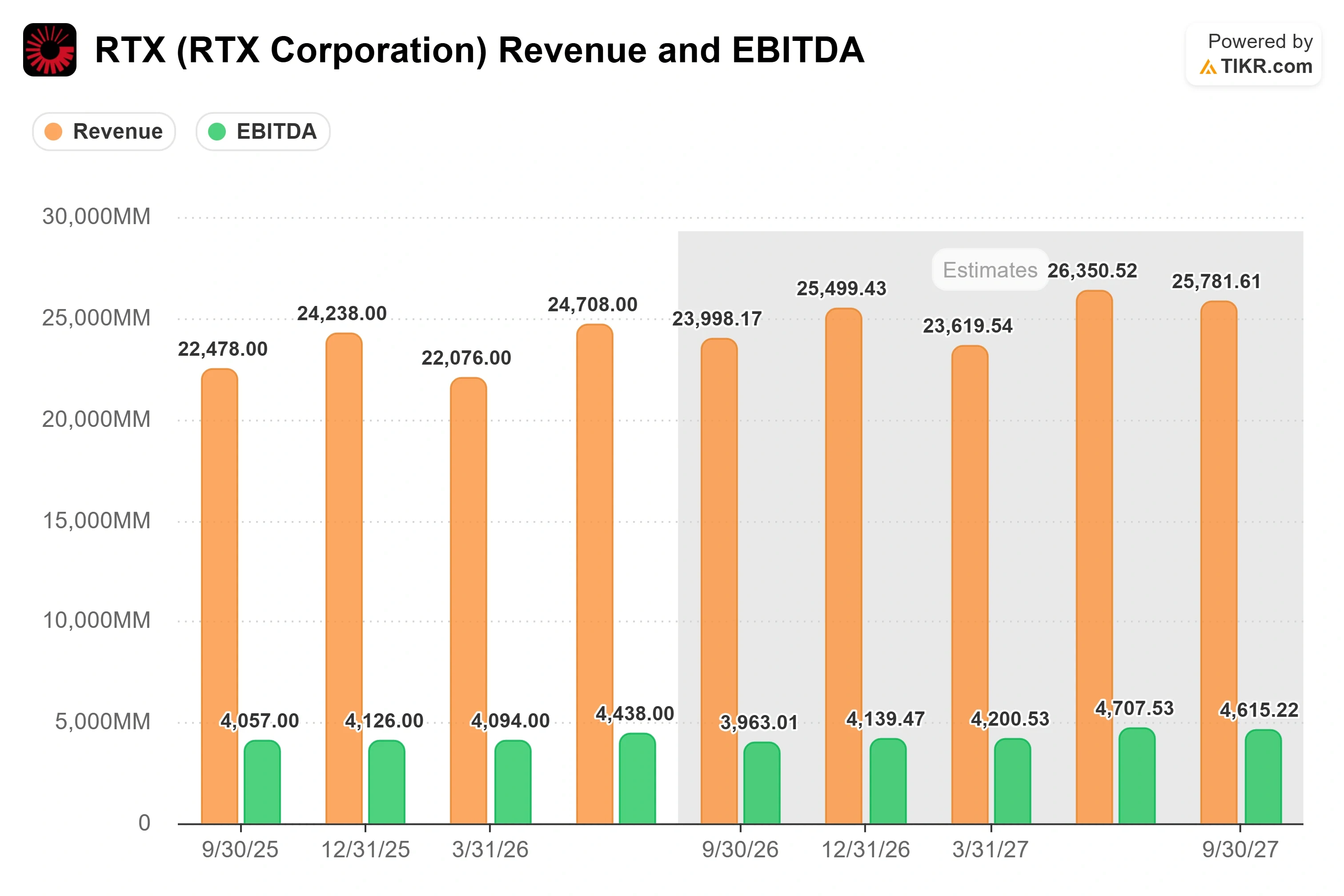
RTX Corporation (RTX) did everything a shareholder could ask for this summer and watched the stock fall anyway. The aerospace and defense giant behind Pratt & Whitney engines, Collins Aerospace avionics, and Raytheon missiles beat on every line in its July 23 report, raised full-year guidance across sales, earnings, and cash flow, then landed a $22.9 billion Tomahawk contract in mid-August. Shares still closed at $200.79 on September 4, down roughly 11% from the $226.88 high they set on August 10.
The business is executing better than it has in years, yet the market has spent a month marking the stock down from its peak. The question is whether that retreat hands patient investors a cheaper entry into a defense supercycle, or whether the crowd is right that the price ran ahead of the fundamentals.
The Quarter That Should Have Sent It Higher
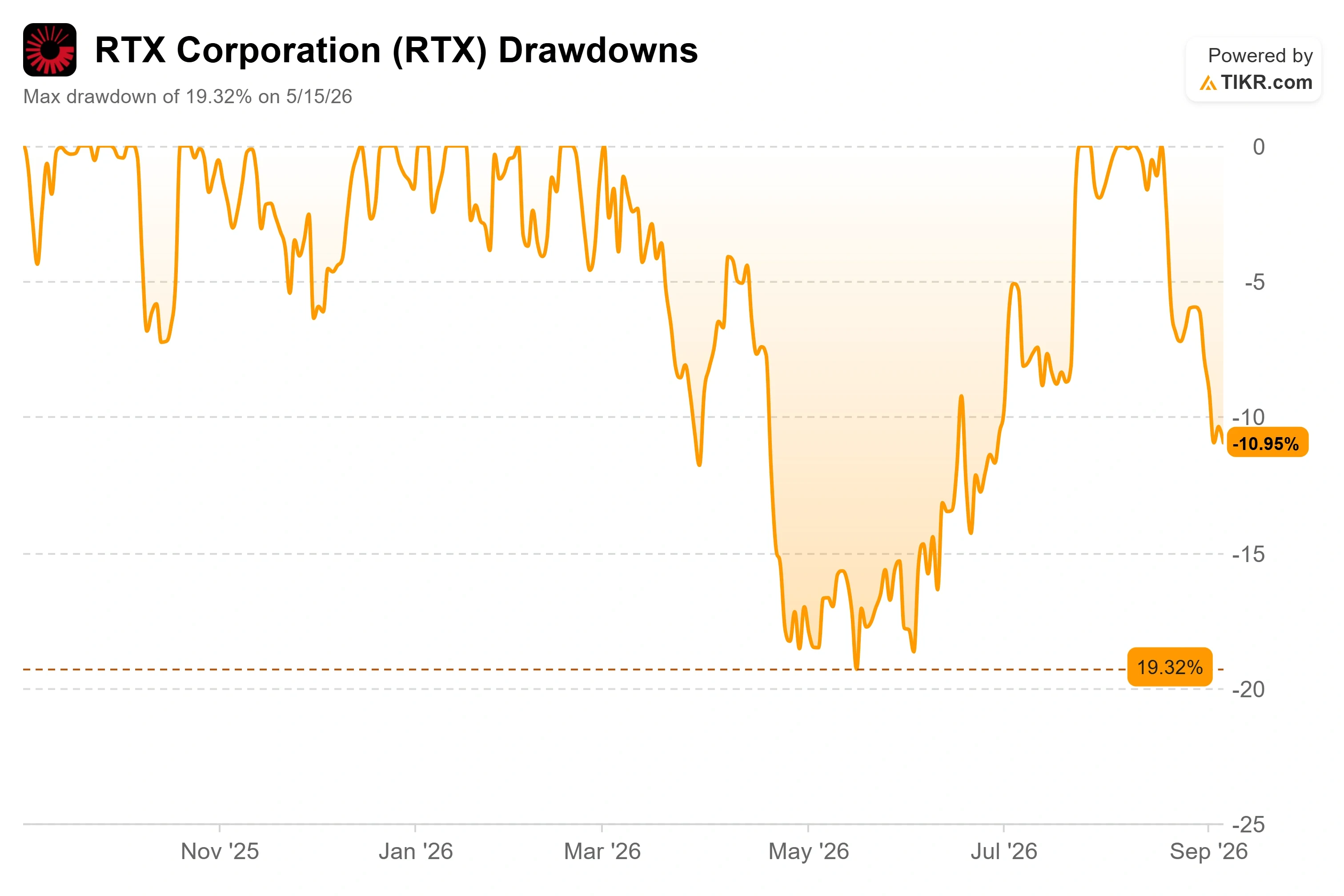
Q2 adjusted sales came in at $24.7 billion, up 16% organically, with all three channels growing at once: commercial original equipment up 9%, commercial aftermarket up 18%, and defense up 16%. Adjusted earnings per share of $1.89 beat the Street’s $1.66 estimate by about 14% and rose 21% year over year. Free cash flow was $2.9 billion.
Management did not just report a good quarter. It raised the bar. RTX lifted its full-year adjusted sales outlook by $2.5 billion to $95 billion to $96 billion, pushed adjusted EPS to $7.10 to $7.25, and nudged free cash flow guidance to $8.5 billion to $8.75 billion. Organic sales growth for the year now runs 8% to 9%, up three points from the prior view. The backlog reached another record of $289 billion, up 22% year over year, with a defense book at Raytheon that is now 48% international. CEO Chris Calio put it plainly on the call: “Across RTX, we continue to see exceptional demand for our products and services.” A backlog growing faster than revenue is the clearest signal that the runway extends well past this fiscal year.
See historical and forward estimates for RTX stock (It’s free!) >>>
The $22.9 Billion Reason the Thesis Just Got More Concrete
On August 17, the U.S. Navy awarded Raytheon a seven-year, $22.9 billion deal to accelerate Tomahawk cruise missile production, part of the Department of War’s Arsenal of Freedom initiative. The award lifts annual Tomahawk output toward more than 1,000 missiles per RTX’s own statement, a dramatic step up from the roughly 60 per year Raytheon builds today, as reported by The Hill.
This matters because of something specific Calio said in July. Asked about the five framework agreements RTX signed earlier this year, he flagged a decade of demand behind them and added a crucial detail: “Those aren’t even in our backlog today.” The Tomahawk award is the clearest example so far of those framework agreements converting into a definitive, backlog-eligible order. It is proof, not projection, that the munitions ramp management keeps describing is real and funded. Raytheon president Phil Jasper called Tomahawk “the Navy’s most important strike weapon,” and the deal lands against depleted U.S. inventories after the Iran conflict and NATO allies pushing budgets toward 3.5% of GDP.
Scaling output leans on hundreds of sub-tier suppliers, and he framed the multiyear structure as the mechanism that makes it work: “If you can go out and give a supplier or a set of suppliers a 7-year firm order, they will lean forward. They will make the investment.” The order is signed. Building the missiles at that rate is what the next few years will test.
Why the Numbers Say “Fairly Priced,” Not “Cheap”
Everything above is bullish, yet RTX trades at about 27 times next-twelve-month earnings, a premium to pure-play defense peers Lockheed Martin, near 17 times, and Northrop Grumman, near 18 times, though below commercial aerospace names like GE Aerospace, near 40 times. That split multiple is fair in one sense, because RTX is the rare name with a near-even commercial and defense mix and should not trade like either group alone.
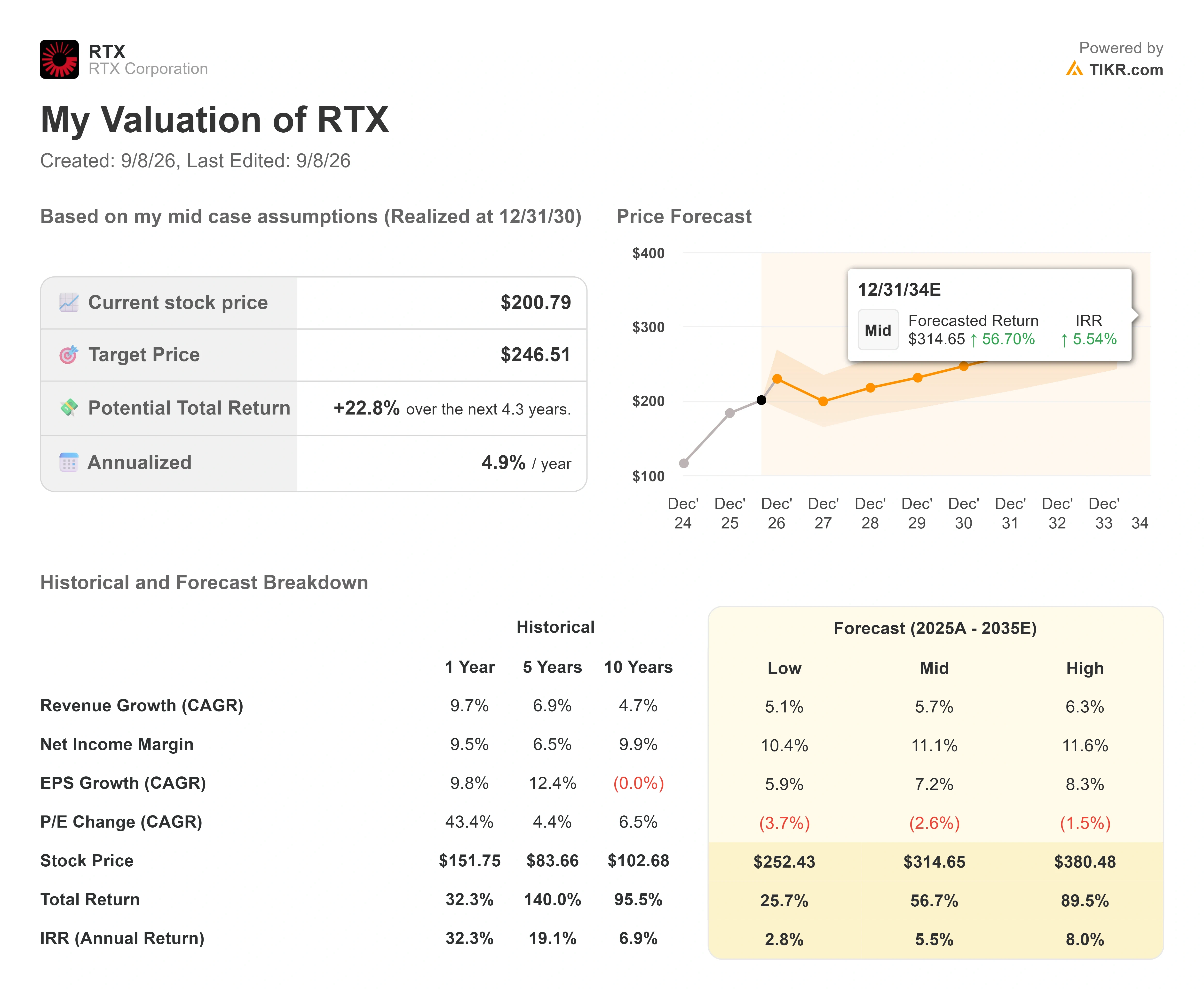
The TIKR valuation model, on its mid-case assumptions, targets around $247 by the end of 2030. From today’s $200.79, that implies roughly 23% total return, or about 5% annualized over 4.3 years. Extend to 2034, and the mid case points toward roughly $315, a 57% total return at about 5.5% annualized. Respectable for a defensive compounder with a 1.4% dividend yield and a 48% payout ratio, but not the outsized returns the record backlog might imply.
The model assumes revenue compounds around 6% and net income margin expands toward 11%, both of which are reasonable given the raise and the aftermarket mix shift at Pratt, with EPS growing around 7% a year. What holds the return back is P/E compression of roughly 3% annually, the model’s way of saying today’s premium normalizes over time. Wall Street lands in nearly the same place: a mean target near $235, with 11 analysts rating the stock Buy, 4 Outperform, and 8 Hold as of early September. Both frameworks are anchored to the same idea, that RTX is a high-quality business already priced for most of what it is doing well.
See how RTX performs against its peers in TIKR (It’s free!) >>>
TIKR Advanced Model Analysis
- Current Price: $200.79
- Target Price (Mid): ~$247
- Potential Total Return: ~23%
- Annualized IRR: ~5% / year
See analysts’ growth forecasts and price targets for RTX stock (It’s free!) >>>
The mid case is the honest one to lead with, because it reflects the guidance RTX just raised rather than a heroic acceleration. The two revenue drivers are the defense munitions ramp, now anchored by the $22.9 billion Tomahawk award and the wider framework agreements, and the Pratt & Whitney commercial aftermarket, where MRO output rose over 40% year over year as GTF aircraft-on-ground counts fell 25% in the first half. The margin driver is mix: Raytheon’s shift toward mature, increasingly international programs lifted its operating margin 100 basis points in the quarter, and Collins’s structural cost actions are still early.
- Upside: roughly $315 by 2034 if the framework agreements land on schedule and margins keep expanding.
- Downside: a stock that grows earnings but drifts sideways as the multiple compresses, leaving you the dividend and little else for a few years.
- Primary risk: execution on the ramp. Converting a $289 billion backlog depends on a supply chain scaling faster than it ever has, and any stall means the backlog turns to cash more slowly than the valuation assumes.
Conclusion
The Tomahawk award changed what to watch. For years, the RTX question was whether the order book was real; now it is how fast the framework agreements behind that $289 billion backlog convert into signed, funded contracts. The next test is the Q3 report on October 20. Good looks like a second framework agreement following Tomahawk into the backlog, and Raytheon holding its operating margin in the mid-12% range. Bad looks like a quarter where nothing new converts, and management starts hedging on the munitions ramp it has spent all year promising.
See what stocks billionaire investors are buying so you can follow the smart money with TIKR.
Should You Invest in RTX?
The only way to really know is to look at the numbers yourself. TIKR gives you free access to the same institutional-quality financial data that professional analysts use to answer exactly that question.
Pull up RTX, and you’ll see years of historical financials, what Wall Street analysts expect for revenue and earnings in the quarters ahead, how valuation multiples have moved over time, and whether price targets are trending up or down.
You can build a free watchlist to track RTX alongside every other stock on your radar. No credit card required. Just the data you need to decide for yourself.
Looking for New Opportunities?
- See what stocks billionaire investors are buying so you can follow the smart money.
- Analyze stocks in as little as 5 minutes with TIKR’s all-in-one, easy-to-use platform.
- The more rocks you overturn… the more opportunities you’ll uncover. Search 100K+ global stocks, global top investor holdings, and more with TIKR.
Disclaimer:
Please note that the articles on TIKR are not intended to serve as investment or financial advice from TIKR or our content team, nor are they recommendations to buy or sell any stocks. We create our content based on TIKR Terminal’s investment data and analysts’ estimates. Our analysis might not include recent company news or important updates. TIKR has no position in any stocks mentioned. Thank you for reading, and happy investing!