Key Stats for Union Pacific Stock
- Current Price: $289.62
- Target Price (Mid): ~$395
- Street Target: ~$330
- Potential Total Return: ~37%
- Annualized IRR: ~7.5% / year
Now Live: Discover how much upside your favorite stocks could have using TIKR’s new Valuation Model (It’s free) >>>
What Happened?
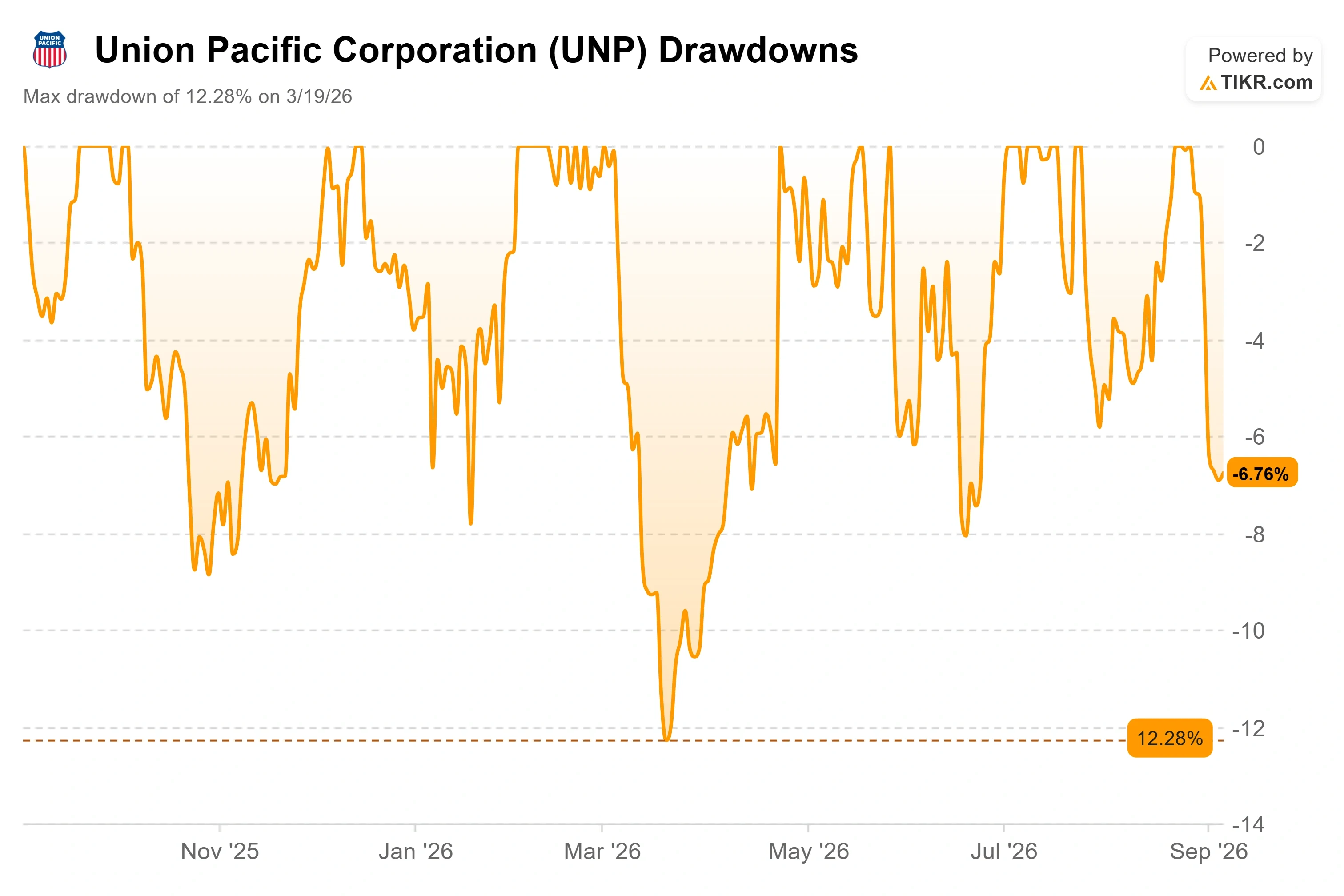
Union Pacific Corporation (UNP) sits about 6% below its late-August record with one question hanging over the entire investment case: Does the regulatory clock finally run in its favor? Its $85 billion cash-and-stock acquisition of Norfolk Southern (NSC), the deal that would create the first coast-to-coast U.S. freight railroad, just cleared a major procedural milestone. On September 2, CEO Jim Vena and CFO Jennifer Hamann sat down with Bernstein analyst David Vernon to walk investors through it. The Surface Transportation Board accepted the revised merger application on May 28, 2026, starting a hard 12-month statutory clock, and on August 18, it adopted a procedural schedule and pulled the proceeding out of abeyance.
That moves the largest railroad merger ever proposed into the merits review, where Vena said “the conversation will be focused on data and facts.” The STB was explicit that the schedule is procedural and does not constitute a ruling on the merits, so this is a milestone, not a win. The market’s nervousness is no longer about surviving a completeness check. It is about what conditions the Board demands in exchange for approval, and whether the synergy math still holds in a freight market that looks nothing like the 2023 baseline the deal was modeled on.
The Clock That Cannot Be Easily Moved
Vena’s central point was structural. Once the STB accepted the application, statute gave the Board 12 months to finish gathering evidence. “That’s not something that can be easily changed when the statute tells you exactly what it is,” he said.
Comments, protests, and requests for conditions from competing railroads and shippers are due November 18, 2026; responses by February 16, 2027; and final briefs by May 28, 2027, with a decision within 90 days of the record closing. Management’s guidance of a late-2027 close, Q3, or as late as Q4, is a company projection built on that schedule, not a regulatory promise. BNSF, CSX, and CPKC have already filed motions urging dismissal, so the November docket is where the fight gets real.
Hamann reaffirmed the framework that makes the deal worth fighting for: $1.8 billion in annual net revenue synergies and $1 billion in cost synergies, numbers that “keep coming back to basically the same place” after repeated reworking. She also confirmed buybacks resume within two years of close, and the combined company expects to generate roughly $11.8 billion to just under $12 billion in cash by year three.
See historical and forward estimates for Union Pacific stock (It’s free!) >>>
Why One Owner Beats Two Partners
The most useful part of the session was Vena explaining, as an operator, why single ownership unlocks value partnerships cannot. His example was the Meridian Speedway, where a partnership arrangement led one party to cap train lengths through the corridor. “A railroad that was one railroad would never do that,” he said, because it would not damage its own customers that way. One owner removes the friction points, from locomotive disputes to interchange delays, that slow carload and intermodal freight alike.
That logic feeds the shipper savings case: $3.5 billion in annual savings from shifting roughly 2.1 million truckloads to rail, an estimate that Oliver Wyman, Charles River Associates, and Econic Partners built using traffic files from all six Class I railroads. Hamann argued that the figure is understated today, given where fuel and truck pricing have moved. To keep rivals honest, Union Pacific committed to keeping every gateway open and layered on a committed gateway pricing program that lets competitors like BNSF and CSX pull rates without asking, on terms of up to three years.
Union Pacific is the only pure-play name in TIKR’s Ground Transportation peer set, so a clean rail-peer multiple comparison is not available. What the data shows is a full valuation: an NTM P/E of 21.4x and an NTM EV/EBITDA of 14.3x, both the highest in the six quarters TIKR shows.
See how Union Pacific performs against its peers in TIKR (It’s free!) >>>
TIKR Advanced Model Analysis
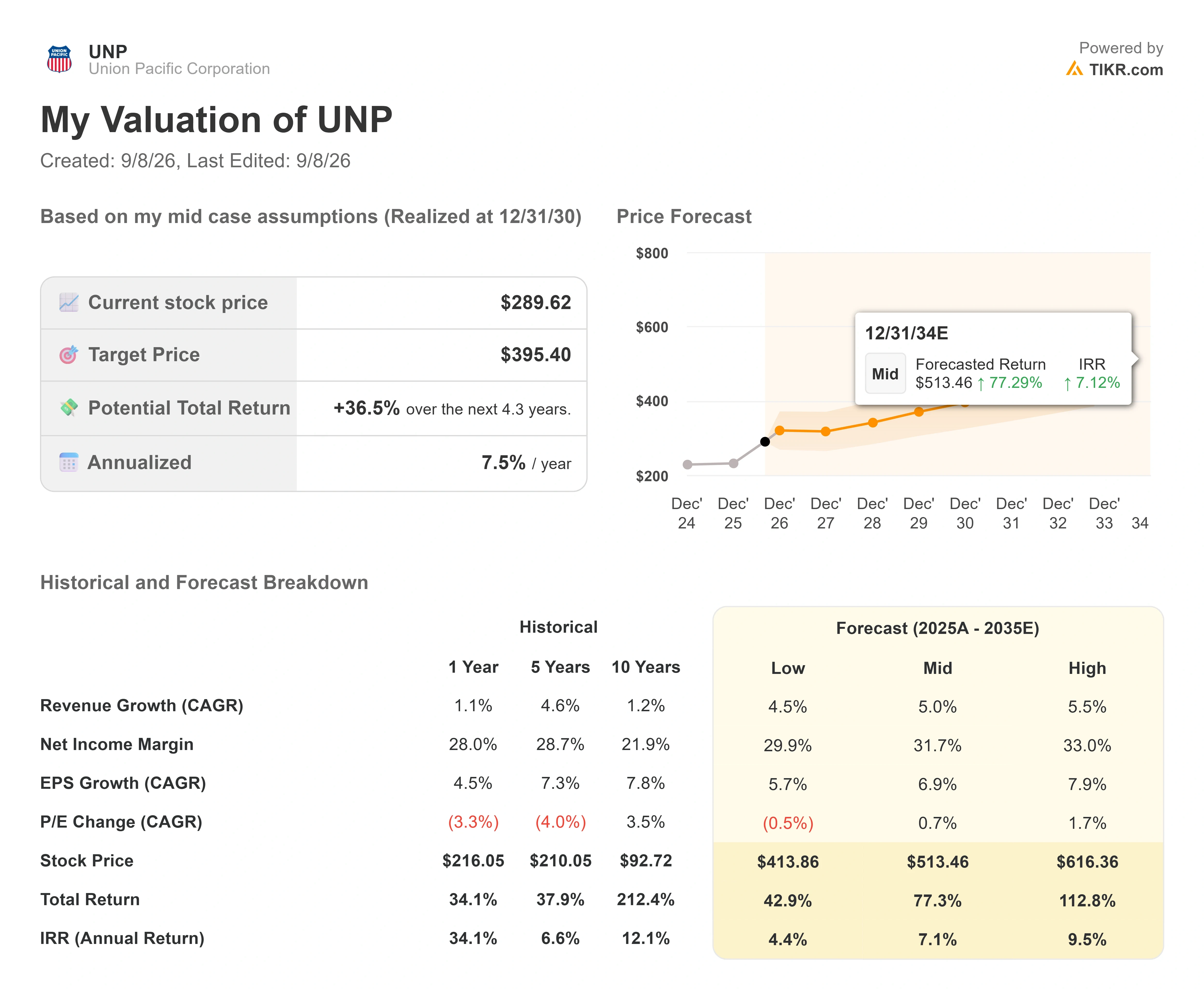
- Current Price: $289.62
- Target Price (Mid): ~$395
- Potential Total Return: ~37%
- Annualized IRR: ~7.5% / year
See analysts’ growth forecasts and price targets for Union Pacific stock (It’s free!) >>>
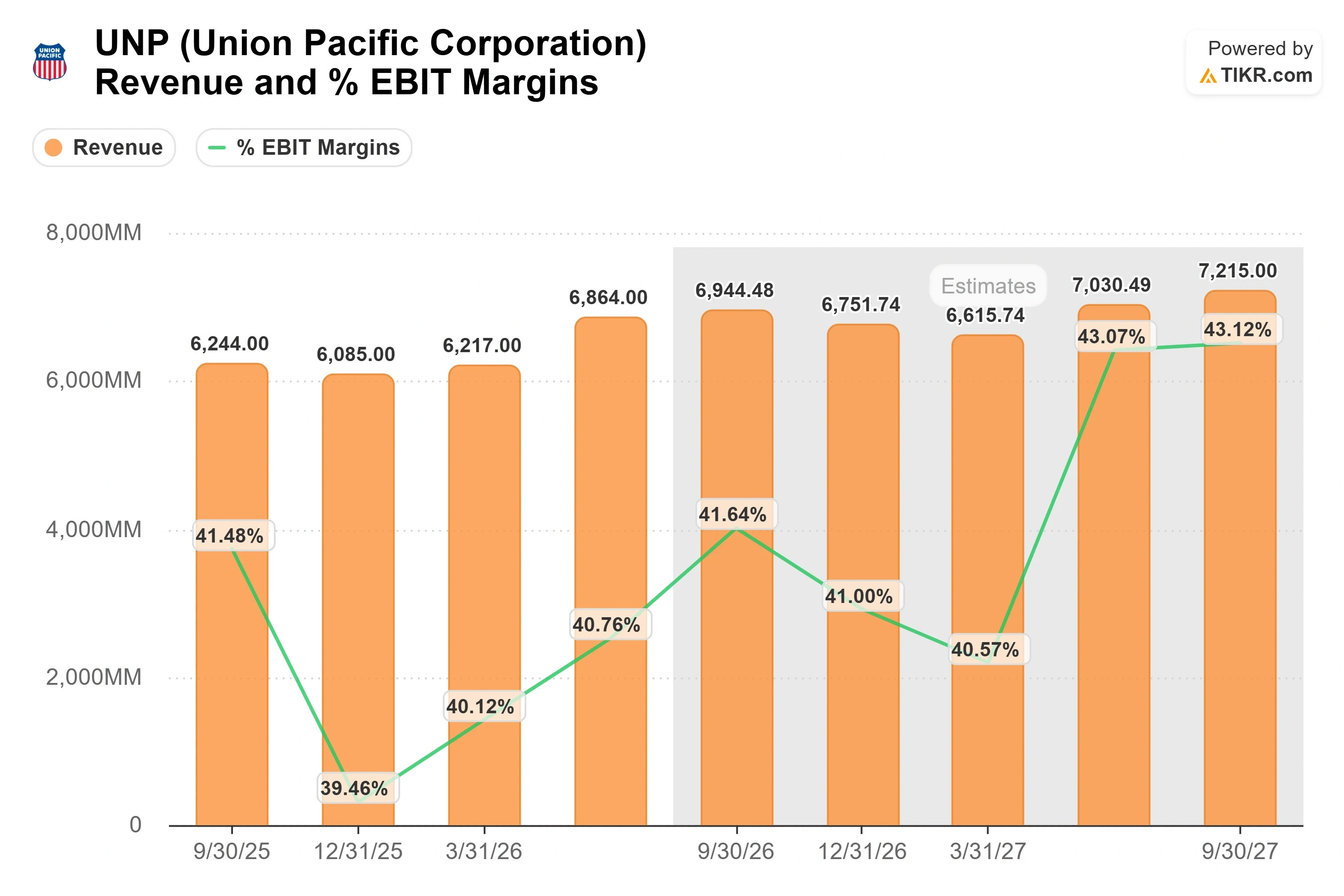
The TIKR mid-case values Union Pacific at around $395 per share by the end of 2030, a total return of roughly 37%, or about 7.5% annualized over 4.3 years. The revenue path leans on two drivers: core pricing, which management says still runs ahead of cost inflation, and a mix shift toward higher-margin industrial and intermodal freight as capacity absorbs growth without adding trains. The margin driver is Union Pacific’s operating ratio, which Hamann said remains the best among Class I railroads, with net income margin modeled to expand toward roughly 32%.
The 5.0% mid-case revenue CAGR sits close to the standalone five-year trend of 4.6%, so the model appears to value the railroad largely on its own merits rather than a completed merger. The upside case: approval on reasonable conditions layers on synergies that the price only partly reflects. The downside: conditions heavy enough to erode the economics, or a denial, leaving a fully valued railroad at about 21x forward earnings with slowing near-term growth.
Conclusion
The next real test is November 18, when opponents file their comments, protests, and requested conditions. That docket, not the next earnings print, decides whether the synergy math survives contact with regulators. Watch two things: how aggressive the competing railroads’ condition requests are, and whether the committed gateway pricing program becomes a chip that Union Pacific has to sweeten. Light conditions vindicate the mid-case and the merger optionality; heavy conditions or a summary denial leave a great railroad at a demanding multiple with little room to grow into it. The Street’s 14 buys, 3 outperform, 7 holds, and 1 underperforms, with a mean target near $330, says consensus sees moderate upside while it waits for that answer.
See what stocks billionaire investors are buying so you can follow the smart money with TIKR.
Should You Invest in Union Pacific?
The only way to really know is to look at the numbers yourself. TIKR gives you free access to the same institutional-quality financial data that professional analysts use to answer exactly that question.
Pull up Union Pacific, and you’ll see years of historical financials, what Wall Street analysts expect for revenue and earnings in the quarters ahead, how valuation multiples have moved over time, and whether price targets are trending up or down.
You can build a free watchlist to track Union Pacific alongside every other stock on your radar. No credit card required. Just the data you need to decide for yourself.
Analyze Union Pacific on TIKR Free →
Looking for New Opportunities?
- See what stocks billionaire investors are buying so you can follow the smart money.
- Analyze stocks in as little as 5 minutes with TIKR’s all-in-one, easy-to-use platform.
- The more rocks you overturn… the more opportunities you’ll uncover. Search 100K+ global stocks, global top investor holdings, and more with TIKR.
Disclaimer:
Please note that the articles on TIKR are not intended to serve as investment or financial advice from TIKR or our content team, nor are they recommendations to buy or sell any stocks. We create our content based on TIKR Terminal’s investment data and analysts’ estimates. Our analysis might not include recent company news or important updates. TIKR has no position in any stocks mentioned. Thank you for reading, and happy investing!