
Key Stats for Salesforce Stock
- Current Price: $259.23
- Target Price (Mid): ~$448
- Street Target: ~$272
- Potential Total Return: ~73%
- Annualized IRR: ~13% / year
Now Live: Discover how much upside your favorite stocks could have using TIKR’s new Valuation Model (It’s free) >>>
What Happened?
Salesforce (CRM) spent an entire investor webinar on September 1 explaining a new way to charge for AI, then deferred every hard number to Dreamforce. That deferral is the story. On September 16, the company holds its Investor and Analyst Session at Dreamforce, and it has to answer the one question its blowout quarter left open: as AI agents replace the human seats it has billed for since 1999, does surging usage actually become recurring revenue, or does it just show up as activity?
After results on August 26, Salesforce beat on both lines and raised full-year guidance, and shares jumped as much as 18% the next session. They have since drifted back to $259, roughly 4% below the 52-week high and a long way up from June, when the stock bottomed near $150 for a peak-to-trough drawdown of 43.61%.
The Beat Was Real, but One-Time Gains Flattered the Headline
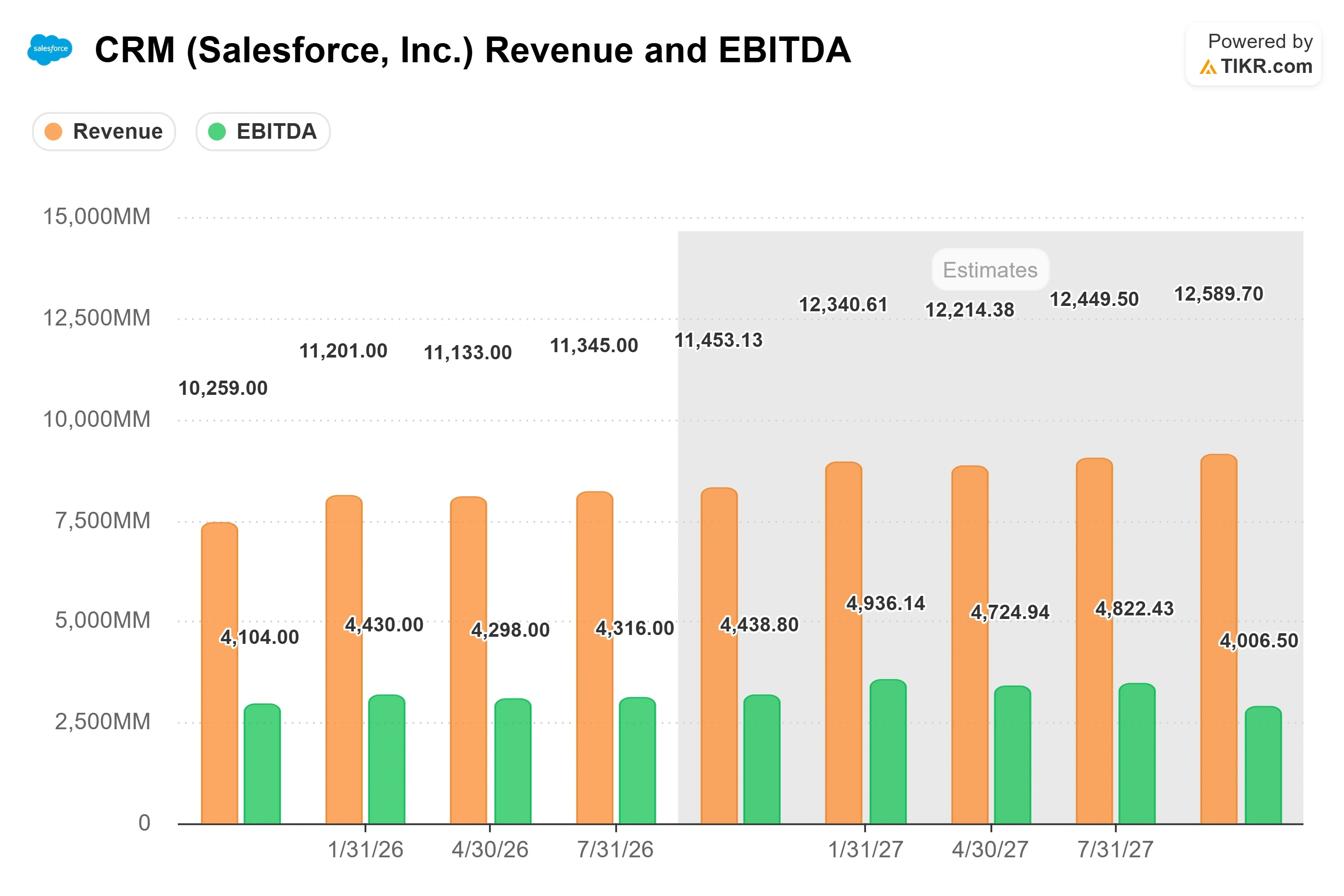
Revenue rose 10.83% year over year to $11.345 billion, current remaining performance obligation (the contracted revenue Salesforce expects to book over the next year) grew 14% in constant currency to $33.5 billion, its fastest bookings pace in four years, and free cash flow climbed 81%.
The headline EPS, though, was flattered. Of the $5.90 in adjusted EPS, $2.53 came from a gain on strategic investments, most of it an unrealized mark-up on Salesforce’s Anthropic stake, which a recent round valued at $965 billion. Strip it out, and the underlying EPS was closer to $3.37 against $2.91 a year earlier, growth near 16% rather than the doubling the headline implied. That gap is why the 18% pop faded.
Alongside results, Salesforce and Anthropic unveiled Claudeforce, which embeds Salesforce data and 37 prebuilt sales skills inside Claude, in pilot now with an open beta due this month. It reframes Salesforce as the system of record AI models reach into, rather than the software AI displaces.
See historical and forward estimates for Salesforce stock (It’s free!) >>>
Why Pricing Is the Whole Ballgame on September 16
Salesforce told investors on September 1 that it has rebuilt how it charges. Bill Patterson, President and Chief Commercial Officer, described a shift to outcome-based pricing, where a service agent like its Casey product is billed by resolutions rather than seats. “If they don’t resolve the issue, you don’t pay for the offering,” Patterson said. That answers the seat-cannibalization fear directly: if agents retire human seats, Salesforce bills for the work those agents do instead. He also flagged a customer whose AI spending was up 30% while measured productivity rose only 3%, the exact mismatch outcome pricing is meant to fix.
Connor Marsden, President of Sales and Chief Consumption Officer, said service use cases consume roughly five times the Agentic Work Units of other workloads, and that “top-up” credit purchases, where customers exhaust capacity and buy more, are concentrated there. Top-ups are the tell analysts will chase on September 16, because they signal customers getting enough value to refill the tank. The IR team’s Valmik Desai added that half of Agentforce bookings now come from existing customers refilling in that same motion.
JPMorgan’s Samik Chatterjee named the event as the next major catalyst and laid out the two-sided bet: outcome pricing could lift margins if Salesforce routes each task to the cheapest capable model, but a failed task can burn compute without producing revenue. Desai took on that gross-margin question on the webinar, saying Salesforce owns model routing to capture “the efficiency and token pricing changes that are happening.”
At its October 2025 Investor Day, Salesforce set a target of $60 billion-plus in revenue by fiscal 2030 and a “50 by FY30” framework, aiming for subscription growth plus operating margin to sum to 50. This year’s session is billed as a look at the “latest innovation and financial framework,” so investors will watch whether those targets get reaffirmed, raised, or quietly walked back now that the pricing model is real rather than theoretical.
A Valuation That Prices In the Doubt
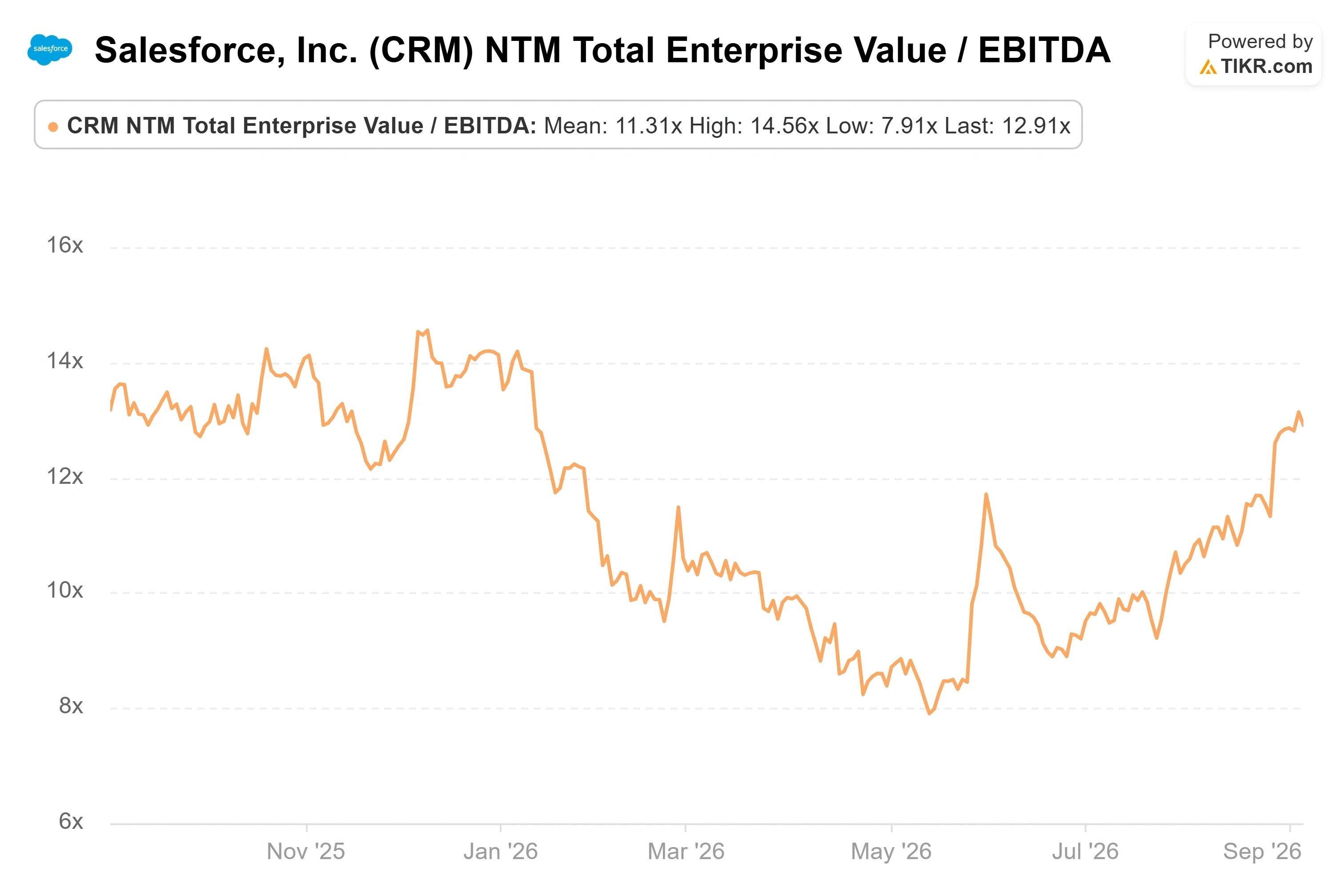
Salesforce trades at an NTM P/E of 17.68x and an EV/EBITDA of 12.91x, a discount to most large software peers: ServiceNow sits at 21.59x forward EBITDA and Cadence at 25.25x, with only Oracle at 11.89x and Adobe at 8.19x screening cheaper. For the world’s largest CRM platform, growing revenue at a double-digit clip with 77% gross margins, a low-teens multiple reads as a market that wants proof before it pays up.
The mean target sits at $272.13, down from $351.45 a year ago, leaving only about 5% of implied upside from $259.23. Analysts have cut targets faster than the fundamentals have deteriorated, which either flags a structural problem or means expectations have reset low enough that a credible framework on September 16 pulls them back up. The balance still tilts positive: 34 Buys and 6 Outperforms against 14 Holds and 2 Underperforms, with no Sells.
See how Salesforce performs against its peers in TIKR (It’s free!) >>>
TIKR Advanced Model Analysis
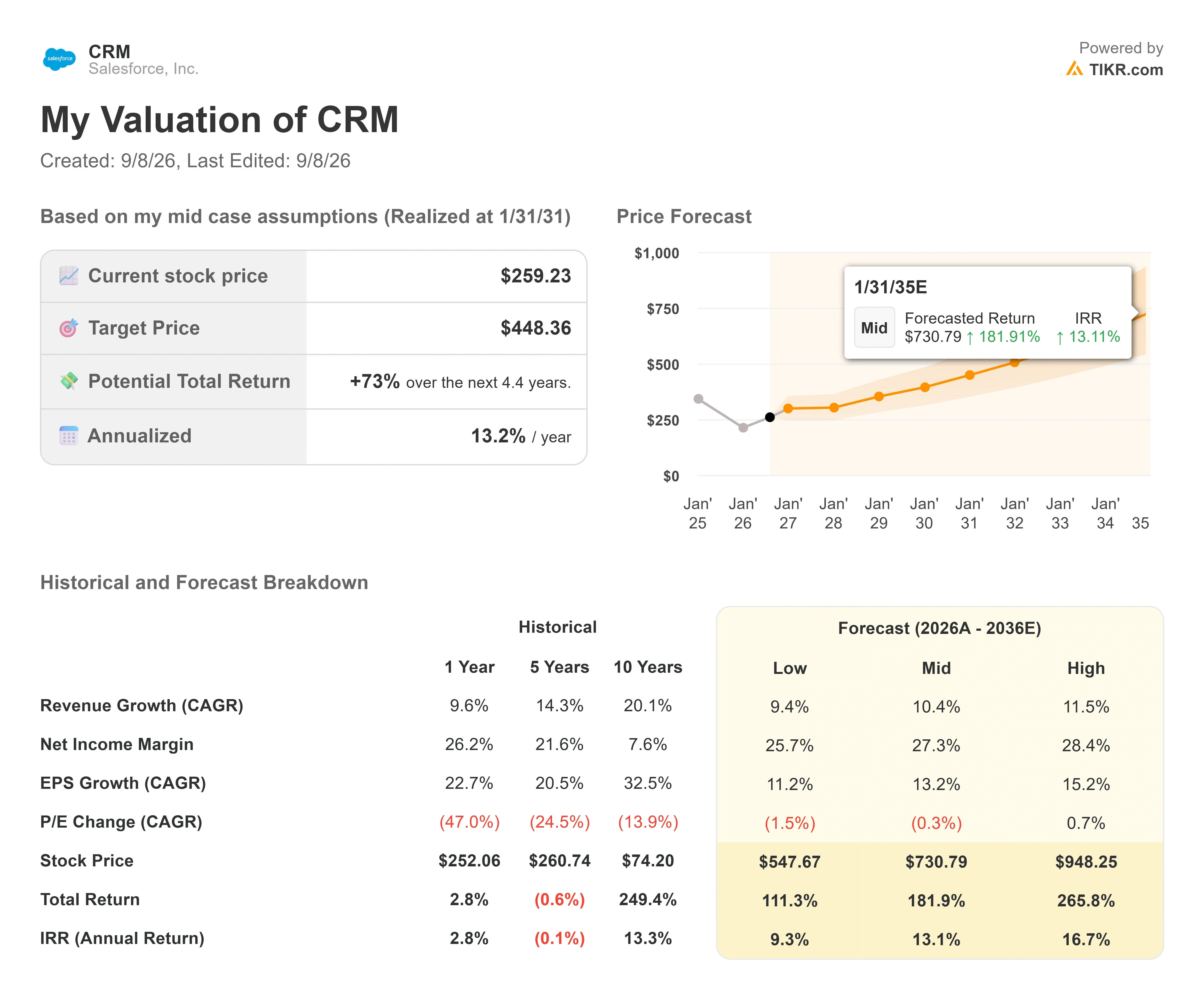
- Current Price: $259.23
- Target Price (Mid): ~$448
- Potential Total Return: ~73%
- Annualized IRR: ~13% / year
See analysts’ growth forecasts and price targets for Salesforce stock (It’s free!) >>>
The mid-case assumes the business grows into its scale rather than re-rating. The two revenue drivers are a forward revenue CAGR near 10%, led by AI-related ARR across Agentforce and Data 360, and cross-sell into the installed base, where existing customers already supply half of Agentforce bookings. The margin driver is net income margin widening from 26% toward roughly 27% as outcome-based pricing and model-routing efficiency flow through. The multiple barely moves, so the return is earnings-driven.
That works out to a mid-case target near $448, about 73% total return over roughly four years, or 13% annualized. The scenarios fan out from there. That works out to a mid-case target near $448, about 73% total return over roughly four years, or 13% annualized. The bull case pushes higher if outcome pricing lifts margins faster than modeled and AI ARR compounds through the high case’s ~11% revenue CAGR. The bear case, where agents cannibalize seat revenue faster than usage billing replaces it, trims the return but, on the model’s assumptions, still leaves the stock above today’s $259 rather than below it. That the downside case clears the current price at all tells you the market and the model disagree less about direction than about pace.
Conclusion
Watch one thing on September 16: whether management attaches numbers to outcome-based pricing, specifically a reaffirmed or raised path toward the $60 billion FY30 revenue target and the “50 by FY30” framework. A framework that ties Agentforce usage to recurring revenue with margin math that the Street can model would be a good outcome, and could pull the mean target back up from its depressed $272. A vague “we’re excited about the journey” that leaves token economics unexplained would tell you the seat fear is still unanswered.
See what stocks billionaire investors are buying so you can follow the smart money with TIKR.
Should You Invest in Salesforce?
The only way to really know is to look at the numbers yourself. TIKR gives you free access to the same institutional-quality financial data that professional analysts use to answer exactly that question.
Pull up Salesforce, and you’ll see years of historical financials, what Wall Street analysts expect for revenue and earnings in the quarters ahead, how valuation multiples have moved over time, and whether price targets are trending up or down.
You can build a free watchlist to track Salesforce alongside every other stock on your radar. No credit card required. Just the data you need to decide for yourself.
Analyze Salesforce on TIKR Free →
Looking for New Opportunities?
- See what stocks billionaire investors are buying so you can follow the smart money.
- Analyze stocks in as little as 5 minutes with TIKR’s all-in-one, easy-to-use platform.
- The more rocks you overturn… the more opportunities you’ll uncover. Search 100K+ global stocks, global top investor holdings, and more with TIKR.
Disclaimer:
Please note that the articles on TIKR are not intended to serve as investment or financial advice from TIKR or our content team, nor are they recommendations to buy or sell any stocks. We create our content based on TIKR Terminal’s investment data and analysts’ estimates. Our analysis might not include recent company news or important updates. TIKR has no position in any stocks mentioned. Thank you for reading, and happy investing!